
Amber’s $78.5m Raise: What It Means for Home Batteries
Amber’s $78.5m raise puts battery automation in focus. Understand SmartShift compatibility, wholesale pricing, fees, backup reserves and EV charging.
Amber’s $78.5m raise puts battery automation in focus. Understand SmartShift compatibility, wholesale pricing, fees, backup reserves and EV charging.
If you’re choosing a home battery, it helps to think beyond storage capacity. The software controlling that battery can shape when you use your solar, buy electricity or send energy back to the grid.
Amber announced a $78.5 million Series E funding round on 21 September 2026, with plans to expand its Australian business and European operations. The round was led by Morgan Stanley Investment Management’s 1GT strategy, alongside existing investors ETF Partners, Innovation Victoria and E.ON. Amber’s announcement sets out the investment and growth plans.
For homeowners, the useful question is what better battery software could change at home. A battery stores electricity; automation decides when to charge, hold that energy, supply the house or export. Getting those decisions right can matter alongside the hardware you choose.
The nearly twice oversubscribed round funds Amber’s technology and expansion. It is company investment, not a payment to individual battery owners. Morgan Stanley’s release independently confirms the Series E. The announcement also appears in RenewEconomy’s coverage.
The overseas business is already operating. E.ON Next announced the UK rollout of Next Optimise on 30 March 2026, following a pilot called Next Solar Max. Its service combines market-linked electricity pricing with automated battery management using Amber’s technology. UK tariffs and pilot results should not be treated as forecasts for an Australian household. E.ON Next’s rollout announcement.
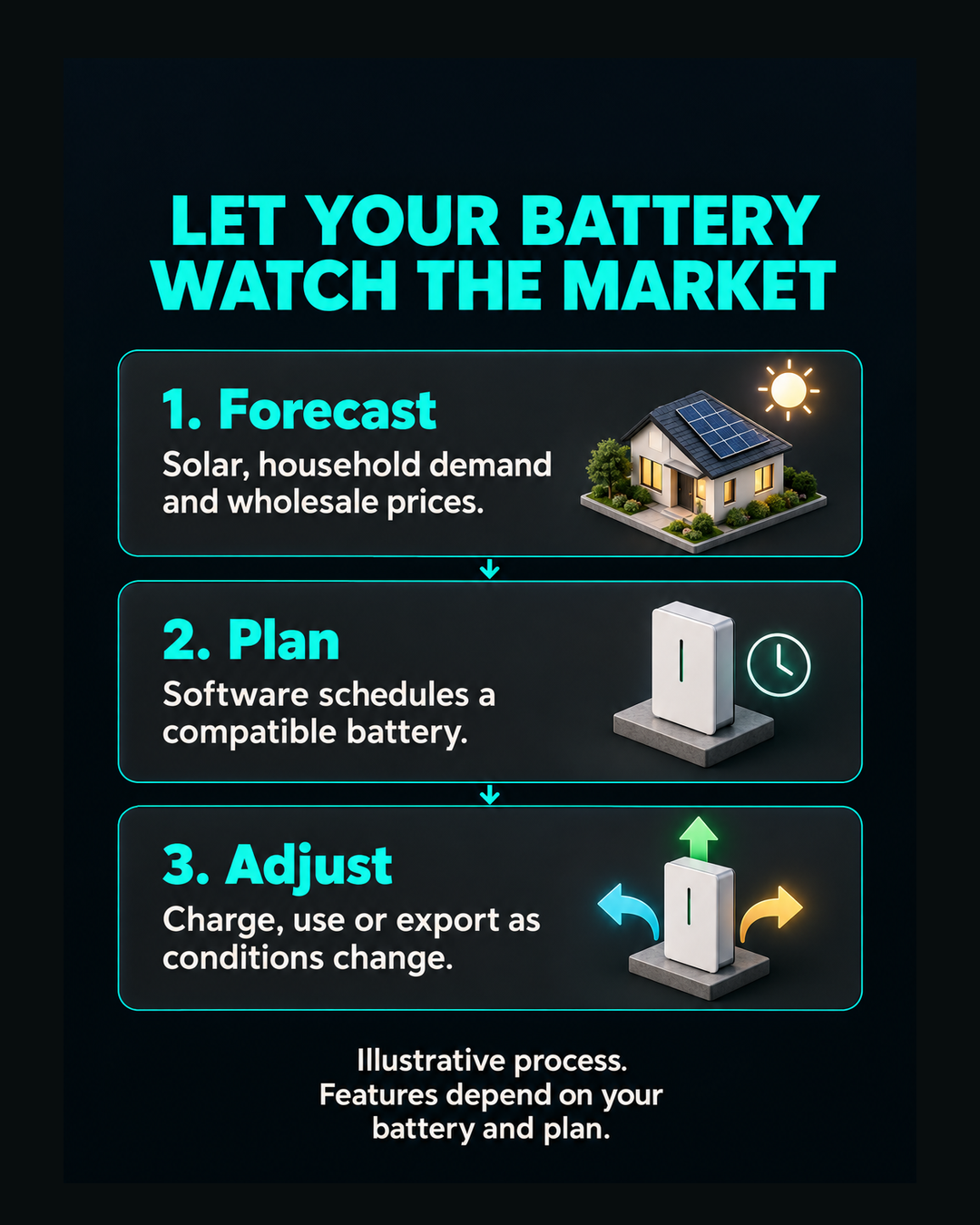
Amber’s SmartShift can direct a compatible battery to charge from the grid, export, preserve energy for later or operate in self-consumption mode. In self-consumption mode, stored energy supplies the home and surplus solar can refill the battery. The plan changes as new information arrives. SmartShift’s operating modes.
Imagine a sunny afternoon followed by an expensive evening. Depending on its forecast and available capacity, the system might retain daytime energy for later use or export. That is an illustration of the mechanism, not a promised daily outcome.
Forecasts can change. Amber acknowledges that automation will not always choose the cheapest charging interval with hindsight. It also explains that relatively flat prices can favour self-consumption over repeated trading. More activity is not automatically a better result. Amber’s explanation of SmartShift decisions.
Compatibility has two distinct parts: controlling the battery and controlling solar exports. A battery may support automated charging and discharging without giving SmartShift full control over the solar inverter.
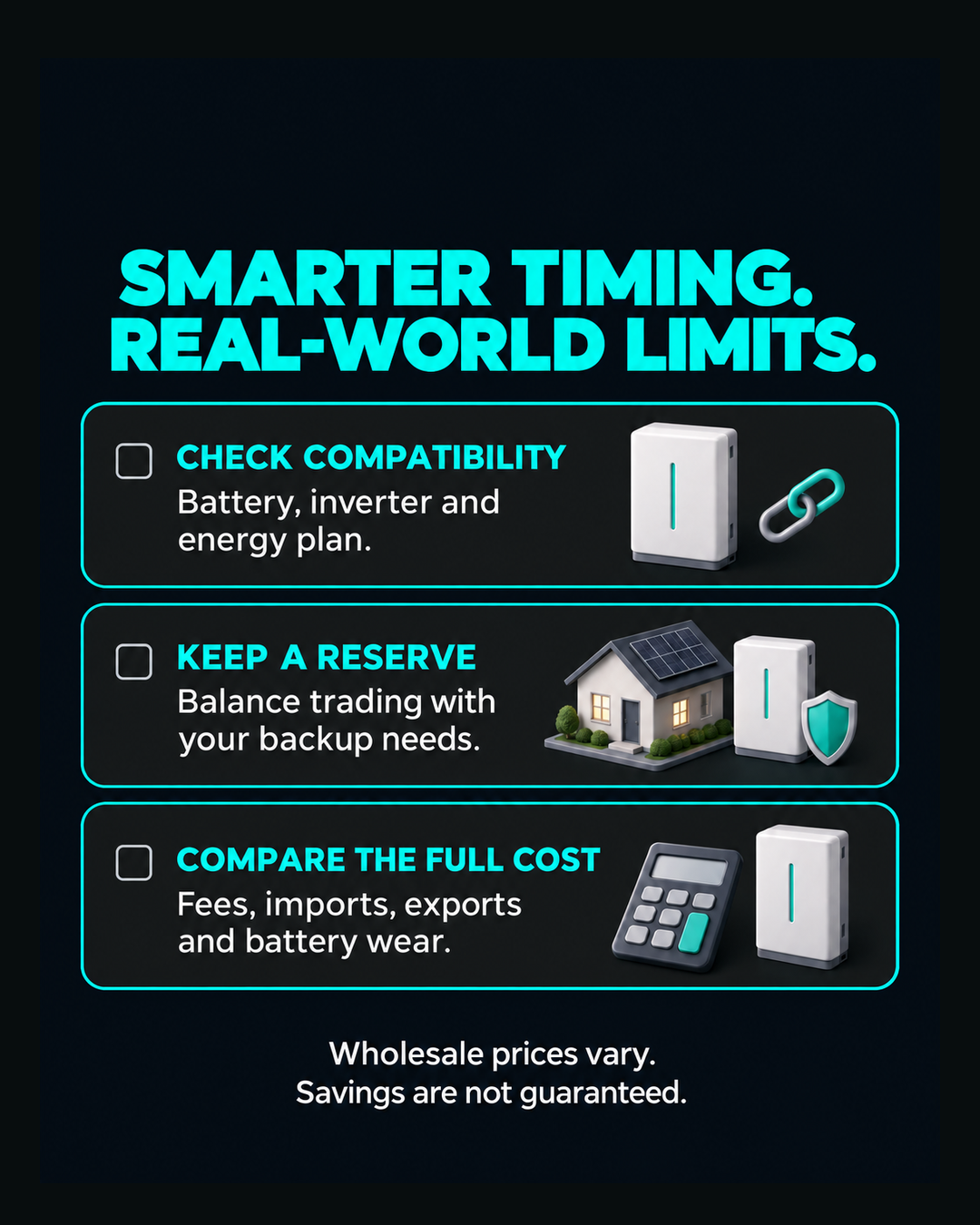
That matters when export prices turn negative. Some supported configurations can reduce surplus solar output while continuing to supply the home; others use an on/off approach. Available control depends on the equipment and how it is installed. Check the exact model, inverter, meter and configuration in Amber’s compatibility checker, and confirm the proposed setup before buying.
Confirm which integrations are available today. Have the installer record the controls supported by your proposed configuration.
At the time of writing, Amber’s residential information lists a $25 monthly subscription. Electricity charges remain variable, with network, metering and other pass-through costs also relevant to the bill. A low wholesale market price does not necessarily mean free delivered electricity. Review the energy fact sheet for your address. Amber’s new-customer information.
Import prices can rise, while export prices can fall below zero. A battery creates flexibility, but it cannot remove every price risk or meet unlimited demand.
Amber offers a Wholesale Energy Price Cap covering the average base wholesale-generation component over a quarter. It excludes other charges, including network and metering costs. This is not a cap on the entire bill or every individual interval. How Amber’s price protection works.
Decide how much stored energy you want reserved for outages. Amber says the minimum reserve set in the battery manufacturer’s app takes priority; the corresponding value in Amber should match so its planning uses the correct information. Amber’s reserve guidance.
A reserve setting does not add blackout capability by itself. Backup depends on the installed equipment and wiring, and may cover selected circuits rather than the whole property. Battery capacity and power output also limit what can run and for how long. Australian Government battery guidance.
Separately from the equity round, ARENA announced an additional $13.6 million for Amber’s EV project in May 2026, bringing its total support to $16.8 million. The expanded project targets 1,000 vehicle-to-grid households and 2,000 smart-charging households. These are project targets, not confirmation that every EV can participate. ARENA’s project announcement.
Vehicle-to-grid sends electricity from a car back to the grid. It requires a suitable vehicle, charging equipment and approved setup. Ordinary scheduled charging does not provide that capability.
Before choosing a battery or changing plans, gather recent bills and interval meter data. Compare total annual costs using your actual consumption and exports, not a memorable high-price trading event. Historical data makes a comparison more personal, although future usage and prices will differ. Energy Made Easy explains the role of meter data.
A battery assessment should examine solar production, usable storage, charging power, export limits, warranty conditions, backup priorities and ongoing fees together. Request the assumptions behind any savings estimate and consider less favourable conditions as well.
Amber’s funding makes battery automation a development worth watching. The decision at home still starts with a suitable system, compatible controls and a plan that fits how your household uses electricity.
Information checked on 22 September 2026. Plan terms, fees and supported equipment can change. The graphics are editorial illustrations.
Available times
Book a consultation and we'll map solar, storage, hot water, and the rebates around your bills and your goals.
Question 1 of 6