
Reading Battery Warranties: Years, Throughput and Retained Capacity
Battery warranties need more than a years comparison. Read throughput limits, retained capacity, operating conditions and claim costs for the exact model.
Battery warranties need more than a years comparison. Read throughput limits, retained capacity, operating conditions and claim costs for the exact model.

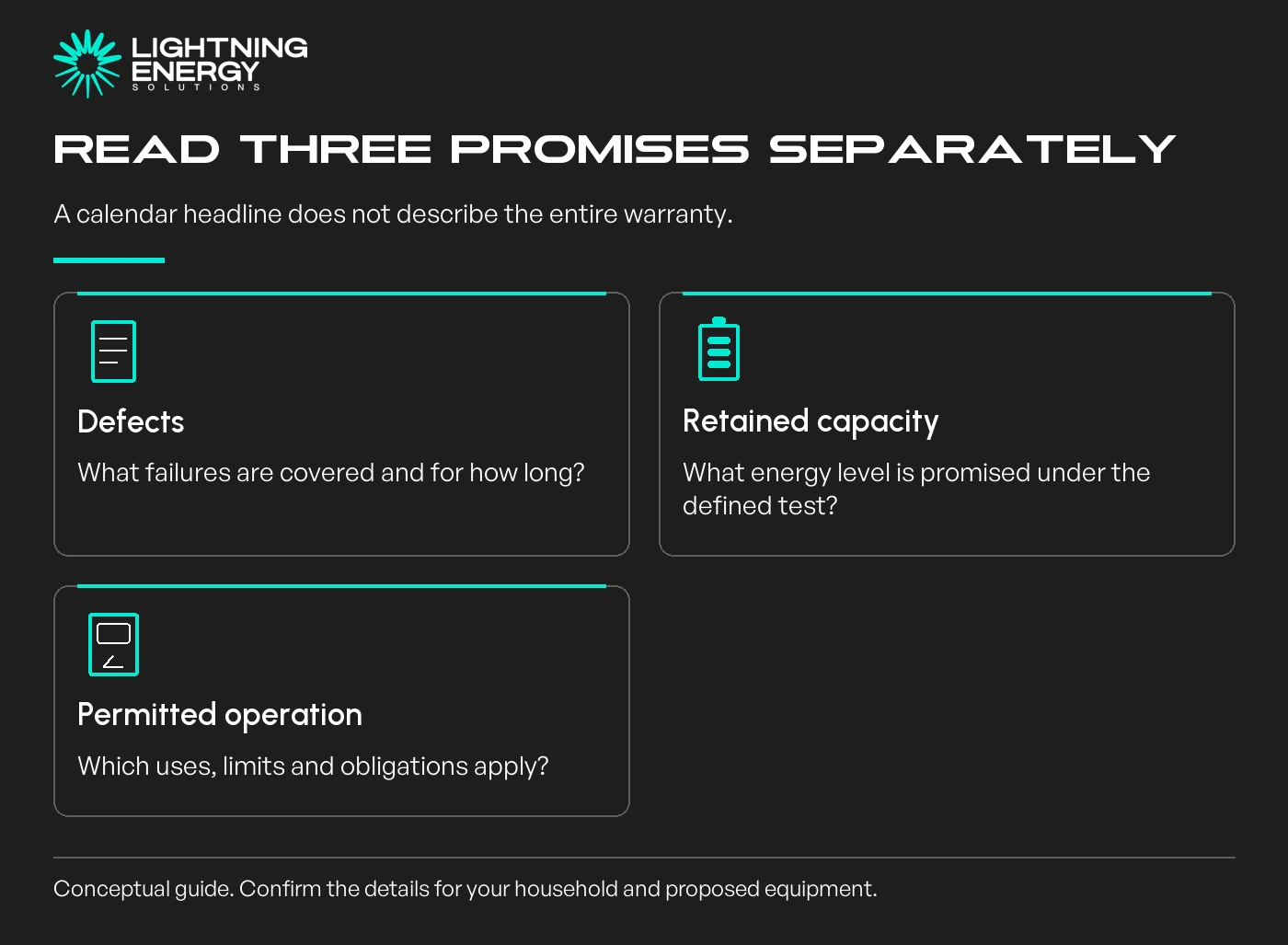
A ten-year battery warranty does not necessarily mean ten years of unrestricted use, full original capacity or every service cost paid. Read the calendar term, permitted operation and performance promise together.
Start with the Australian warranty for the exact model and supplied components. A warranty from another country, an older generation or an optional promotional program may describe different cover.
A defects warranty concerns specified failures. A retained-capacity promise addresses how much usable energy remains under defined conditions. They answer different questions and can carry different qualifications.
For example, Tesla's Australian and New Zealand Powerwall warranty has a ten-year term and a 70% energy-retention provision.
Its operating table distinguishes specified self-consumption, time-based control and backup from other applications.
Tesla Australian and New Zealand warranty.
That document is an example of why the table matters, not a recommendation to judge all products against one headline. Read every applicable footnote before comparing your proposed use.
Throughput measures accumulated energy moved through the battery under the warranty's definition. It is not the same as its one-time storage capacity, and charging or discharging may be counted differently by different documents.
Tesla's example specifies unlimited cycles for its listed applications, while other applications have a 37.8 MWh aggregate-throughput limitation. Check how the warranty defines the actual activity you intend, including third-party control.
A hypothetical warranty could instead say ten years or 30 MWh discharged, whichever occurs first. If 10 kWh were discharged every day, that would be about 3.65 MWh a year and reach 30 MWh in roughly 8.2 years.
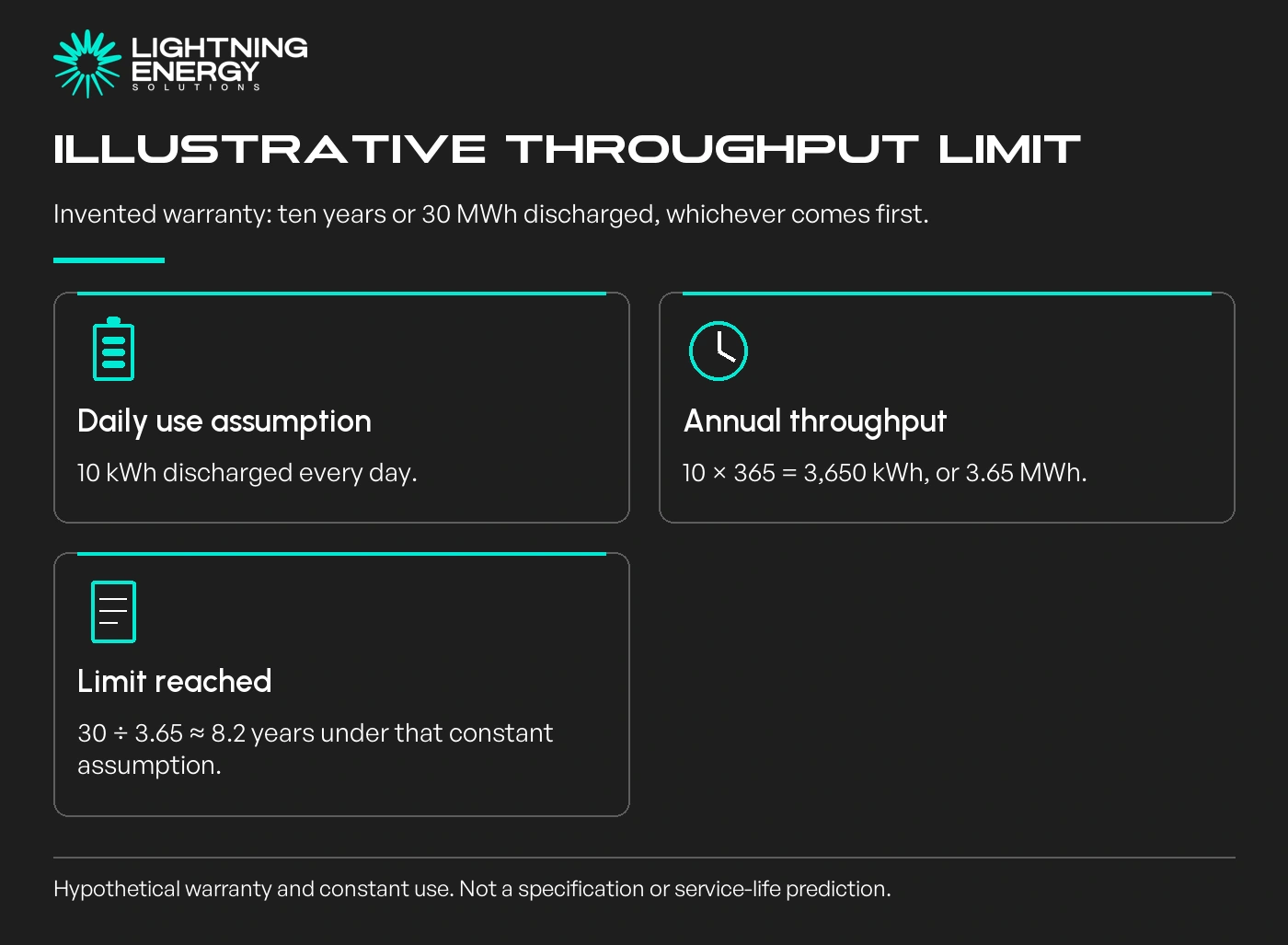
Those hypothetical figures are not a real product offer. They show why a similar-looking calendar promise can cover different usage patterns. Seasonal demand and provider events would change actual throughput.
Our VPP guide explains why participation should be checked against the equipment warranty.
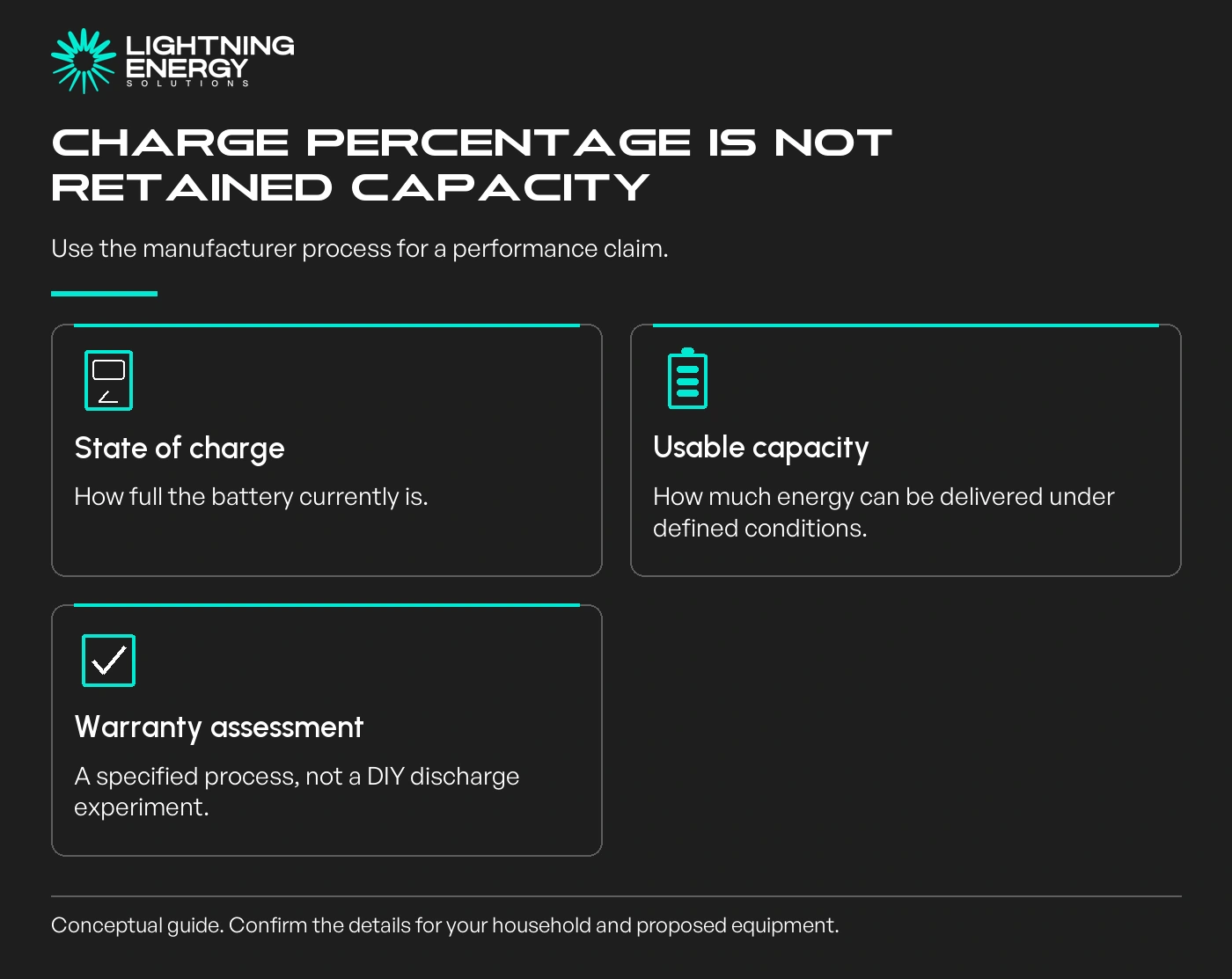
An app showing a lower charge percentage is not automatically evidence that warranted capacity has fallen. State of charge describes the current fill level; capacity assessment needs the manufacturer's defined process.
Ask which test conditions apply, who performs the assessment and how a claim is assessed. Do not attempt a deep-discharge experiment or alter installer settings to produce your own warranty test.
A useful comparison records the retained percentage and the baseline it refers to. It also identifies whether the promise applies to the whole system, each module or specified battery components.
Check installation, environmental, communications, maintenance and permitted-use conditions. Keep commissioning records and service documentation, and ask what happens if the installer stops trading.
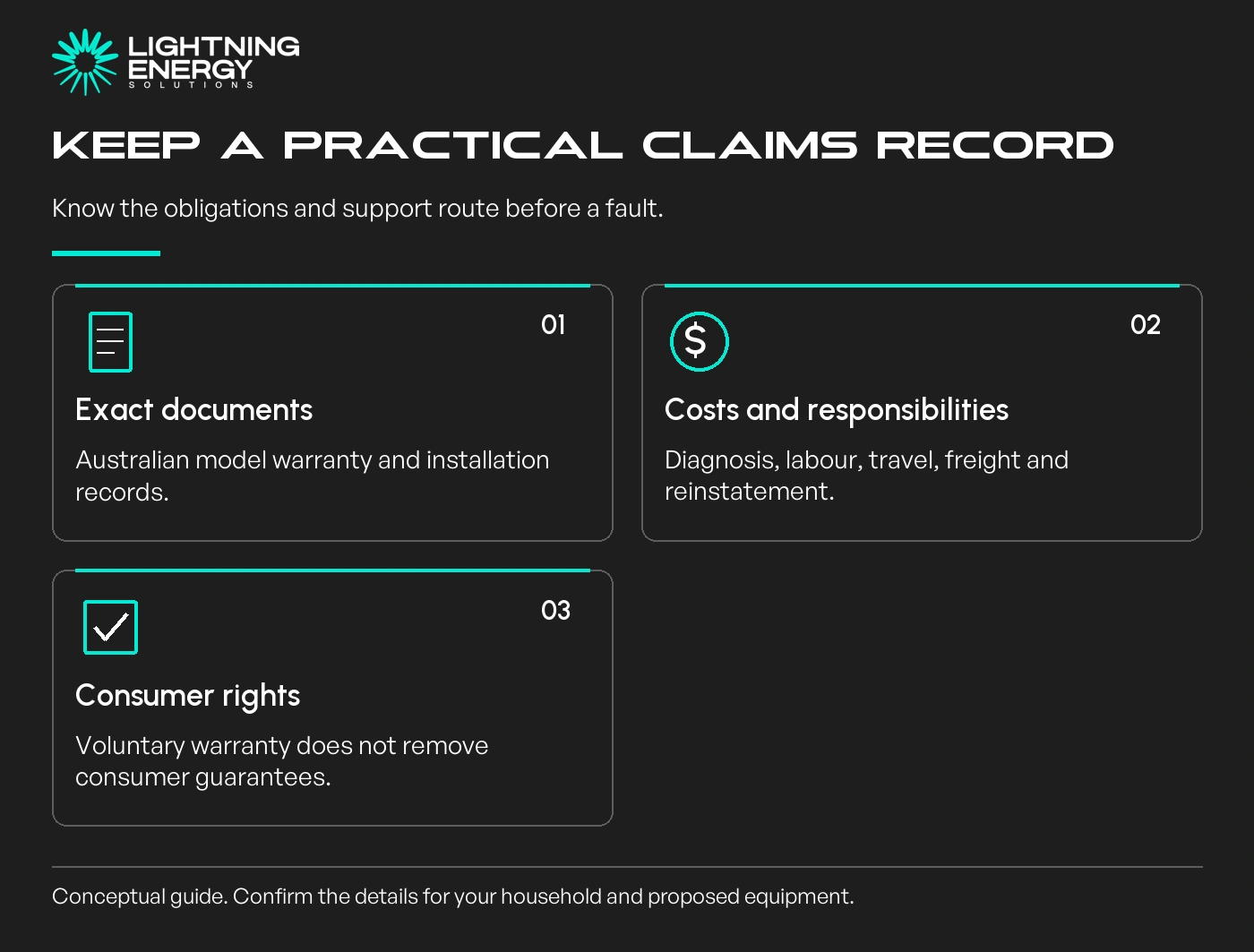
Identify who handles diagnosis, labour, travel, freight, removal and reinstallation. A replacement component supplied at no charge does not necessarily mean the household has no other expense under a voluntary warranty.
Use the battery quote checklist to get the claims pathway and any installer workmanship cover in writing.
The ACCC explains that voluntary warranties sit alongside automatic consumer guarantees. A warranty cannot remove those rights, and the rights may continue beyond the written warranty term depending on the circumstances.
ACCC warranty and consumer-rights guidance.
That does not establish a fixed lifetime or automatic remedy for every old battery. Keep evidence and raise an actual fault with the supplier using the applicable claims and consumer-protection processes.
Choose battery equipment on its suitability and documented support as well as warranty wording. Buying a longer headline term is poor value if the system does not meet the household's needs.
Plan your battery upgradeBring the exact Australian warranty documents with the quote. We can compare the operating limits, capacity promise and practical service responsibilities before equipment is selected.Available times
Book a consultation and we'll map solar, storage, hot water, and the rebates around your bills and your goals.
Question 1 of 6
