
Cybertruck Cancelled for Australia: Tesla Plans 2027 Production Wind-Down
Musk says Cybertruck production at Giga Texas will wind down around mid-2027. What the news means for Australian reservations, refunds and home charging plans.
Musk says Cybertruck production at Giga Texas will wind down around mid-2027. What the news means for Australian reservations, refunds and home charging plans.

Tesla’s Cybertruck story has taken another turn. After the cancellation of Australian and New Zealand production plans in October, Elon Musk has announced a planned production wind-down at Gigafactory Texas around mid-2027.
Updated 7 November 2026: this adds a US factory decision to the earlier Australian cancellation. For local reservation holders, the practical priorities remain the refund and a realistic plan for the next vehicle.
In his 6 November statement, Musk said Tesla plans to wind down Cybertruck production at its Texas factory around the middle of next year to accommodate more Cybercab production.
That timing means around mid-2027. It is a future production plan, not a statement that every Cybertruck production line stopped on the day of the announcement.
Ars Technica reports the planned end of production. Musk’s statement names Giga Texas.
The announcement does not give a final build date or detailed arrangements for outstanding orders. Nor does it announce an Australian Cybercab launch. We have not independently contacted Tesla about those questions.
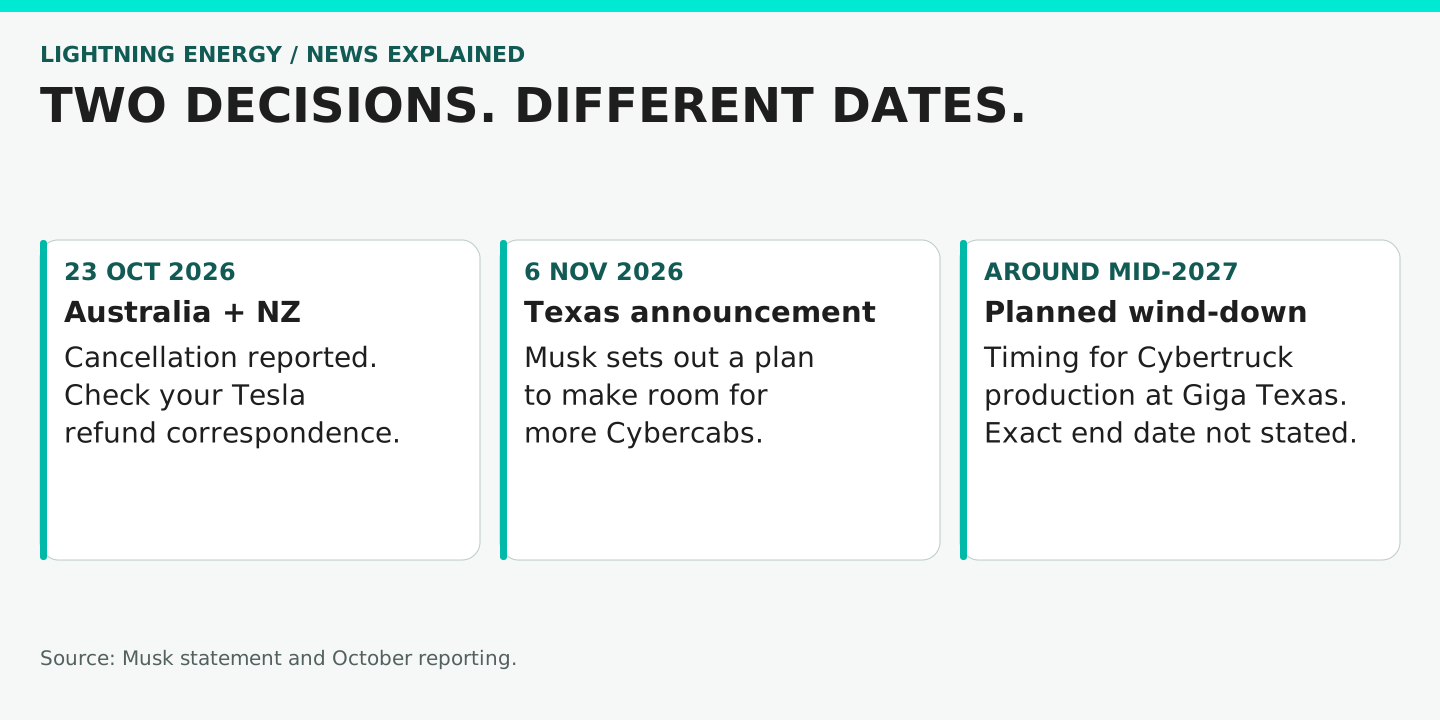
On 23 October, EV Central reported that Tesla had written to Australian and New Zealand reservation holders confirming the cancellation. The reported process was to cancel reservations and refund deposits in full.
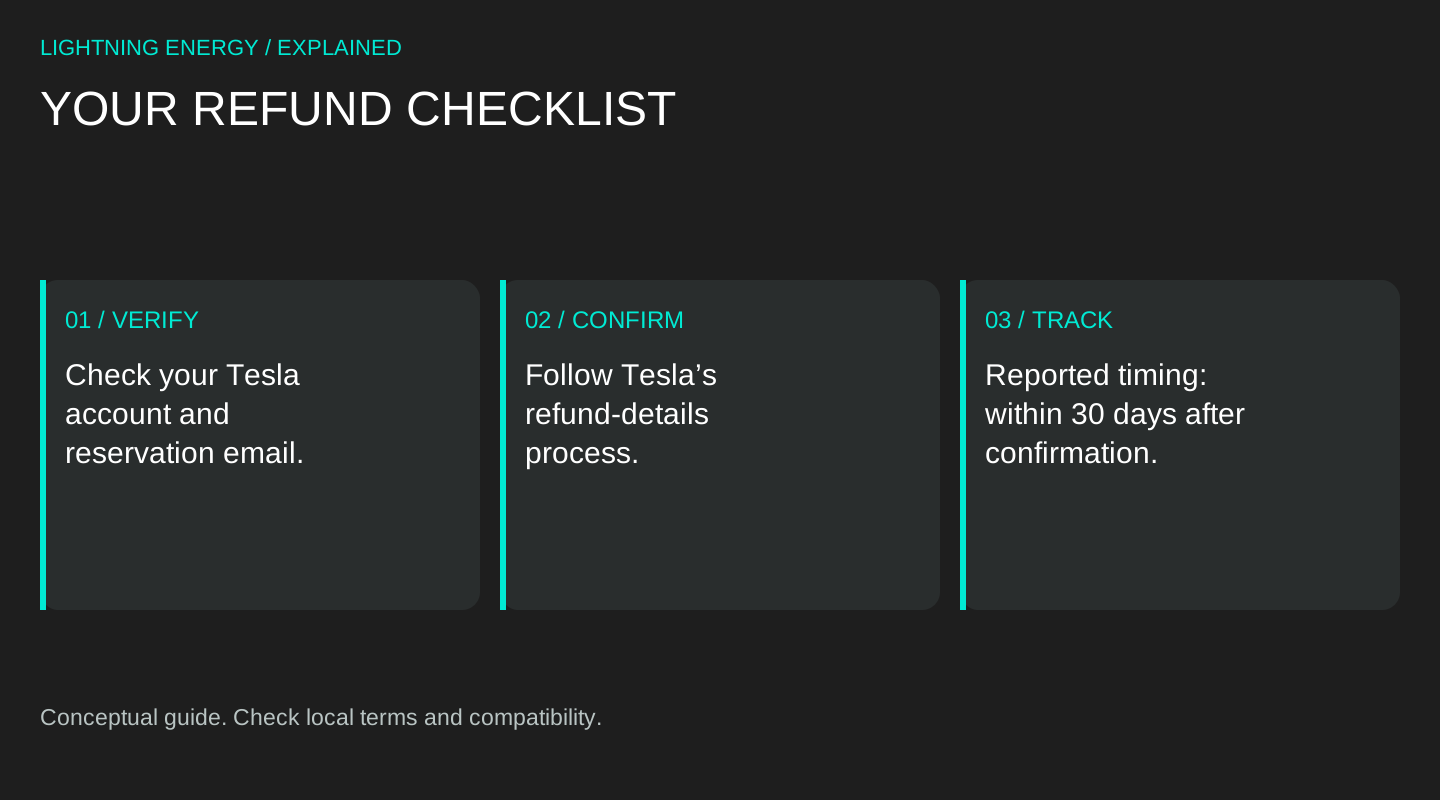
The report describes an email to confirm refund details, then repayment within 30 days of confirmation. Check your Tesla account and correspondence. We cannot verify individual refunds.
That October report also describes a one-year Full Self-Driving (Supervised) offer for reservation holders ordering a new Model 3 or Model Y. Confirm current eligibility and terms with Tesla before relying on it.
Source: EV Central’s 23 October report, which reproduces Tesla’s customer communication. We have not independently received that email from Tesla.
The reports reviewed describe a cancelled local programme, not an Australian regulatory ban. Musk’s later Texas announcement supplies a reason for that factory change: making room for Cybercab production.
It does not establish the full reasoning behind the earlier Australian decision. Treat explanations about Australian engineering costs, demand or regulation as separate claims requiring their own evidence.
Our original October article distinguished the local cancellation from a worldwide shutdown. The November statement is a subsequent development, so this update replaces the old production-status graphic.
Cybertruck attracted attention beyond its shape because of Powershare. Tesla’s US support information describes compatible vehicles supplying home backup through supported equipment, and Cybertruck grid support in certain areas.
That is not a blanket promise for Australian households. Tesla’s eligibility wording specifically identifies US and Puerto Rico Model 3 and Model Y orders after 1 October 2026, with only some earlier vehicles supported.
Source: Tesla’s Powershare support and eligibility information. An overseas capability needs separate Australian confirmation for the exact vehicle, equipment and installation.
Powering an appliance, backing up a house and exporting to the grid are three different jobs. Do not buy a charger on the assumption that a future software update will provide all three.
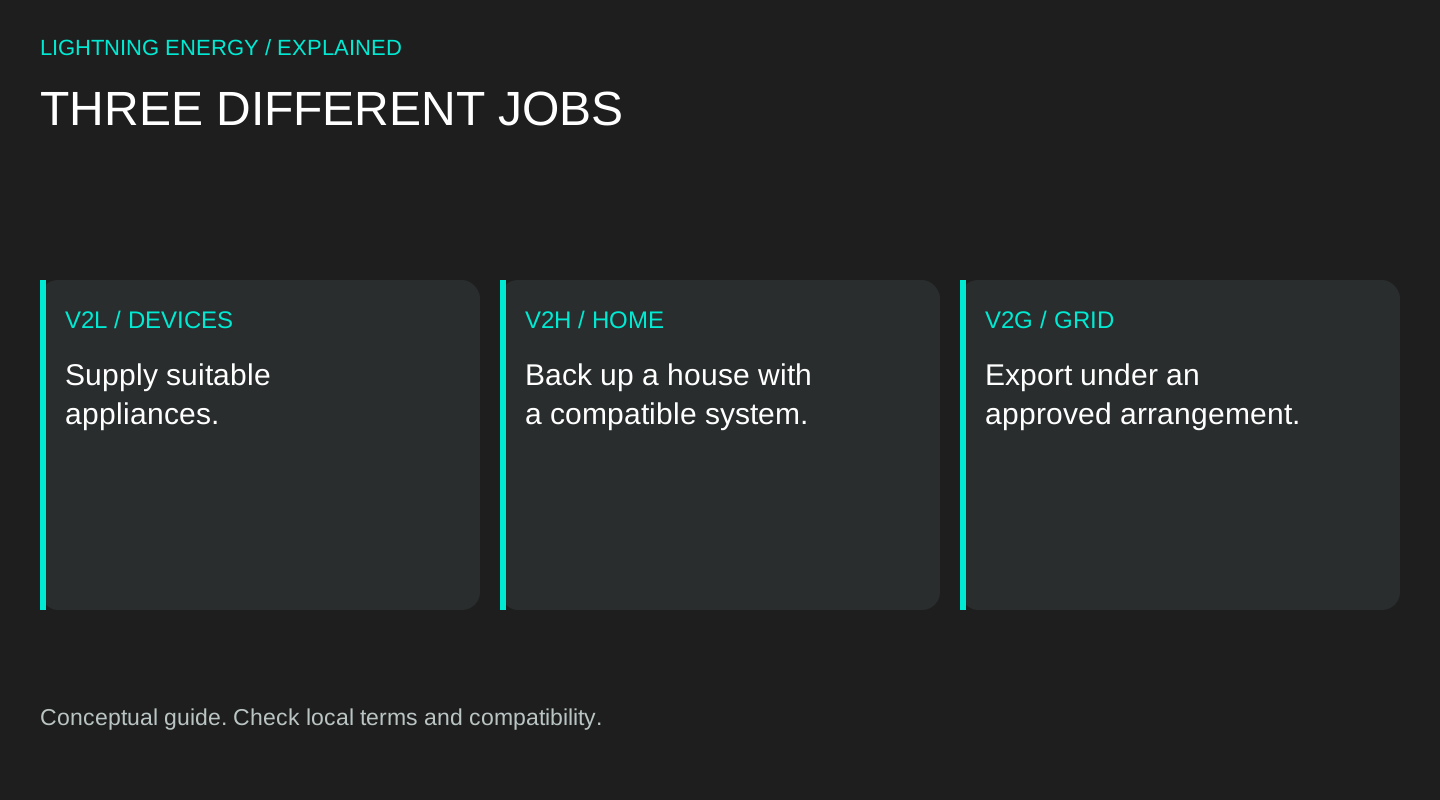
For backup planning, start with the essentials you want to keep running. Then ask which supported home battery system can supply those loads, for how long, and under which conditions.
The useful question now is what your next vehicle needs to do. Write down normal daily kilometres, parking hours, towing needs and the times you can charge. This makes competing vehicles easier to assess.
Separate must-have functions from features you would like later. If home backup is essential, get written confirmation of a supported Australian solution before paying for equipment chosen around it.
For ordinary charging, Tesla’s Australian Wall Connector guidance says the plug must match the vehicle inlet. Charging speed also depends on the vehicle’s onboard charger and the electrical installation.
Source: Tesla Australia’s Wall Connector guide. Ask an installer to assess the site rather than treating a charger’s maximum rating as your guaranteed charging speed.
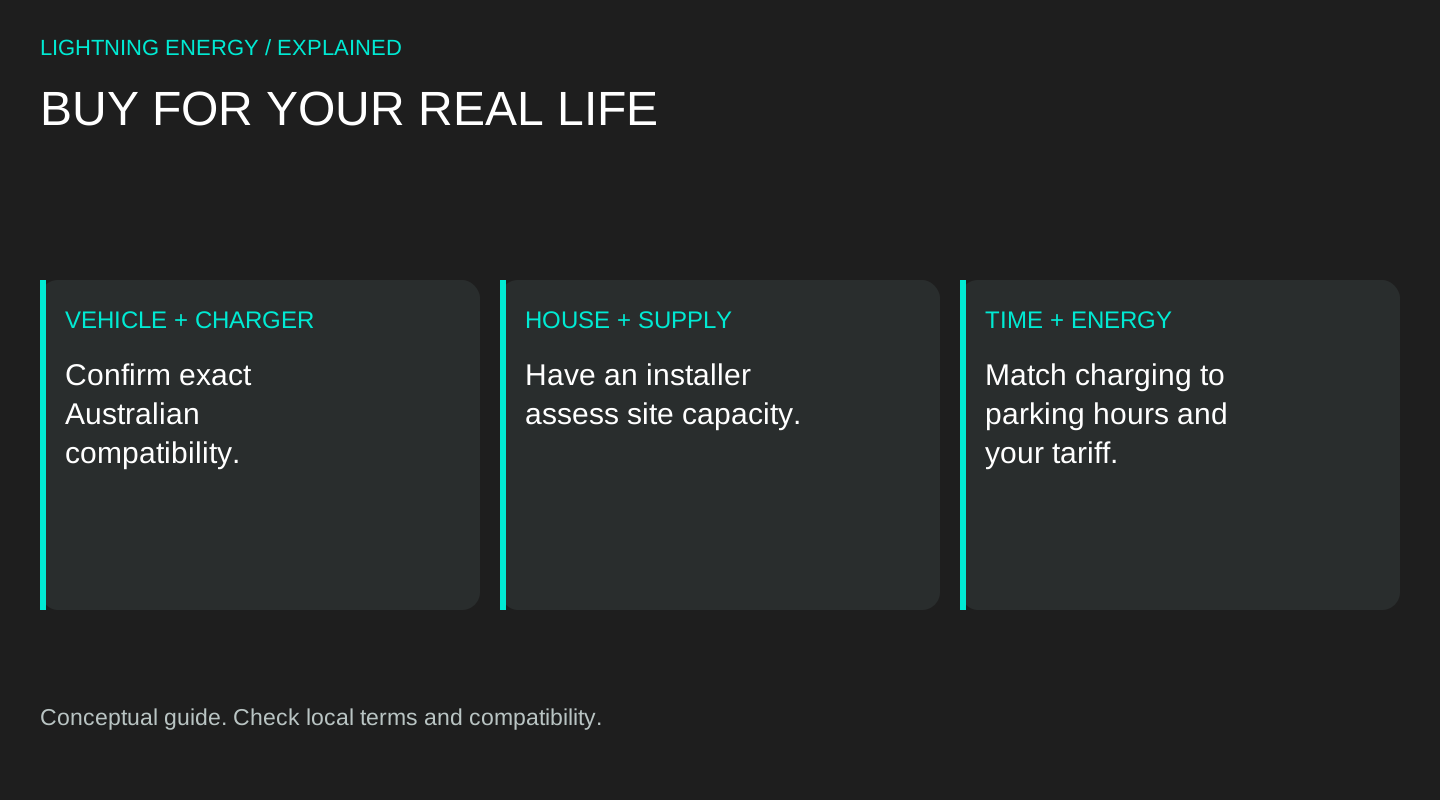
A vehicle that spends every weekday away from home may miss much of your rooftop generation. One parked at home during sunny hours creates a different charging opportunity. Your timetable belongs in the design brief.
Review your solar setup and EV charging options together. Ask how the proposed charger schedules energy use, whether surplus-solar control needs extra hardware, and which vehicle combinations are supported.
A home battery is another design choice, not an automatic requirement for an EV. Its value depends on when you use electricity, your tariffs, installed cost and any backup requirement.
Avoid assuming a home battery pays for itself through car charging alone.
If you want help planning around a vehicle available in Australia, talk to Lightning Energy. Bring your usage history and vehicle shortlist so the discussion starts with your home rather than a promised future feature.
Research updated 7 November 2026. This is a news explainer, not a vehicle test. Photograph: Mpelas199, AUTO ATHINA 2024 in Greece, Wikimedia Commons, CC0. It does not depict an Australian delivery.
Available times
Book a consultation and we'll map solar, storage, hot water, and the rebates around your bills and your goals.
Question 1 of 6
