Solar

Best Solar Panels for VIC, NSW and SA: What Actually Matters

Which panel specs genuinely change your outcome in Melbourne, Sydney or Adelaide, and which are just marketing noise. A practical decision filter, not a spec-sheet ranking.

LukeLightning Energy21 September 2026 · 9 min read
Best Solar Panels for VIC, NSW and SA: What Actually Matters

When a panel brochure shows up in a quote, there's usually a wall of numbers: temperature coefficients, NOCT, degradation curves, hail ratings.

Most homeowners glaze over and pick whatever the salesperson pushed hardest. So let's cut through it properly.

Some of those numbers change your outcome. Most don't, particularly if your roof has decent space, isn't in a hail-prone suburb, and you're focused on payback speed rather than squeezing out the last few per cent of 30-year output.

What actually differs between VIC, NSW and SA

The climate, roof arrangement and modelled cell temperatures all affect generation. Use local conditions in the system estimate rather than assuming one temperature-performance conclusion applies across Victoria, NSW and South Australia.

That's a genuinely different heat profile to the extreme inland heat of somewhere like Alice Springs. For a place like Melbourne or Adelaide, it means the specs premium brands push hardest, extreme heat durability, are oversold.

The real differences are narrower than 'panel technology for your state'. They come down to three things.

  • How many STCs (rebate certificates) your postcode earns
  • Whether your suburb sits in a hail corridor
  • How your specific roof handles heat: tin versus tile, ventilated versus flush-mounted

Whatever the exact zone, STC differences between cities translate into real dollars on your rebate, depending on your system size.

For a full breakdown of what that rebate gap can look like across the three cities, see Solar Panel Cost 2026: Melbourne vs Sydney vs Adelaide.

This article is about the panel itself, not the invoice.

The metrics that matter versus the noise

A panel's temperature coefficient measures how much power drops for every degree the cells rise above the 25°C lab test standard, not the air temperature around them.

Cells on your roof commonly run well above ambient on a sunny day, which is exactly why this number gets marketed so hard.

A temperature coefficient describes an output change at a given cell temperature. Its contribution to annual energy depends on the weather and operating conditions across the year.

For an arithmetic illustration, a cell temperature of 42°C is 17°C above the 25°C reference. A power coefficient of −0.24%/°C implies a 4.08% reduction from the reference output under that simplified comparison.

At the same temperature, −0.35%/°C implies a 5.95% reduction. The difference is 1.87 percentage points at that operating temperature; it is not an annual-yield result.

Estimating annual energy requires a model that accounts for local weather, cell temperature, roof orientation and other system losses.

1.87 pointsIllustrative difference at a 42°C cell temperatureComparing −0.24%/°C and −0.35%/°C at 17°C above the reference. This is an instantaneous arithmetic comparison, not an annual-yield prediction.

Compare the exact modules and the modelled annual result for the roof. A temperature coefficient is useful information, but does not determine the whole purchasing decision.

Compare the exact cell and module design

Cell type is one part of a module specification. Compare model-specific performance, dimensions and warranties rather than selecting solely from an N-type or P-type label.

Heat and low-light performance vary between complete module designs. A broad cell-category label alone does not establish the annual advantage of one quoted panel over another.

Read the selected model’s first-year and later degradation allowances. A cell-technology description is not a replacement for the actual performance warranty.

Use manufacturer documents for the exact model and market when comparing those terms.

I've covered what N-type actually changed, using the Jinko Tiger Neo as the working example, in the Jinko Tiger Neo Review.

Ask the designer why the selected module suits the layout, output estimate and budget, and compare an alternative if the reasoning is unclear.

Hail: the standard everyone already meets, and the one some don't

Every panel that qualifies for STC rebates in Australia has to pass a mandatory hail test under the current IEC 61215 standard: 11 impacts from 25mm ice balls travelling at roughly 83km/h.

This is confirmed consistently by SolarQuotes' hail resistance guide and independently by Australian Solar Quotes.

So asking 'is this panel hail resistant' isn't that useful a question anymore. Every CEC-listed panel already clears that bar as a condition of being sold with a rebate attached.

The better question is how far beyond that minimum a specific model has been tested.

AIKO holds VKF HW4 certification, a tougher third-party standard than the CEC baseline, as one Australian installer source notes.

I haven't seen confirmation that other premium brands carry an equivalent third-party hail certification, so treat this as one point in AIKO's favour rather than proof it stands alone.

One installer source notes Victoria's hail season sits mainly across spring and summer, September to March, overlapping closely with South Australia's October-to-February window, per SolarQuotes.

That date range comes from industry sources rather than official Bureau of Meteorology mapping, so treat it as a general seasonal guide, not a precise forecast for your suburb.

One installer source also points to Melbourne's outer eastern and northern suburbs as areas that see notably more hail activity in this window, though this isn't confirmed against official hail mapping.

It's still a reasonable enough signal that enhanced certification is worth considering there, rather than being pure marketing polish.

Where a cheaper Tier 1 panel is genuinely fine

I'll be upfront: for most Victorian, Adelaide and Sydney roofs with decent space and outside a hail corridor, a budget-tier N-type panel from a reputable manufacturer is not a compromise.

It just needs to be CEC-approved, from a brand with a long warranty track record and active installer support here. For that reader, it's the sensible choice.

  • You've got ample roof space and aren't squeezing for every extra watt per square metre
  • Your suburb isn't in a known hail corridor
  • You're optimising for the fastest payback rather than the last few per cent of 25-year output
  • You want a well-proven brand with a long warranty track record, not a boutique name

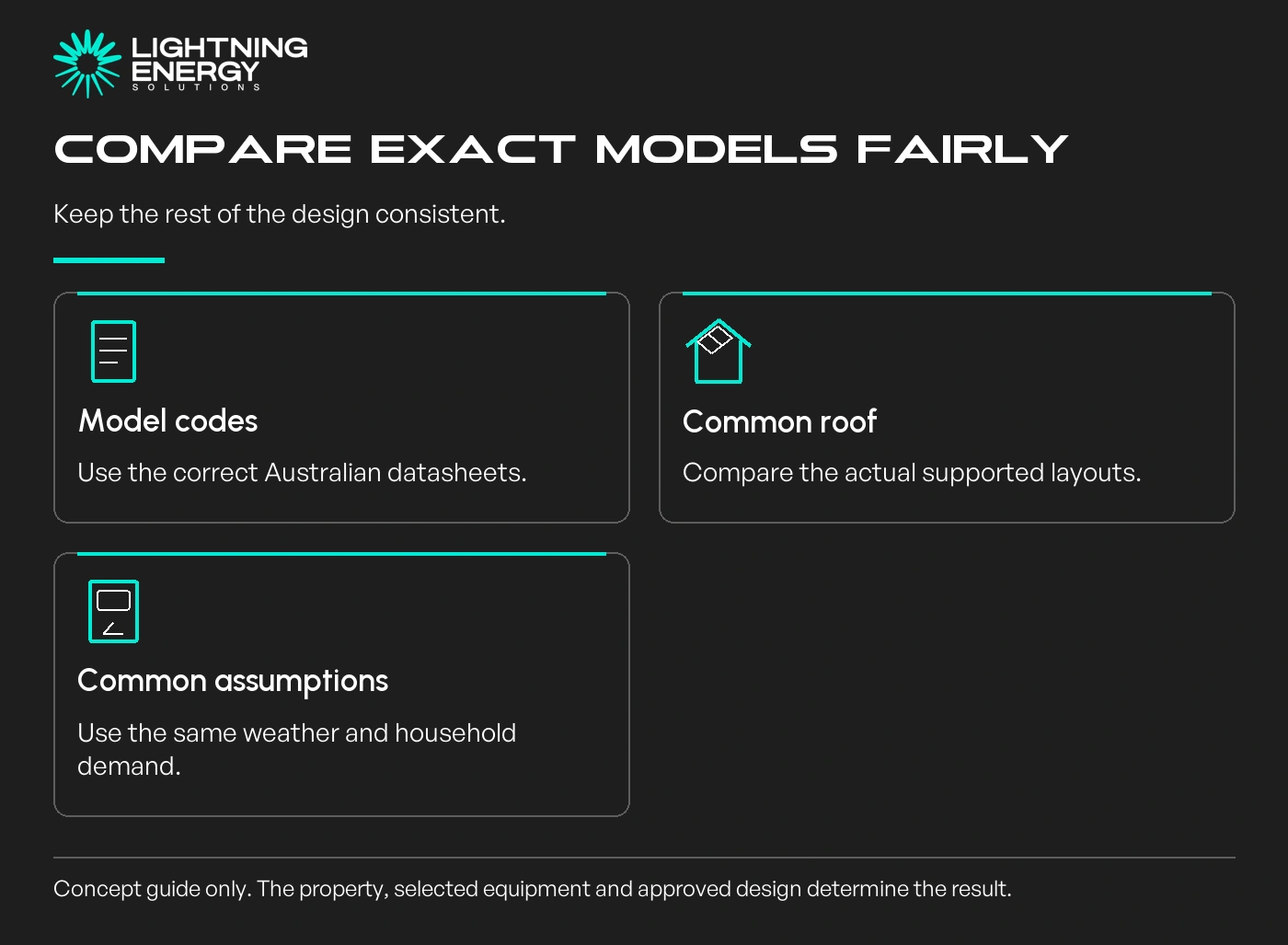
Compare the selected Jinko, Trina, Canadian Solar or LONGi module by model code. Check its current listing, datasheet, certification and warranty rather than applying one family-wide claim.

Where premium panels actually earn their price

There are three situations where I'd genuinely recommend spending more, and I'd say so to any customer sitting across the table from me.

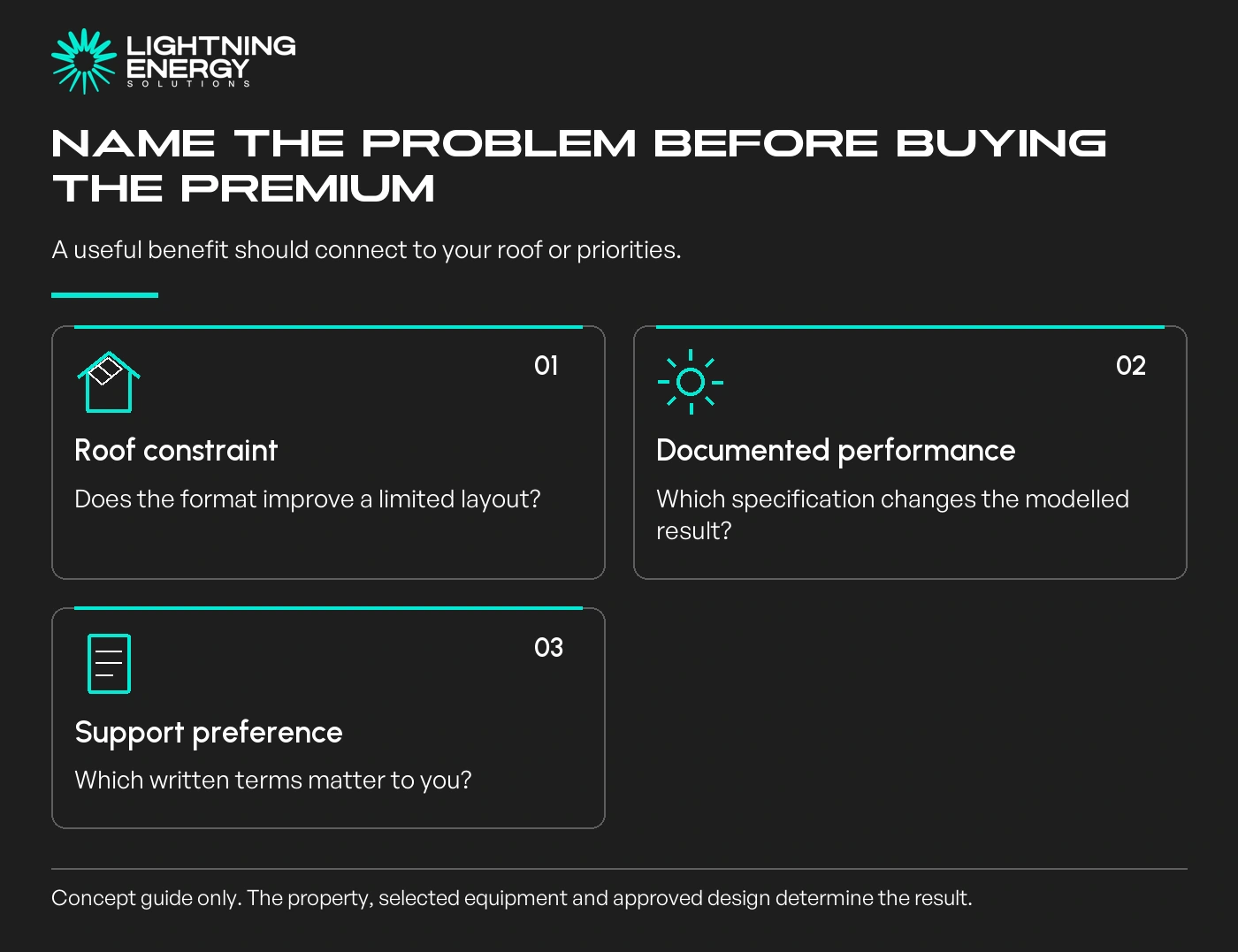
  1. Restricted roof space where the exact module dimensions and efficiency improve the proposed layout.
  2. A site-specific requirement supported by the selected model’s test certificate.
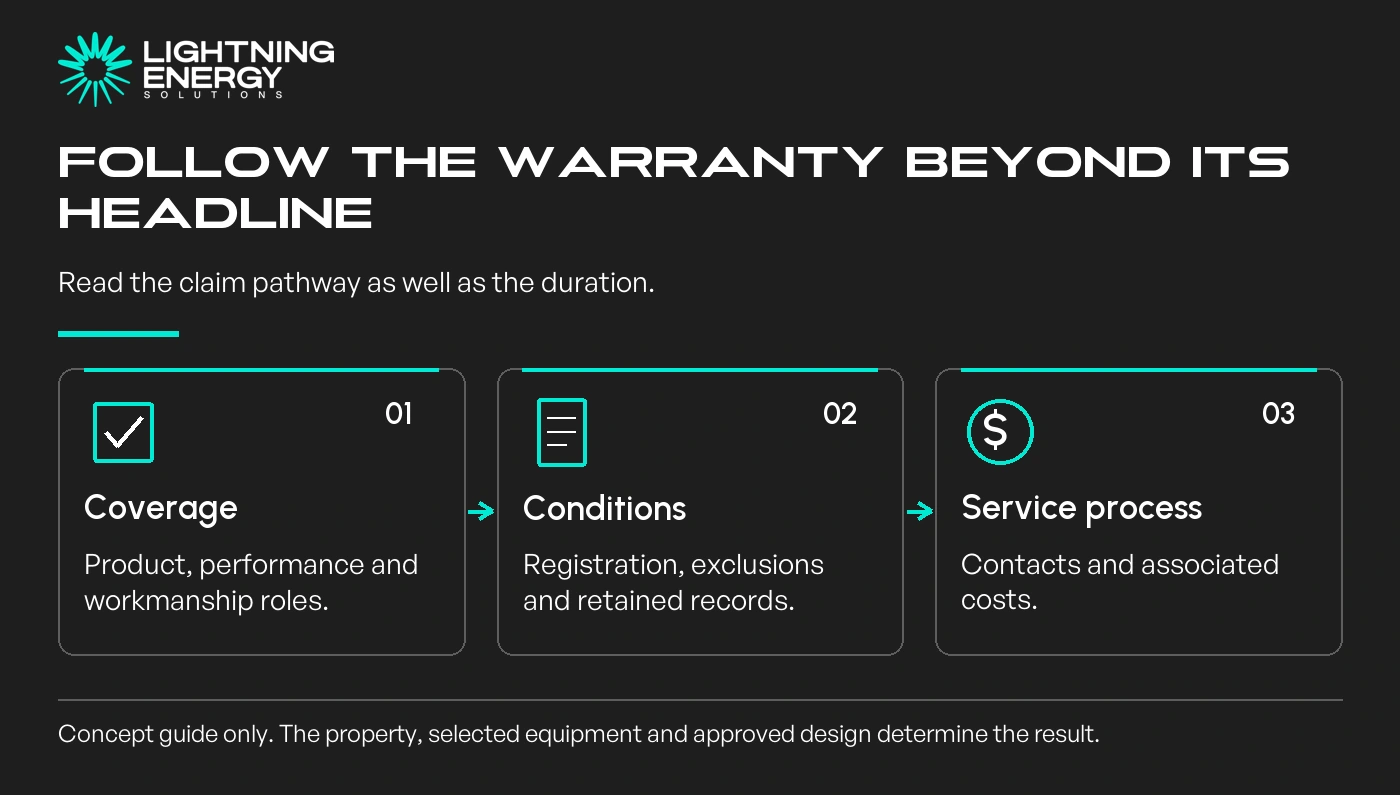
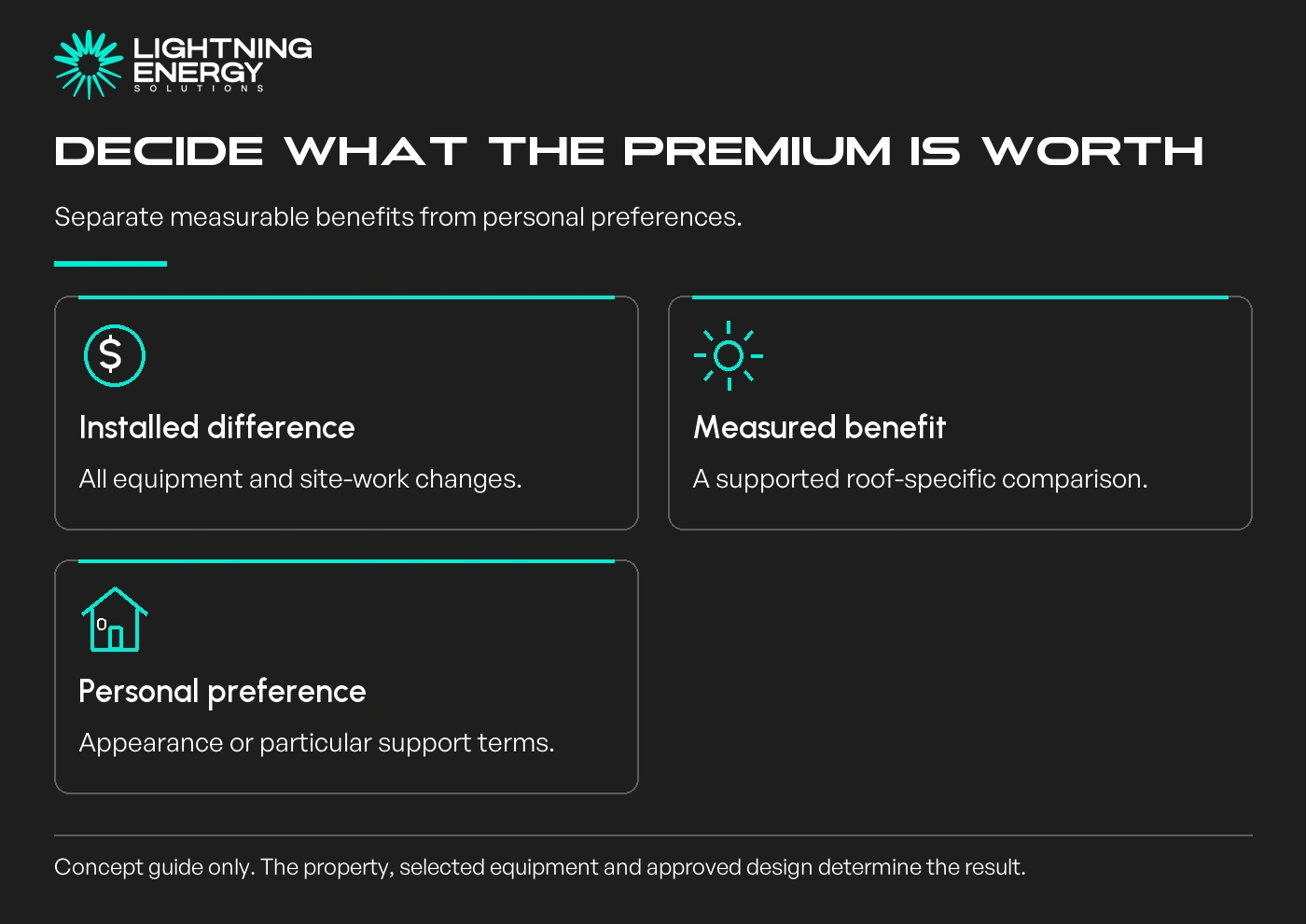
  3. Warranty and service terms that justify the additional installed cost for the buyer.

As of 2026, here's roughly how the warranty terms compare between a premium and value-tier option.

  • AIKO Neostar 2S54 and related models: typically a 25-year product warranty, 30-year performance warranty, and degradation of no more than around 1% in year one and 0.35% annually thereafter (terms can vary across the Neostar range)
  • Jinko Tiger Neo: typically a 12-year product warranty and a 30-year linear performance warranty guaranteeing roughly 85% of rated output at year 30

A word on inverters, because panels are only half the story

None of this panel comparison matters much if the inverter behind it is the wrong choice for your export limits, battery plans or roof layout. I've covered that side of the decision in Solar Inverters Australia: The Boring Box That Decides If Your Solar Is a Toy.

My honest take: who should think twice

If you're on a standard suburban roof with reasonable space, not in a hail corridor, and mainly want your bill down, I don't think you need to pay a premium for AIKO or REC-tier panels.

A well-installed Tier 1 N-type panel will do the job on a standard roof. That said, if you're weighing a premium panel against other system upgrades, the inverter choice often matters more to long-term reliability.

Where I'd push back on a budget choice: if your roof space is genuinely constrained, or you're in one of those outer Melbourne hail-prone pockets, buying the cheapest panel on the page to save a few hundred dollars is a false economy.

That's the honest split, not a blanket 'premium is always better' line.

Timing: is now the right time to buy?

From 1 May 2026, new panel models seeking CEC approval must meet the IEC 61730:2023 safety standard, a deadline reported by pv magazine Australia and confirmed in the CEC's application guidelines. It follows an earlier 1 April 2025 shift to IEC 61215:2021 testing.

This mostly affects manufacturers applying for new listings, not panels already approved or already installed.

If you're buying before that date, existing CEC-listed stock remains fully eligible. Don't let that deadline alarm you into rushing or delaying a purchase on its own.

The bigger timing lever is the STC scheme itself. The rebate value steps down over time as the scheme's deeming period shortens, a genuine timing pressure that has nothing to do with which panel brand you choose.

What to actually do next

Review the exact panel model, roof layout, estimated annual generation, applicable certificates and warranty terms together.

Rather than parsing datasheets yourself, let us walk you through what those mean for your specific roof. You can see how we've approached this for real installs in our case studies.

Not sure which panel suits your roof?Every roof has its own constraints: shading, orientation, hail exposure, space. Rather than guessing from a spec sheet, let's look at your actual property and match the panel to the site, not the other way around.Book a free assessment

Available times

Ready to talk about your own home?

Book a consultation and we'll map solar, storage, hot water, and the rebates around your bills and your goals.

Loading consultations…