
Heat Pump Hot Water During a Blackout: What Still Works?
Understand stored hot water during a blackout, the power needed to reheat it, water-pump dependencies and the requirements for deliberately designed battery backup.
Understand stored hot water during a blackout, the power needed to reheat it, water-pump dependencies and the requirements for deliberately designed battery backup.

A blackout does not instantly remove the heat already stored in a hot water tank. However, a heat pump needs electricity to heat more water, and your ability to draw the stored water depends on the plumbing and water supply.
Separate three questions: is there hot water in the tank, can water reach the taps, and can the heater operate without the grid? They do not always have the same answer.
A storage system holds heated water for later use. During an outage, that stored heat is a limited resource: drawing water and heat loss reduce what remains available.
The government’s hot water guide explains storage systems and the heat pump mechanism.
Where the water supply and plumbing permit normal delivery, a household may still use stored hot water. That does not mean the compressor or an electrical booster is operating.
Alinta’s outage guidance notes that continued use can exhaust the available hot water.
For illustration, an outage immediately after a heating cycle differs from one after several showers. Neither the nominal tank size nor the blackout start time establishes how many showers remain.
Choose heat pump capacity for the household’s ordinary demand. Do not promise a fixed number of blackout hours from the tank label alone.
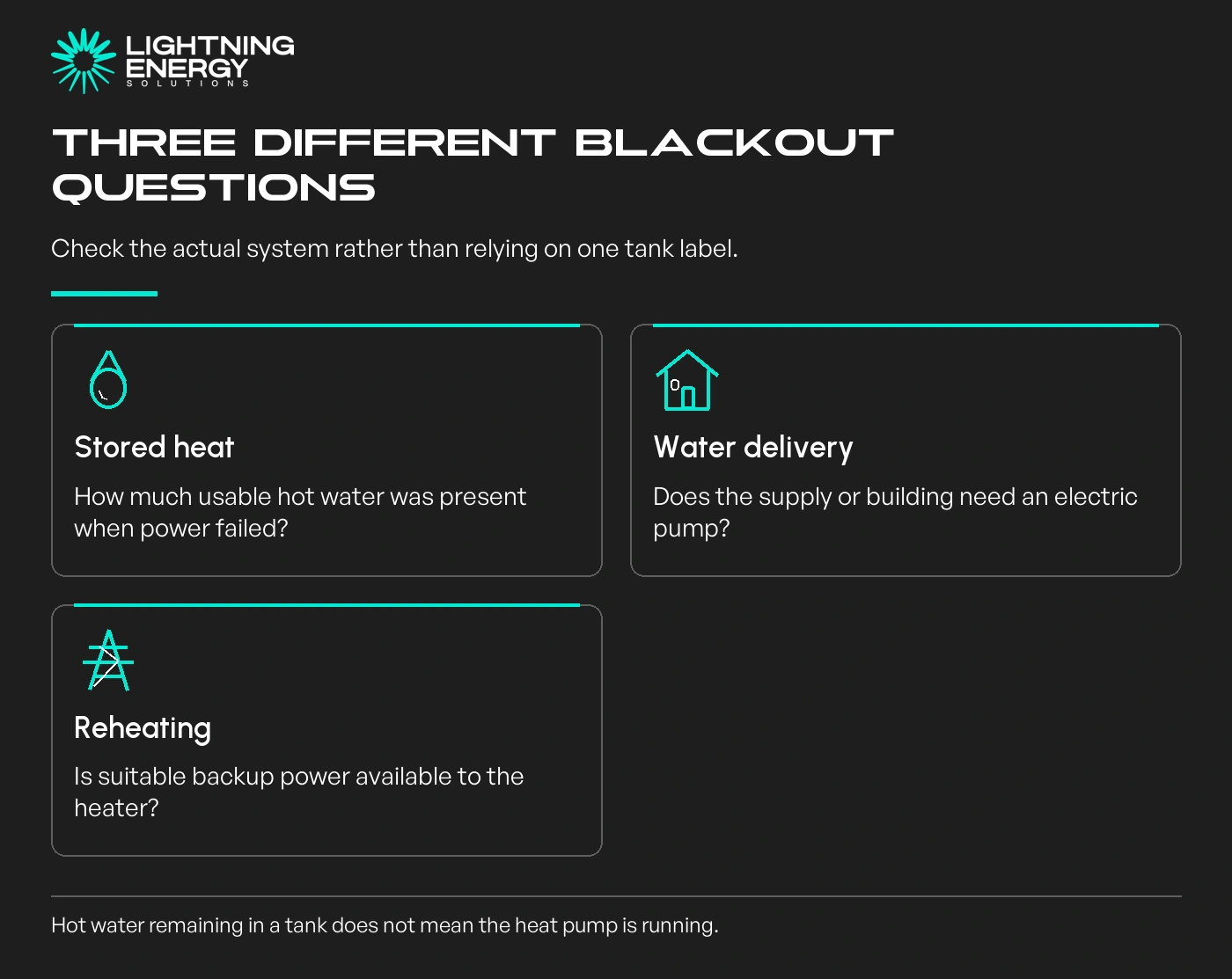
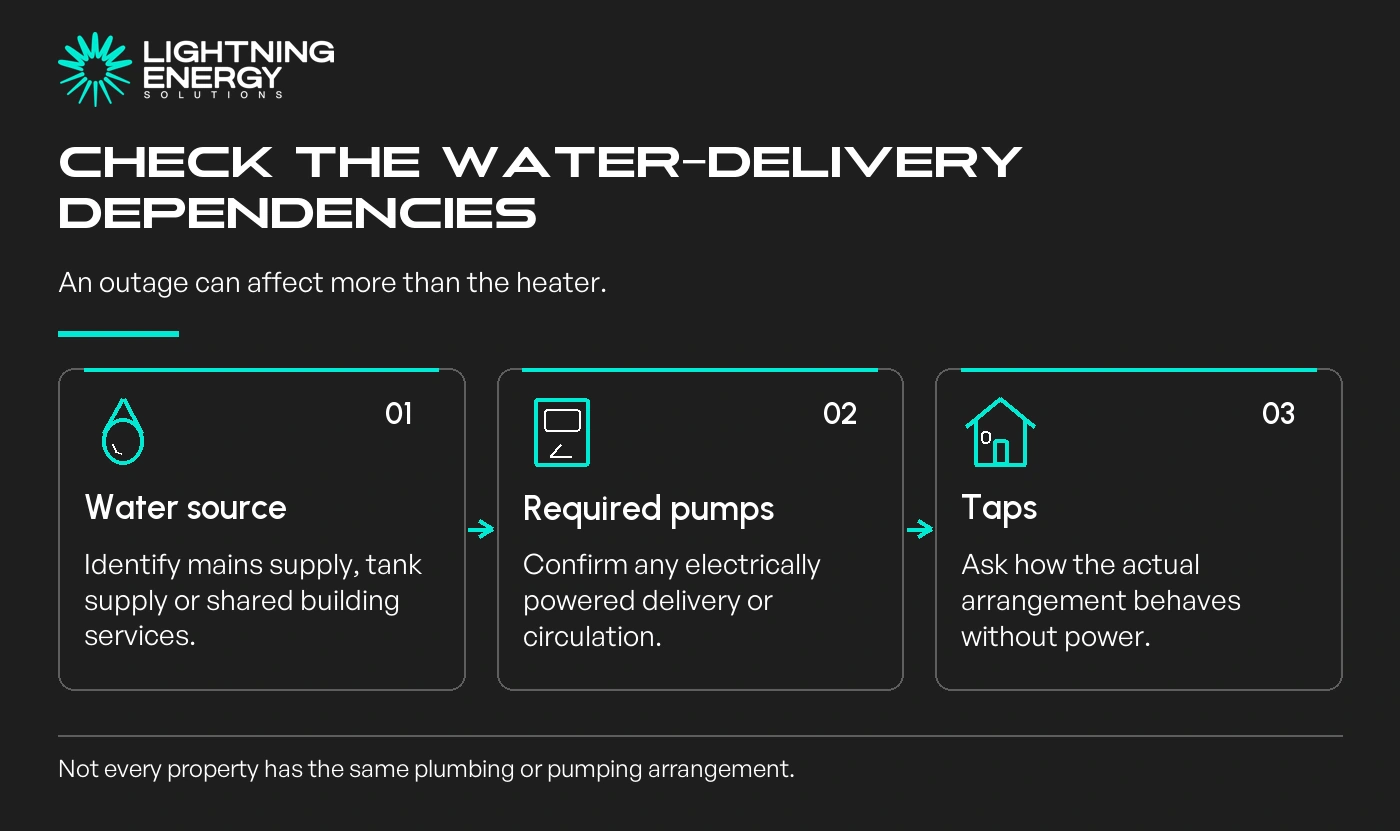
A home supplied through an electric water pump may lose water pressure when that pump loses power. Some buildings also depend on shared pumps or other services outside the water heater itself.
NSW Government outage advice identifies household water-pump dependence as a preparation issue.
Ask the installer which parts of your arrangement need electricity for normal delivery or circulation. Do not assume every mains-pressure tank or apartment has identical plumbing.
If the water supply is interrupted too, follow the water supplier’s advice and the equipment instructions. Do not restart or modify the heater based solely on the fact that household lights have returned.
Keep the model manual and service contact available offline. A saved document is useful when the home internet equipment is also without power.
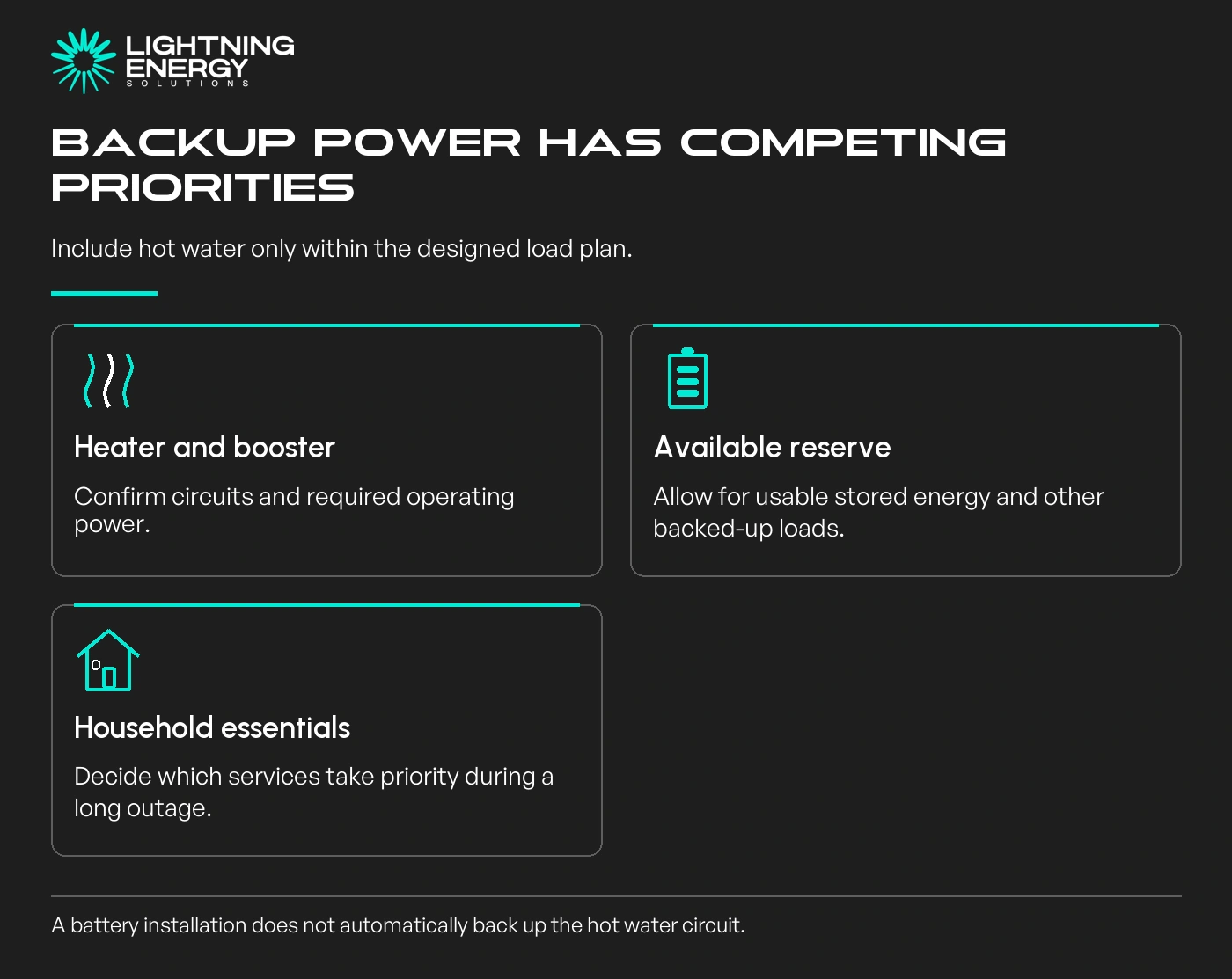
Owning a battery does not prove that the hot water circuit works during an outage. Backup capability, selected circuits, available power and stored energy all matter.
The government’s battery guide explains that backup requires suitable configuration and can cover selected circuits rather than the whole property.
Ask a qualified designer whether the heat pump and any booster are included, along with the water pump if needed. Confirm what happens when other backed-up appliances operate at the same time.
Our blackout backup guide separates the circuit plan from normal bill-saving operation.
During a long outage, reheating water competes with refrigeration, lighting and other priorities for limited stored electricity. A supported operating plan may reasonably preserve those priorities instead of heating water immediately.
Discuss battery options around the actual loads. Solar panels alone should not be assumed to supply the heater while the grid is unavailable.
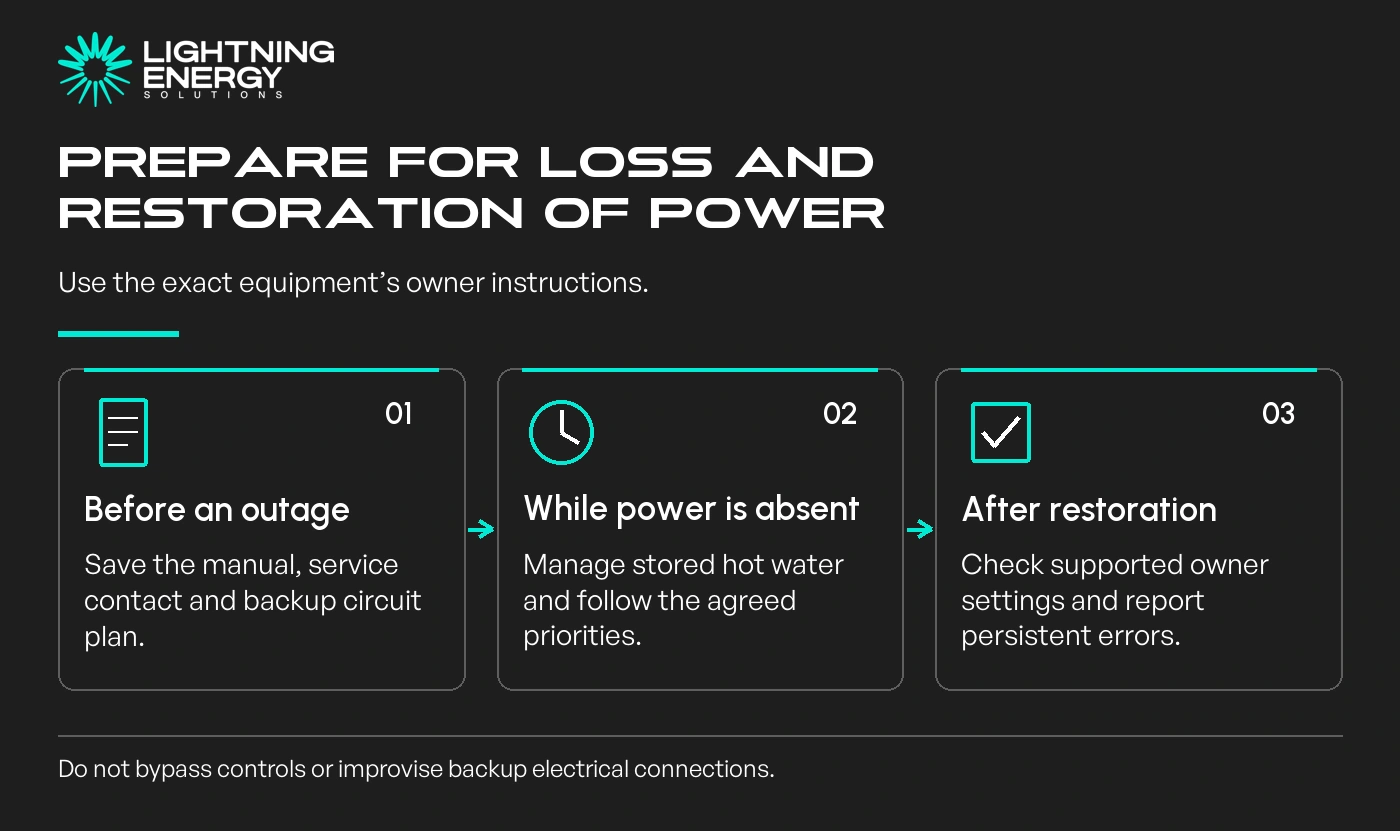
Ask at handover how the system behaves after loss and restoration of power. Confirm whether its clock and schedule are retained and which owner checks are appropriate.
For a prolonged interruption, follow the manufacturer’s instructions and contact the installer about any protective functions that depend on power. Do not bypass alarms, alter safety controls or improvise an electrical connection.
Keep hot water use modest if the available stored supply is important to the household. This is practical conservation, not a guarantee that the tank will remain usable for a particular duration.
Avoid buying a battery solely because a short outage once delayed a shower. Compare the broader resilience need, required equipment and household priorities first.
If backup hot water is essential, state that requirement in the design brief before installation. It is more useful than discovering later that the heater sits outside the backed-up circuits.
Ask for a site-specific backup assessment that includes the heater, water supply and household priorities. Stored hot water and electrically supported reheating are separate parts of the plan.
Available times
Book a consultation and we'll map solar, storage, hot water, and the rebates around your bills and your goals.
Question 1 of 6
