
Home Battery Backup Is Not Automatically an Uninterruptible Power Supply
Home battery backup and a UPS solve different continuity problems. Check transfer behaviour, sensitive equipment and runtime before assuming no interruption.
Home battery backup and a UPS solve different continuity problems. Check transfer behaviour, sensitive equipment and runtime before assuming no interruption.

A home battery with blackout backup should not automatically be treated as an uninterruptible power supply for every appliance.
It may provide useful outage energy without guaranteeing that a computer, modem or other sensitive device never resets.
Check the documented behaviour of the complete backup installation and the requirements of the equipment it will supply. Stored energy, transfer behaviour and power quality are different parts of continuity planning.
When the grid fails, supported backup equipment must establish the intended local supply arrangement. The applicable transfer conditions depend on the battery, inverter, switching hardware and installation.
A quoted fast transfer figure needs its test conditions. It does not by itself promise that every device will ride through every type of grid disturbance, overload or restart sequence.
Our blackout backup guide covers available energy, output and supported circuits. Those limits continue to matter after any initial transfer.
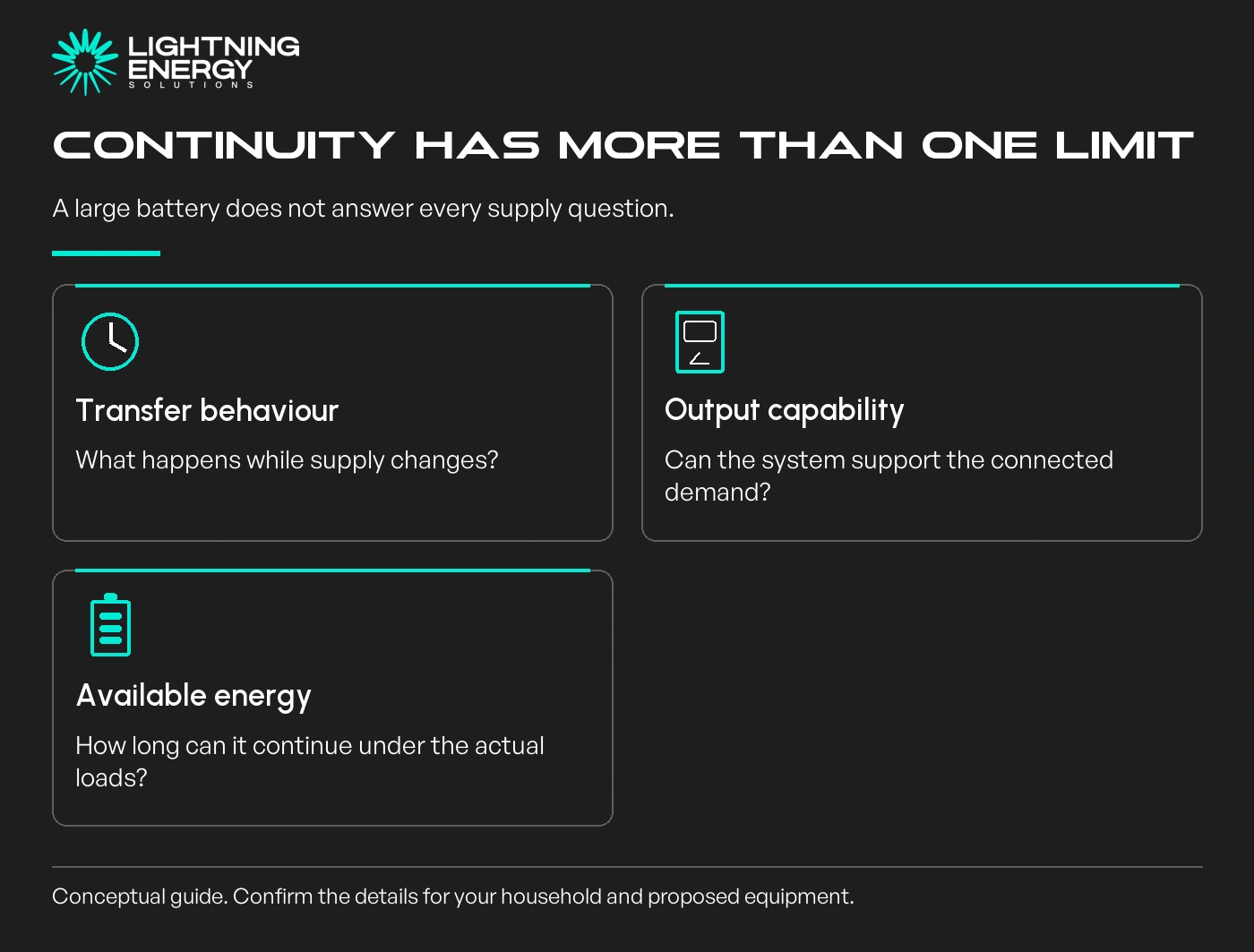
Tesla's Australian outage guidance, for example, discusses the effects of remaining charge, household demand and supported solar. It should not be interpreted as unlimited supply to everything in the home.
Tesla Australian outage guidance.
Make a short list of devices where a reset would cause a real problem. A desktop computer saving work may have different requirements from a refrigerator that can tolerate a brief interruption.
Include the entire chain needed for the task. Keeping a computer on does not preserve an internet connection if the router, network terminal or relevant upstream service is unavailable.
For a hypothetical home office, the goal might be preserving a workstation and local network long enough to save work safely. That is a more useful specification than asking whether the whole house is uninterrupted.
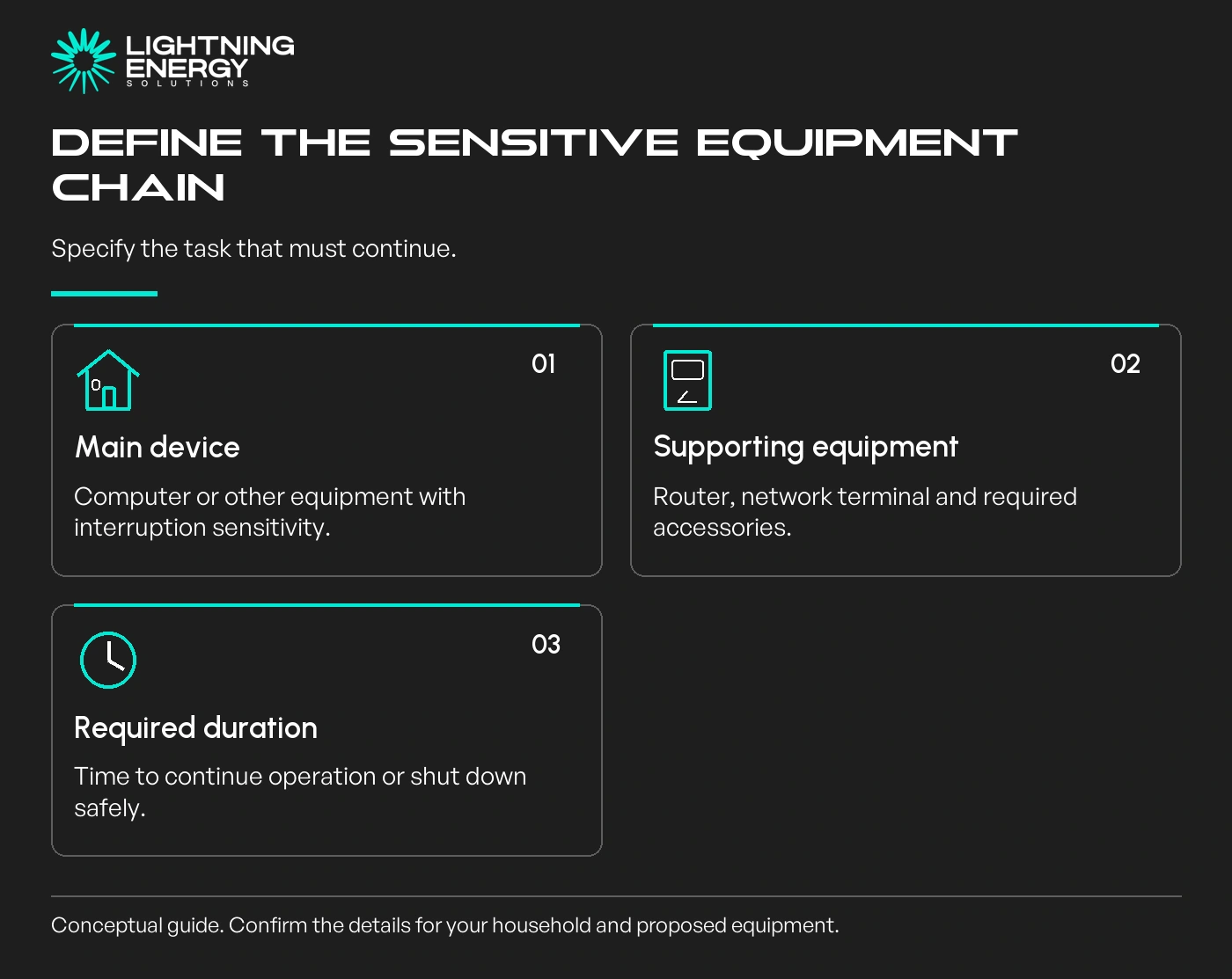
A battery assessment can establish which circuits are supported. The sensitive equipment's manufacturer or a suitable UPS specialist should assess its particular continuity needs.
UPS is not one uniform technology.
Schneider Electric's Australian guidance distinguishes line-interactive products with transfer intervals from named online double-conversion products with no transfer interval during normal online operation.
Schneider Electric UPS transfer guidance.
Check the exact product's output rating, battery runtime, waveform and equipment compatibility. Do not assume that any small desktop UPS can safely support every appliance or a large motor load.
A suitable UPS may address a short interruption while the home battery supplies longer-duration backup. That combination still needs compatibility checked rather than being treated as automatically seamless.
Have the installer explain the documented transfer and recovery process, and arrange any appropriate commissioning demonstration professionally. Do not simulate a grid failure by experimenting with electrical isolation or wiring.
Ask what happens when stored energy is low, a large load starts or the system reconnects to the grid. Check how the sensitive equipment behaves during the relevant supported conditions.
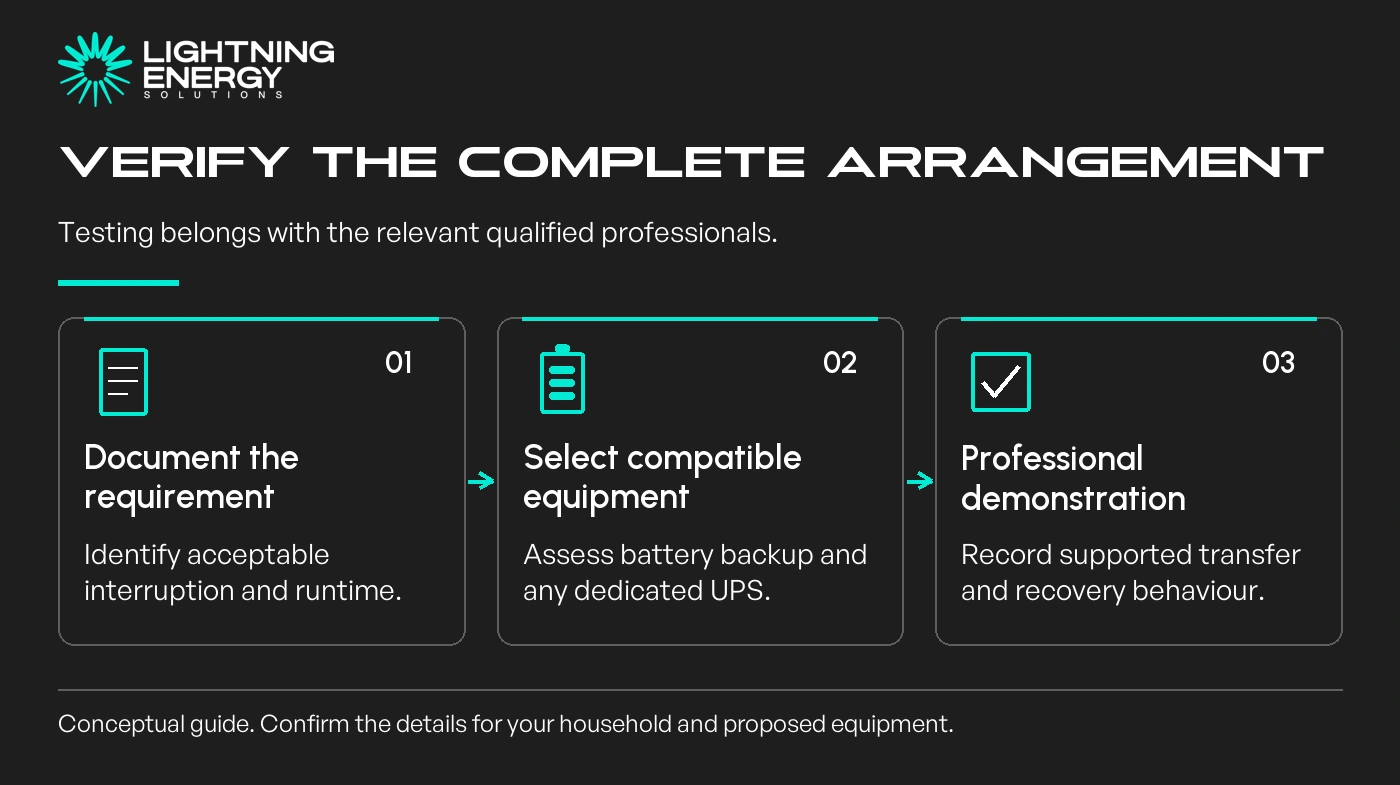
Record what was tested, the connected devices and any limitations. A demonstration under one set of conditions is useful evidence, but not a guarantee covering every future outage.
The battery quote checklist helps put those requirements into the agreed scope.
If a brief reset is merely inconvenient, a conventional supported home-backup arrangement may meet the need. If interruption has serious consequences, obtain a specifically designed continuity solution.
Medical and other critical equipment requires an appropriate plan with its supplier or relevant professional. A general home battery recommendation is not sufficient evidence that the required supply is assured.
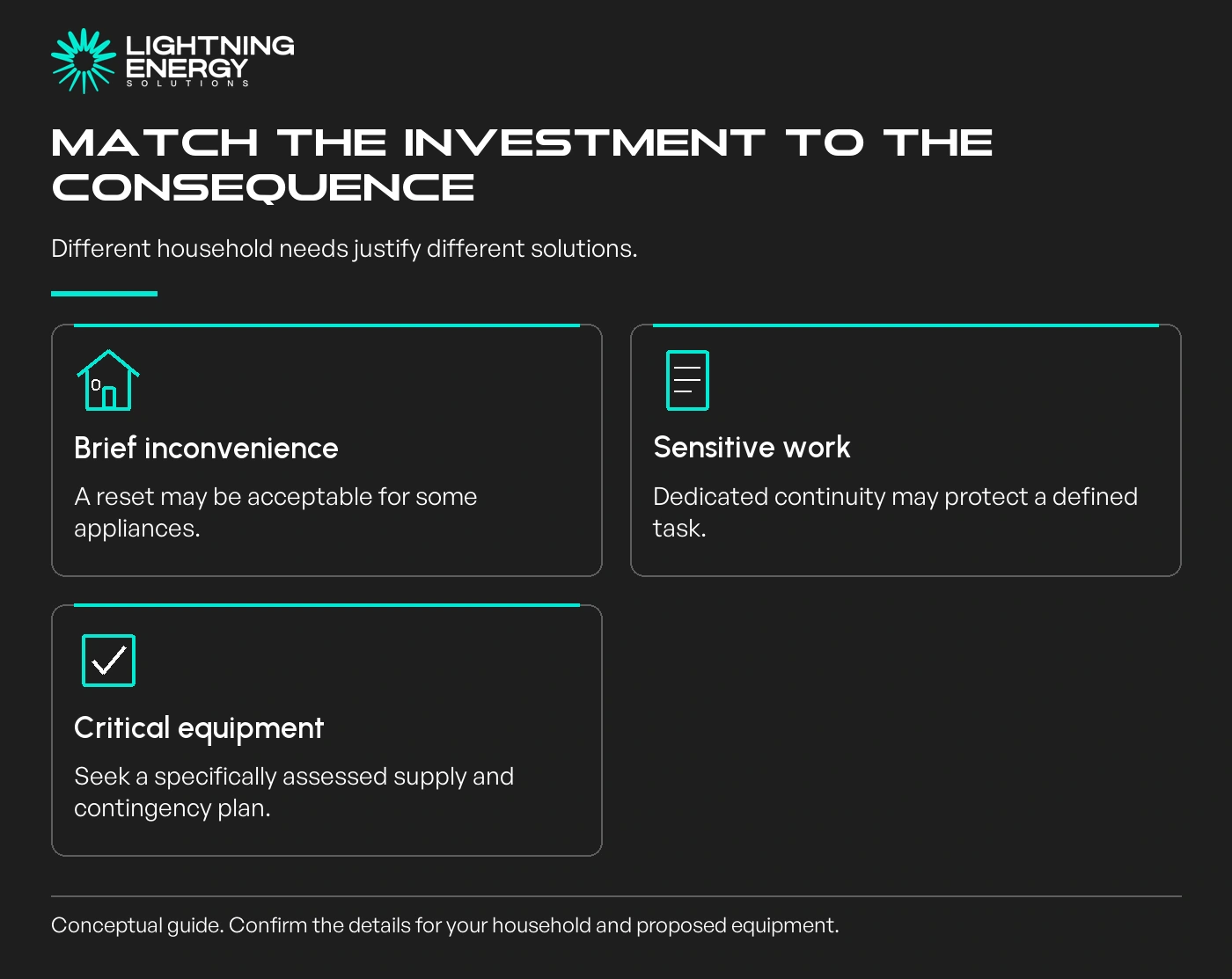
Avoid paying for a large storage system solely to solve a small interruption problem before comparing suitable alternatives. Conversely, a compact UPS should not be assumed to replace the household's longer outage-energy requirement.
Plan your battery upgradeTell us which devices must stay operating and for how long. We can define the home-backup scope and identify where dedicated continuity equipment needs specialist assessment.Available times
Book a consultation and we'll map solar, storage, hot water, and the rebates around your bills and your goals.
Question 1 of 6
