
Why a Charged Home Battery Might Not Discharge During Peak Hours
A charged battery may preserve energy during peak hours for several reasons. Check current data, reserve, schedules and provider control before assuming a fault.
A charged battery may preserve energy during peak hours for several reasons. Check current data, reserve, schedules and provider control before assuming a fault.

A charged battery that does not discharge during an expensive period is not necessarily faulty.
It may be holding a reserve, following a forecast or provider instruction, or operating under a limit that the headline charge percentage does not reveal.
Start by recording a specific event. The time, actual import rate, household load and current operating status are more useful than a general impression that the battery should be doing more.
Check the app's timestamp and connection status. A charge level from the last successful update may not describe what the battery is doing now.
Look at household demand and grid imports during the same interval. If solar is already supplying the load, a lack of battery discharge can be entirely consistent with normal operation.
Our battery overview explains why energy storage and instant power flow are different things.
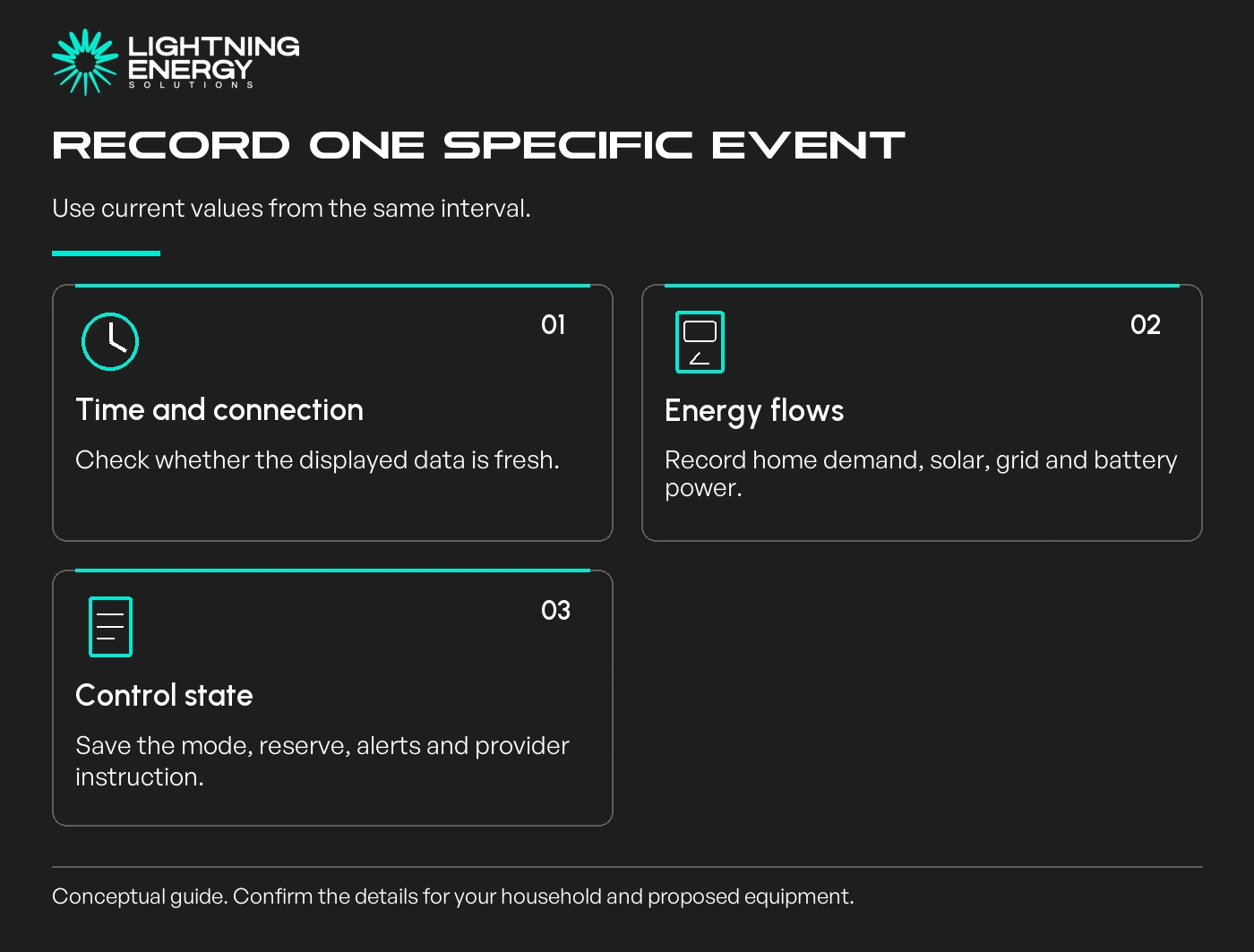
For a hypothetical event log, note: 6.10 pm, 70% displayed charge, 2 kW household demand, 1.8 kW grid import and the named active mode. Those invented details illustrate the evidence needed, not a fault diagnosis.
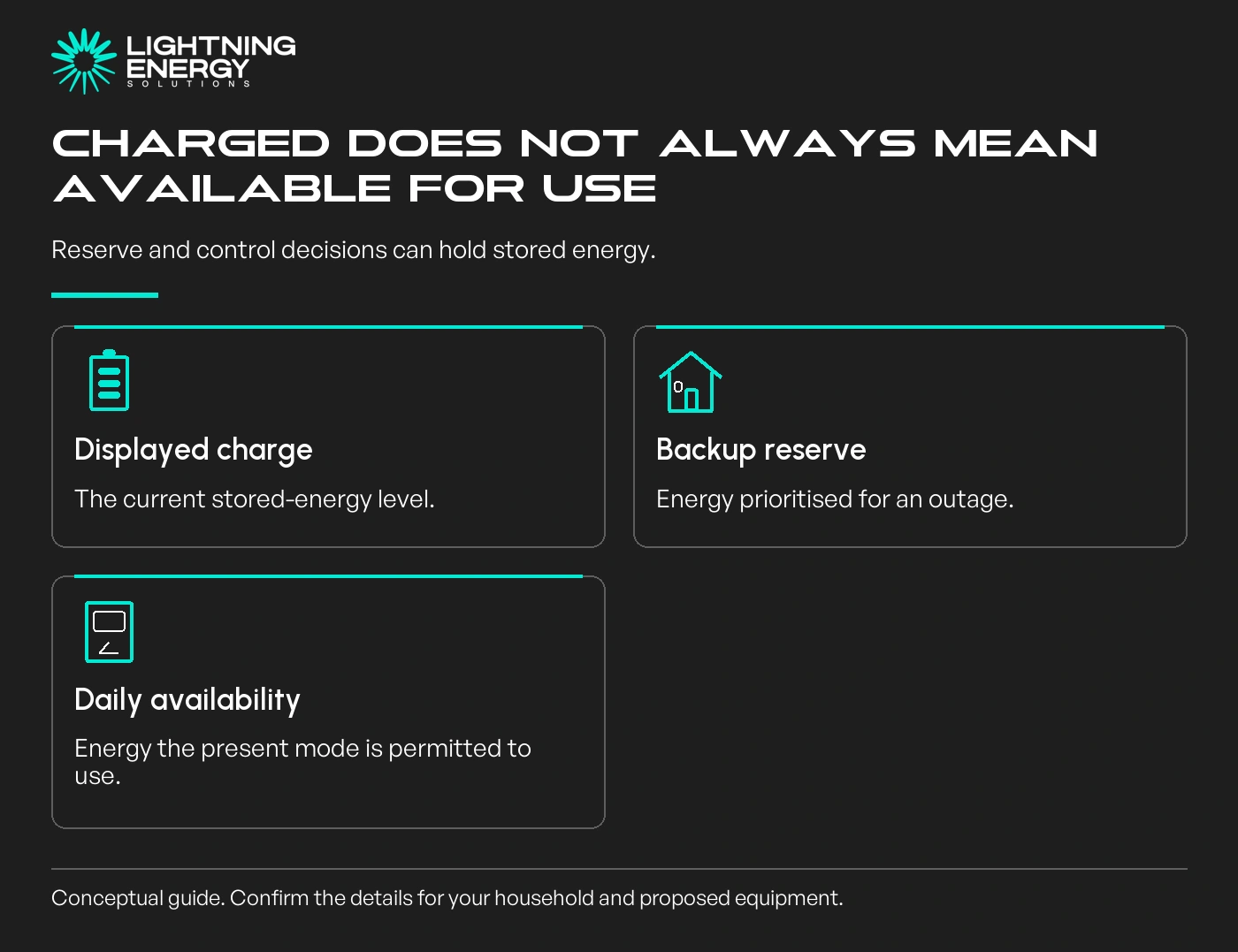
The displayed charge percentage includes energy that may be reserved for outages. A battery at or near its configured reserve may hold that energy while grid power remains available.
Tesla's Australian reserve guide explains the trade-off between outage priority and normal operation. Other products need their corresponding owner guidance checked.
If the household deliberately chose a high reserve for resilience, holding charge may be the intended outcome. Do not lower it without considering the backup requirement it was set to protect.
Our blackout planning guide helps relate that reserve to the actual essential loads.
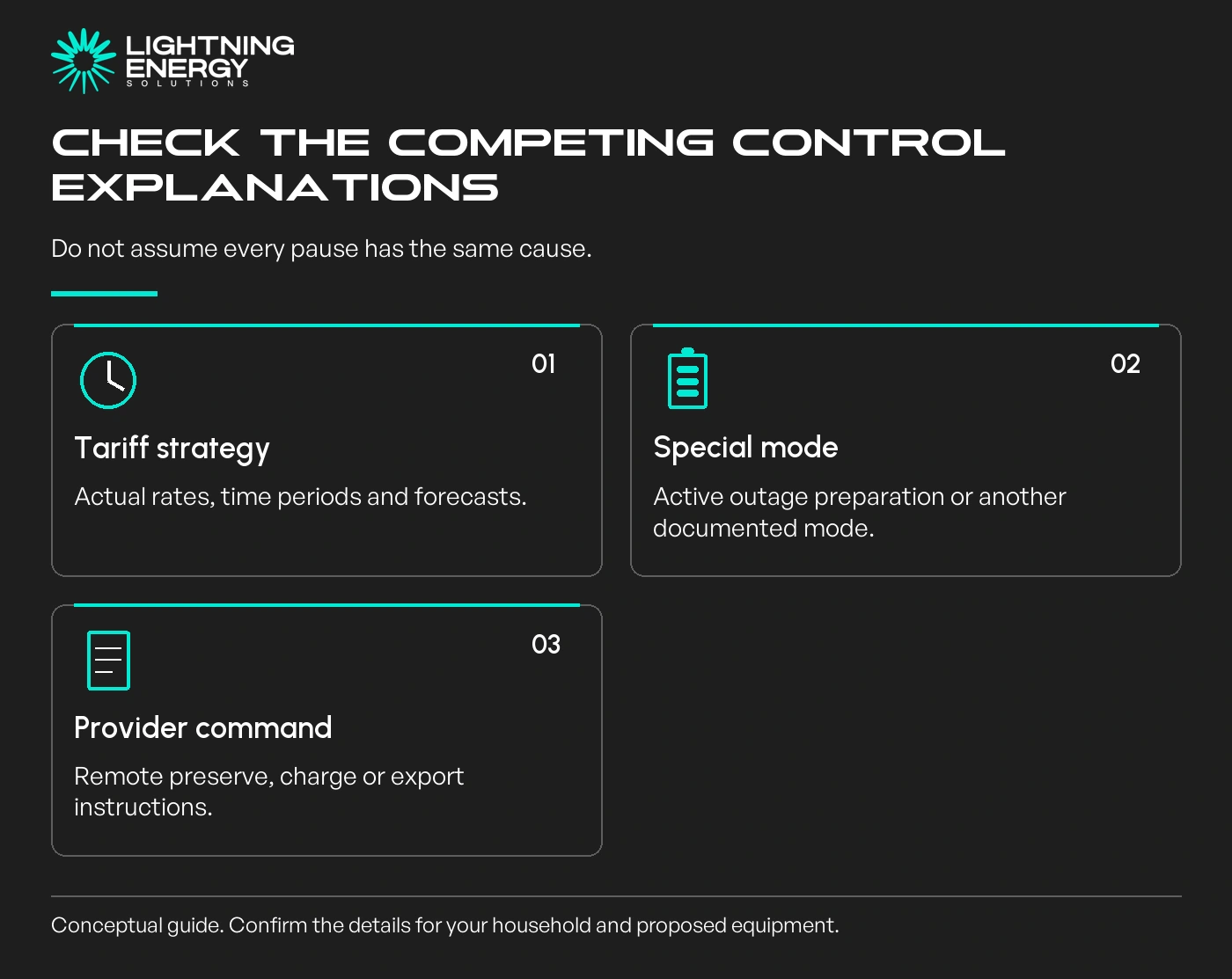
Confirm that the app's tariff periods, seasonal dates and rates match the current retail plan. A clock-based peak on one plan is not necessarily the same period used by another retailer or a wholesale service.
Tesla's Savings mode uses forecasts and tariff information. It can make decisions across a period rather than simply emptying the battery as soon as a price looks high.
Tesla Australian Savings mode guidance.
Also check any active special mode. Tesla's Storm Watch, for example, can prioritise preparing stored energy for an outage when activated, changing the ordinary bill-saving behaviour.
Tesla Australian Storm Watch guidance.
If a provider manages the battery, review its current plan and event history. A local mode setting may not describe every command being sent by the service.
Amber explains that SmartShift can preserve charge based on forecasts and that remote commands may not take effect immediately. That is a specific service explanation, not proof that every unexplained pause is correct.
Our VPP overview sets out why control permissions matter. Ask the provider to explain the recorded event against its actual rules.
If reserve, solar contribution and active controls do not explain the behaviour, give the installer the event record and any alerts. Output limits, equipment conditions or measurement issues need a professional diagnosis.
Do not alter protected inverter or network settings, move measurement hardware or repeatedly reset the system to force a result. Those changes can obscure the original issue or affect safe operation.
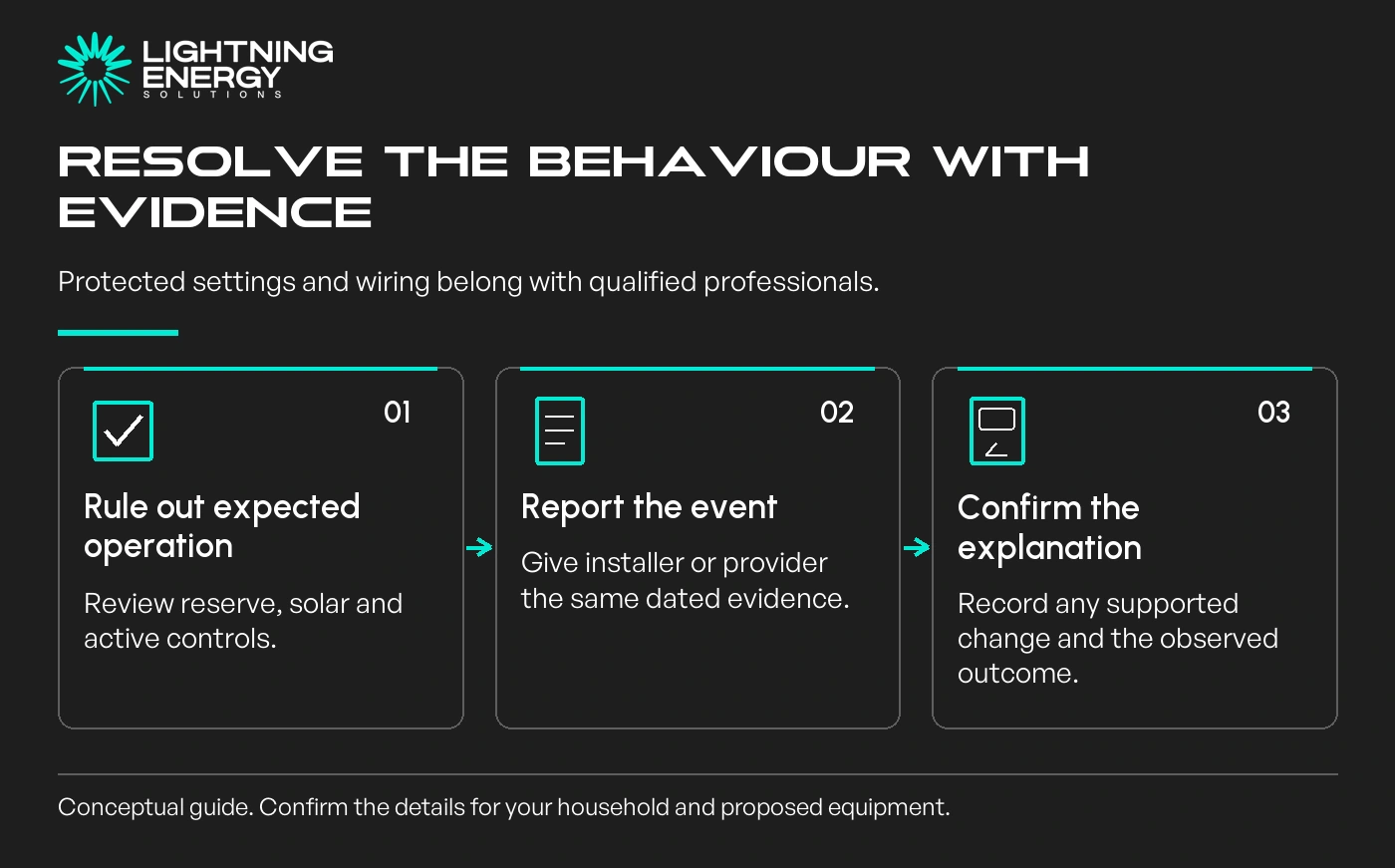
Record any support-directed change and compare subsequent equivalent periods. A useful resolution explains why the behaviour occurred and whether it was intended, rather than merely clearing an app message.
Plan your battery upgradeSend a dated event record with the active mode, reserve, tariff and provider details. We can assess the installation-related questions and identify any control decision the provider needs to explain.Available times
Book a consultation and we'll map solar, storage, hot water, and the rebates around your bills and your goals.
Question 1 of 6
