6.6 vs 10 vs 13.3 kW Solar: Which Size Fits Your House
6.6, 10 and 13.3 kW aren't marketing tiers, they're the panel-side result of a real inverter rule. Here's how to match roof, phase and usage to the right size instead of defaulting to the biggest.
LLukeLightning Energy21 September 2026 · 10 min read
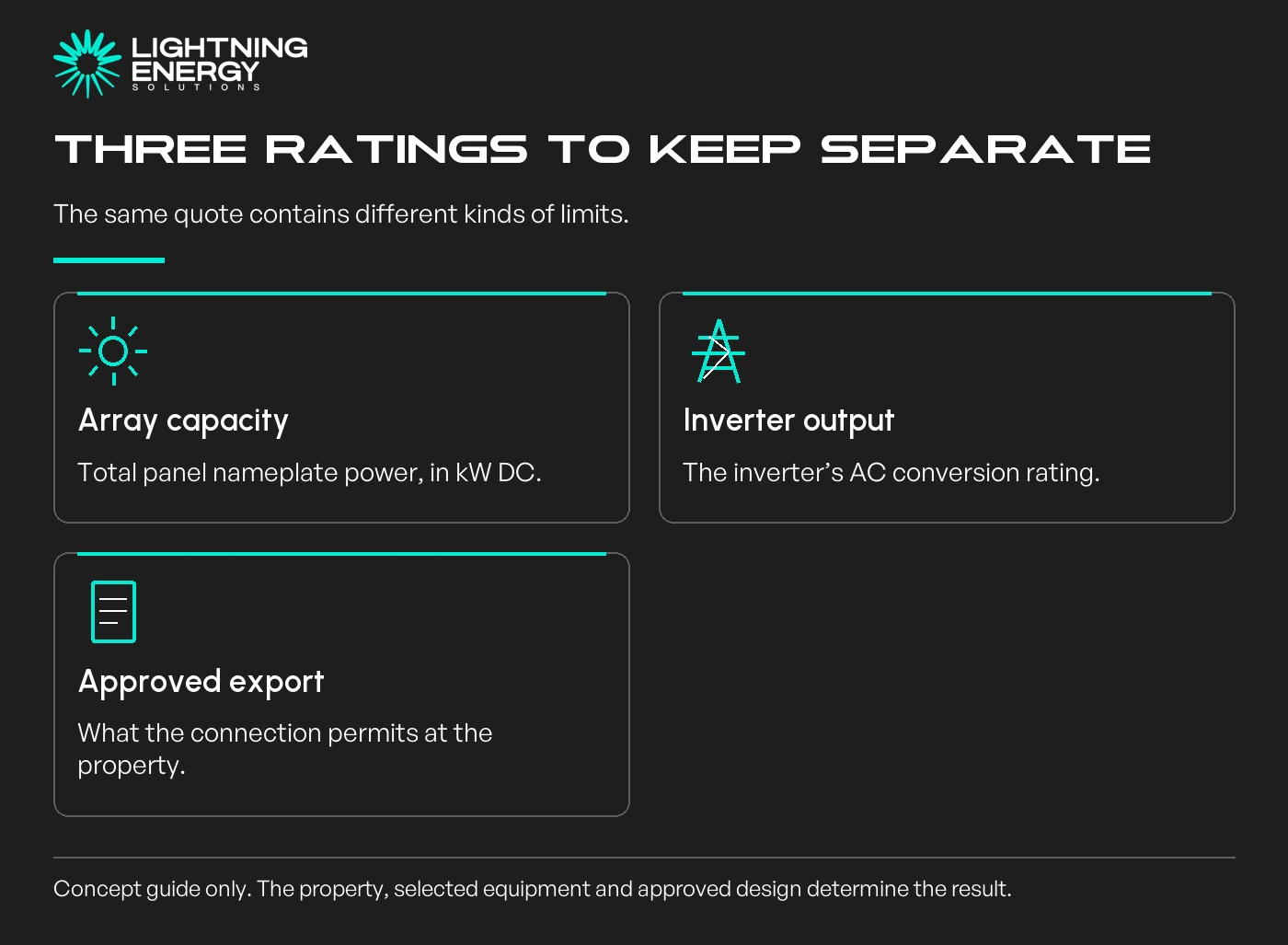
Residential quotes often use capacities such as 6.6 kW, 10 kW and 13.3 kW. These describe the panel array’s DC nameplate capacity; the inverter’s AC rating is a separate number.
Panel ratings, inverter selection and the supported design determine the quoted combination.
Why these three numbers exist
A solar array can have a different DC nameplate capacity from the inverter’s AC rating. Check the applicable design guidelines, manufacturer limits and connection conditions for the actual configuration.
A 6.6 kW array paired with a 5 kW inverter is a familiar example, but it is not a rule that determines every installation.
Likewise, a 10 kW or 13.3 kW array does not automatically require one particular inverter rating. The designer must assess the supported arrangement.
Compare both the array capacity and inverter output on each quotation.
The panel array’s DC nameplate capacity is a valid capacity measure. It should be distinguished from AC output and estimated annual energy rather than described as unreal.
So the real decision was never "6.6, 10 or 13.3". It was always "which inverter does my house need", and the panel number just follows.
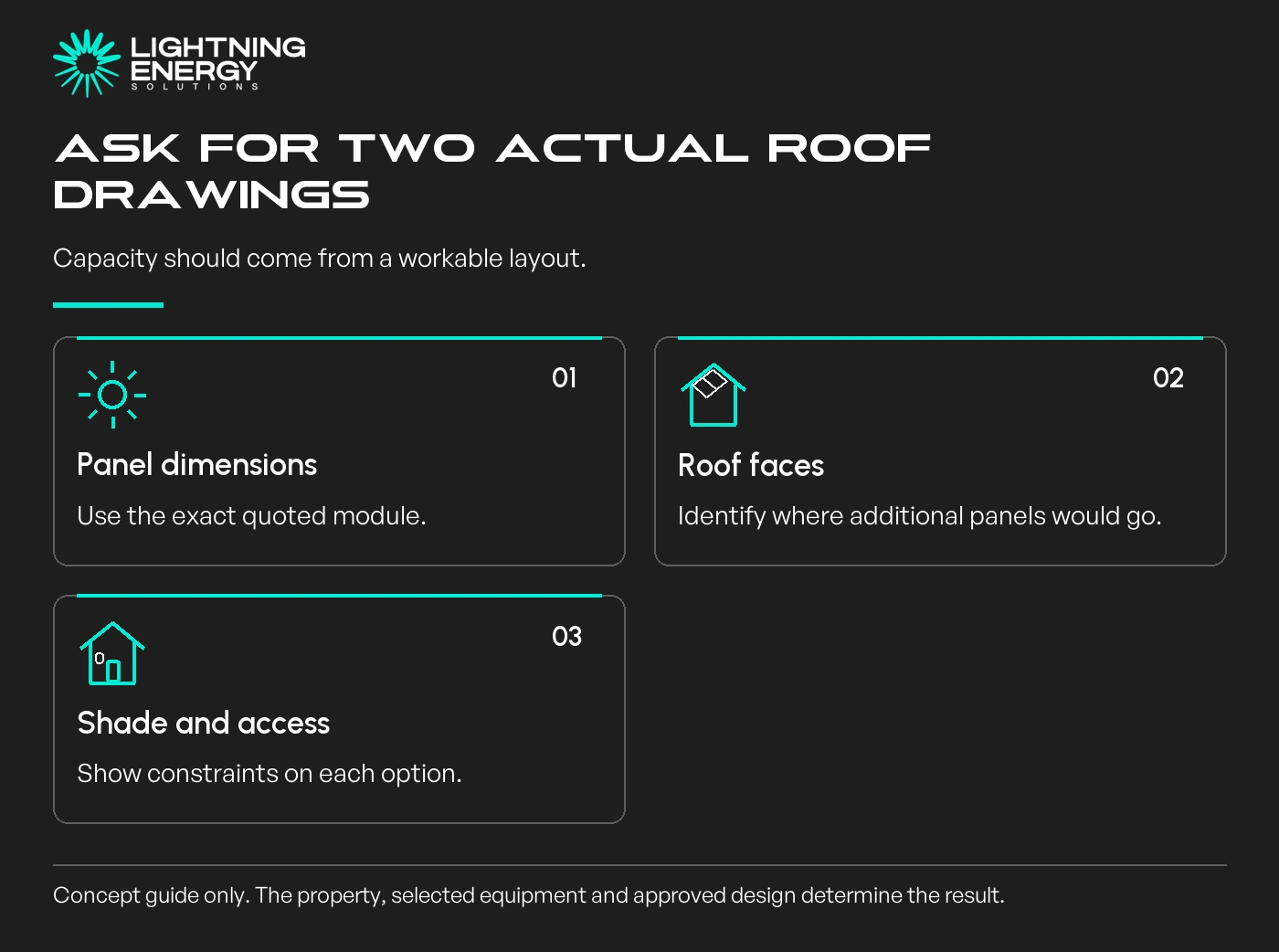
Does it physically fit your roof?
Before budget or export limits matter, does the roof have the room?
Using a rough 2 square metres per panel, a 6.6kW system typically needs roughly 28 to 32m² of usable roof.
A 10kW system typically needs roughly 44 to 50m². A 13.3kW system typically needs roughly 60 to 70m².
Usable is the key word. A hip roof with four small faces, a chimney in the middle, and a tree shadow across the northern third loses area fast.
Roofs that look generous from the street often turn out tight once you subtract shading and awkward planes.
Multiple small roof planes waste space at the edges where a full panel row won't fit
Shading from next door's tree or your own second storey rules out entire sections, not just the shaded panel
Tile roofs generally take longer to install than Colorbond, which affects labour cost more than panel count
North-facing area matters more than total roof area; east and west can help but produce less over the day
If your roof genuinely can't reach 44m² of clean, unshaded space, a 10kW system isn't really on the table regardless of what you'd like your bill to look like. That's a roof constraint, not a compromise.
Does it match what you actually use?
A typical household using around 15kWh a day is well served by a 6.6kW system. That covers most single-phase homes with normal daytime habits and no big new electric loads on the horizon.
A fully electrified household (solar, battery, heat pump, induction cooktop and an EV charging at home) can use closer to 37kWh a day, per one industry estimate citing Rewiring Australia's modelling (https://solarcalculator.com.au/solar-system-size/2024).
That's the profile where 10kW to 13.3kW starts to make sense, not because bigger is safer, but because the load genuinely needs it.
If you're still cooking on gas, heating with a split system or two, and don't have an EV in the driveway or the budget for one this year, jumping straight to 13.3kW is buying capacity you won't use for years, if ever.
The Victorian export limit reality check
Export conditions depend on the network and connection offer. For example, AusNet’s flexible-export guidance describes limits depending on available capacity; do not assume every Victorian property receives the same limit.
Ask for the approved export limit and any flexible or emergency-control conditions for the property.
An export limit differs from the permitted inverter and array size. A larger array on a single-phase property still requires a supported design and the relevant connection approval.
Anything generated above what your house uses and what the grid will accept gets curtailed, essentially wasted, unless you're storing it.
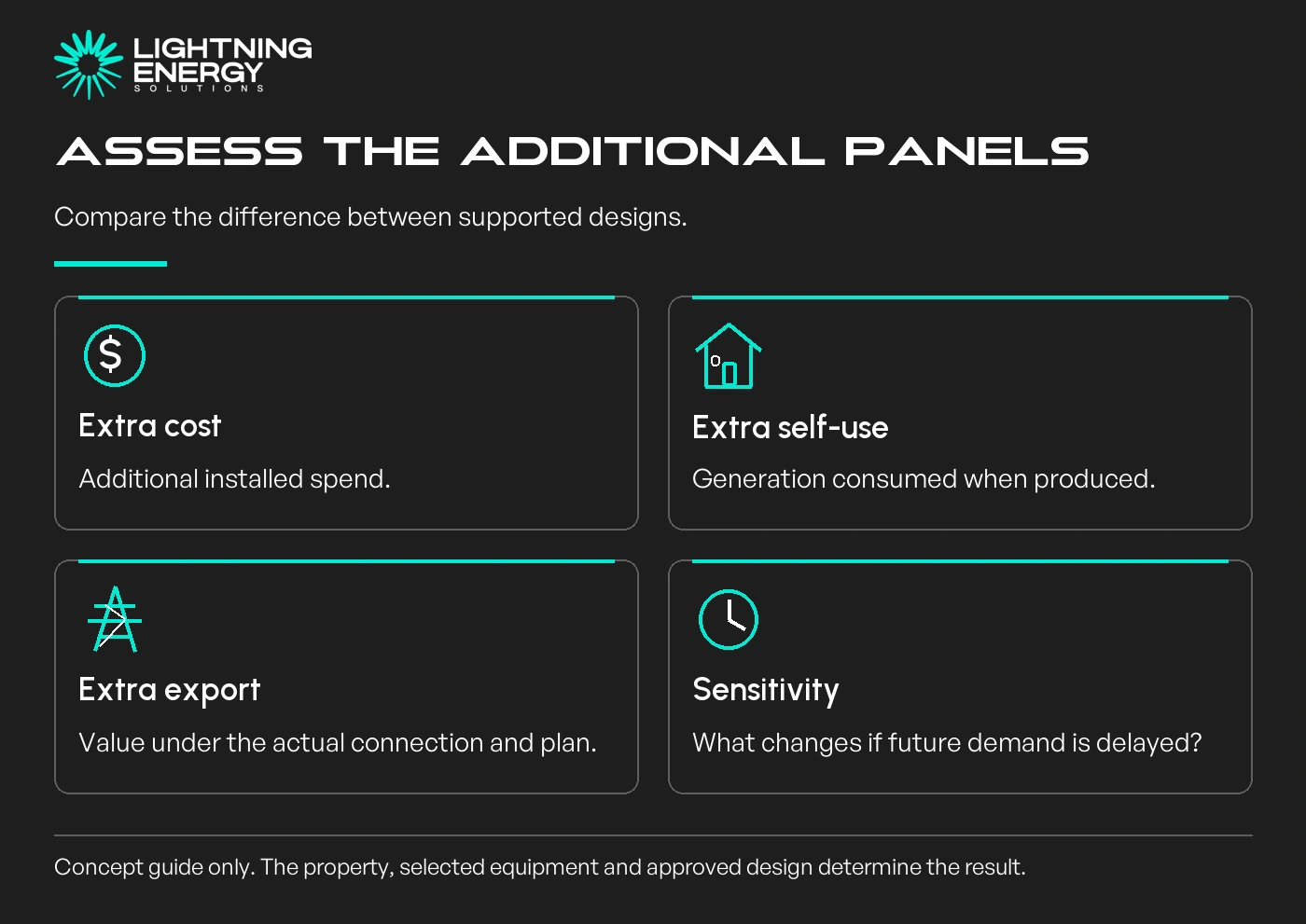
Curtailment depends on generation remaining after onsite use and any storage charging, compared with the allowed export. Estimate its annual effect using the proposed design, household demand and tariff rather than a generic dollar loss.
Phase type needs checking before sizing past 6.6kW, because it genuinely changes the economics, not the eligibility.
For the mechanics of how export limits and inverter throttling work more broadly, this explainer (/blog/solar-export-limits-inverter-throttling) covers the general principle.
What it means for your wallet, roughly
Victoria's minimum feed-in tariff was deregulated from 1 July 2025. Retailers now set their own rate, with a floor of $0.00/kWh.
The ESC had determined a 0.04-cent flat minimum for 2025–26 before the subsequent deregulation. Victoria’s current explanation confirms the change from 1 July 2025; that determination is not a current mandatory household rate.
Compare that to the retail import price you're avoiding by using your own solar directly, typically in the range of 26 to 35 cents per kilowatt-hour on the Victorian Default Offer.
Self-consumed solar is worth roughly five to ten times more than exported solar right now. That single fact should drive your sizing decision more than anything else.
~0.04c/kWh vs 26-35c/kWhFeed-in credit vs avoided retail costIllustrative Victorian figures for 2025-26. Self-use is worth far more than export under current settings, which favours matching system size to actual daytime consumption rather than maximising panel count.
Using illustrative assumptions (roughly 1,400kWh per installed kW per year of Melbourne yield, current import and export rates, and mid-range installed costs), simple payback works out to around 3.6 years for 6.6kW, 5 years for 10kW, and 5.6 years for 13.3kW.
Those paybacks assume self-consumption of roughly 55%, 40% and 32% for the three sizes respectively. Those percentages are our own modelling assumptions, not measured Victorian averages, and they'll vary a lot by household usage pattern, roof orientation and shading, and whether you pair the system with a battery or EV.
Bigger systems generate more total value over their life, but the payback per dollar spent gets slower unless you protect self-consumption with a battery, EV charging, or genuinely higher daytime loads.
Rebates: bigger systems don't mean bigger rebates across the board
Solar Victoria's rebate is flat: typically up to $1,400 towards the cost, regardless of whether you install 6.6kW or 13.3kW, plus an optional interest-free loan of up to $1,400 repaid over four years.
To qualify you generally need to be the owner-occupier, have a property valued under $3 million, and not have claimed a rebate at that address before.
The combined household income threshold has recently changed, and because that figure moves, it's covered together with the other changing numbers below rather than stated here.
The federal STC discount does scale with size, typically ranging from around $1,500 for a 5kW system to around $3,500 for a 10kW system in 2026, per SEC Victoria (https://www.secvictoria.com.au/households/help-centre/rebates-and-discounts/solar-rebates).
STC values move with certificate prices and step down under the scheme's deeming schedule each January, so those figures are indicative for 2026 and can shift.
A bigger system attracts a bigger STC discount in dollar terms right now, even though as a percentage of total spend it usually shrinks.
Melbourne's postcode zones are split for STC purposes. Many inner and middle-ring postcodes sit in Zone 4 (a lower rating), while Sydney and Adelaide are mostly Zone 3. Some outer suburban and regional Victorian postcodes fall into different zones again.
The Clean Energy Regulator's postcode table (https://cer.gov.au/document/postcode-zone-ratings-and-zones-solar-panel-systems) lists every postcode. Practically, most Melbourne metro addresses earn a smaller STC discount than an identical system in Sydney or Adelaide.
Future-proofing without overbuying
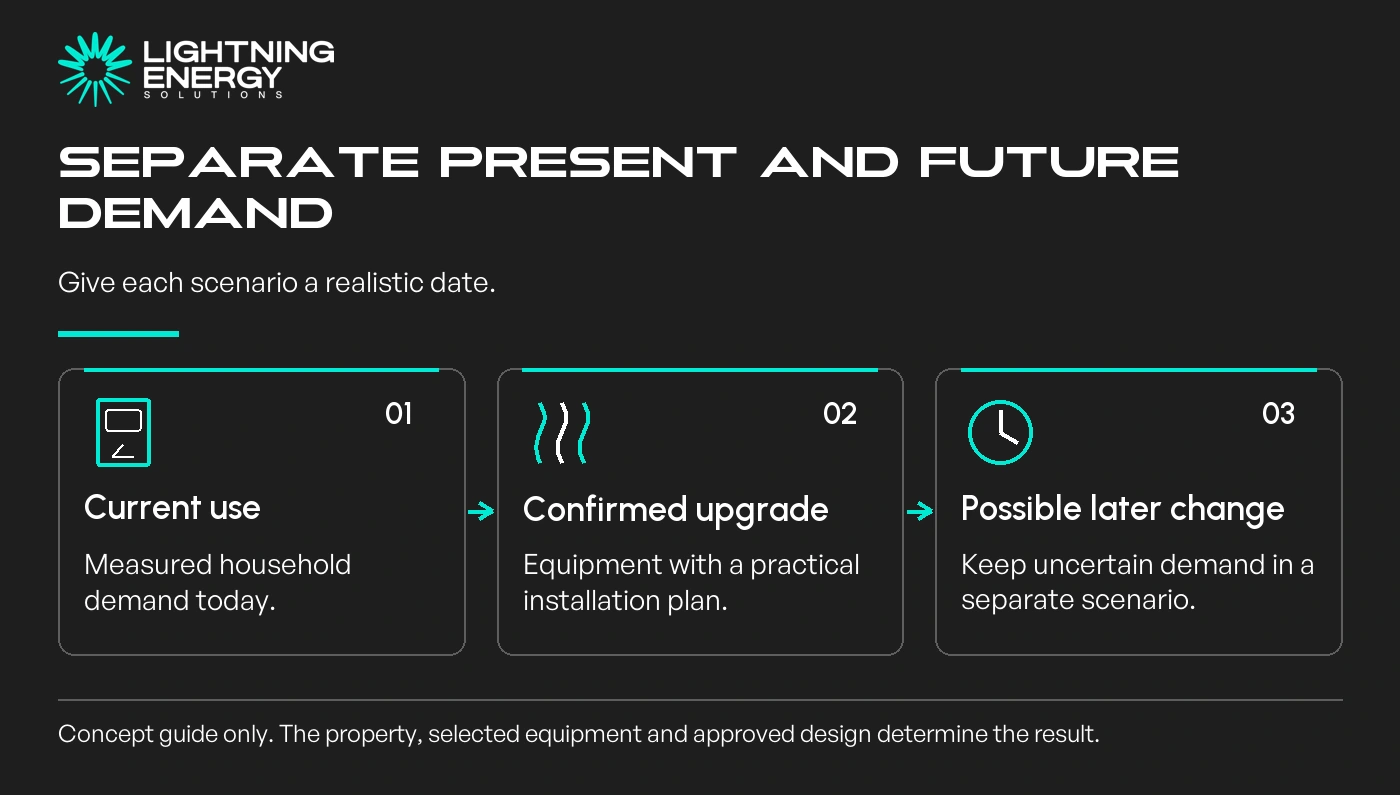
If an EV or heat pump is firmly on your two-year horizon, it's often worth sizing a hybrid-capable inverter and slightly more panel capacity now rather than retrofitting later.
Swapping an inverter down the track means paying for the labour twice, and new-build pricing is usually kinder than a retrofit.
But "we might get an EV eventually" isn't a plan, it's a maybe. Sizing for what you know is coming in the next year or two avoids paying upfront for capacity that may never get used.
For the fuller electrification picture, including how batteries, heat pumps and EV chargers stack together, this article (/blog/home-electrification-australia-solar-battery-heat-pump-ev) covers the strategy end of it.
This one (/blog/best-home-battery-australia-2026-how-to-choose) covers picking a battery to catch what a bigger system would otherwise curtail.
My honest recommendation
Most single-phase homes without electrification plans stick with 6.6kW and don't regret it. The ones that stretch to 10kW or 13.3kW are usually already running an EV charger or a pool pump, or have a battery genuinely on the way.
The ones that go bigger without those loads tend to end up paying for panels that spend a lot of the day curtailed.
If you're a typical household on single-phase power, decent but unremarkable daytime usage, and no firm electrification plans, 6.6kW remains the sensible default. It fits most roofs, sits comfortably under the export cap, and pays back fastest under current feed-in settings.
If you're already running a pool pump, working from home most days, or have a battery or EV genuinely planned for the near term, 10kW earns its keep, provided your roof has the space and you understand you'll be exporting into the cap regularly on single-phase.
13.3kW is a load-driven decision, not an aspirational one. It suits larger households stacking an EV, heat pump and battery together, ideally on three-phase power where the export ceiling isn't constantly in the way. It shouldn't be treated as a safety margin if there aren't firm plans for those loads.
Is now the right time?
STC values step down each January as the scheme winds toward its 2030 close, so waiting doesn't generally help the federal rebate side.
Victoria's income eligibility threshold for the rebate has changed recently, so if you're near that line, timing matters more than usual. See the rebates section above for how we'll check your current eligibility.
Beyond the rebate calendar, the right time is whenever your roof, phase type and actual usage are properly assessed, not whenever a sales call creates urgency. Get those three things checked before you pick a number.
For a full breakdown of what each size typically costs installed across different states, this cost comparison (/blog/solar-panel-cost-2026-melbourne-sydney-adelaide) has the current ranges and rebate estimates.
Book a consultation and we'll map solar, storage, hot water, and the rebates around your bills and your goals.
Loading consultations…
Lightning EnergyPlan your next energy upgrade.
⚡
Hi, I’m Lightning Energy’s project guide. I’ll ask a few practical questions, explain what usually matters for your project, and help you decide on a useful next step — no guesswork or sales pressure.
First, what kind of property are we planning for?