Can Your Pool Pump Use More of Your Daytime Solar?
A pool pump can be a useful daytime solar load, especially when its current schedule sits outside the sunny part of the day. The right change starts with the pool's filtration requirements, then tests whether spare generation is available.
LLightning Energy TeamLightning Energy27 October 2026 · 5 min read
A pool pump can be a useful daytime solar load, especially when its current schedule sits outside the sunny part of the day. The right change starts with the pool's filtration requirements, then tests whether spare generation is available.
Moving a timer is not a reason to reduce necessary filtration or sanitation. Ask your pool professional to confirm the operating requirements before changing the schedule, speed or equipment.
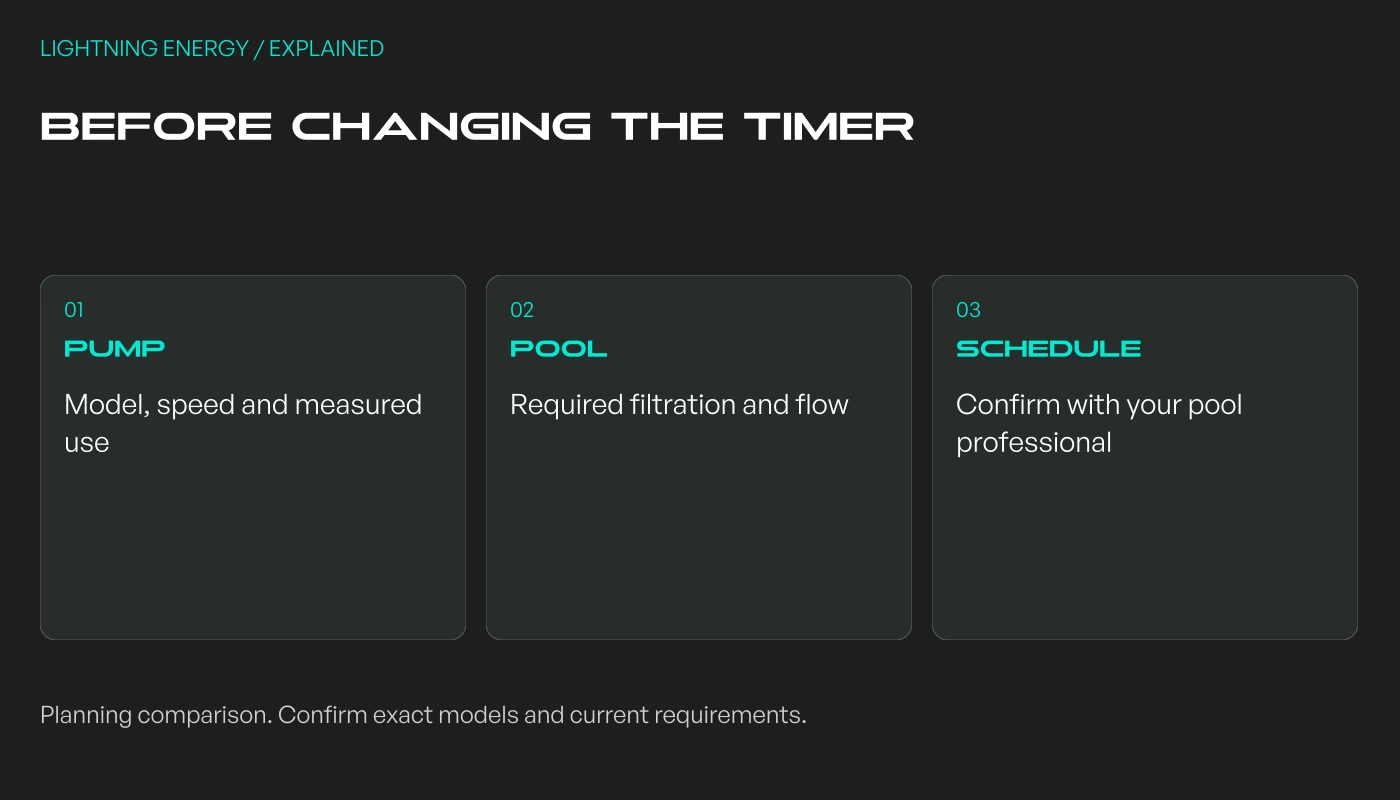
Find out what the pump actually uses
Record the pump model, speed settings, daily operating periods and measured electricity use where available. A nameplate rating alone will not describe every variable-speed operating mode.
The Australian Government's pool-pump guide explains the efficiency advantages of variable-speed and multi-speed equipment. The appropriate speed and run time still depend on the pool and its equipment.
Check whether heating, cleaning or a chlorinator requires particular flow conditions. A low-speed setting that looks economical on paper may not support every connected function.
Planning comparison. Confirm exact models and current requirements.
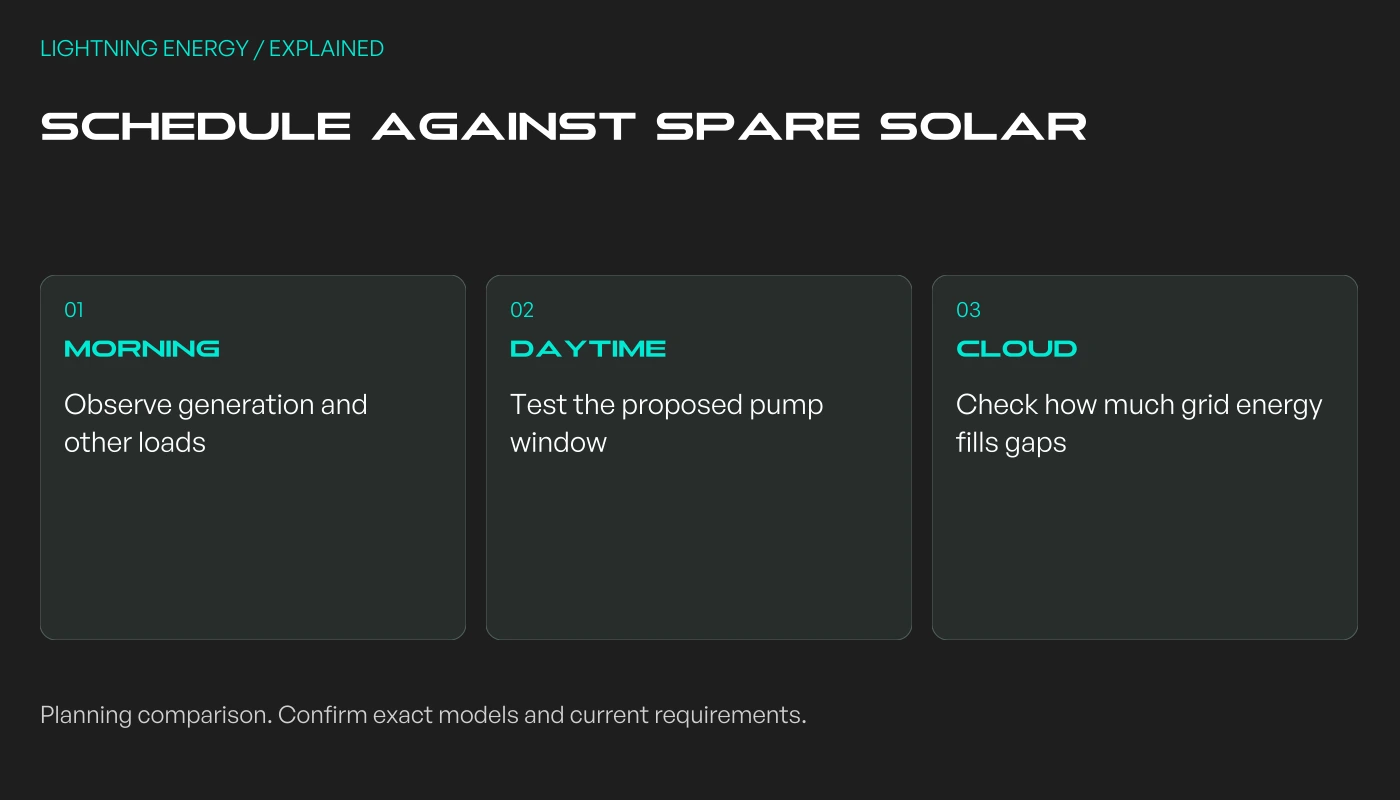
Look for surplus during the proposed hours
Your solar system may already be supplying cooking, cooling, hot water or other appliances at midday. Compare the pump's proposed window with exports, rather than assuming all panel generation is spare.
Use several ordinary sunny and cloudy days. A schedule that works on one clear summer day may behave differently during winter, heavy cloud or a busy weekend at home.
If you have a battery, include it in the comparison. Electricity sent to the pump cannot simultaneously be counted as charging the battery or earning a feed-in credit.
Planning comparison. Confirm exact models and current requirements.
Compare the avoided cost with the opportunity cost
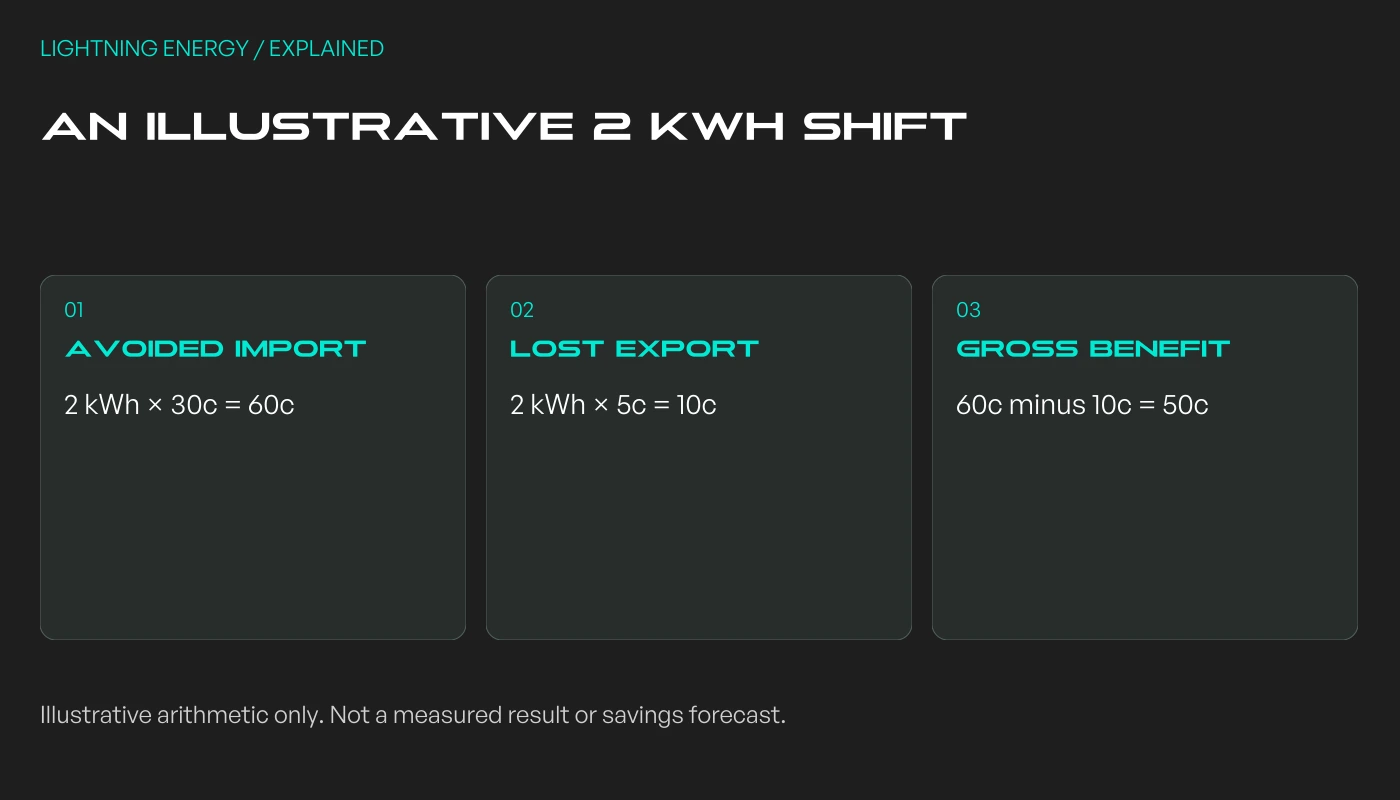
Here is invented arithmetic, not a savings forecast. Suppose 2 kWh of pump use moves from grid electricity costing 30 cents per kWh to solar that would otherwise earn 5 cents per kWh as exports.
The avoided import cost is 60 cents. The foregone export credit is 10 cents. The gross difference is 50 cents for that shift, before any other consequences or tariff conditions.
The result changes if the old schedule used a cheaper controlled-load rate, if daytime imports fill a solar shortfall, or if battery charging would otherwise have been more valuable. Use the rates on your own bill.
Victoria's solar-use guidance provides background on using generation at home. The figures above are ours solely to illustrate the calculation.
Illustrative arithmetic only. Not a measured result or savings forecast.
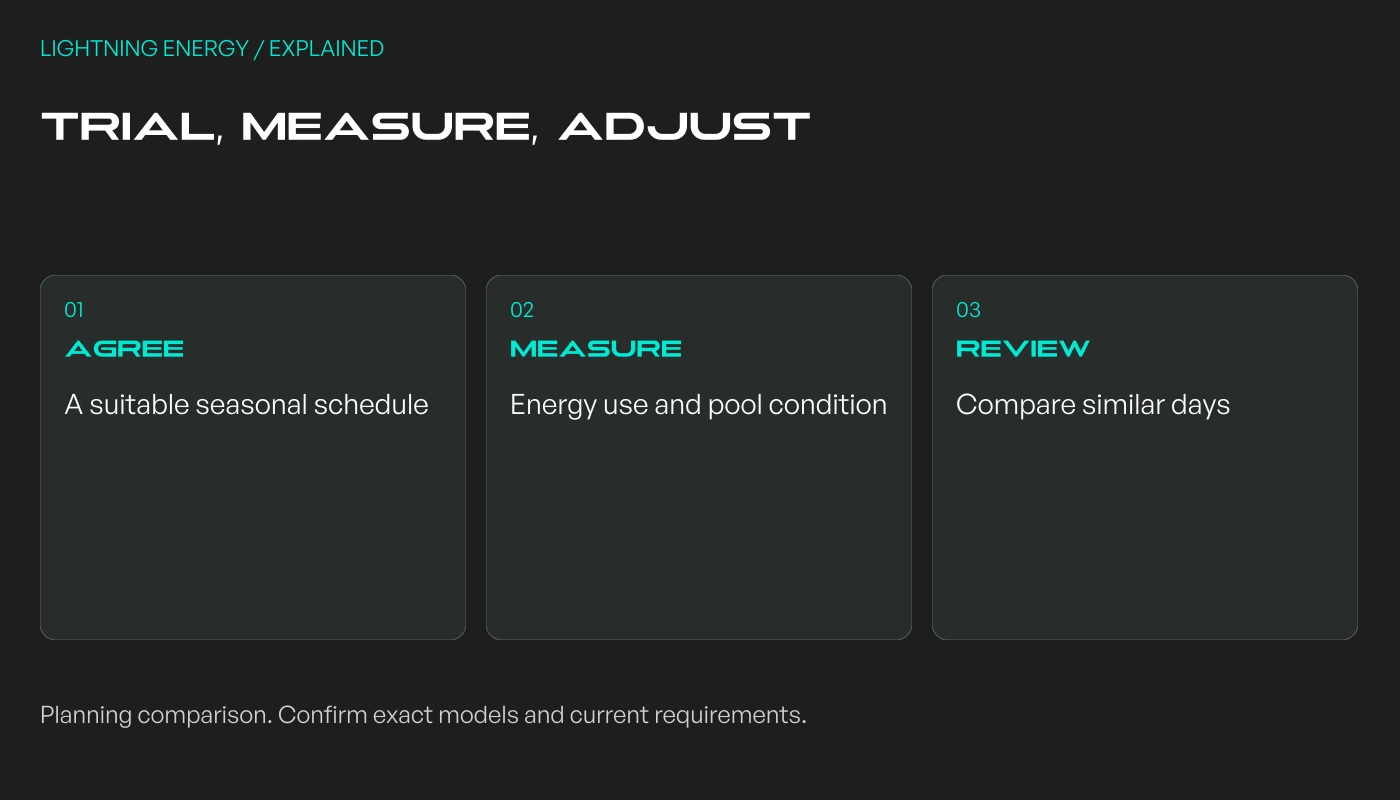
Make a measured scheduling change
Ask the pool professional for a suitable trial schedule, including seasonal needs. Keep a record of the settings, pool condition and electricity use so the change can be assessed rather than guessed.
South Australia's pool and spa energy advice also highlights maintenance and appropriate equipment operation. Clean filters and a suitable cover can matter alongside the timer.
If a circuit, controlled-load connection or electrical controller needs alteration, use a qualified electrician. This article is an operating-plan discussion, not instructions to change pool wiring.
Consider other flexible loads, including heat-pump hot water, in the same daytime plan. Staggering loads may be more useful than scheduling everything to start together.
Planning comparison. Confirm exact models and current requirements.
Decide whether replacement is necessary
A functioning pump may only need a better schedule. A replacement decision should compare measured use, pool compatibility, installation cost and support, rather than treating a solar-friendly label as proof of savings.
Ask for the proposed speed settings and operating assumptions with the quote. After installation or scheduling changes, compare similar weather and pool-use periods and keep water quality as a non-negotiable requirement.
Contact Lightning Energy with your solar monitoring, tariff and pump details to discuss the electrical side of the plan. Have the pool specialist confirm filtration requirements. Sources checked 27 October 2026.
Book a consultation and we'll map solar, storage, hot water, and the rebates around your bills and your goals.
Loading consultations…
Lightning EnergyPlan your next energy upgrade.
⚡
Hi, I’m Lightning Energy’s project guide. I’ll ask a few practical questions, explain what usually matters for your project, and help you decide on a useful next step — no guesswork or sales pressure.
First, what kind of property are we planning for?