
Turnbull’s EV and Battery Means-Test Call: What It Means for Buyers
Turnbull wants EV and battery subsidies means tested. What has changed, what the proposed $75,000 EV threshold means, and what Australian buyers should check.
Turnbull wants EV and battery subsidies means tested. What has changed, what the proposed $75,000 EV threshold means, and what Australian buyers should check.

Could your income decide whether you receive support for a home battery or an electric car?
Malcolm Turnbull has put that question back into the national debate.
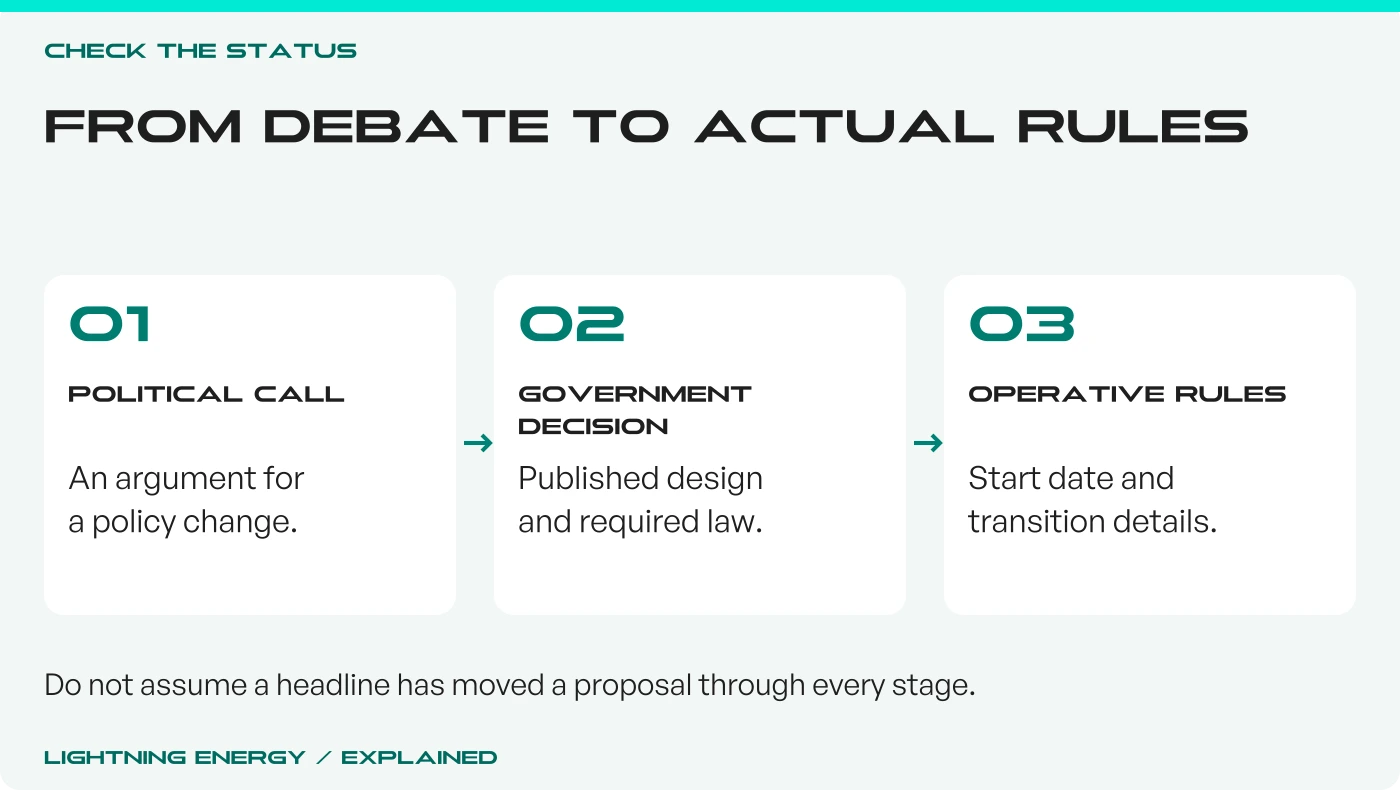
A call for means testing, however, does not itself introduce an income limit.
As checked on 13 November 2026, we have not found an adopted federal household-income test arising from this report.
The useful distinction is between the political proposal, separate EV tax changes already being pursued, and the rules applying to a purchase today.
The Australian Financial Review report by Michael Read, dated 12 November, reports that former prime minister Malcolm Turnbull urged the government to means test or scrap EV and home battery subsidies.
That is the proposal behind the headline circulating on social media. It should be described as a call for a policy change, rather than an announcement that households above a particular income have lost eligibility.
We have not verified a proposed income threshold, assessment method or start date attached to Turnbull’s call.
This article uses the report’s accessible headline and introduction, then checks official sources for the practical rules.
We have not relied on access to the full paywalled report.
For the earlier Treasury savings debate, read our battery rebate review explainer.
Here, the focus is specifically means testing and the difference between battery support and EV tax concessions.
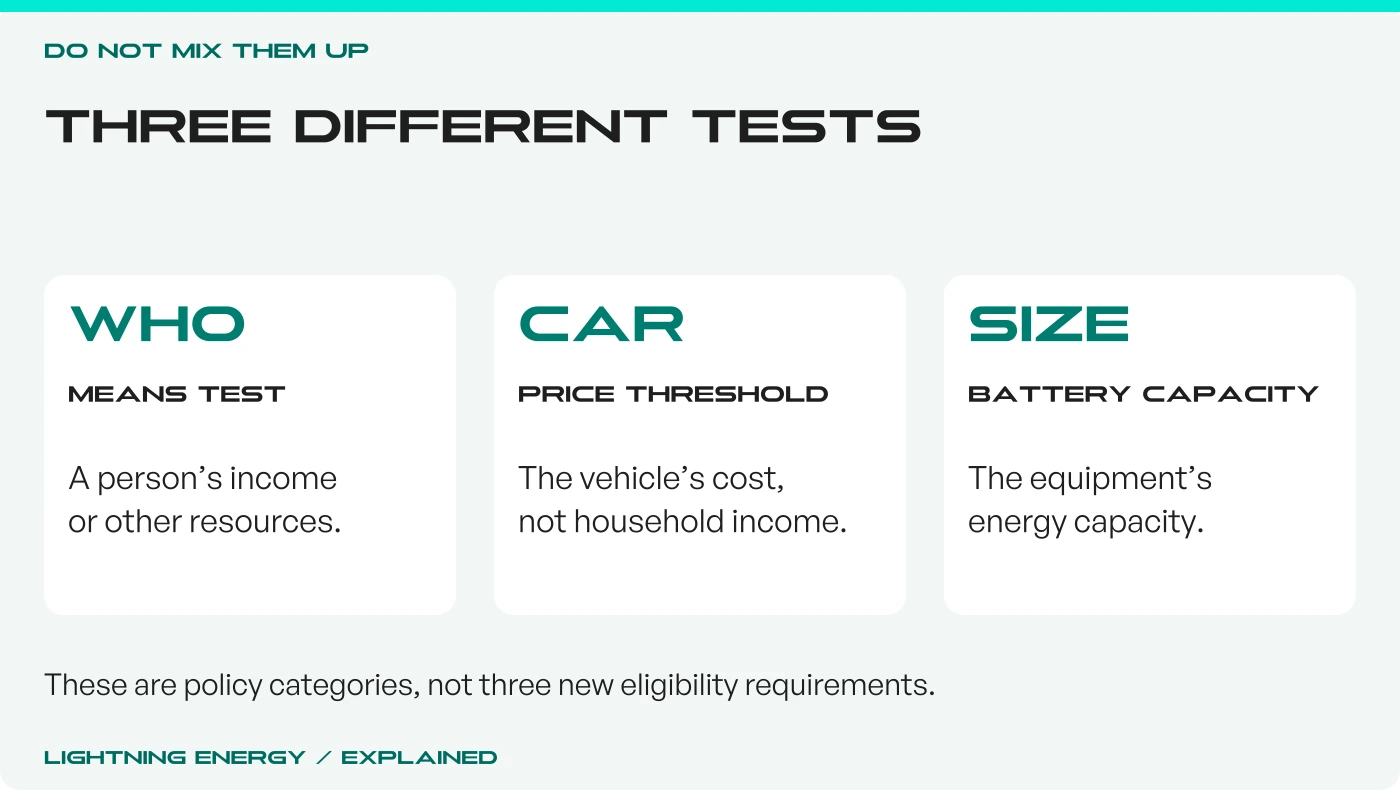
In general, a means test assesses a person’s or household’s financial resources, such as income and sometimes assets. A policy could use one measure or several. Those design choices cannot be inferred from the words “means test”.
If a government adopted one, households would need clear answers: whose income counts, which financial year is used, whether assets matter, and whether support stops abruptly or reduces gradually.
None of those details should be invented from this headline.
Consider two households buying the same battery.
A means test could treat them differently because their financial circumstances differ.
A battery-size rule instead changes support according to the equipment.
These are hypothetical examples of policy design, not new eligibility tests.
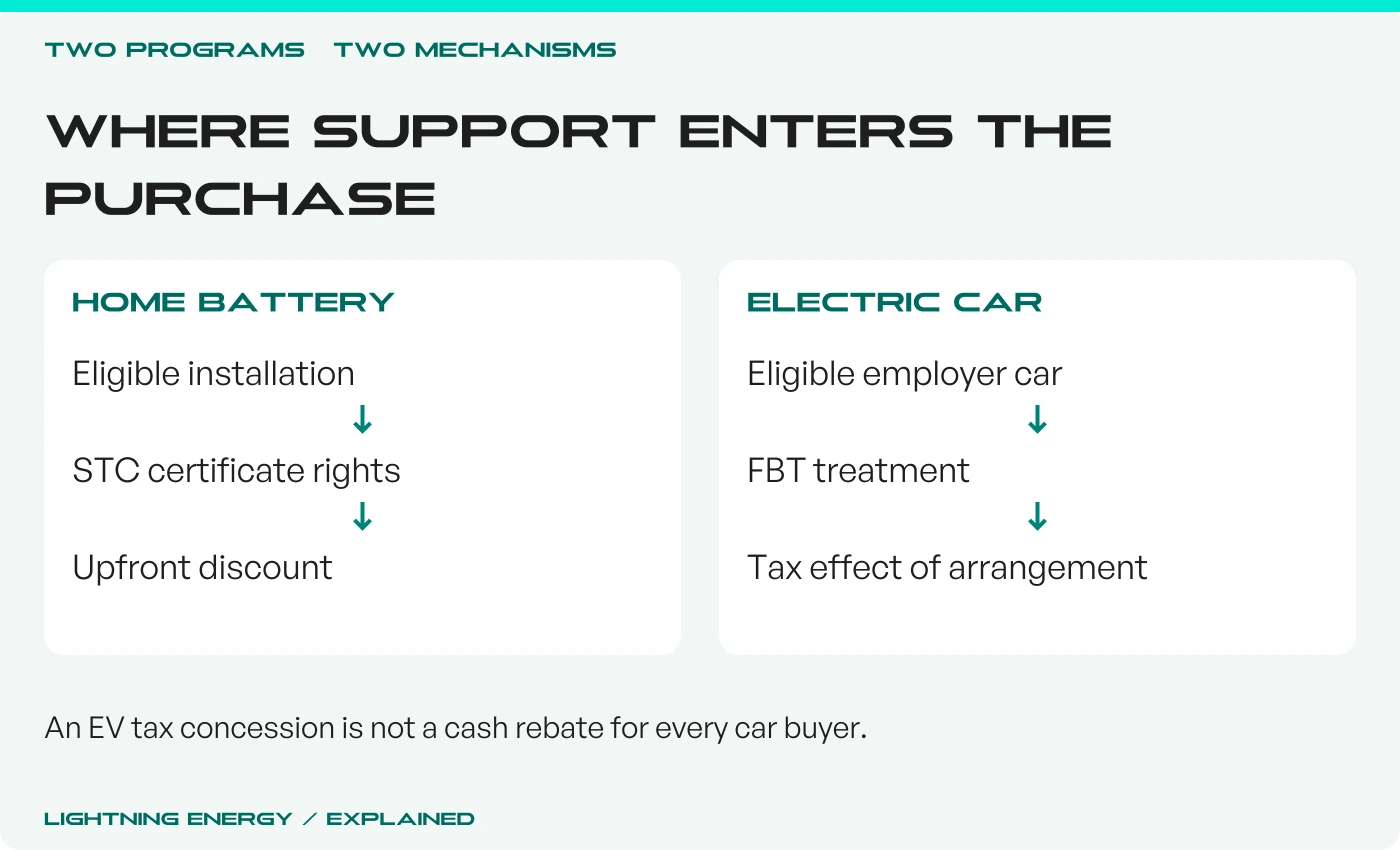
The current DCCEEW eligibility guidance sets out equipment, installation and premises requirements. It does not list a household-income ceiling.
Among those requirements, eligible batteries must connect to solar, use approved equipment and be installed through the required accredited process.
On-grid systems must be capable of joining a virtual power plant, but joining a VPP is not compulsory under the federal program.
That does not make every battery purchase eligible. Nor does it establish eligibility for a separate state rebate or a commercial VPP offer. Check each scheme independently, especially where a quote combines several incentives.
Our VPP capability and membership guide explains that distinction in more detail.
The federal discount uses small-scale technology certificates. Certificate rights can be assigned for an upfront discount; the dollar outcome is not a universal cash payment to every buyer.
The Treasury review of the Electric Car Discount explains the fringe benefits tax exemption for eligible cars supplied by employers for employees’ private use, including salary-sacrifice arrangements.
It is not a cash rebate automatically paid to everyone who buys an EV outright.
The review also identifies unequal access to salary packaging and greater tax benefits for higher-income earners, while acknowledging uptake beyond the highest-income groups.
That helps explain why fairness is part of the debate.
It does not tell a particular household whether leasing is better than buying, or what its actual tax saving would be.
Those calculations depend on the arrangement and personal circumstances.
The ATO’s EV tax-change guidance, updated 3 November and checked for this article, explicitly says the measure is not yet law.
Under that separate proposal, eligible cars costing $75,000 or less would retain the full FBT discount during the transition from April 2027 to April 2029.
More expensive eligible cars below the relevant luxury-car-tax threshold would receive a 25% FBT discount.
From April 2029, the proposal would move eligible cars below that threshold to the 25% discount.
The ATO says existing leases would not be affected by those changes.
That statement concerns this particular proposal, not every possible future budget decision.
Crucially, $75,000 refers to the car’s cost. It is not a $75,000 household-income limit, and a 25% FBT discount is not 25% off the car’s purchase price.
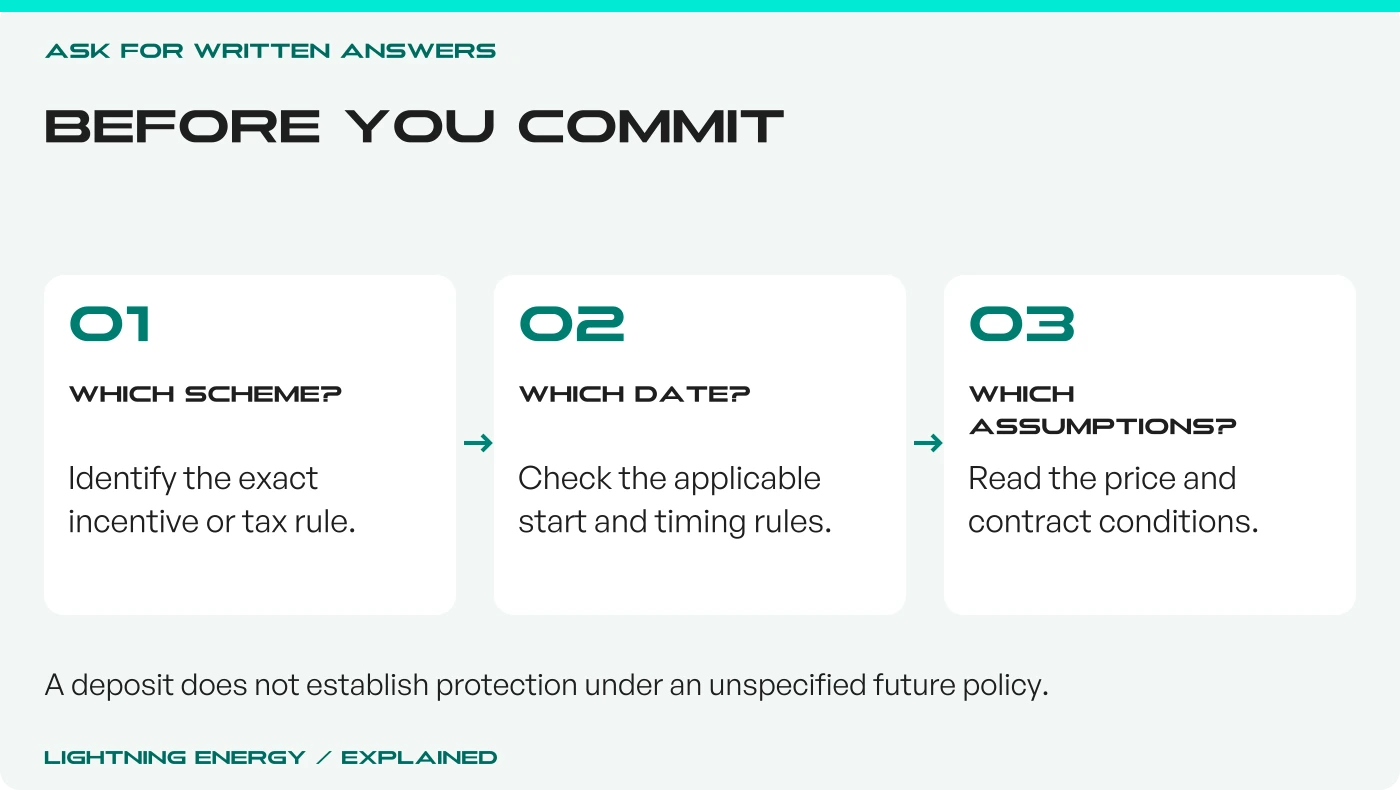
Our recommendation is to ask for written assumptions before committing. A headline does not establish a cut-off date, and a salesperson cannot guarantee the design of a future government decision.
For a battery, request the gross installed price, the specific incentive deducted, the expected installation timing, and who carries a price difference if the assumptions change.
Keep the actual contract and the eligibility evidence together.
Use our home battery quote checklist to compare equipment, installation scope and the incentive calculation alongside each other.
For an EV lease, ask the provider to identify the tax rules used in its calculation, all fees and the residual payment.
Have a registered tax agent check the consequences for your circumstances before treating an advertised saving as your own.
If the purchase includes a charger, its practical design remains a separate question. Our 7 kW versus 22 kW home-charging guide covers the household considerations.
Look for a published government decision, the necessary legal changes, a start date and transition rules.
Any future means test would also need a defined assessment process.
Until those details exist, individual eligibility cannot be calculated from a political comment.
We will assess any adopted change against the official program guidance.
For now, separate the two purchasing decisions, compare the full costs, and avoid assuming either that support is guaranteed forever or that this headline has already removed it.
This is a desk-researched policy explainer, not personal tax advice.
Cover: existing supplied Tesla photograph from Lightning Energy’s website library, used illustratively.
It does not depict Turnbull’s comments or imply a particular household’s eligibility.
Available times
Book a consultation and we'll map solar, storage, hot water, and the rebates around your bills and your goals.
Question 1 of 6
