
Charging a Home Battery Off-Peak: When Do the Numbers Work?
Check whether off-peak battery charging pays after energy losses, plan costs and later demand, while preserving space for solar and backup needs.
Check whether off-peak battery charging pays after energy losses, plan costs and later demand, while preserving space for solar and backup needs.

Off-peak charging can reduce electricity costs when the value of later battery discharge exceeds the cost of charging and using it. A cheap rate is only the start of that calculation.
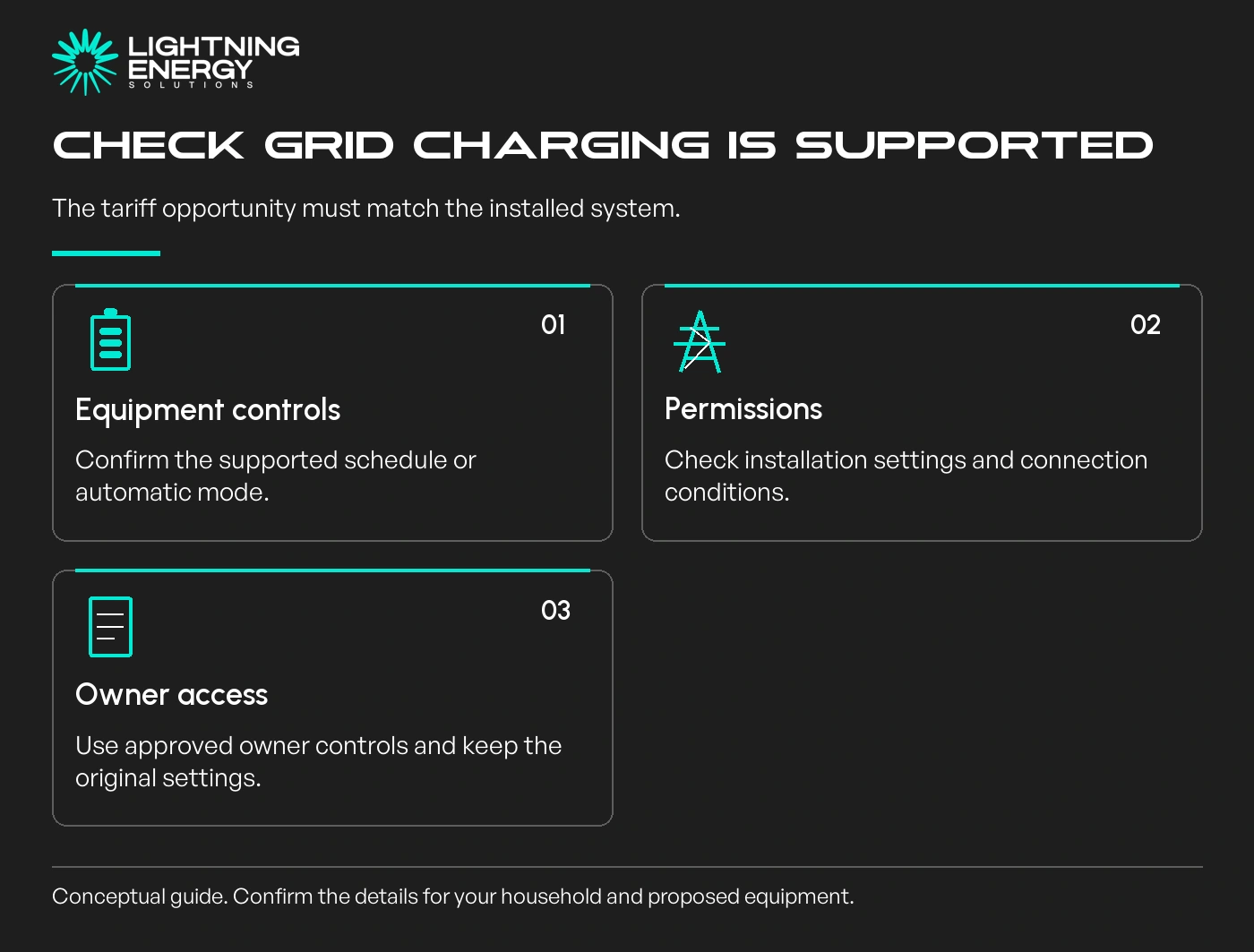
First confirm that the installed system supports the intended grid charging and that the connection and plan permit it. Then assess the actual price difference, losses and household demand.
Ask how your battery decides when to charge from the grid. Some systems use schedules, while others forecast demand and prices. Check which controls are owner-accessible and what permissions apply.
Tesla's Australian advanced-settings guidance, for example, describes grid charging subject to the system's settings and conditions. Enabling the feature is not the same as telling every battery to charge continuously.
Tesla Australia: advanced settings.
Our battery operating-value guide explains why the operating assumptions need to match the installed system.
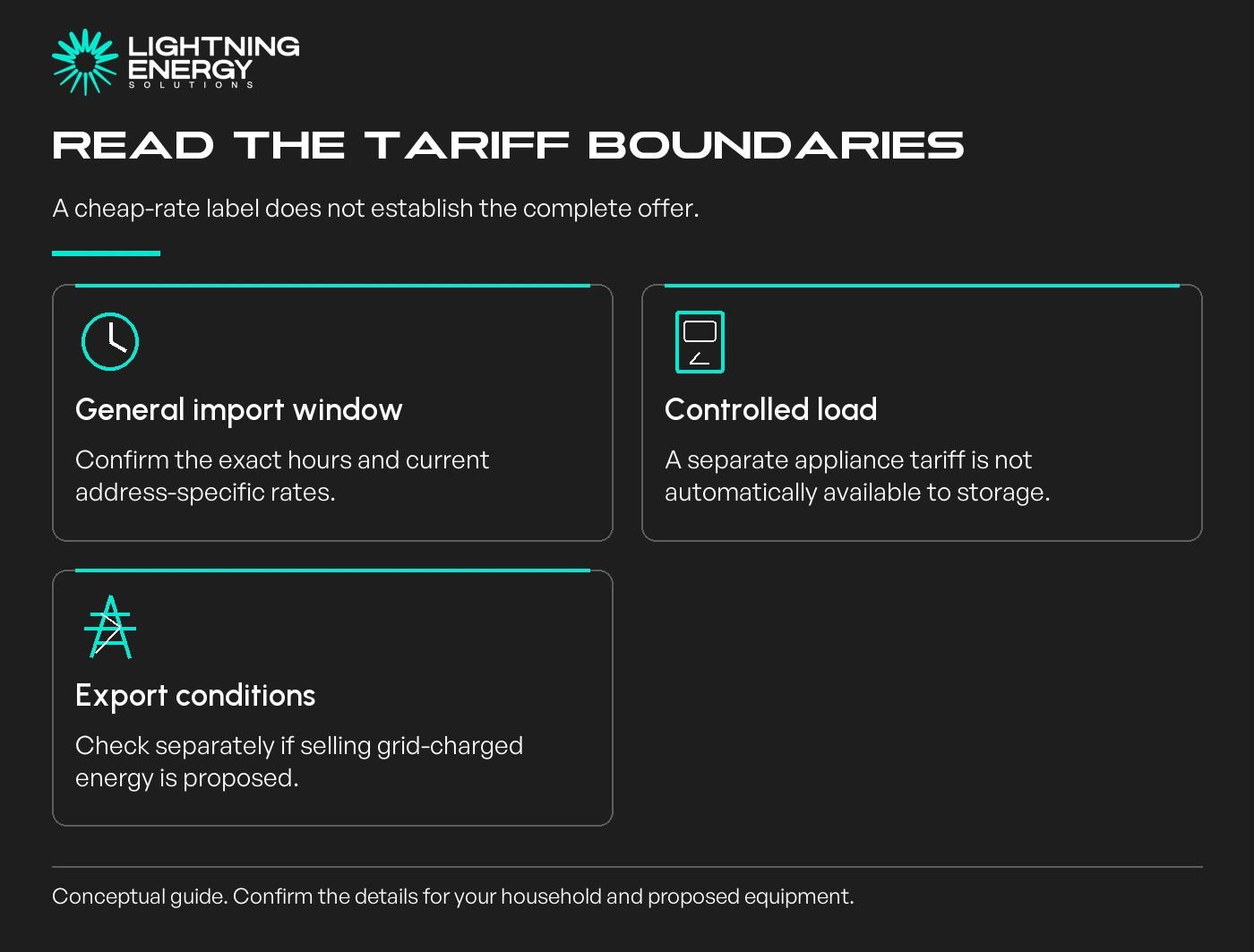
Use the written offer for your address, including the meter requirement, cheap-rate hours and the rates charged at other times. Do not assume every off-peak plan uses the same schedule.
Origin's Night Shift illustrates why eligibility matters: its current offer identifies a midnight-to-6 am window, an electric-vehicle requirement and a remotely read smart meter.
As checked on 11 October 2026, it is not available in Victoria. Compare offers actually available at your address, including rates outside the cheap window.
Origin Night Shift conditions.
Also distinguish a general household tariff from a controlled-load circuit. A cheap rate attached to one controlled appliance is not automatically available for charging the home battery.
Check whether grid-charged energy may be exported and under what terms if that is part of your intended strategy. Household use and paid export are separate calculations.
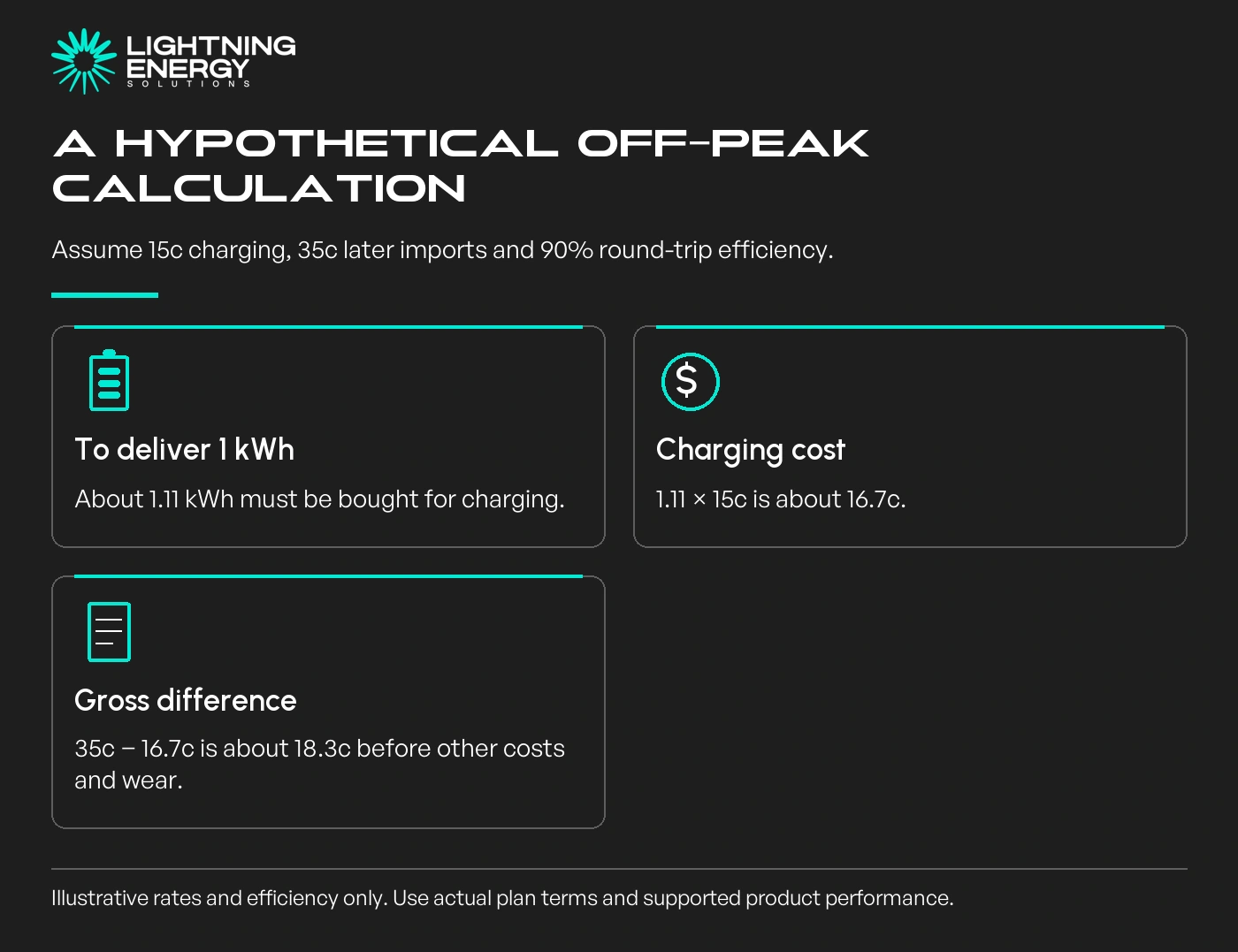
Suppose, purely for illustration, charging costs 15 cents per kWh and later imports cost 35 cents per kWh. Assume a 90% round-trip efficiency for the calculation, not as a rating for your product.
Delivering 1 kWh later would require about 1.11 kWh of charging energy. That costs about 16.7 cents, leaving roughly 18.3 cents before other costs and battery wear are considered.
Now reduce the later import rate to 18 cents. The same calculation leaves only about 1.3 cents before those additional factors. A small rate spread can disappear after realistic allowances.
Include any extra supply or subscription costs when comparing plans. Only count energy that would otherwise have been bought at the higher rate; unused stored energy has not created that saving.
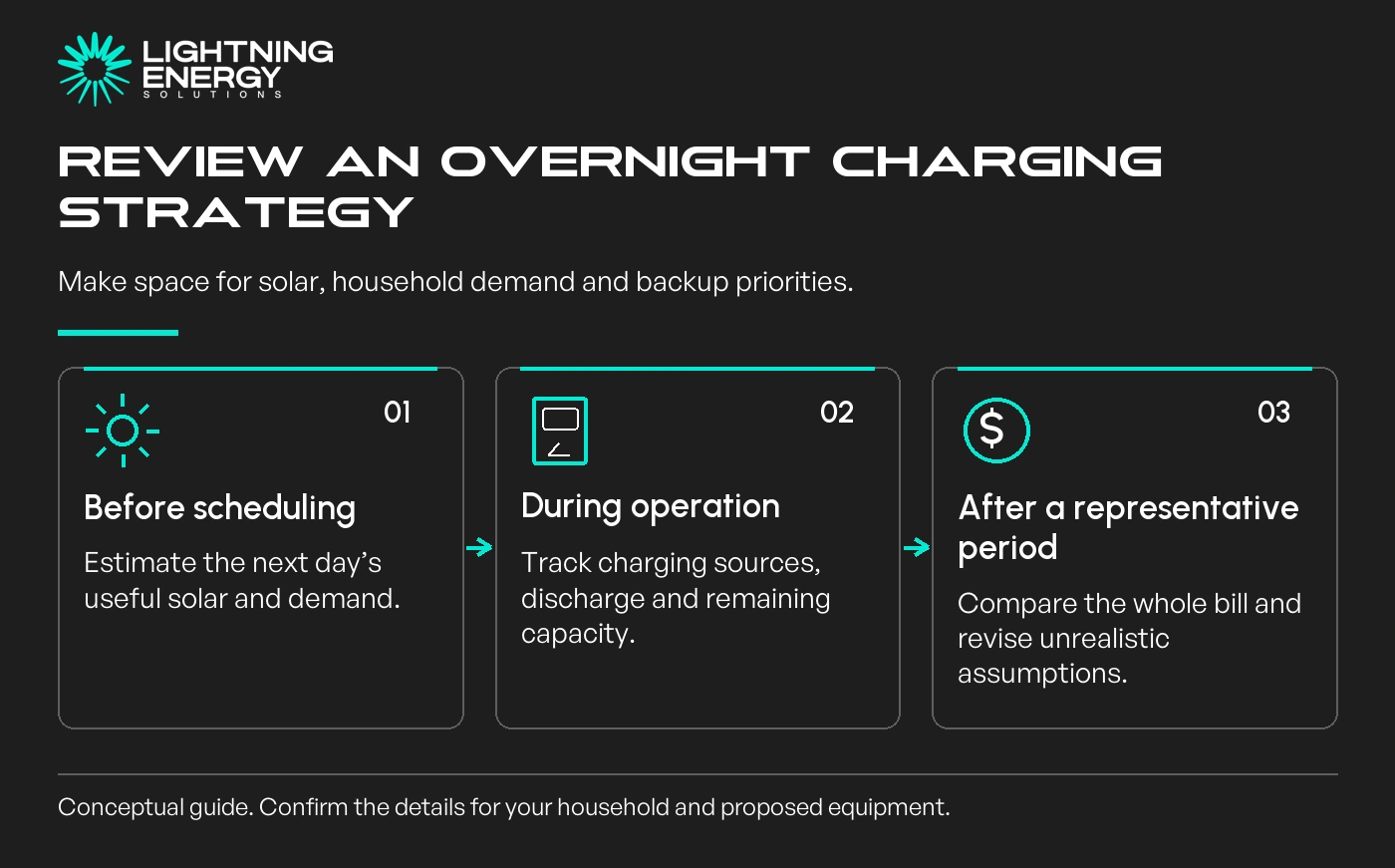
Filling the battery overnight may leave less capacity for excess solar the next day. Model the forgone export credits, later consumption and available charging space together.
For a household expecting strong daytime surplus, partial overnight charging might meet the required morning load while preserving solar capacity. On a low-solar winter day, the balance could be different.
These are operating scenarios to evaluate, not universal settings. Our Melbourne winter solar guide explains the seasonal side of that decision.
A backup reserve creates another priority. Check how the chosen operating mode protects it, and remember that grid charging is unavailable once the grid itself has failed.
Save the original settings and note any change you make through approved owner controls. Compare charging, discharge and the bill over representative periods, allowing for weather and household changes.
Avoid buying extra storage just to capture a small theoretical overnight spread. Assess additional capacity against its installed cost, expected useful cycles and the terms of the actual battery proposal.
Plan your battery upgradeBring the current tariff and the battery's supported control options. We can help assess the charging assumptions before you commit to a new schedule or a larger system.Available times
Book a consultation and we'll map solar, storage, hot water, and the rebates around your bills and your goals.
Question 1 of 6