Cheaper Home Batteries Program 2026: What You Actually Need to Know
The federal battery rebate is live across every state. Here's what it covers, what it's actually worth at different sizes, and where your state adds something on top.
It gets called a rebate, but honestly, it doesn't really work like any rebate you might have seen before. So, let's go through what you're actually getting here, what changed back in May 2026, and for those of you across different states, I'll cover what you need to know for each one.
So first up, this isn't something you have to apply for. It runs through the STC (Small-scale Technology Certificate) system, which is the same mechanism that's been knocking money off solar panels for over a decade now.
Here's how it actually works. When your battery gets installed, your installer creates a set of certificates tied to the battery's size and your location. Those certificates have a real dollar value on the open market. They sell them, and that value comes straight off your invoice. There's no form to fill in, no waiting around. Your price just comes down.
It started on 1 July 2025 and it runs nationwide. Now, the reason the government did this is they want more household batteries connected to the grid, particularly to support the rollout of virtual power plants, or VPPs. That's their agenda. But the benefit to you is real regardless of why.
I've been installing solar and batteries long enough to have watched a few of these programs come and go. And what's different this time is the demand. Storage has genuinely shifted more in the past 12 months than in the three years before it. Customers are coming in more informed, more frustrated with feed-in tariffs, and more ready to act. Feed-in rates have been sitting at 3 to 5 cents per kWh across most of the country, while evening grid prices are sitting at 28 to 33 cents and climbing. People are giving away their solar for basically nothing and then buying it back at retail. The rebate didn't create that problem. But it's made fixing it a lot more achievable.

So the good news here is it's a lot broader than most people expect. Here's who's eligible:
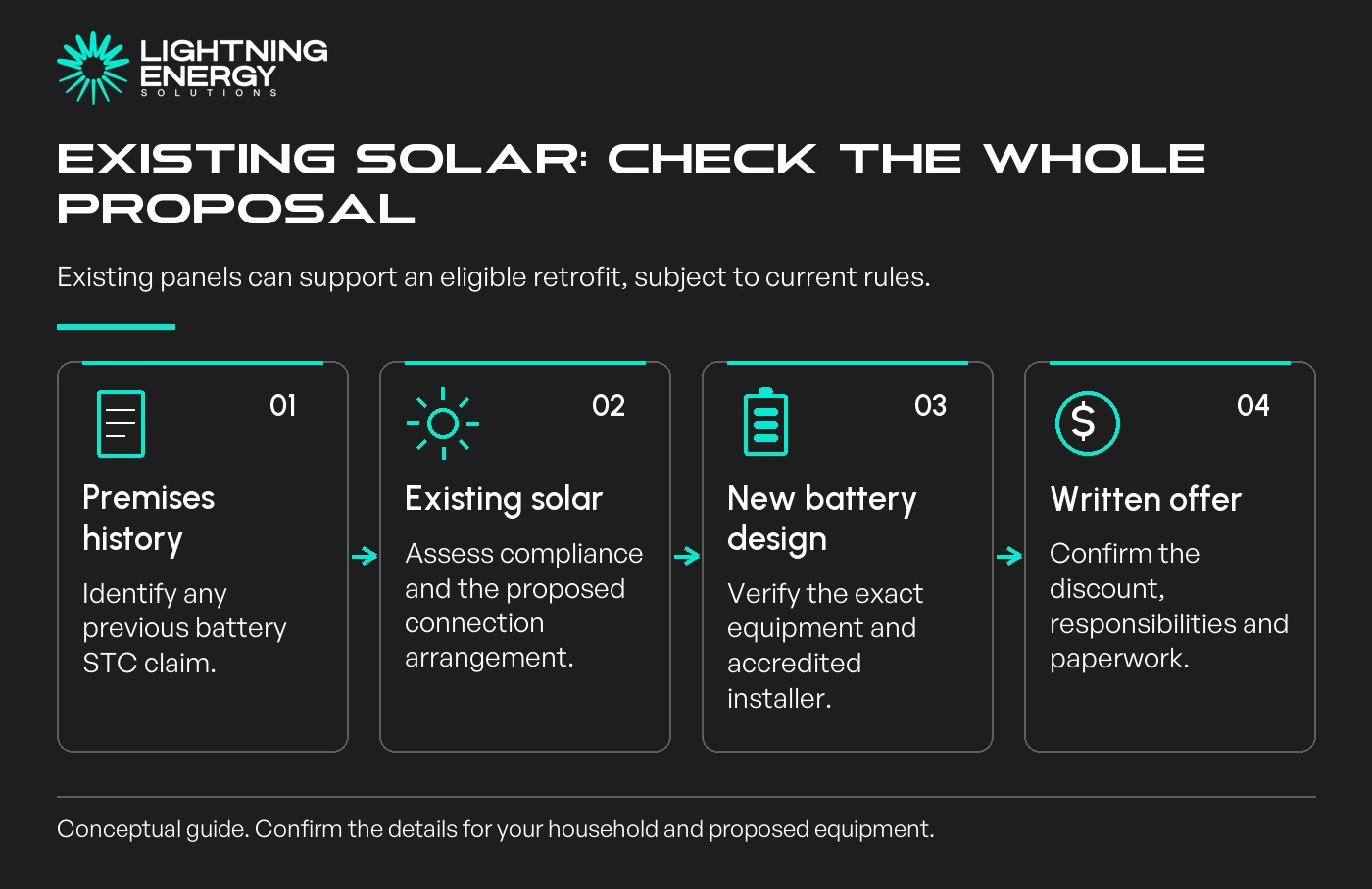
One thing a lot of people miss: there's no means test here. No income cap, no application queue. If you own the property and it's got solar on it, you're in. And existing solar counts, which is a big one. If you've had panels for five years and are now thinking about adding storage, you don't need a new system. Just the battery.
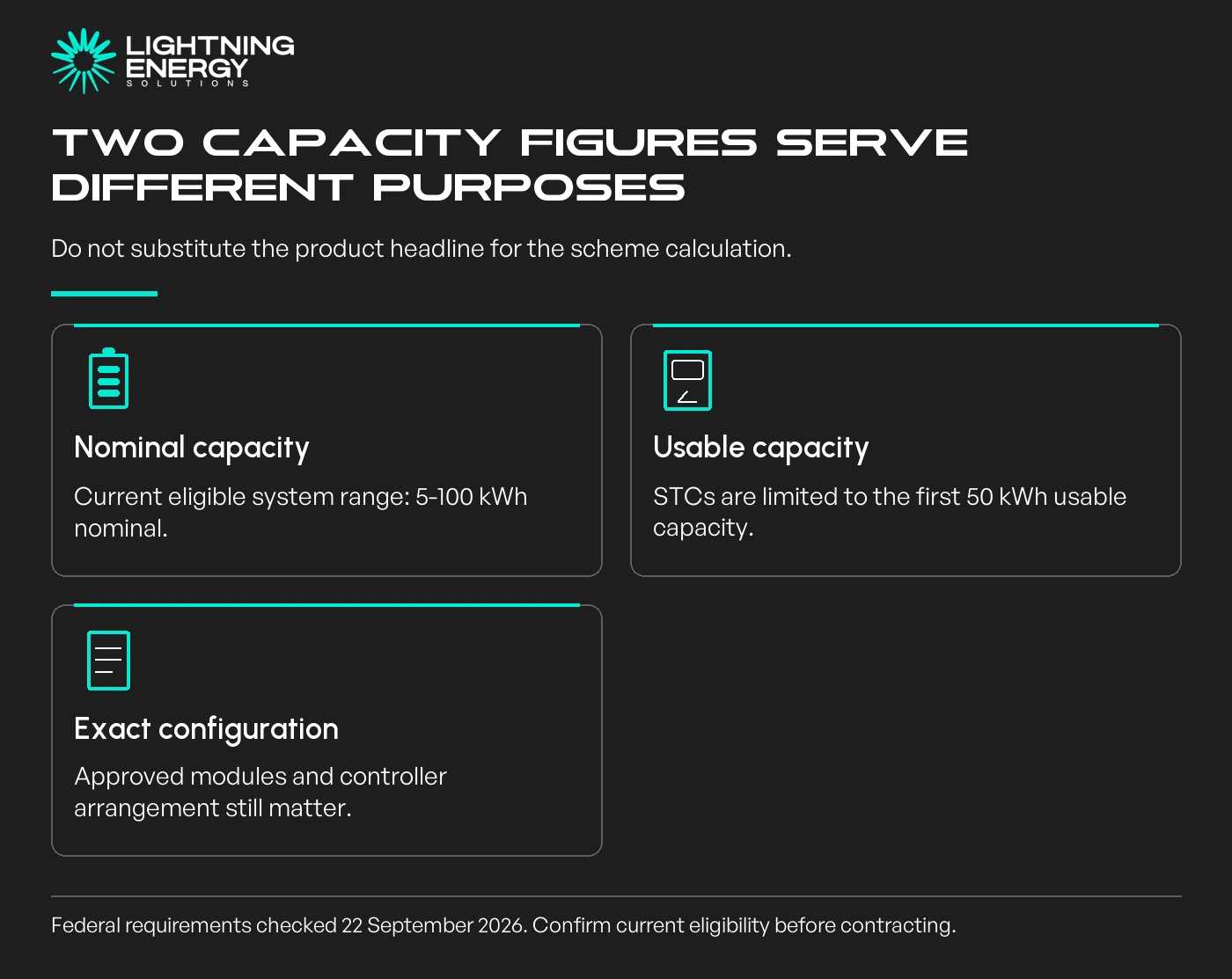
Here's what most people don't realise, and honestly it's where the real story is: the rebate isn't flat. Since 1 May 2026 it's been tiered, which means the size of your battery actually changes how much you get per kWh. Smaller batteries get the most support. So let's look at what the tiers actually mean.
Quick note on the numbers here: these assume an STC price of around $37, which is where it's been sitting in mid-2026. It moves between $35 and $40. So your actual rebate will shift a little depending on when you install.
So what does that actually mean if you're buying a battery? Let's put it in real numbers.
The STC multiplier reduces on a set schedule. Next step down is January 2027. So the rebate is at its highest right now, and it won't be this high again. That's not manufactured urgency, it's just how the program works.
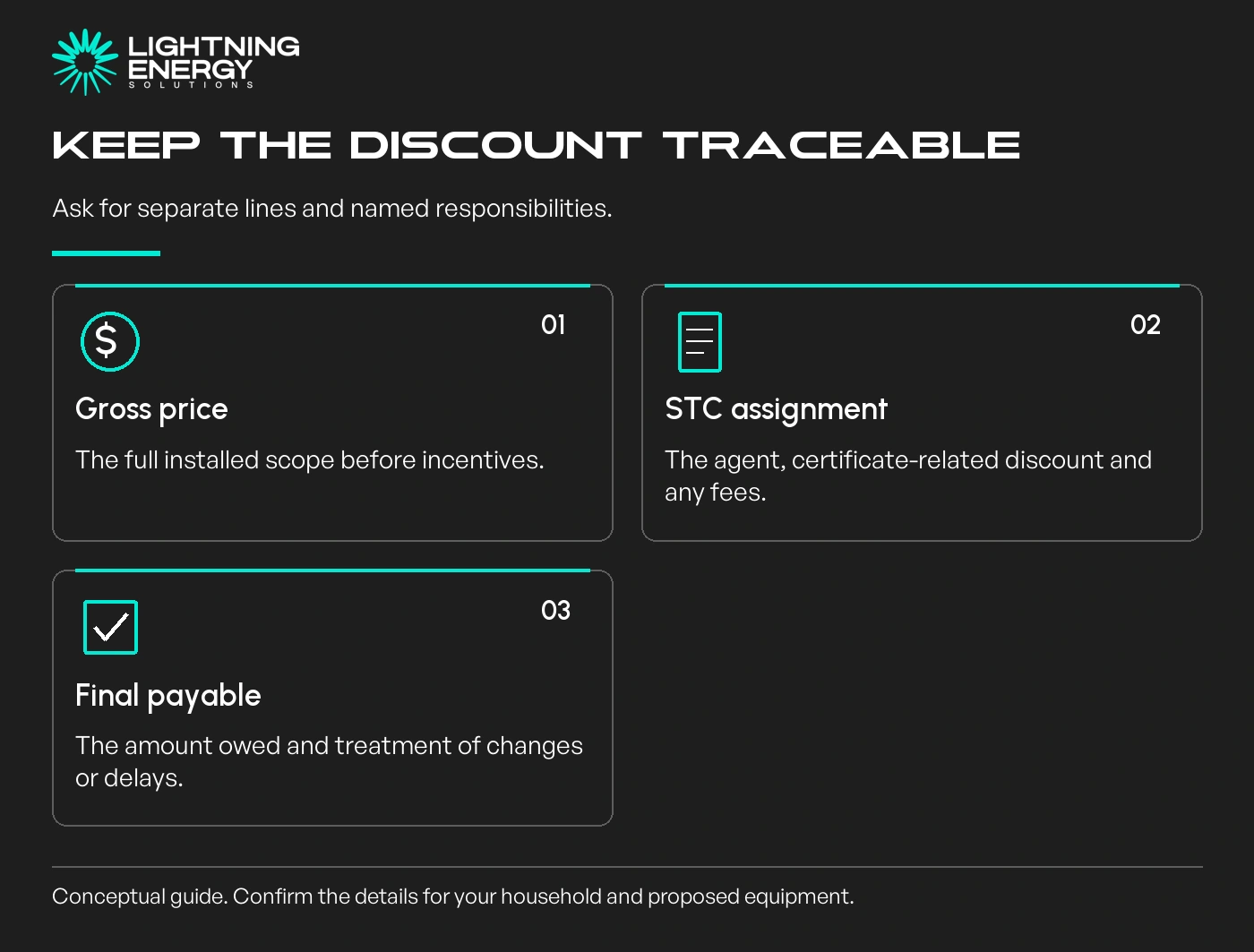
Honestly, nothing on your end. Your installer takes care of all the paperwork. The one thing you want to keep an eye on though: make sure the rebate shows up as its own line item on your quote, not buried inside a package price.
If you get a quote that shows only a total without breaking out the STC value, just ask them to show it separately. Some retailers bundle it in to make their headline price look lower than competitors, and that makes it really hard to compare quotes properly. Any reputable installer will show you the gross price and the rebate deduction as separate lines.

So, let's go state by state. The federal program runs everywhere, but the full picture depends on where you live. Some states have real top-ups worth stacking on top. Others are federal only. Here's where things stand as of mid-2026.
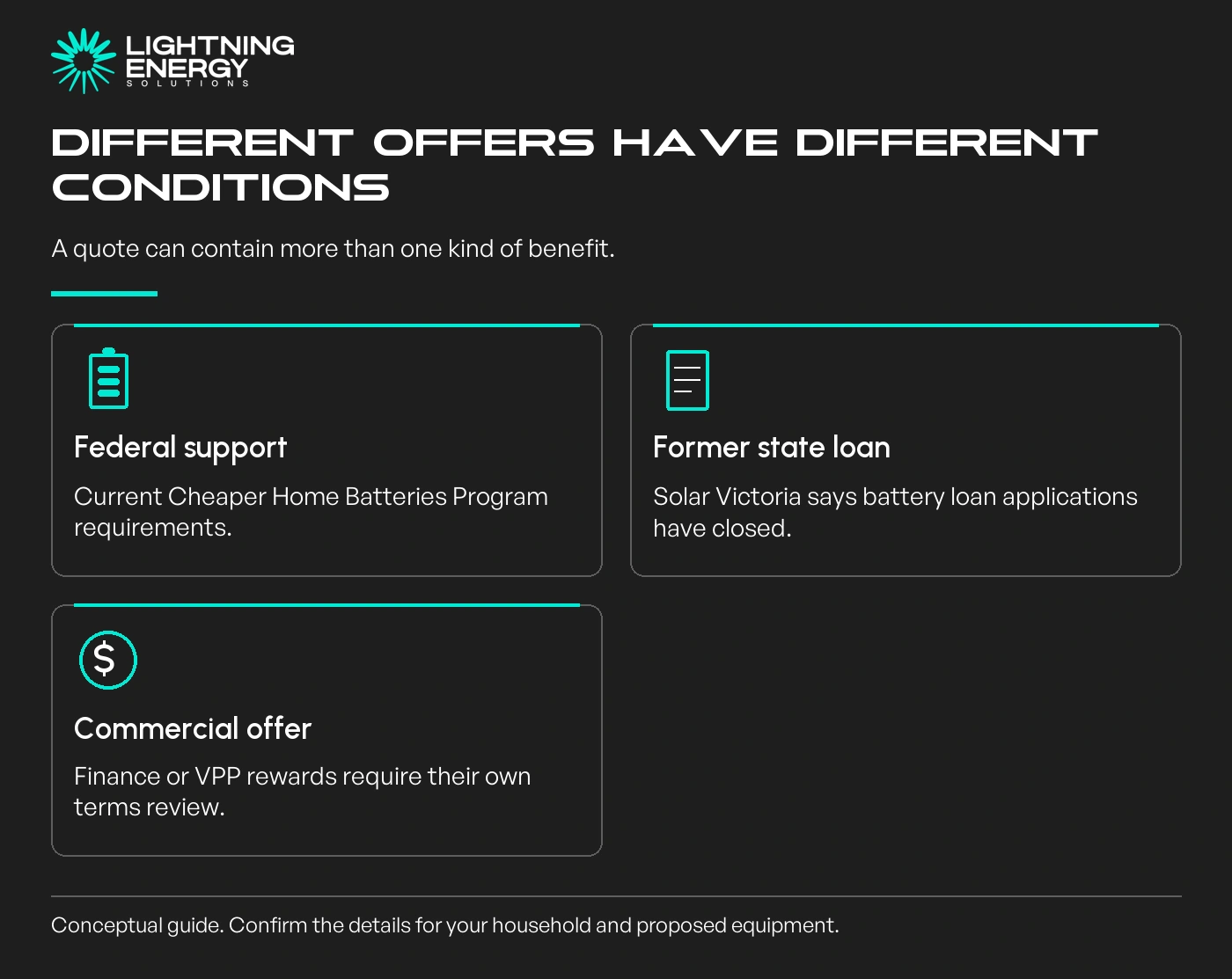
Federal program only for Victorians. Solar Victoria's battery loan program closed and hasn't been replaced with anything comparable. So the STC discount is what you're getting. That said, it's still real money: a 13.5 kWh Powerwall comes down by roughly $3,400 on the invoice. There's just nothing stacking on top of that for Victorian households right now.
If you're in NSW and you're open to joining a VPP, there's a genuine stack worth chasing. The NSW Electricity Infrastructure Roadmap includes a VPP incentive of roughly $36 to $55 per kWh usable, capped at around $1,500 depending on which provider you connect to. It's explicitly stackable with the federal rebate, which is great. The catch is you do have to actually enrol in an approved VPP, not just be capable of it. If you're comfortable with that, the combined saving is real.
WA has the most generous deal in the country right now, full stop. The WA Residential Battery Scheme offers a direct subsidy on top of the federal rebate: up to $1,300 for Synergy customers in metro Perth, or up to $3,800 for Horizon Power customers in regional WA. The regional number is particularly significant for people out there who've historically paid more for power and have had less solar export value. VPP participation is required, but honestly, if you're in WA right now, this is genuinely the best battery deal in Australia.
The ACT Sustainable Household Scheme offers low-interest loans rather than a direct grant. So it doesn't cut your purchase price the same way, but it does take the cash-flow hit out of going for a larger system. If you're in the ACT and you're looking at 20 kWh or more, it's worth looking into alongside the federal rebate.
Federal program only for Queensland. The Battery Booster program closed in 2025 and hasn't come back. So there are no active state-level incentives to stack as of mid-2026. The federal STC discount still applies in full though.
Federal program only. SA's state incentives have wound down. The STC discount applies. What SA does have though is some of the best time-of-use tariff structures in the country for battery owners. That can make the numbers stack up really well even without a state top-up. The rebate plus a decent tariff is often genuinely enough here.
Federal program only for Tasmania. No TAS-specific incentives as of mid-2026. The federal STC discount applies to eligible installs. Tasmania's grid is a bit different from the mainland given the hydro mix, but the rebate mechanics are exactly the same.
Federal program only. It's a smaller market, but the rebate applies to eligible installs across the territory. Grid rules do vary in some remote areas, so it's worth checking eligibility for your specific location before you commit.

So let's talk through the batteries themselves. I keep a short list on purpose. All of them are on the CEC approved products list, all qualify for the rebate, and all are products I've installed enough of to have a genuine opinion on. Here's what I work with and why:
The SigenStor is my go-to when someone wants flexibility on system size without committing to a large number upfront. Start with 8kWh, add another module later when your usage grows or you add an EV. We've got 30 of these in stock right now, so lead times are realistic. Sigenergy is building out their Australian presence properly and the support has been solid. If you want a modular system that can actually grow with you, this is the one I'd start the conversation with.
The GoodWe ESA is a solid 8kWh option and we have stock available right now. It pairs best with a GoodWe hybrid inverter, which keeps everything under one warranty and one support conversation if something goes wrong. LFP chemistry, IP66 rated so it can go indoors or outdoors, and fully CEC-approved and eligible for the rebate. If you're after a reliable 8kWh system without the Powerwall price tag, this one does the job well.
Honestly, this is the one I'd want on my own house. The built-in solar inverter makes for a cleaner install, the backup Gateway is genuinely useful, and the Storm Watch and time-based control features actually work the way they're supposed to. It costs more, and that's real. But if you're planning to stay in this house for 15-plus years and you want the experience to just work, the premium is worth it. I genuinely haven't had a customer regret the Powerwall 3.

I've kept this list short on purpose. A longer catalogue sounds impressive, but it means knowing each product less well. And there are brands I won't install: mostly cheaper imports with no real Australian distribution or warranty support. When something goes wrong in year 4 and the answer is 'email our overseas team', that's just not good enough. Every battery I put on a wall has someone I can actually call.
Look, the rebate is real and right now it's genuinely the best it's been. But it doesn't make a battery a smart buy on its own. I have this conversation with customers every single week and my answer's always the same: the numbers still have to stack up for your specific situation.
A 10 kWh battery in Victoria today costs roughly $8,000 to $12,000 installed before the rebate, depending on brand and complexity. After roughly $2,500 off, you're in the $5,500 to $9,500 range. Whether that actually works for you comes down to three things: what you're getting for exported solar right now, how much grid power you're pulling in the evenings, and whether your system is actually producing more than your household uses during the day.
If you're exporting cheap solar all day and buying it back at 28 to 33 cents a unit in the evenings, that's your whole case right there. Feed-in tariffs across most of Australia are sitting at 3 to 5 cents a kWh right now. Do that maths. If your solar's already well-matched to your usage and you're not exporting much, the case is softer. So get a quote and look at your last few bills. It'll be pretty obvious.

I'd rather give you the honest version than write a payback number that makes it look like a no-brainer. Get a quote, look at your bills, and the maths will be obvious.
So, if you want my honest opinion: yes, absolutely, if you've already got solar that's working hard and you're exporting cheap daytime power. We've seen a massive increase in demand since this rebate launched and I get why. Customers are doing the maths themselves and realising the sub-14 kWh sweet spot lines up almost perfectly with what most Australian households actually need. The rebate is at its highest right now, with the STC factor stepping down every six months. The next reduction is January 2027. If you're in NSW or WA, the state top-ups are live right now and those programs change annually. There's no guarantee the same terms are on the table next year.
But I also need to be honest about when it's genuinely not worth it. If you don't have solar yet, stop here and sort that first. The economics are completely different without a working solar system behind it. If you're renting without your landlord on board, it's not the right move right now. And if your current tariff doesn't reward load-shifting, a battery won't fix that. A bad tariff is a bad tariff. I'd rather tell you that upfront than have you spend $8,000 finding it out the hard way.
Want to know what your battery would actually cost after the rebate?I'll work through the numbers with you: what size makes sense, what it'll cost, and whether it'll actually pay off for your situation.Available times
Book a consultation and we'll map solar, storage, hot water, and the rebates around your bills and your goals.
Question 1 of 6