Enphase IQ Battery 5P vs SolarEdge Home Battery: Start With Your Existing System
Enphase IQ Battery 5P and SolarEdge Home Battery are easiest to compare after identifying what is already on your roof and wall. The existing inverter can change the equipment, labour and backup design needed for either option.
LLightning Energy TeamLightning Energy29 October 2026 · 5 min read
Enphase IQ Battery 5P and SolarEdge Home Battery are easiest to compare after identifying what is already on your roof and wall. The existing inverter can change the equipment, labour and backup design needed for either option.
This desk comparison uses Australian manufacturer documents checked on 28 October 2026. It covers IQBATTERY-5P-1P-ROW and SolarEdge BAT-10K1PS0B-01, rather than mixing specifications from other IQ 5P or SolarEdge battery families.
Start with the full model number
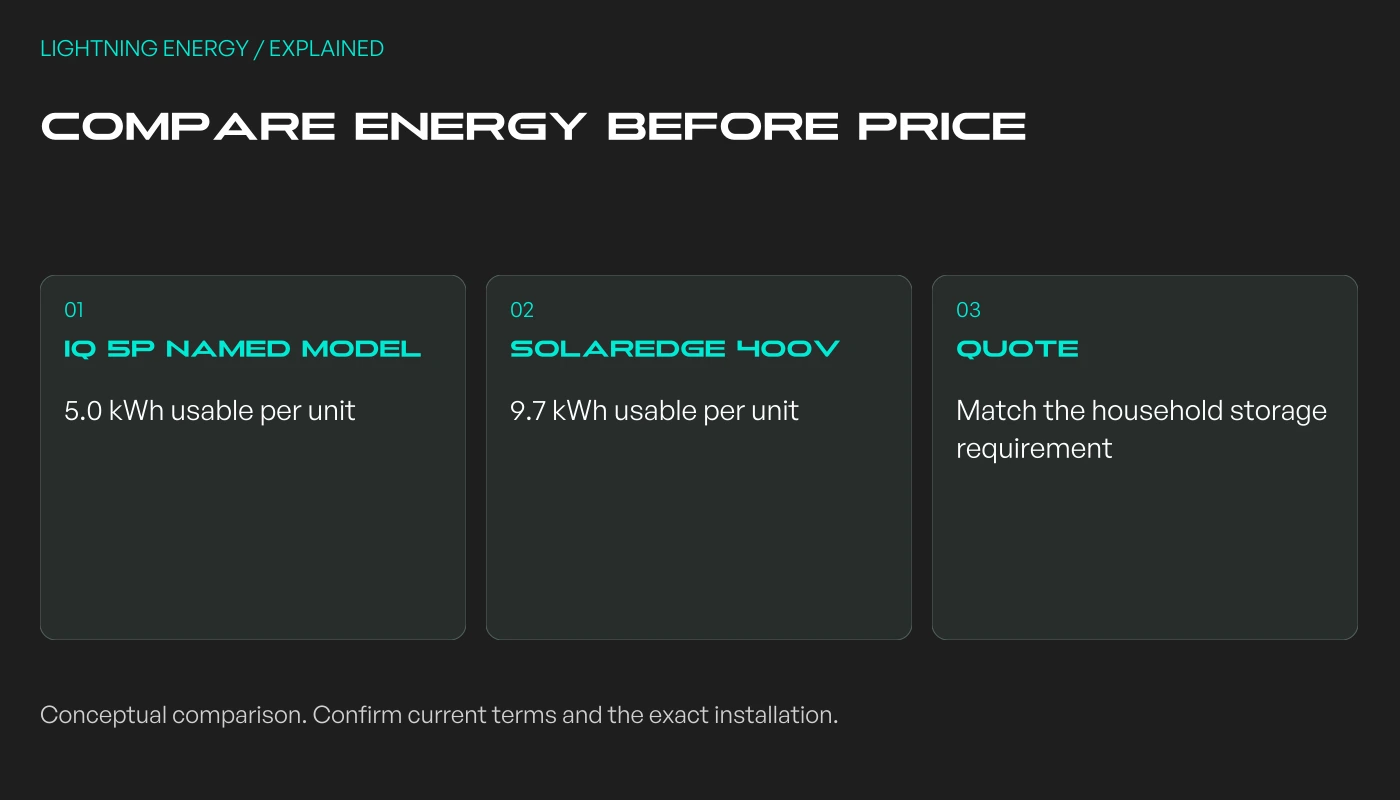
The Enphase Australia/New Zealand datasheet lists 5.0 kWh usable capacity and 3.84 kVA continuous output for this single-phase IQ Battery 5P. It is an AC-coupled system with integrated microinverters.
The SolarEdge Australian datasheet lists 9.7 kWh usable energy and 5 kW continuous battery output for BAT-10K1PS0B-01. This is a DC-coupled battery for specified SolarEdge inverters.
One unit of each therefore does not provide equivalent storage. A quote comparison should show usable energy, supported output and complete installed cost, rather than placing two different-sized boxes beside the same price heading.
Conceptual comparison. Confirm current terms and the exact installation.
Existing solar determines the integration work
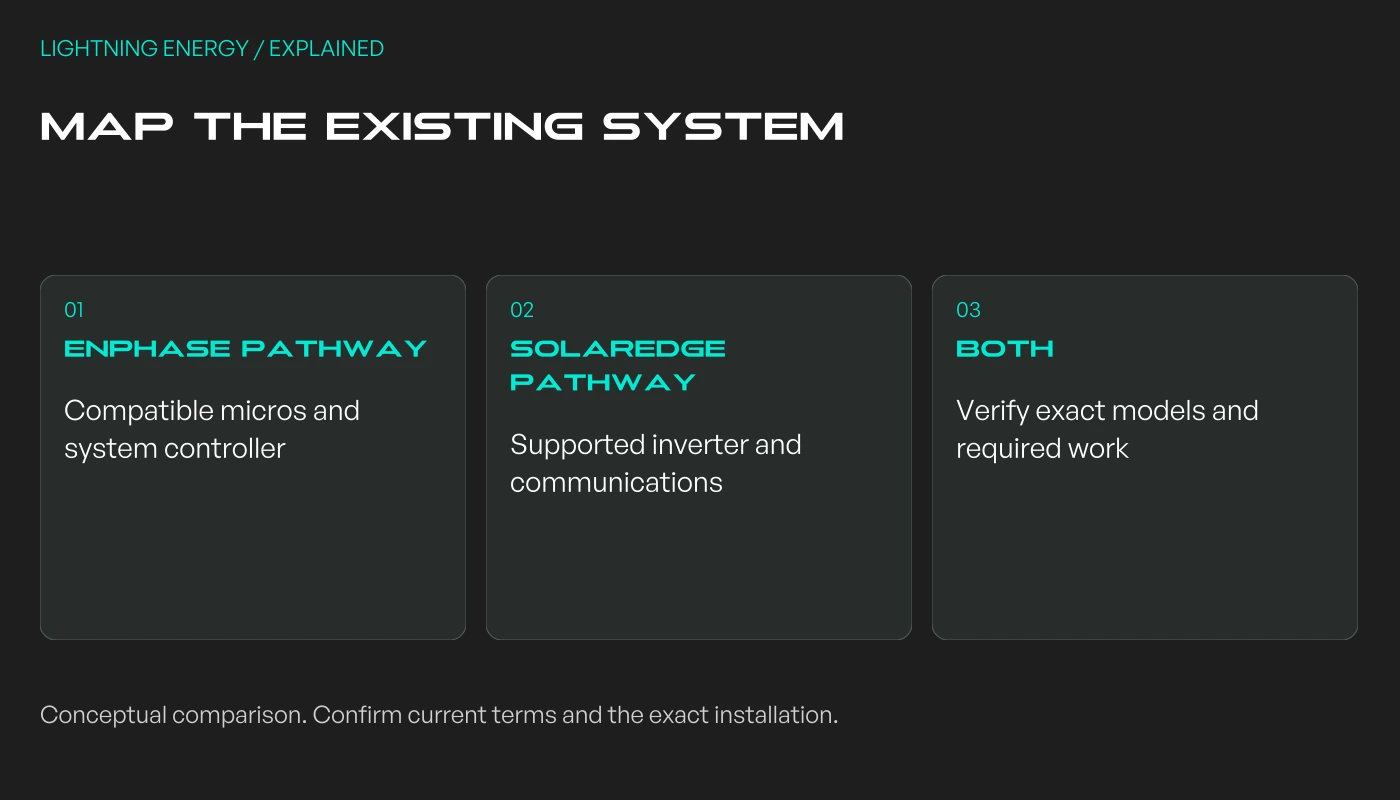
Enphase's named datasheet lists IQ Series and S Series microinverter compatibility and requires IQ System Controller 3 INT for grid-connected and backup operation. Confirm the proposed design against the exact equipment already installed.
SolarEdge lists Home Genesis, Home Hub and its Australian SExK-AUB residential three-phase inverter family. The datasheet adds a specific single-battery, single-inverter-per-site restriction for SExK-AUB configurations.
Neither list is permission to assume that an unspecified older inverter will work. Ask the installer to record model codes, firmware requirements, communications equipment and any replacement hardware in the quote.
For an existing solar installation, compare the cost of keeping suitable equipment with the cost of replacing it.
A cheaper battery alone can become a more expensive project if substantial integration work is left outside the headline price.
Conceptual comparison. Confirm current terms and the exact installation.
Storage and backup are separate design decisions
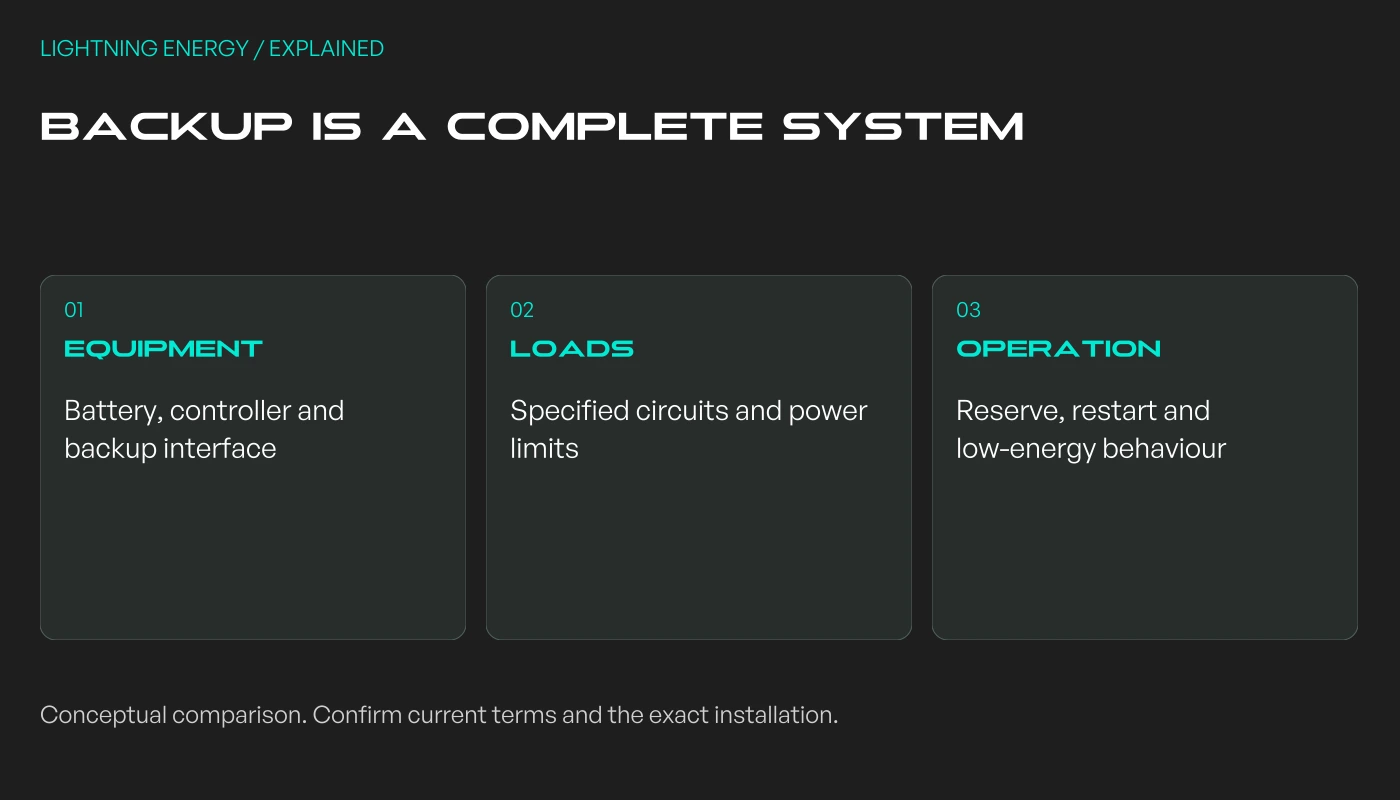
SolarEdge's Australian product page says backup requires the Home Hub Universal Inverter and Home Backup Interface. It currently describes backup availability for single-phase inverters.
That distinction matters when a three-phase home is offered a battery for everyday bill management. Charging and discharging while the grid is available do not prove that the same installation can supply all three phases during an outage.
For either system, request a list of backed-up circuits, continuous and starting-load limits, reserve settings and the behaviour when stored energy runs low. Include any switchboard changes in the installed price.
A fridge, lighting and communications have a different load profile from an oven, air conditioner or EV charger. Avoid a vague promise of whole-home backup unless the design and operating limits are clearly documented.
Conceptual comparison. Confirm current terms and the exact installation.
Compare capacity at the household level
Two 5.0 kWh units provide 10.0 kWh of stated usable capacity before considering reserve settings and operation. One 9.7 kWh battery is close in energy terms, but that does not make their power, integration or backup capabilities identical.
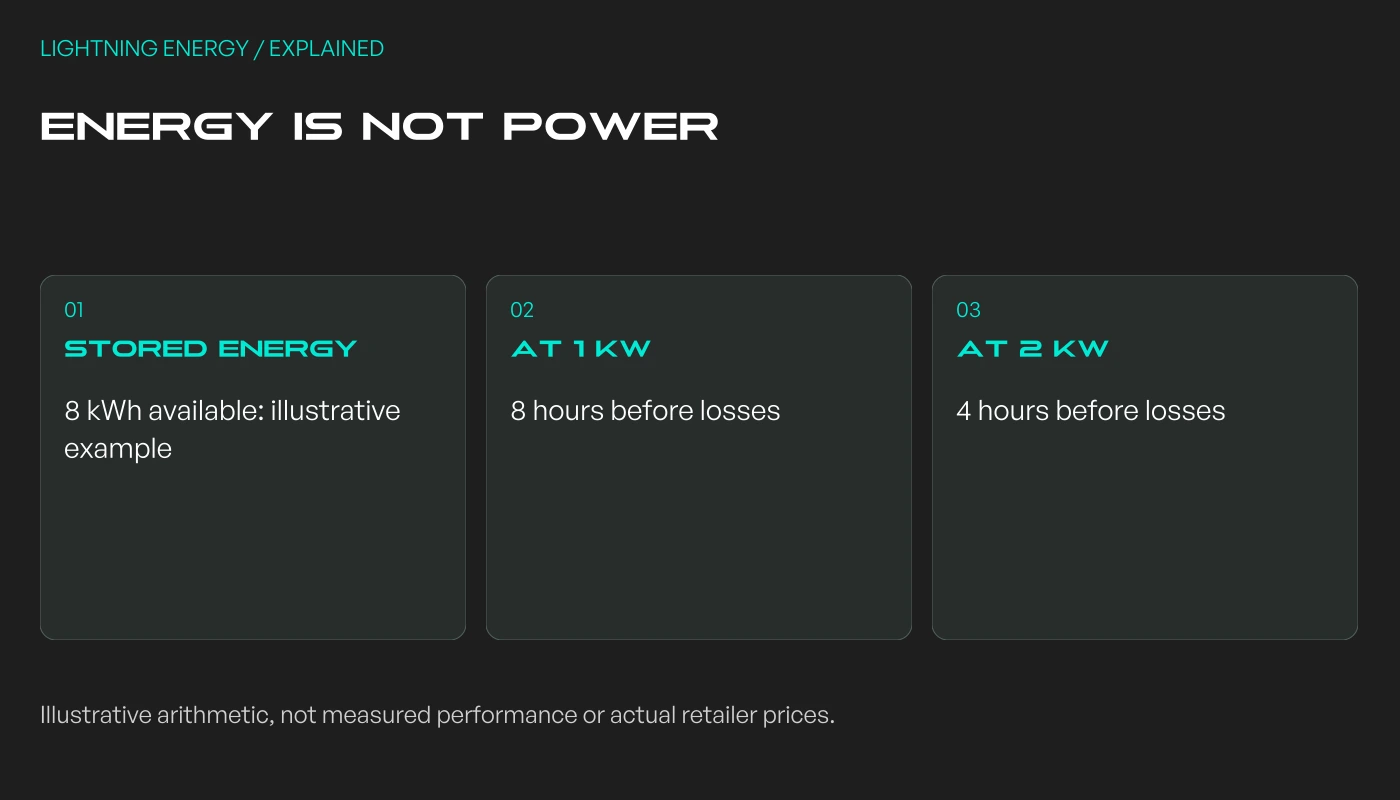
As a simple illustration, 8 kWh available to loads would support a constant 1 kW load for eight hours before losses. At 2 kW, the same energy would last four hours. Real household demand changes continuously.
This distinction helps explain why a larger energy store does not automatically run a demanding appliance. The proposed inverter and backup arrangement must also support the required instantaneous power.
Use interval data to estimate your evening demand and seasonal charging opportunities. Our battery options can then be compared against the same household requirement, rather than a different assumed daily cycle for each brand.
Illustrative arithmetic, not measured performance or actual retailer prices.
Read the warranty as a set of conditions
The Enphase datasheet summarises a limited warranty of up to 15 years or 6,000 cycles, whichever occurs first, with restrictions. The SolarEdge datasheet states ten years and directs buyers to the full battery warranty.
SolarEdge's current 400V warranty defines when coverage starts and the applicable conditions. Read the version supplied with the proposed system before accepting a comparison based only on years.
Ask both suppliers about retained-capacity thresholds, permitted operating modes, remote monitoring, installation environment and labour or travel costs. A product warranty and an installer's workmanship promise are different commitments.
We have not measured reliability, round-trip performance or outage behaviour for these products. Efficiency figures measured at different electrical boundaries should not be ranked as though they were results from one shared test.
Make the decision from a complete design
For an Enphase-equipped home, investigate the compatible Enphase design first.
For a SolarEdge-equipped home, investigate the supported SolarEdge pathway first.
In either case, compare an alternative if integration costs or backup requirements weaken that initial fit.
Ask for a monitoring demonstration showing generation, consumption, imports, exports and battery state. Confirm who will help if readings look wrong, and retain commissioning documents with the warranty and invoice.
Book a consultation and we'll map solar, storage, hot water, and the rebates around your bills and your goals.
Loading consultations…
Lightning EnergyPlan your next energy upgrade.
⚡
Hi, I’m Lightning Energy’s project guide. I’ll ask a few practical questions, explain what usually matters for your project, and help you decide on a useful next step — no guesswork or sales pressure.
First, what kind of property are we planning for?