
How to Calculate Solar Payback From Your Own Electricity Use
Calculate a solar-only payback estimate from your household demand, installed price and electricity plan, with clear assumptions and a realistic sensitivity check.
Calculate a solar-only payback estimate from your household demand, installed price and electricity plan, with clear assumptions and a realistic sensitivity check.

Solar payback is the time it takes for accumulated savings to recover the cost you are assessing. For a useful estimate, start with solar alone and make the household demand and tariff assumptions visible.
A short payback claim is difficult to judge without those inputs. Ask which costs are included, how much generation the home is expected to use and whether future electricity prices are assumed to rise.
A solar design should give you enough information to rebuild the calculation, not just its final answer.
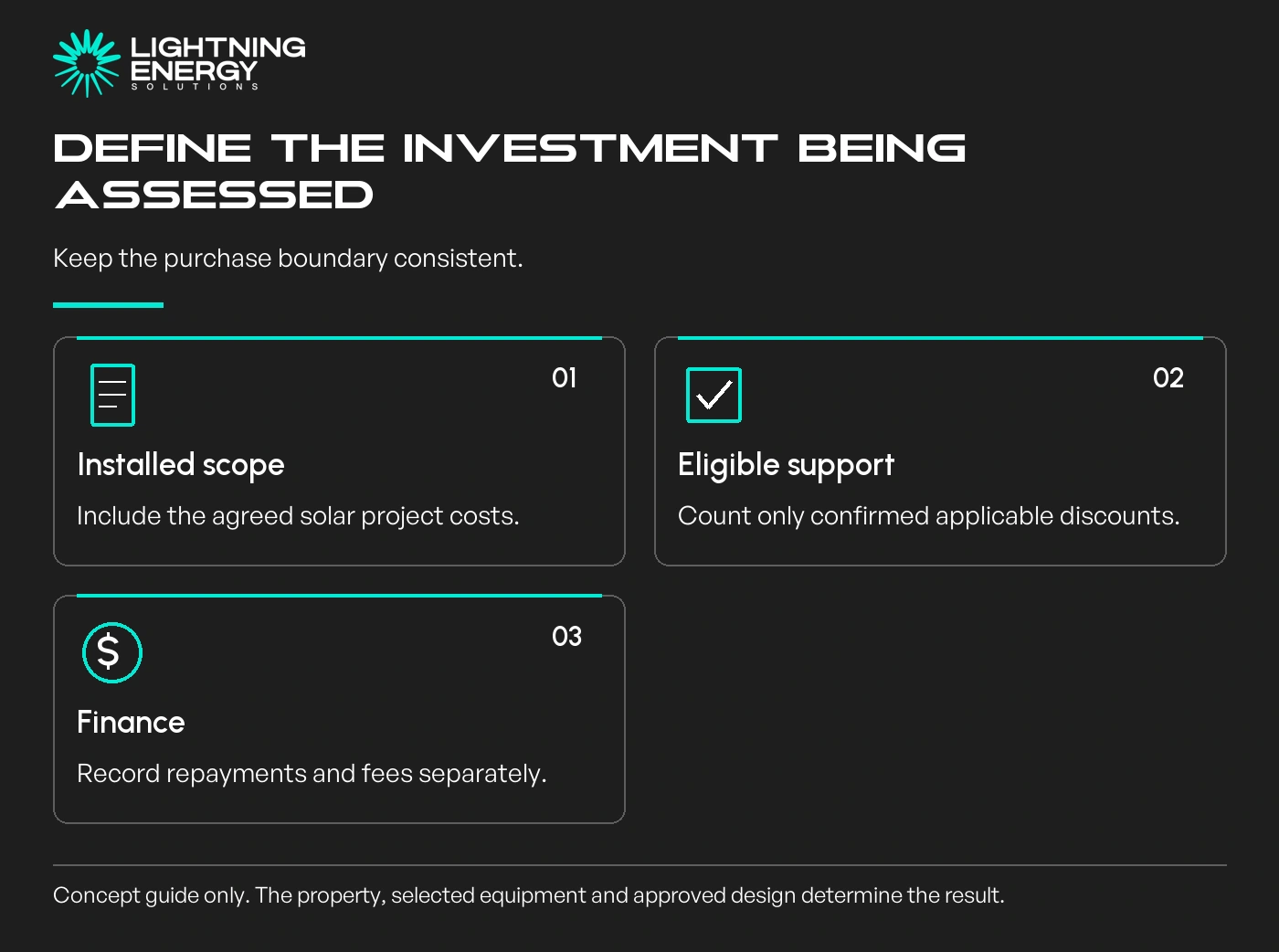
Use the installed price for the agreed scope after support you are eligible to receive. Keep a repayable loan separate: borrowing the money does not remove the purchase cost.
If you are comparing finance with cash, record the total finance cost and timing. If the roof or electrical installation needs work, decide which costs genuinely belong to the solar project and explain that choice.
Our installation-cost guide helps identify the scope that should be visible before a return is calculated.
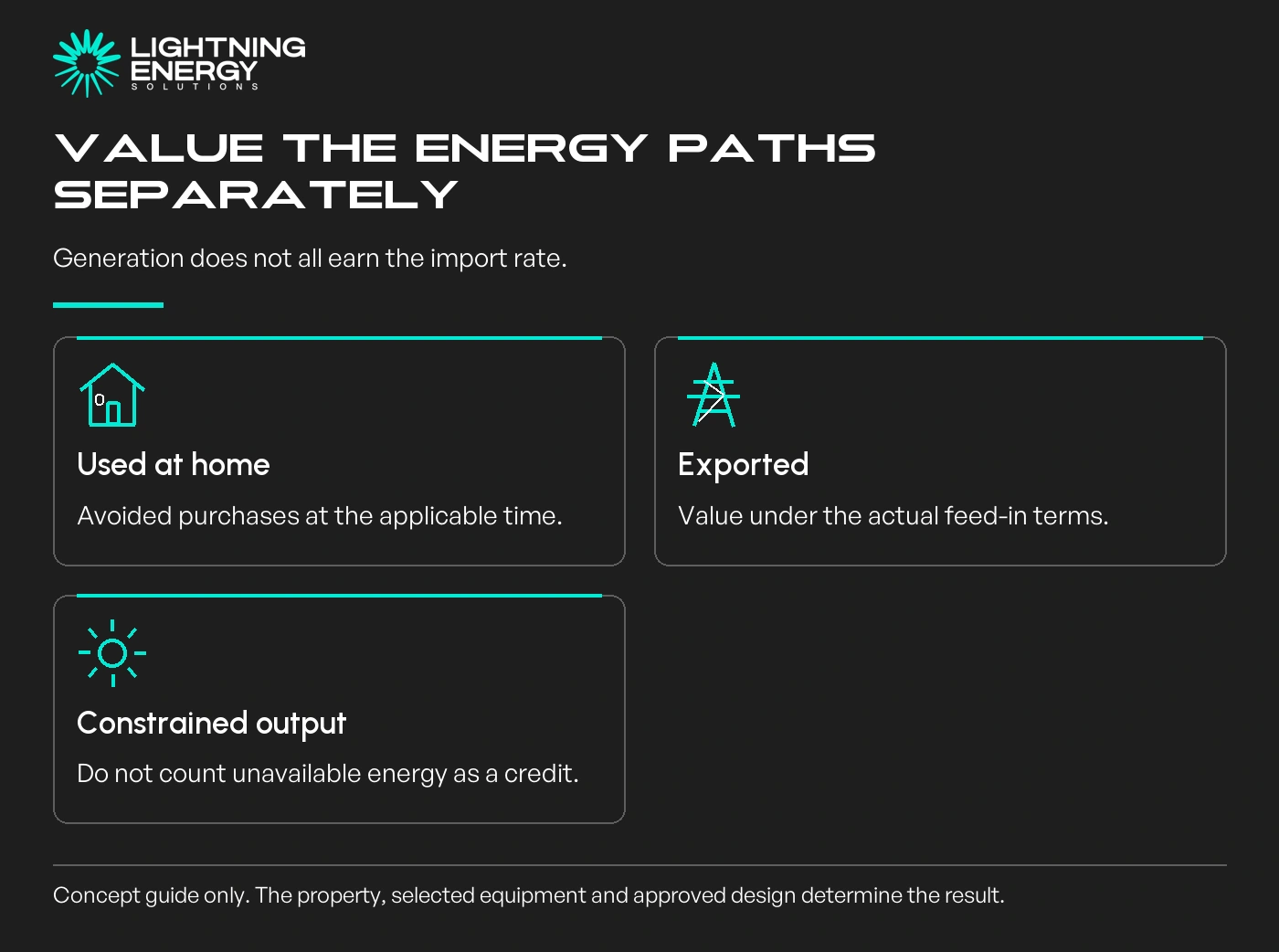
Estimate electricity used directly in the home and electricity exported, using the proposed layout and household timing. Value each at the applicable rate rather than multiplying all generation by the import price.
The Government financial guide describes self-consumption and export as different contributions to the result, and notes that weather, maintenance and future prices affect payback.
Government solar payback guidance.
Check that the estimate respects the approved export conditions. Electricity that cannot be used or exported should not quietly earn a credit in the calculation.
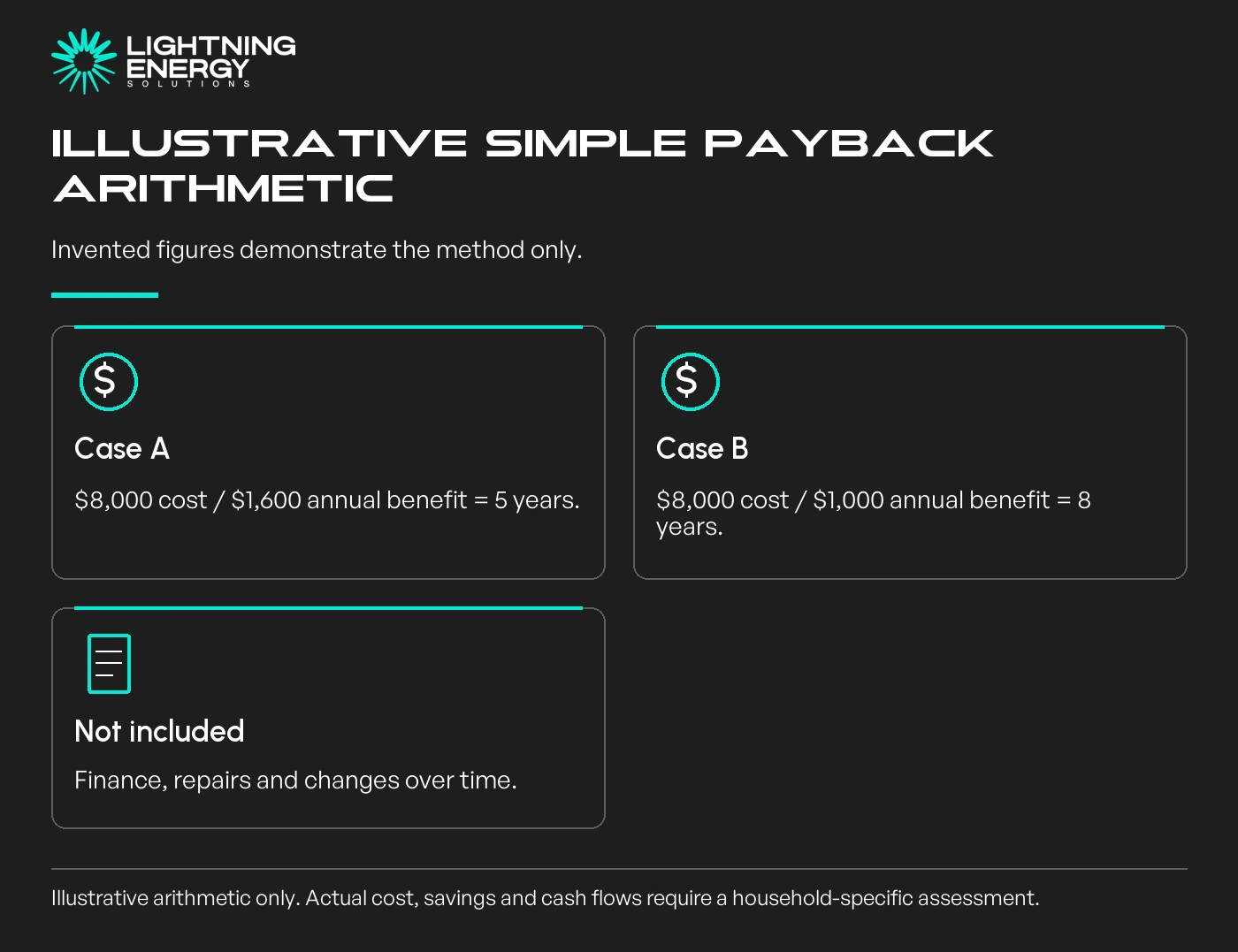
For illustration only, suppose an installation costs $8,000 and reduces the annual bill by $1,600 before future costs or changes. Dividing $8,000 by $1,600 gives a simple five-year payback.
Those numbers are invented to demonstrate the arithmetic. They are not a current quote, a Melbourne average or a prediction for your roof.
If the benefit were instead $1,000 a year under another stated scenario, the same arithmetic would give eight years. That difference shows why the assumptions deserve as much attention as the result.
A simple calculation also leaves out when cash flows occur, financing, performance changes and later repairs. A more detailed assessment should identify those assumptions explicitly.
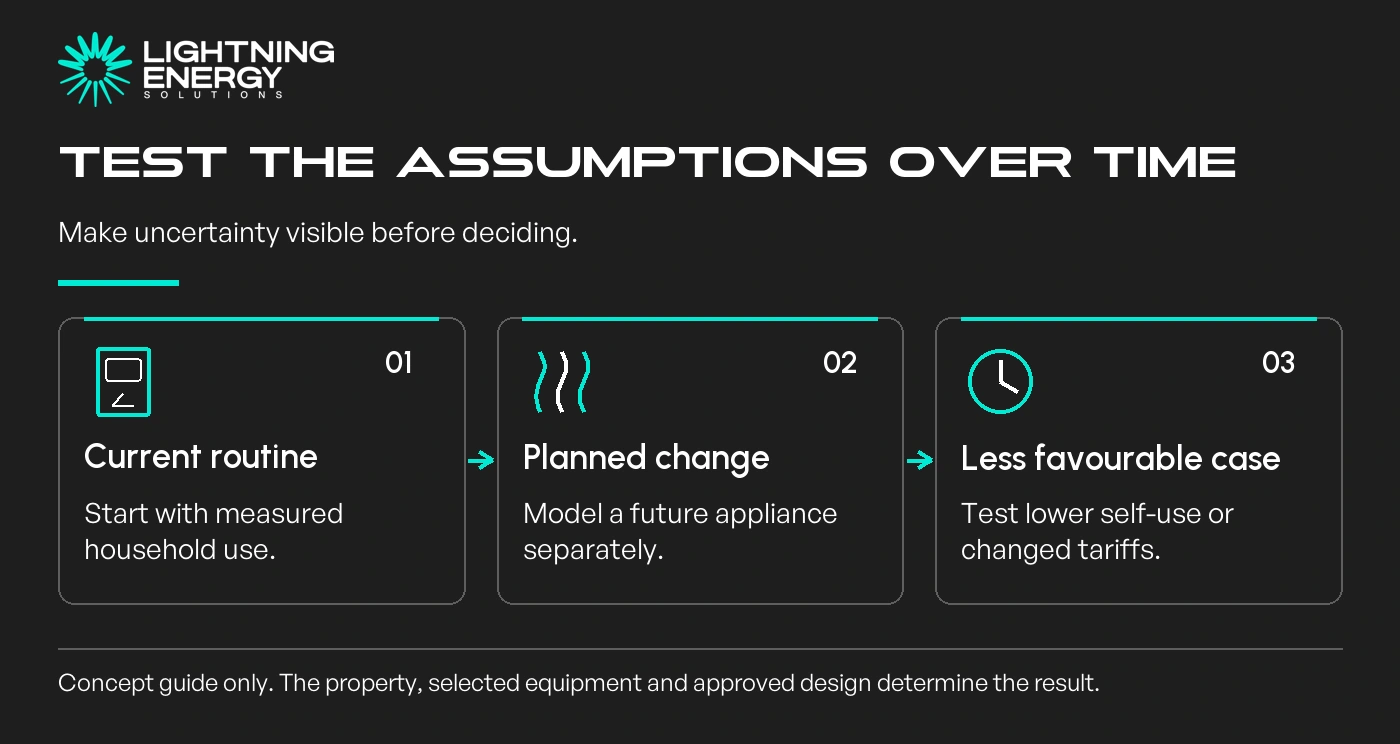
Ask for lower self-consumption and a different export price as sensitivity cases. If you expect an EV or new heating, show a delay in that purchase as another case.
Do not apply a future electricity-price increase to every component automatically. Usage rates, export terms and fixed charges can change differently.
Government guidance on tariff structures.
If a battery is proposed, compare its additional cost with its additional benefit. Combining it with a strong solar result can hide whether storage itself meets your objective.
There is no need to force a quick payback from a roof with serious limitations or a budget that cannot comfortably cover the work. Consider a different design or postpone the investment if the case is weak.
Conversely, a forecast need not be precise to the month to be useful. A transparent range can help you judge the decision more confidently than a single optimistic date.
Contact Lightning Energy with your bills and quotation. Ask for the base case, the less favourable case and the assumptions that matter most, so the decision remains understandable when circumstances change.
Available times
Book a consultation and we'll map solar, storage, hot water, and the rebates around your bills and your goals.
Question 1 of 6