Mitsubishi Heavy Industries Avanti Plus vs Mitsubishi Electric AP
Mitsubishi Heavy Industries and Mitsubishi Electric are separate manufacturers. Their Avanti Plus and AP ranges can both appear in a Victorian split-system shortlist, but the shared word in the brand name does not mean the equipment, controls or service arrangements are interchangeable.
LLightning Energy TeamLightning Energy27 October 2026 · 5 min read
Mitsubishi Heavy Industries and Mitsubishi Electric are separate manufacturers.
Their Avanti Plus and AP ranges can both appear in a Victorian split-system shortlist, but the shared word in the brand name does not mean the equipment, controls or service arrangements are interchangeable.
This is Australian document research, checked on 27 October 2026, rather than a hands-on noise or winter-performance test. We compare the 2.5 kW cooling class and explain what still needs checking for your room.
Start with matched capacity and exact pairs
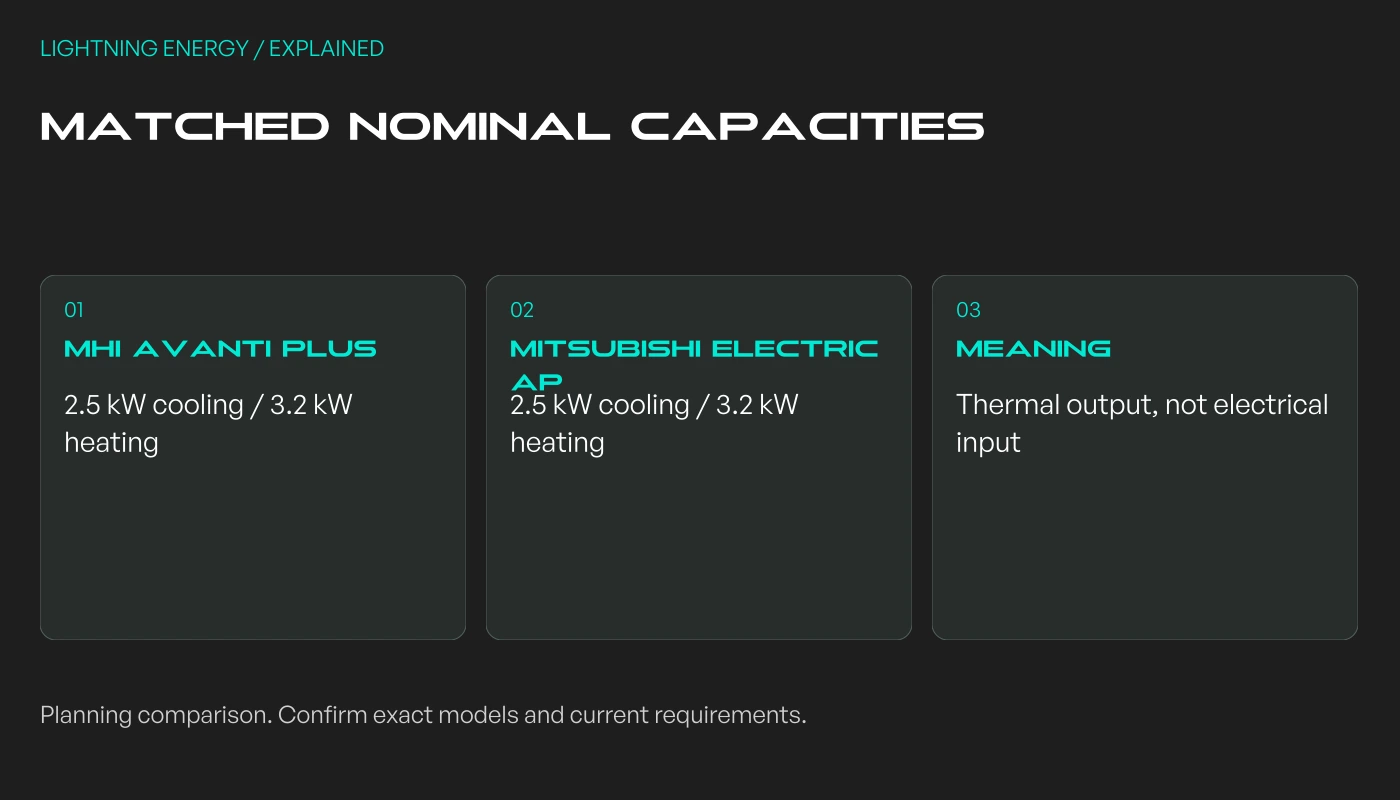
The MHI Avanti Plus specification lists SRK25ZSXA-WF with SRC25ZSXA-W at 2.5 kW nominal cooling and 3.2 kW nominal heating.
The Mitsubishi Electric AP Australian page lists MSZ-AP25VGKD2 with MUZ-AP25VGD2 at the same nominal capacities. Ask the supplier to confirm any additional suffix on the actual quote.
Those are thermal outputs, not constant electrical consumption. A room assessment should consider glazing, insulation, ceiling height, orientation and use before deciding that this size is suitable.
See our air-conditioning service information for the installation discussion. A bigger model is not automatically a better match for a small bedroom.
Planning comparison. Confirm exact models and current requirements.
Use the cold-climate label for a winter discussion
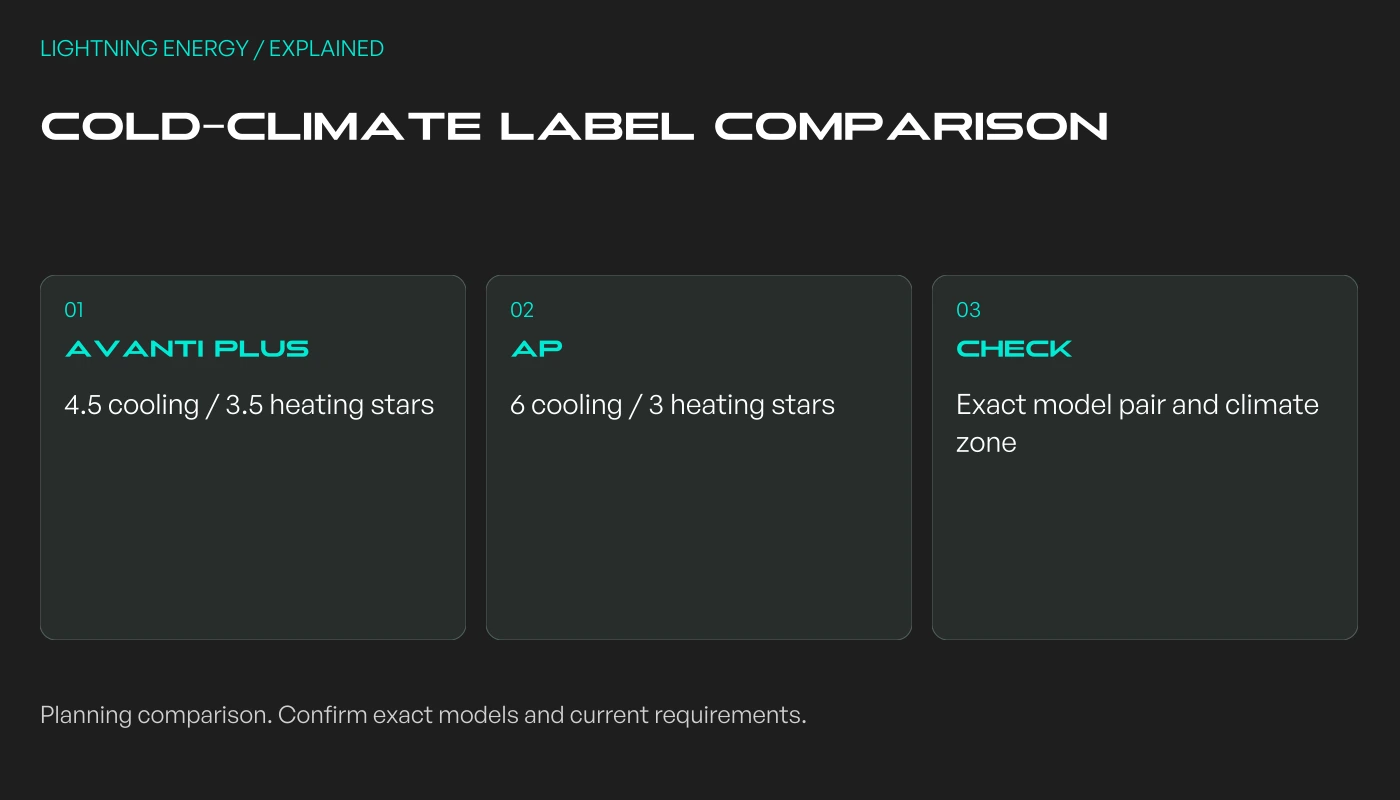
The manufacturers' published tables show cold-climate heating ratings of 3.5 stars for the selected Avanti Plus and 3 stars for the selected AP. Their cold-climate cooling ratings are 4.5 and 6 stars respectively.
These are seasonal label comparisons for the specified pairs, not a measured result in your home. Check the current label supplied with the exact equipment and compare the same climate zone and operating mode.
The different heating and cooling ordering is a useful reminder to consider when the room is used. A winter-heavy household should not choose solely on the most prominent cooling figure.
Planning comparison. Confirm exact models and current requirements.
Fit, airflow and sound belong in the same conversation
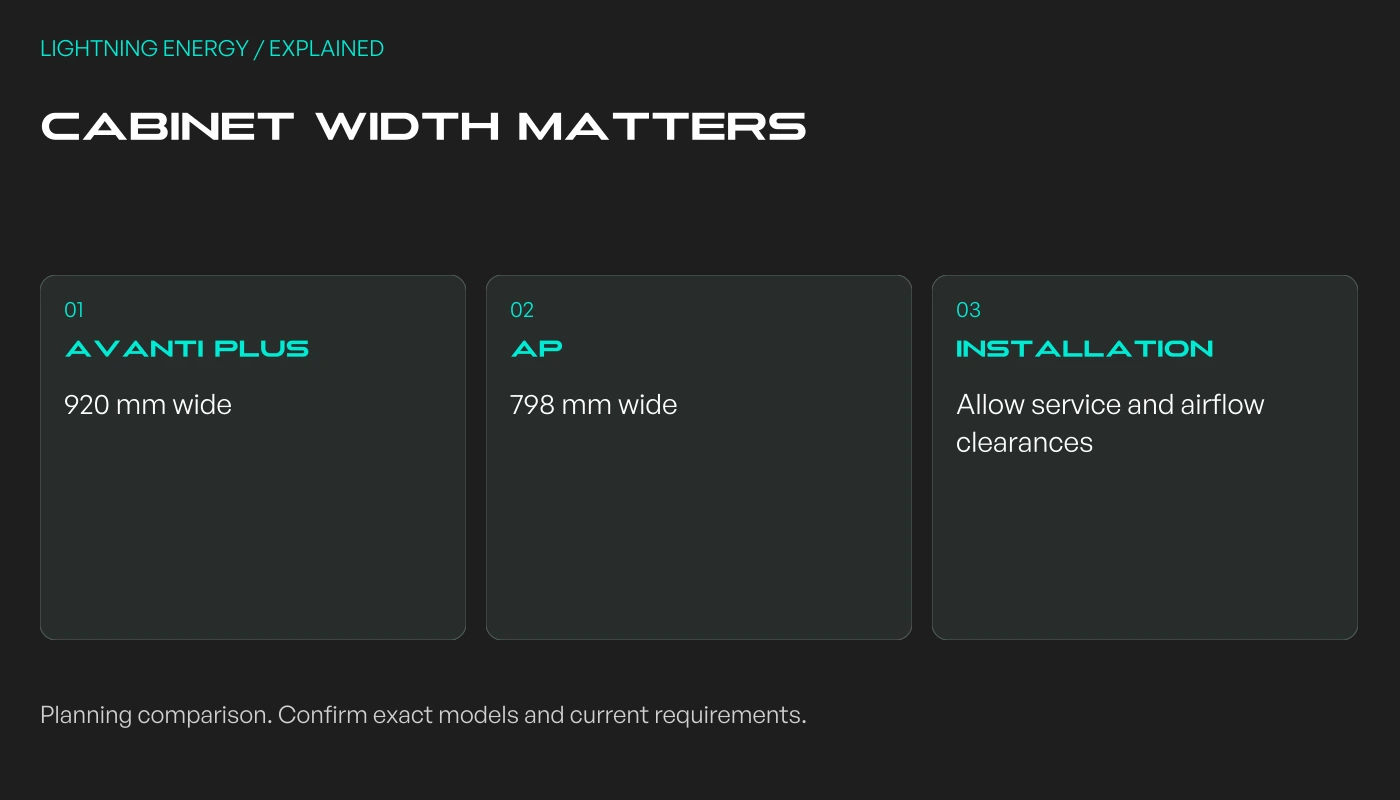
The published indoor dimensions are 305 × 920 × 220 mm for the selected Avanti Plus and 299 × 798 × 219 mm for the selected AP, expressed as height, width and depth.
That makes the AP narrower in this comparison. Required clearances, servicing access and airflow direction still need checking; the cabinet width alone does not establish that a location is suitable.
For sound, ask for indoor figures at comparable fan settings and the outdoor unit's specification. A lowest-fan sound-pressure number is not the same measurement as a sound-power figure on an energy label.
We have not independently measured either unit. Ask the installer about bed position, neighbour-facing outdoor placement and vibration control instead of assuming a brochure's quiet mode describes every operating condition.
Planning comparison. Confirm exact models and current requirements.
Confirm controls and warranty responsibilities
MHI's WF Avanti Plus version includes Wi-Fi; older W descriptions can differ. Confirm the supplied controller, app requirements and included accessories against the exact pair rather than relying on a family photograph.
MHI's current warranty terms list five years for SR-series residential parts, labour and compressor, with conditions including installation, maintenance and safe access.
Mitsubishi Electric's residential support page states five-year parts-and-labour cover for its M series. Read the current warranty card and clarify installation-workmanship support separately.
Ask who handles a fault first and which costs could arise for access or out-of-area attendance. Keep model numbers, invoices and installation records together. These voluntary warranties are additional to applicable consumer rights.
Planning comparison. Confirm exact models and current requirements.
Choose around the room and the household
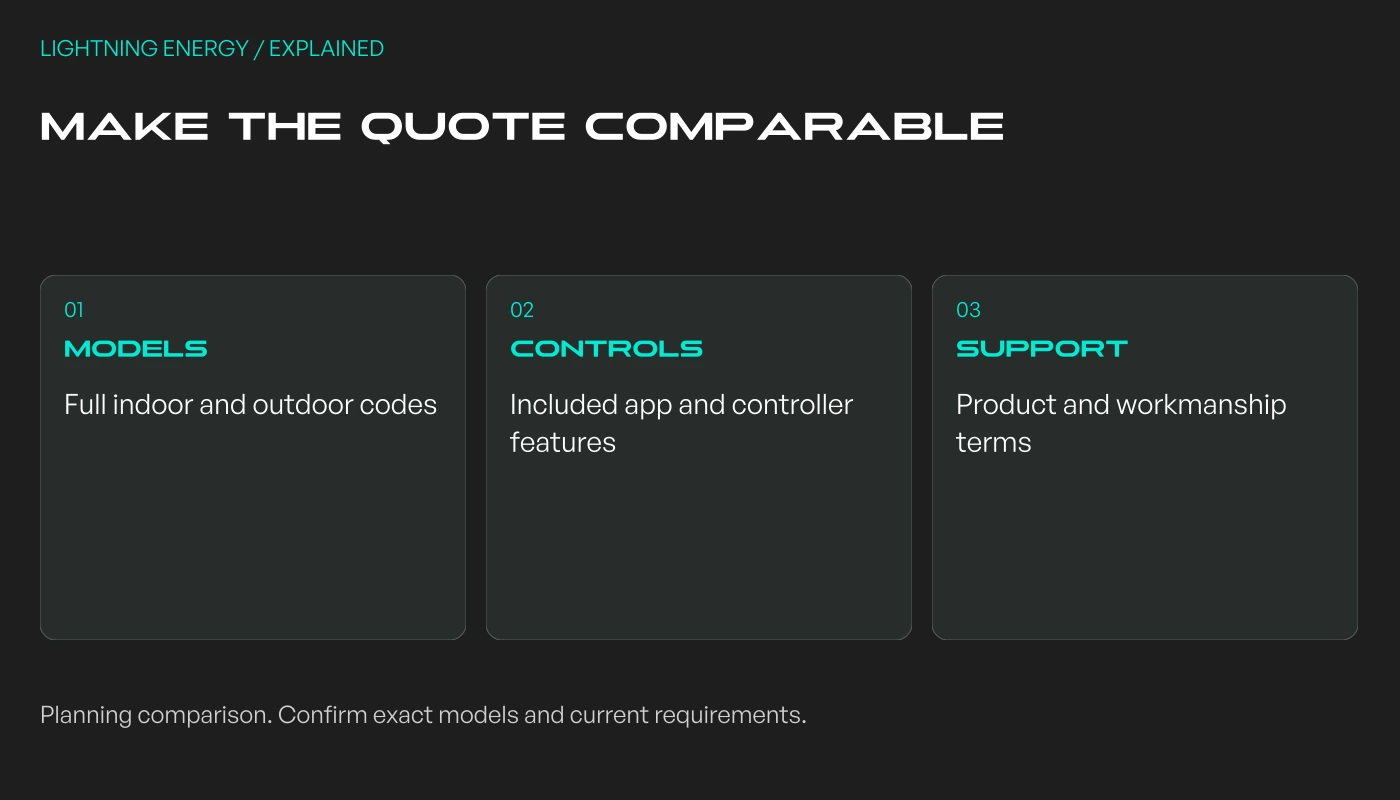
Request two quotes using the same room assessment, outdoor position and installation scope. Ask for commissioning, drainage, electrical work, disposal and controls to be included consistently.
If the home has solar, discuss daytime operation without assuming all heating will be solar supplied.
A battery assessment must account for the electrical load and winter generation, rather than using thermal output as battery demand.
Contact Lightning Energy with the room details and both full model pairs. The useful choice is the system and installation that suit your winter needs, space and support expectations.
Book a consultation and we'll map solar, storage, hot water, and the rebates around your bills and your goals.
Loading consultations…
Lightning EnergyPlan your next energy upgrade.
⚡
Hi, I’m Lightning Energy’s project guide. I’ll ask a few practical questions, explain what usually matters for your project, and help you decide on a useful next step — no guesswork or sales pressure.
First, what kind of property are we planning for?