SA's StrataCharge Explained: Grants and Zero-Interest Loans for Shared Solar and Batteries in Apartments and Strata
South Australian strata communities can now apply for a grant covering up to 50% of a shared solar and battery system, plus an optional zero-interest loan for the rest. Here is who qualifies and the steps to get your committee moving.
LLuke CoveLightning Energy27 November 2026 · 6 min read
If you live in an apartment, unit or townhouse complex in South Australia, you have probably watched rooftops across the suburbs fill up with panels while yours stays bare.
The roof is shared, the decisions are shared, and nobody quite knows where to start.
Source and editorial check: 27 November 2026. This guide uses published information; it is not a hands-on test or a report of a customer installation.
A new program is built for exactly that.
It is called StrataCharge, and it opens applications for shared solar and battery systems in strata and community title buildings.
This guide covers who it is for, what it pays for, and the practical steps to get a strata committee moving.
In a strata building, the roof is common property.
A system needs a vote, a fair way to share the power, and a plan for who pays.
Renters are in the same bind.
You pay the power bill, but you cannot put anything on a roof you do not control.
Your bill should not depend on whether you live in a house or an apartment, and StrataCharge is designed to chip away at that gap.
What StrataCharge offers
According to the StrataCharge website, eligible applicants can access three things:
Conceptual guide. Check current terms and your installation.
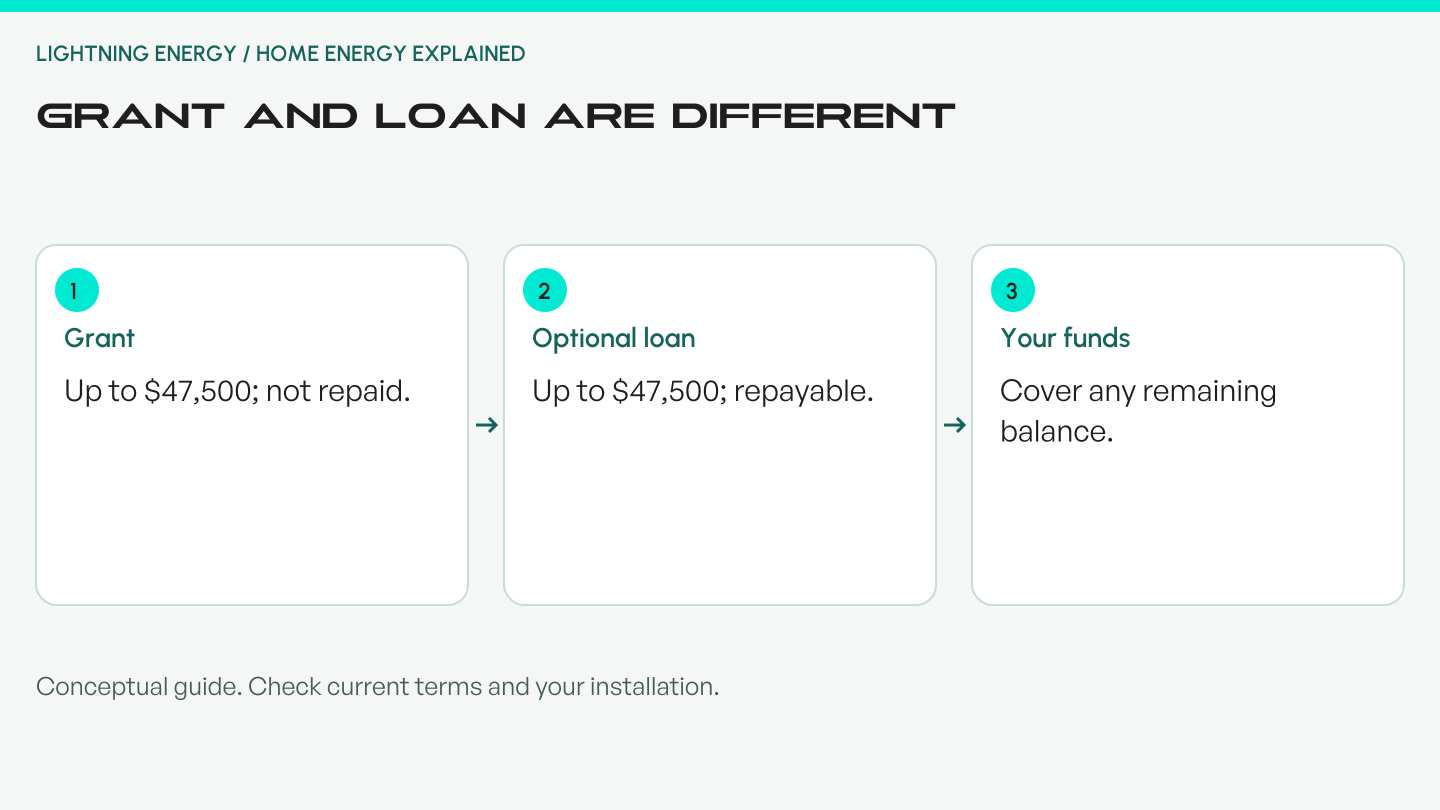
A grant for up to 50% of the cost of a shared solar and battery system, to a maximum grant of $47,500.
An optional zero-interest loan for the remaining system costs, to a maximum loan of $47,500.
And guidance on system sizing, information to support discussions with your strata corporation, and the application and approval process.
The program is delivered by the Government of South Australia, co-funded through the Australian Government's Community Solar Banks Program, and administered with finance partner Brighte Capital.
The loan runs over five years with fixed monthly repayments, and Brighte says a missed repayment attracts 4% a year on the overdue amount only.
The $47,500 figures are caps, not a promise of what your building will receive.
Together they mean up to $95,000 of support per strata corporation, and your corporation covers any balance from its own funds.
A battery is a requirement, and the loan is optional, so a corporation can take the grant and fund the rest itself.
Who can apply, and which buildings qualify
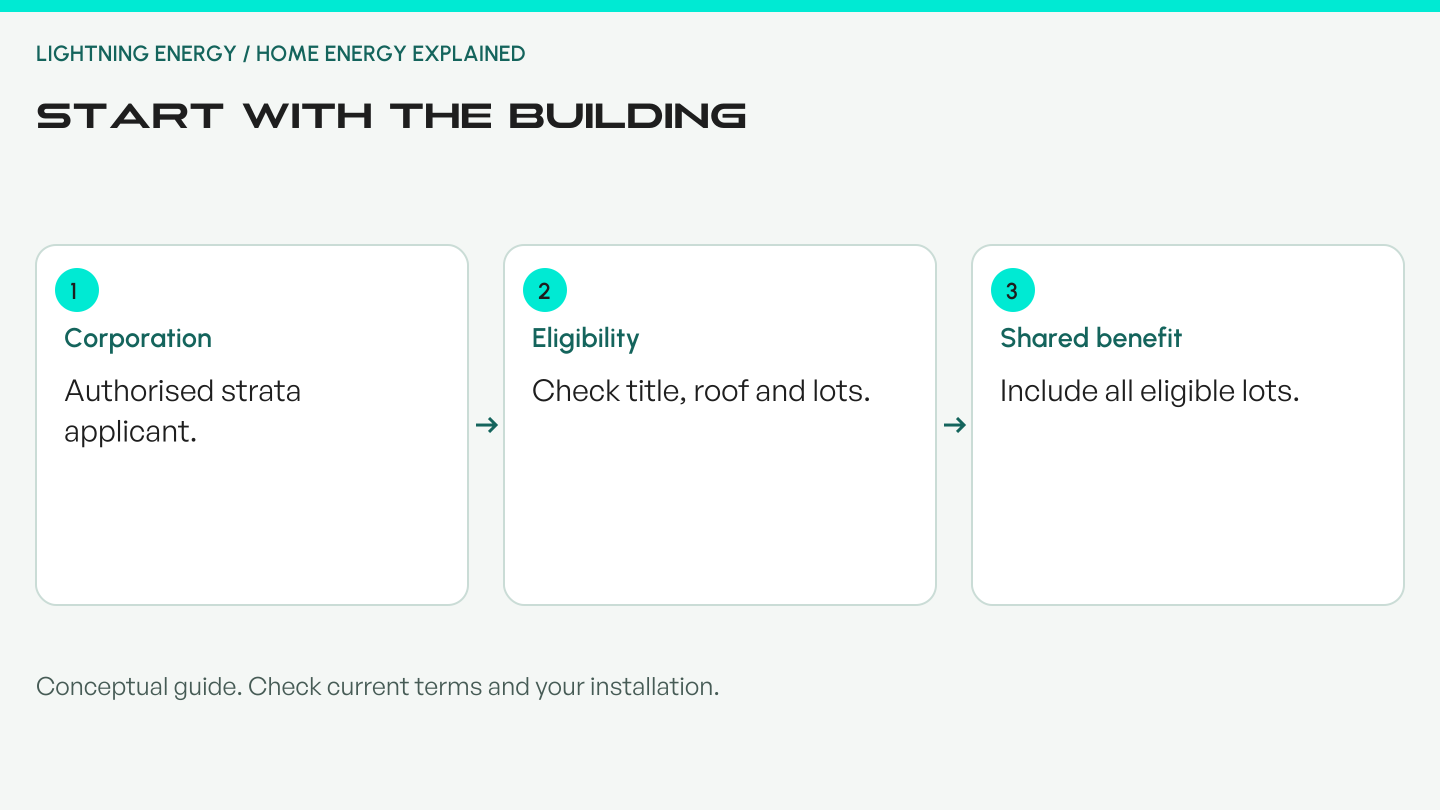
The application comes from the strata or community corporation, not from an individual owner.
It can be lodged by an authorised committee member, a body corporate manager or an authorised resident.
According to the official summary, a building should:
Be a completed residential development with at least three lots, be a Class 2 building, be connected to the SA Power Networks grid, be in South Australia, and have a common roof area big enough for rooftop solar.
It also should not already have a solar array.
The program lists a median lot capital value limit of $750,000 and a few other conditions.
Conceptual guide. Check current terms and your installation.
Missing one of those does not shut the door.
The program says applications that do not meet every requirement can still be submitted and are assessed case by case, although buildings with existing systems or works underway need a strong case.
Read the full program guidelines before you lodge.
What it means for renters
The official FAQ says the system must share costs and benefits fairly across all lots, including rented ones, and that everyone in the building needs to take part.
Residents keep their current electricity retailer and billing arrangements.
If a landlord tries to recover any of the cost, it must be reasonable, and South Australian tenants are protected by the Residential Tenancies Act 1995.
The corporation makes the application, so renters should ask their committee to look.
A plan to get your strata committee moving
The official process has a set order, and it differs a little from how many committees would naturally tackle it.
Here is a practical way through.
**1.
Raise it at a committee meeting, AGM or EGM.** Put StrataCharge on the agenda and share the program page.
You are only asking the committee to look at it.
**2.
Check your building against the eligibility summary.** Look at lot count, building class, roof, existing solar and the grid connection.
Find your registered strata plan, which your strata manager usually holds, because you need it to apply.
Conceptual guide. Check current terms and your installation.
**3.
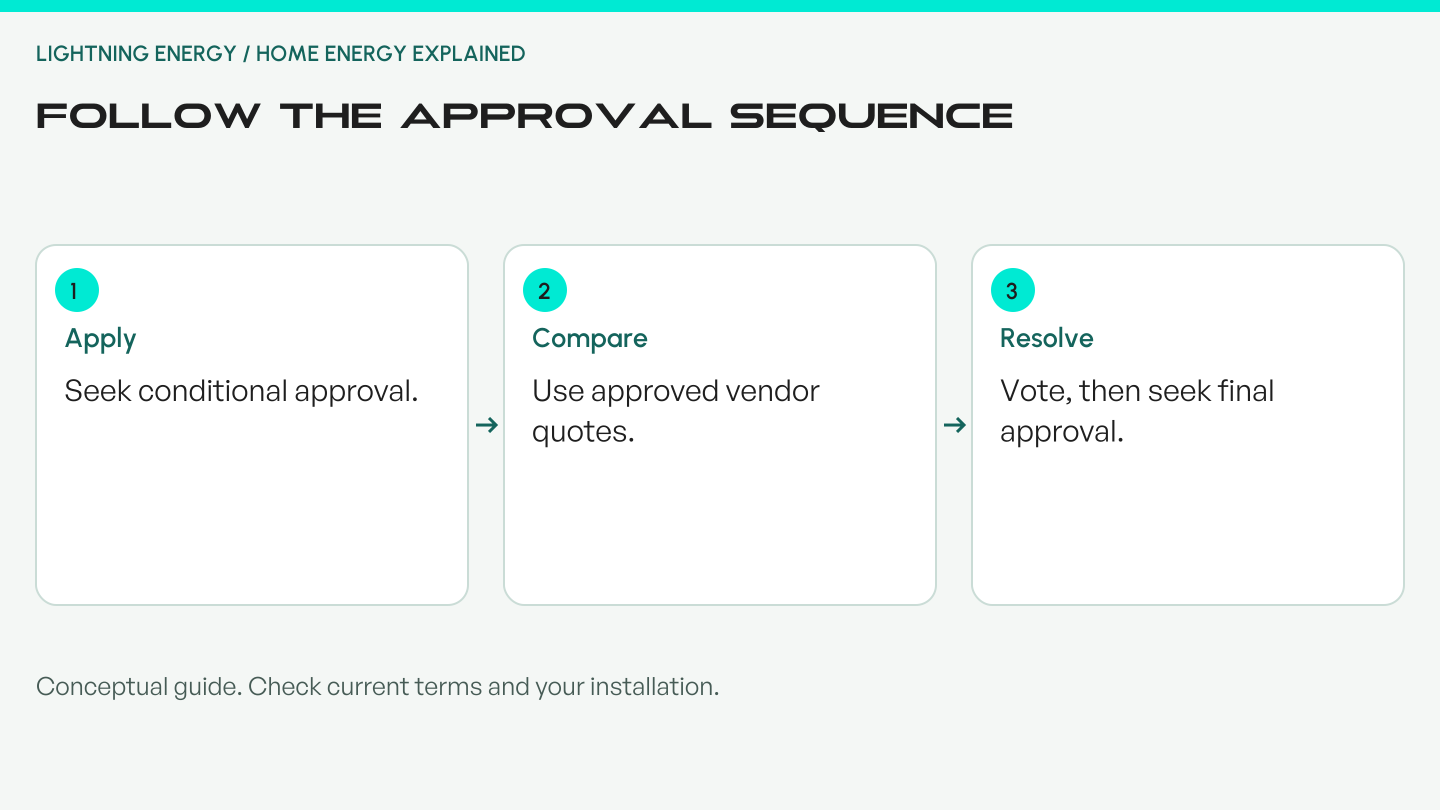
Apply online for conditional approval.** The corporation applies first, and the StrataCharge team reviews it.
Only after that do you choose a vendor and collect quotes.
**4.
Get quotes from approved vendors.** The official FAQ says the system must be installed by an approved vendor listed in the StrataCharge Marketplace.
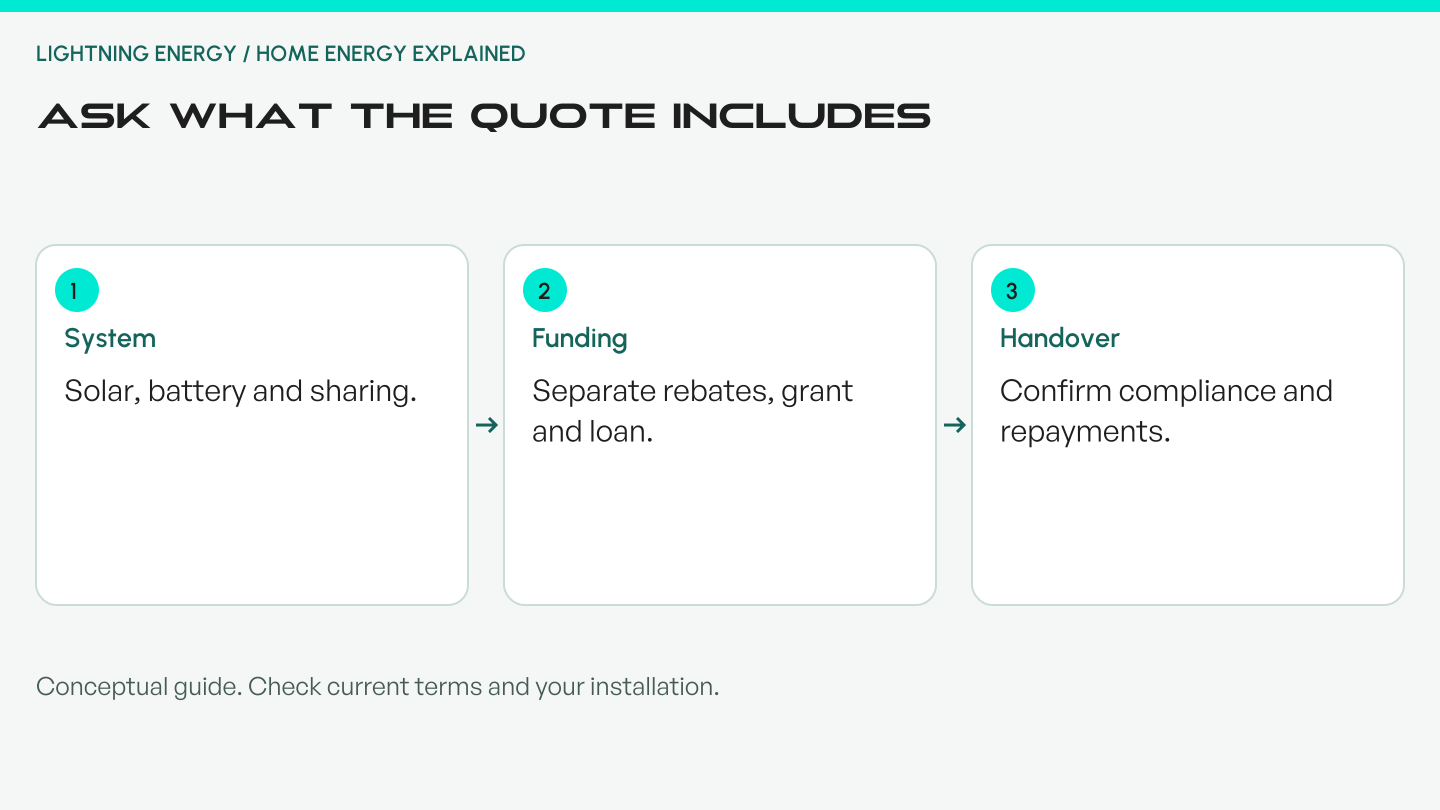
Compare system sizing, battery capacity, energy-sharing technology, switchboard work and exclusions. Show the grant, optional loan and corporation’s own contribution separately.
**5.
Use your support pack and pass a special resolution.** StrataCharge sends a pack to help you put the proposal to the corporation.
The required special resolution is a formal vote on your preferred quote.
**6.
Apply for final approval and finance.** Submit evidence of the resolution, proof of authority to apply and current building insurance.
If you want the loan, Brighte completes the credit assessment.
**7.
Installation and payment.** The installer issues an electronic Certificate of Compliance.
Once you confirm the work is complete, the grant is paid directly to the vendor, and any loan repayments begin.
Where the federal battery rebate fits
Conceptual guide. Check current terms and your installation.
The StrataCharge administrator’s FAQ says grant and loan calculations use eligible costs after STCs and other government rebates.
Ask the approved vendor to show the federal incentive, StrataCharge grant, any loan and your contribution on separate lines.
Eligibility for one program does not automatically establish eligibility for another.
Make the quote do the talking
Shared systems are bigger and more complicated than a typical house job, so a clear quote matters more.
Product choice must also satisfy StrataCharge requirements.
Cover: existing Lightning Energy site photography used for product or solar context. It does not identify a customer, location, grant recipient or approved StrataCharge system.
Book a consultation and we'll map solar, storage, hot water, and the rebates around your bills and your goals.
Loading consultations…
Lightning EnergyPlan your next energy upgrade.
⚡
Hi, I’m Lightning Energy’s project guide. I’ll ask a few practical questions, explain what usually matters for your project, and help you decide on a useful next step — no guesswork or sales pressure.
First, what kind of property are we planning for?