Paying a Deposit on a Home Battery? What the Rules Say in VIC, NSW and SA
Before a battery lands on your wall, a deposit leaves your account. Here is what Victoria, New South Wales and South Australia actually say about deposits, and what a fair payment schedule looks like on a proper quote.
LLuke CoveLightning Energy27 November 2026 · 6 min read
You have done the homework.
You have compared quotes line by line, you know the size you want, and one installer looks right.
Source and editorial check: 27 November 2026. This guide uses published information; it is not a hands-on test or a report of a customer installation.
Then the quote lands with a deposit line, and it is a big number.
The money leaves your account weeks before any battery arrives.
It is a fair thing to stop and check.
This guide covers what Victoria, New South Wales and South Australia say about deposits, how to read the deposit line on a quote, and what a sensible payment schedule looks like.
It is general information, not legal advice.
Rules change, so check the official page for your state before you pay.
Why the deposit feels like the risky part
A deposit is the one payment you make with nothing to show for it yet.
The installer has your money, and you have a piece of paper.
The size of the deposit decides how much of your money is out there while you wait, and no one hands you a rulebook for what is normal.
Victoria: negotiable, with 10% as a common guide
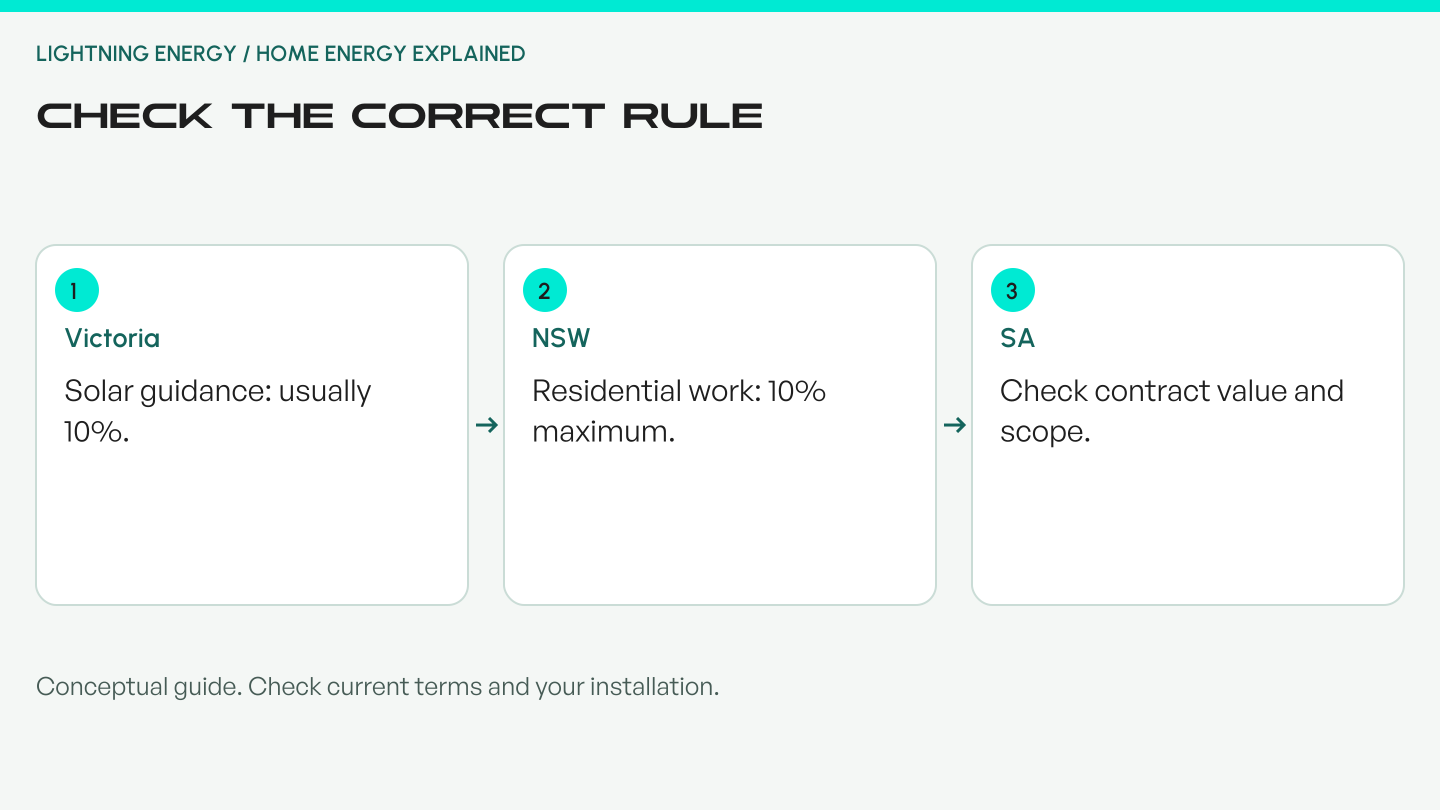
Consumer Affairs Victoria's solar energy guidance lists, under 'Before signing a contract', that you should negotiate the amount required as a deposit, and says it is usually 10%.
That is a rule of thumb, not a legal limit.
The page does not set a cap for solar or battery installs.
Victoria does cap deposits on domestic building work.
Conceptual guide. Check current terms and your installation.
Consumer Affairs Victoria's deposits and payments page says the cap is 10% for contracts under $20,000 and 5% for contracts of $20,000 or more.
That page is about building, renovating and extending a home.
We could not confirm from official sources that it applies to a stand-alone battery install, so treat 10% as a guide and read your own contract closely.
New South Wales: a 10% maximum, plus insurance on bigger jobs
The NSW Government's guidance on installing solar panels says the Home Building Act 1989 sets the maximum deposit at 10 per cent of the contract price.
A written contract comes before a request for money. For covered work above $20,000 including GST, the contractor must provide evidence of Home Building Compensation cover before receiving a deposit.
Confirm the rule for the scope of your installation with CBS, particularly for battery-only work.
The factsheet uses a $20,000 contract threshold including STCs for written domestic building work contracts.
It describes a maximum 5% deposit for contracts above $20,000, with specified third-party payments treated separately.
At the threshold itself, confirm the applicable requirements with CBS.
Do not calculate the threshold from the discounted customer payment alone.
Scope matters. Building-work rules do not automatically cover every battery job.
What the rules do not tell you
No state page gives you a figure that is right for your job.
A cap is a ceiling, not a recommendation.
A deposit under the cap can still be larger than you are comfortable with, and a deposit that is higher than the usual 10% is worth understanding rather than assuming.
A proper quote explains it.
Outside Victoria, New South Wales and South Australia, the rules differ.
Check your own state's consumer affairs page if you live elsewhere.
Where your deposit actually goes
A deposit typically covers the start of your job: securing your installation slot, ordering equipment, and the design and network paperwork before install day.
A proper quote says which of those it is paying for.
In South Australia, building law also allows certain advance payments, such as insurance premiums and third-party professional costs, so the contract should spell out any payment beyond the deposit.
The New Energy Tech Consumer Code, which applies to Approved Sellers, is useful here.
The code says a quote must specify the deposit payable, if any, and the total price.
It also says the seller must give you a receipt for any deposit or payment.
You can look up an Approved Seller on the same site before you commit.
What a fair deposit and payment schedule look like
Pulling that together, here is what a proper installer or quote shows before you pay a cent.
Conceptual guide. Check current terms and your installation.
1.
The deposit as a dollar amount and a percentage, and the price it is calculated on.
A proper quote makes clear whether that is the price before or after incentives, because your state's rule may use one or the other.
2.
Incentives shown separately.
Ask which eligibility rules, installation date and certificate value the quote assumes.
A rebate estimate is not a reason to accept an unclear deposit or payment schedule.
3.
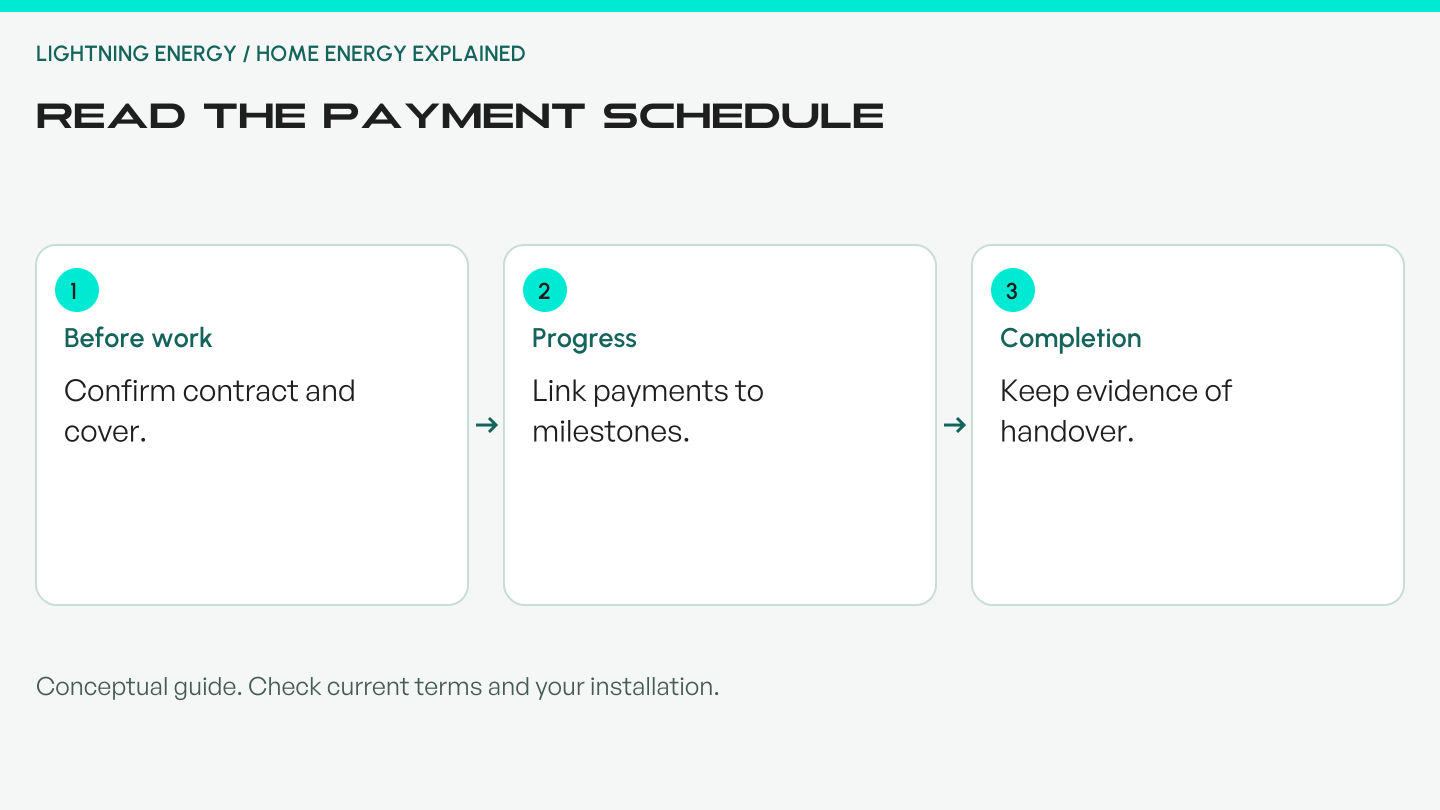
A payment schedule with a purpose for each payment: the deposit, any payment on delivery or installation, and the balance on completion.
Each line says when it is due and what it pays for.
4.
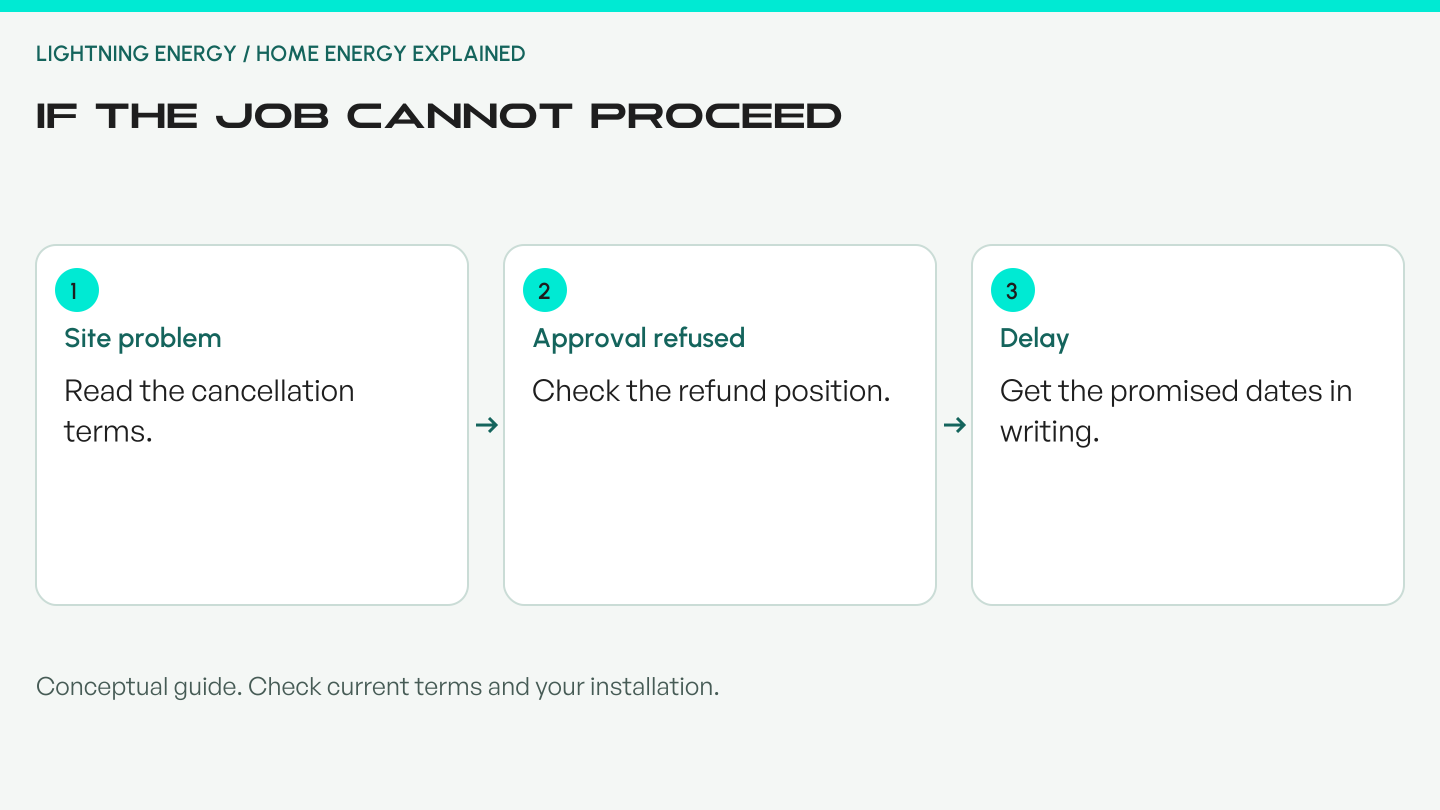
A refund position in writing.
If the install cannot go ahead, for example because the site is unsuitable or a network approval is refused, the contract says what happens to your deposit.
5.
A realistic install timeframe, so you know how long your money is out before the work happens.
6.
Licences and cover.
Conceptual guide. Check current terms and your installation.
In New South Wales, home building compensation cover for jobs over $20,000.
In South Australia, the contractor's licence you can check on the CBS register.
In Victoria, the installer's accreditation and the warranty terms.
7.
A receipt for every payment, and a payment method that leaves a record.
Keep the quote, contract and receipts together.
Your next step
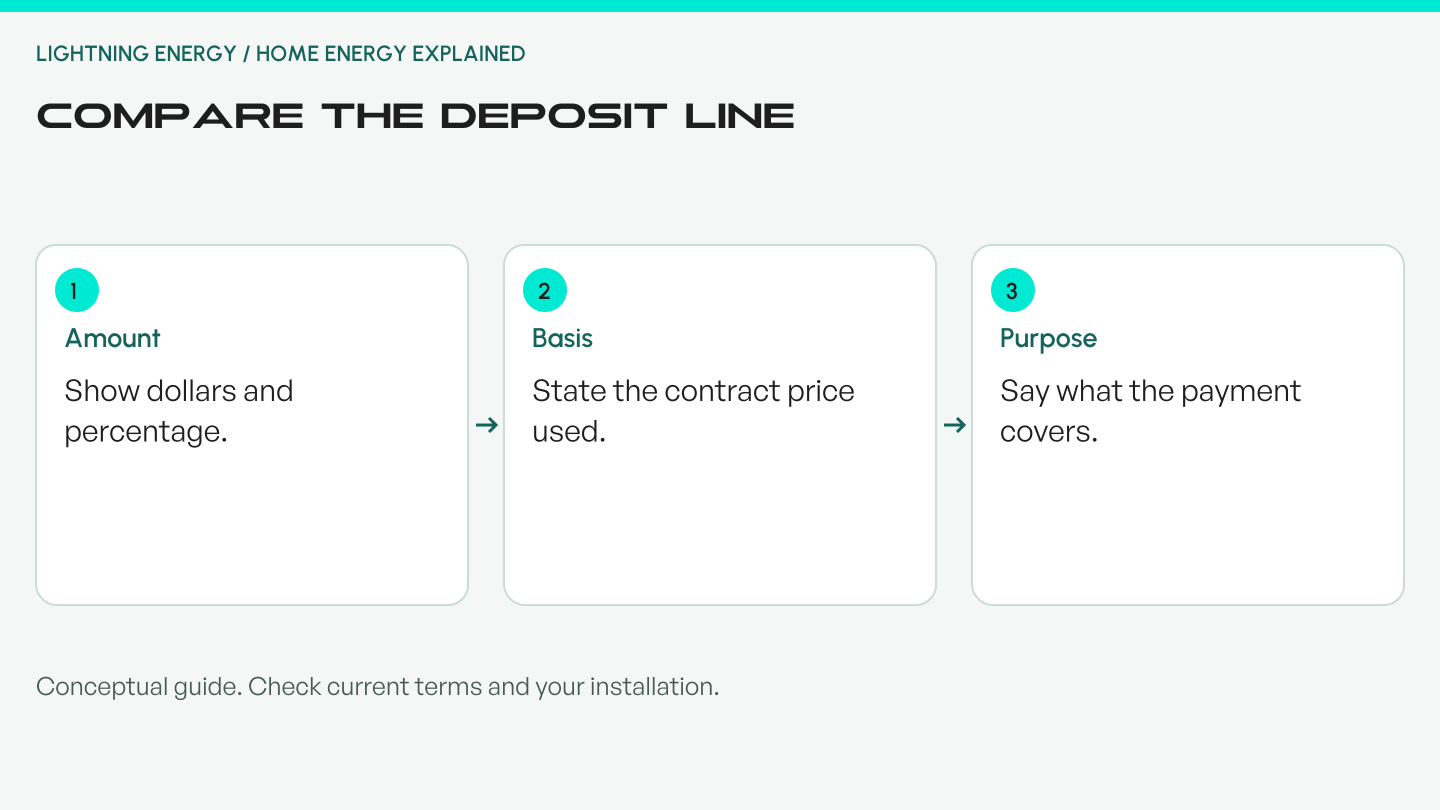
Pull out your quotes and compare the deposit line side by side: the percentage, the price it is based on, and the payment schedule that follows.
Book a consultation and we'll map solar, storage, hot water, and the rebates around your bills and your goals.
Loading consultations…
Lightning EnergyPlan your next energy upgrade.
⚡
Hi, I’m Lightning Energy’s project guide. I’ll ask a few practical questions, explain what usually matters for your project, and help you decide on a useful next step — no guesswork or sales pressure.
First, what kind of property are we planning for?