
Solar EV Charging: Sharing Power with Your Home Battery
Set useful charging priorities for your car, home battery and household, understand solar diversion, and keep a dependable fallback for cloudy days and early departures.
Set useful charging priorities for your car, home battery and household, understand solar diversion, and keep a dependable fallback for cloudy days and early departures.

Plugging an electric car in while the sun is shining is a good start. Getting the most from a home with solar, a battery and an EV takes a little more planning.
All three are sharing the same supply, and the car can become the biggest flexible load in the house.
The useful question is not simply “Can this charger use solar?” It is “What happens when a cloud arrives, the home battery is low, or I need the car ready by seven tomorrow morning?”
Those everyday situations reveal whether the setup suits your household.
Build the charging plan around the energy you need to replace, rather than assuming a full charge every night. Use the car's own recent consumption and your normal distance to estimate a daily requirement.
For example, 40 km at an illustrative 16 kWh per 100 km uses about 6.4 kWh of driving energy. Charging needs a little more energy at the wall because there are losses.
Actual consumption changes with the vehicle, speed, terrain, weather and climate control, so use this as a calculation method rather than a prediction.
Australia's government EV guidance recommends assessing charging speed against your driving habits and checking the vehicle manufacturer's charging instructions.
It also explains that smart controls can schedule charging around solar or electricity prices. How to charge your electric vehicle.
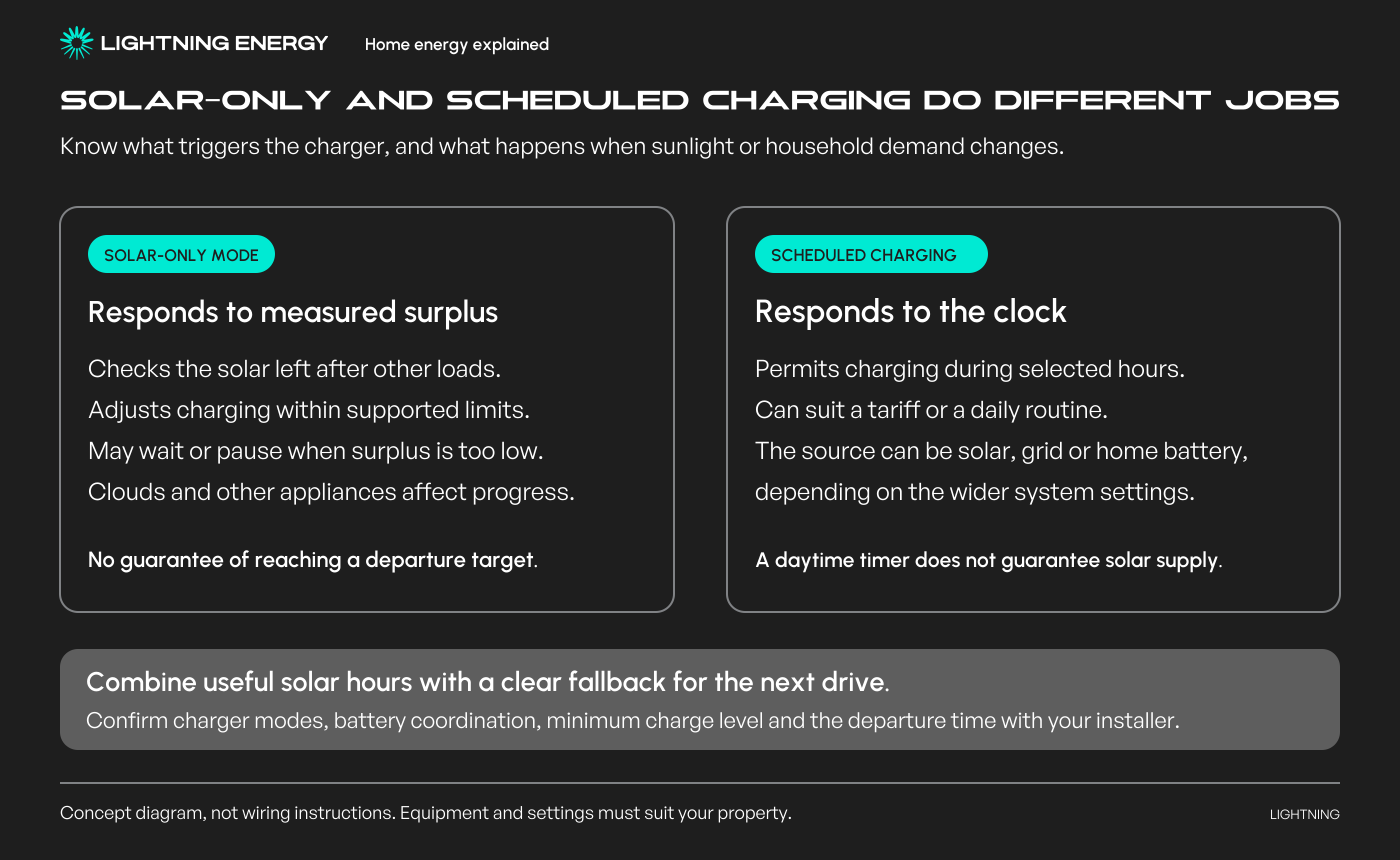
A timer starts charging at selected hours. It is useful when your car is usually home during a reliable solar window, but the timer does not know whether clouds have reduced generation or someone has switched on the oven.
Solar-diversion charging measures available surplus and adjusts charging to suit, within the limits of the charger and vehicle. Some modes pause when surplus falls; others permit electricity from the grid or home battery to keep charging.
Ask for a demonstration of the specific mode you are buying.
The minimum available surplus also matters. For example, Evnex's technical documentation describes roughly 1.4 kW as the minimum consumption for single-phase AC charging, with higher configured start thresholds to manage operation.
The exact behaviour depends on the equipment and settings. Evnex solar-charging documentation.
A small amount of excess solar may therefore be exported while the charger waits. That can be normal operation rather than a fault.
Your household has several competing needs: appliances running now, energy for tonight, hot water and the car's next trip. There is no one priority order that suits every day.
On a working-from-home day, topping up the car in sunlight may be convenient. Before a long drive, reaching the required vehicle charge can matter more than filling the home battery.
On an ordinary day when the car is already comfortable for tomorrow, reserving energy for evening household use may suit you better.
Write down these priorities before choosing EV charging equipment. Some combinations offer integrated control, while others have fixed behaviour or need carefully coordinated schedules.
As one example, Evnex describes its solar-diversion mode as taking surplus after other loads and battery charging; overriding with “Charge Now” changes that behaviour.
That is a product-specific arrangement, not a universal setting available on every charger. Evnex solar diversion.
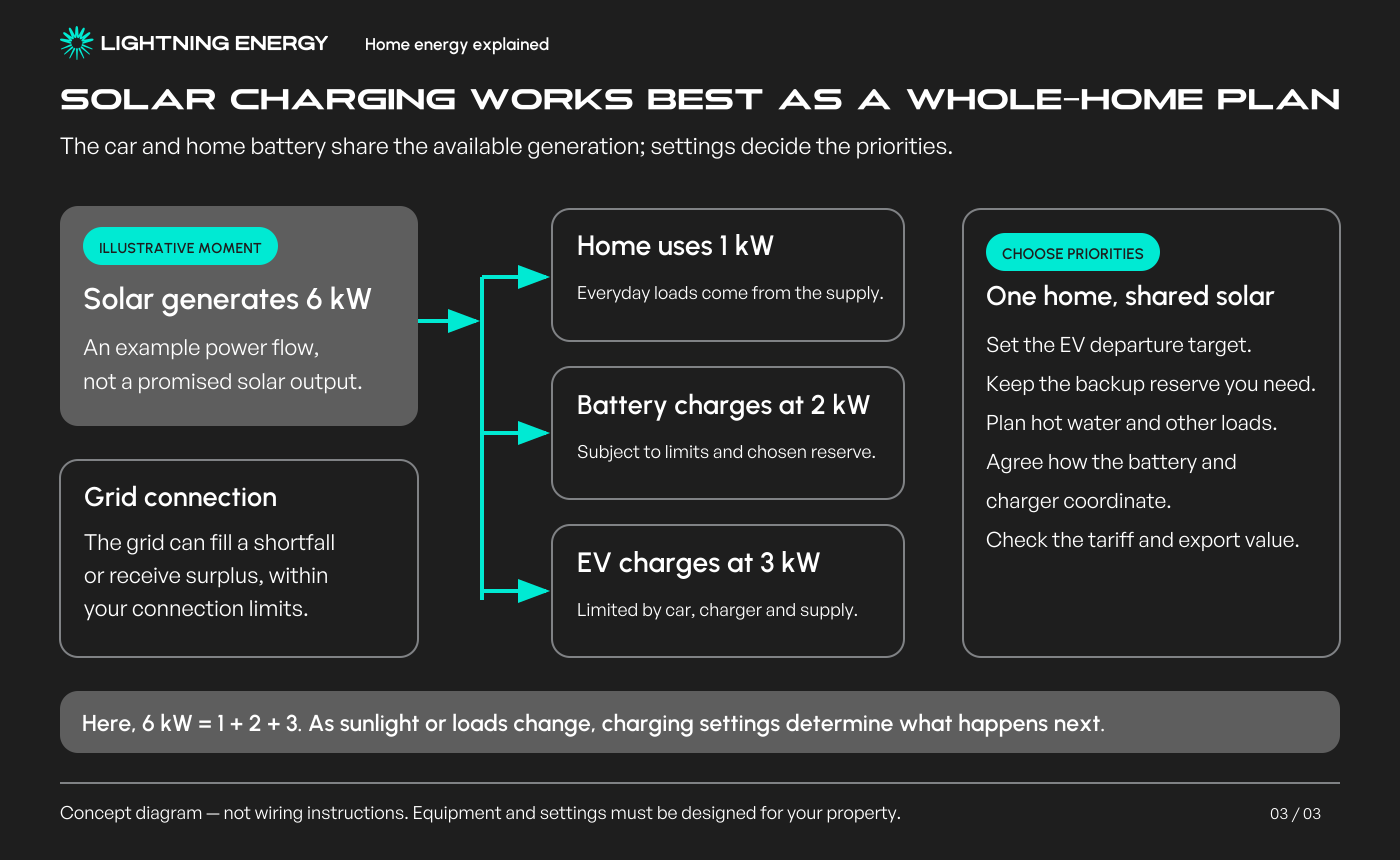
If the home battery treats the EV as another household load, it may discharge into the car. Sometimes that is intentional. Sometimes it leaves very little stored energy for cooking, cooling and lights later that evening.
Ask your installer to confirm what the monitoring equipment measures and how the charger behaves alongside your battery.
Request a practical test with the EV charging: check solar production, battery charging or discharging, household demand and grid import together.
Evnex's Australian FAQ explicitly describes configurations for using stored energy in a car or avoiding that discharge. The choice needs to suit the installation and your priorities.
Evnex Australian charging FAQs.
Also check scheduled overnight charging. Choosing a cheap overnight window does not automatically prevent the home battery supplying the car.
The battery's controls may need coordination with the charger, particularly if a retailer or energy-management service also operates the system.
Solar-only charging can work well when the car spends enough daylight hours at home. A commuter whose vehicle is away most weekdays has a different opportunity: weekend solar top-ups and scheduled grid charging may be more practical.
Solar Victoria points out that the solar array, vehicle battery and charging arrangement all influence what is possible. Regular top-ups are a more useful starting point than expecting every system to refill an empty vehicle in one day.
Agree on a fallback with a clear departure time and charge target. Review the whole electricity plan, including household rates and feed-in terms, before choosing a tariff because of an attractive charging window.
The best routine is one your family can live with through cloudy weeks as well as sunny weekends.

A charger's advertised maximum power is only one part of the decision. The car's AC charging capability, available household supply, phase arrangement and other large loads can limit the useful rate.
Evnex's Australian FAQ identifies the vehicle, home capacity and charger as factors in charging speed. Charging-speed considerations.
Ask the electrician whether dynamic load management is appropriate, what monitoring hardware is included and how the system responds when other appliances run.
Also confirm cable reach, parking position, weather exposure and how another household member can start an urgent charge.
Contact Lightning Energy to assess your solar, battery and parking arrangement together, then recommend a charging setup with clear everyday priorities.
Bring the vehicle model, a typical week's driving and the times it is parked at home. That turns a charger quote into a practical plan for how your household will use it.
Available times
Book a consultation and we'll map solar, storage, hot water, and the rebates around your bills and your goals.
Question 1 of 6