Battery Rebate Under Treasury Review: What Applies to Australian Homes Today
Treasury is reportedly weighing cuts to the home battery rebate, but nothing has been decided. Here's what's already published, what VPP rules say today, and how to decide calmly.
LLuke CoveLightning Energy13 November 2026 · 4 min read
You've been weighing up a home battery, and now the headlines say Canberra is looking at the rebate. It's easy to read that as a reason to rush, or a reason to wait.
It's neither. Some things are already decided and published. Others are only reported options. Keep the two apart and you can make a calm call on the rules that apply today.
What has been reported
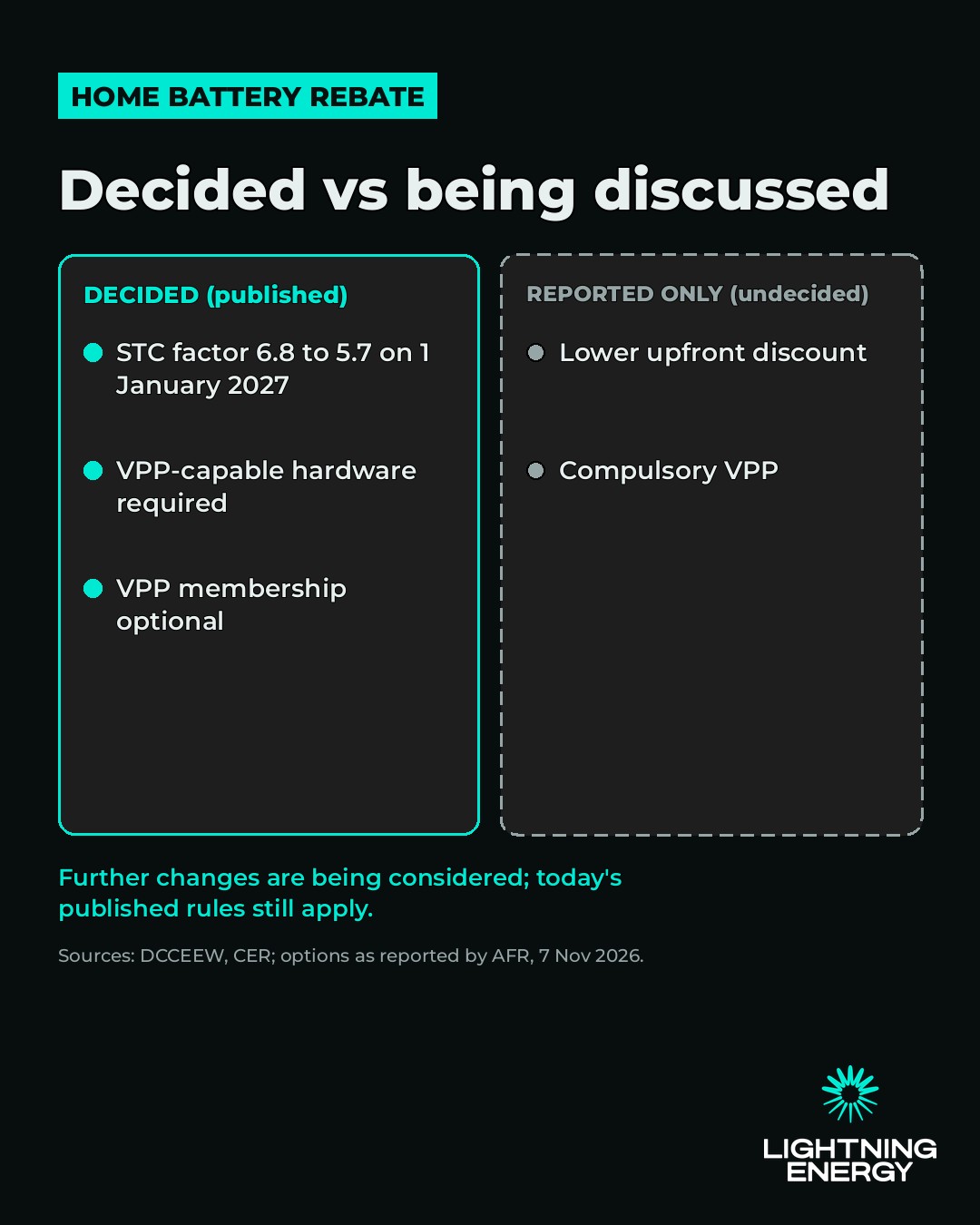
On 7 November 2026, the Australian Financial Review reported that Treasury is drafting options to scale back the federal Cheaper Home Batteries Program as the government looks for savings before December's mid-year budget update (MYEFO). The options reported include lowering the upfront discount or tying support to joining a virtual power plant (VPP).
These are reported options from a newspaper story, not a government decision. ABC News reported the same day that the Environment Minister said savings were being reviewed through the Expenditure Review Committee, while calling the scheme "phenomenally successful". No change to the program has been announced.
Further changes are being considered; today's published rules still apply.
What is already decided
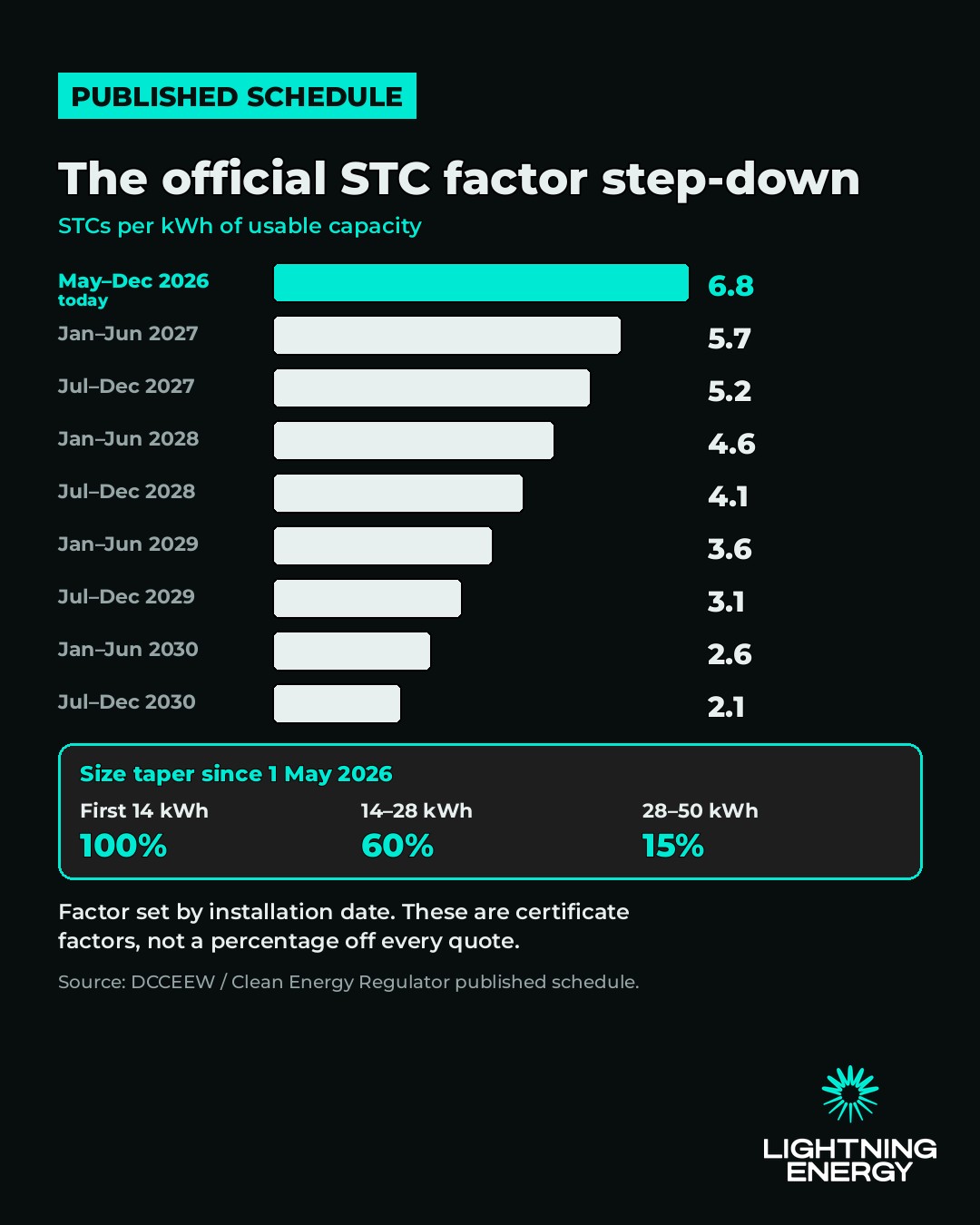
The program works through small-scale technology certificates (STCs). The number of certificates a battery can create depends on its usable capacity and a published STC factor. According to the Department of Climate Change, Energy, the Environment and Water (DCCEEW) and the Clean Energy Regulator (CER), the factor is:
6.8 for May to December 2026
5.7 for January to June 2027
5.2 for July to December 2027
The schedule keeps stepping down every six months to 2030. The 1 January 2027 step from 6.8 to 5.7 was set in regulations finalised in February 2026. It has nothing to do with the Treasury options reported this month.
Two other published details matter. DCCEEW says the factor that applies is the one in force on the date the battery is installed. Since 1 May 2026, support also tapers by size: the full factor applies to the first 14 kWh of usable capacity, 60% of it from 14 to 28 kWh, and 15% from 28 to 50 kWh.
DCCEEW describes the discount as around 30% off the upfront cost of an eligible battery. The actual amount depends on the battery, the installation date and the property meeting the current rules.
Under the CER's current rules, an on-grid battery and its inverter must be technically capable of joining a VPP when installed, to qualify for certificates. You don't have to join one. You can sign up at installation, later, or never.
Making membership compulsory is one of the reported Treasury options. It is not the rule today. Picking VPP-capable hardware simply meets the current requirement and keeps that choice open for you.
How to decide on today's rules
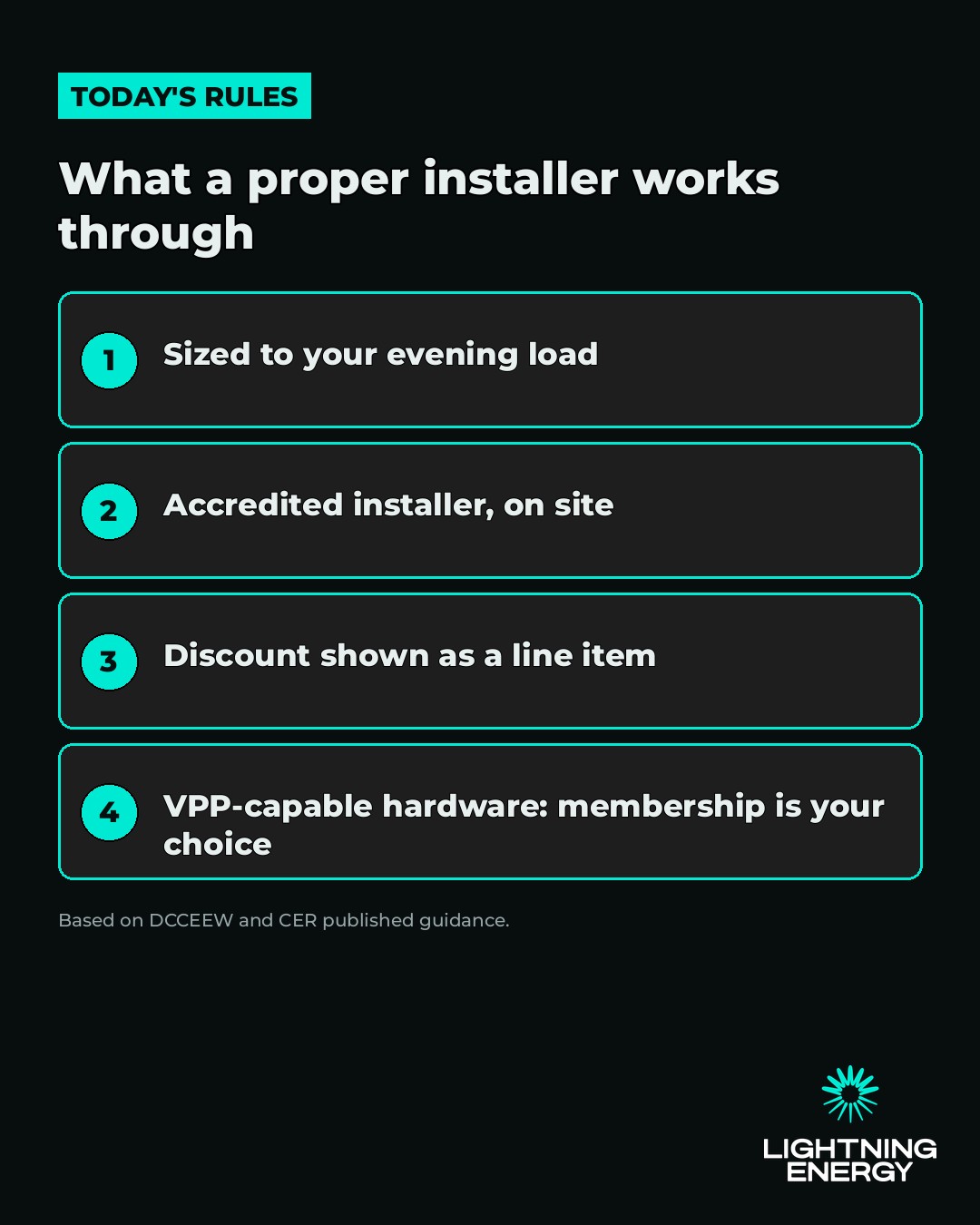
Your battery decision should still rest on your home, not on a headline. A proper installer works through four things.
Second, accreditation. The installer holds Solar Accreditation Australia battery accreditation and is on site for set-up, installation and commissioning, and the battery is on the Clean Energy Council approved list. More on that in why your rebate depends on who's actually on your roof.
Third, a written quote. The quote shows the discount as its own line, with how it was worked out and when you receive it, along with the warranty.
Fourth, the hardware. The battery and the inverter it connects to are VPP-capable under the current CER requirements, so the system qualifies today whatever you decide about a VPP.
Plan around facts, not noise
The published schedule is the part you can plan around. The Treasury options are just reports until the government decides something. If it does, the official program pages are where the new rules will appear.
When you're ready, start with your own usage data and a written, line-itemed quote built on today's rules.
Sources: Department of Climate Change, Energy, the Environment and Water, Cheaper Home Batteries Program (page last updated 9 June 2026): https://www.dcceew.gov.au/energy/programs/cheaper-home-batteries. Clean Energy Regulator, Solar batteries and Virtual power plants guidance: https://cer.gov.au/schemes/renewable-energy-target/small-scale-renewable-energy-scheme/small-scale-renewable-energy-systems/solar-batteries. Australian Financial Review, 7 November 2026: https://www.afr.com/policy/energy-and-climate/treasury-pushes-cuts-to-home-battery-subsidy-in-savings-drive-20261107-p61c07. ABC News, 7 November 2026: https://www.abc.net.au/news/2026-11-07/environment-minister-murray-watt-home-battery-subsidy-scheme/107359436
Book a consultation and we'll map solar, storage, hot water, and the rebates around your bills and your goals.
Loading consultations…
Lightning EnergyPlan your next energy upgrade.
⚡
Hi, I’m Lightning Energy’s project guide. I’ll ask a few practical questions, explain what usually matters for your project, and help you decide on a useful next step — no guesswork or sales pressure.
First, what kind of property are we planning for?