
7 kW or 22 kW Home Charging? Start With Your Car’s AC Limit
A bigger number on a wallbox does not automatically mean a faster charge. Your car, the electrical supply and the way the charger is configured all have a say.
A bigger number on a wallbox does not automatically mean a faster charge. Your car, the electrical supply and the way the charger is configured all have a say.

A bigger number on a wallbox does not automatically mean a faster charge.
Your car, the electrical supply and the way the charger is configured all have a say.
The useful starting point is your normal driving day.
Work out how much energy needs replacing and how long the car can stay plugged in.
Then compare equipment that can meet that need.
This guide uses Australian manufacturer and network information checked on 30 October 2026.
The examples are calculations, not charging tests or promises about a particular installation.
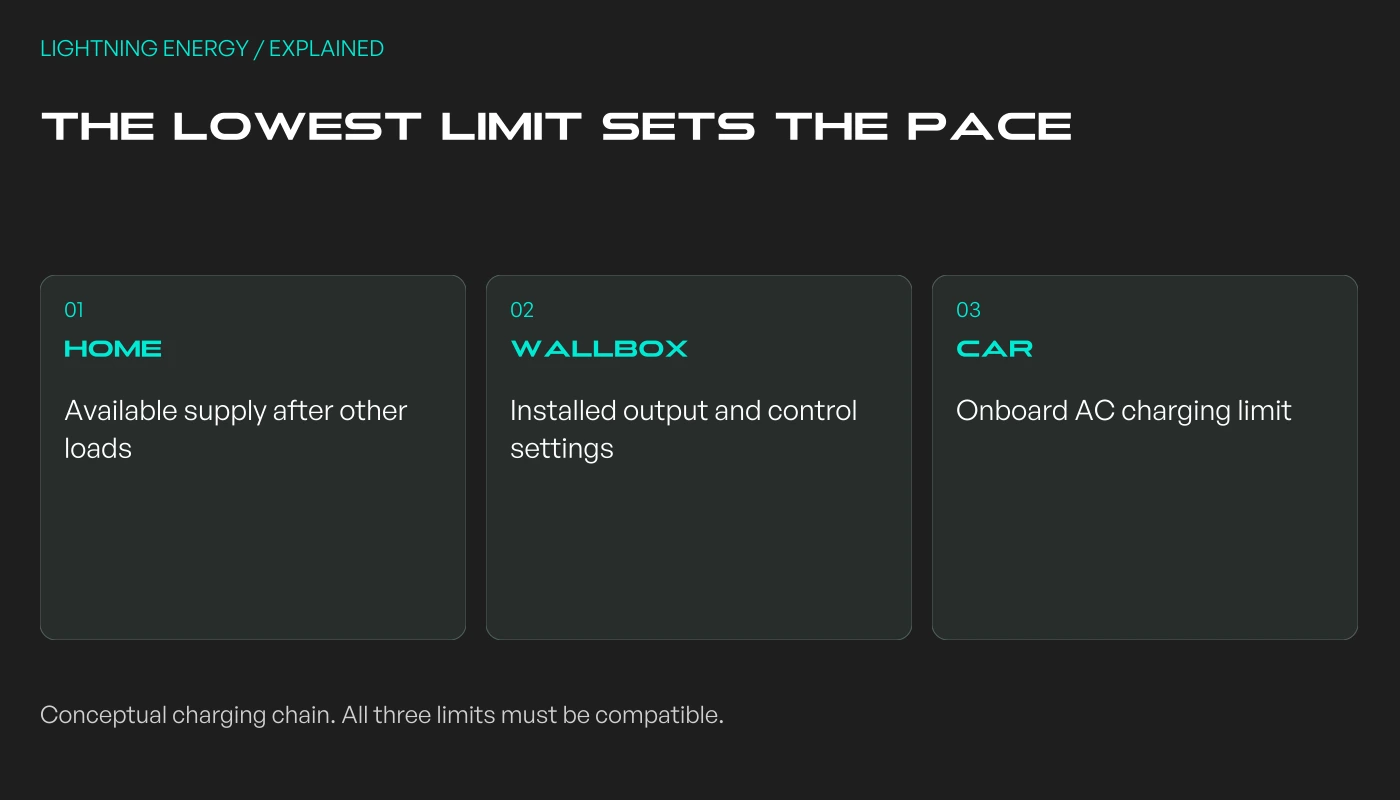
Think of AC charging as a chain: the home's available capacity, the installed wallbox limit and the vehicle's onboard charger.
The lowest compatible limit constrains the result.
Other household loads can reduce it further.
Powercor's EV guidance distinguishes single-phase home charging from higher-capacity three-phase charging.
It also calls for an electrician to assess the extra demand.
A three-phase supply does not itself promise 22 kW charging.
Likewise, fitting a 22 kW-capable unit to a suitable supply cannot make an 11 kW car accept 22 kW AC.
Tesla's Australian Wall Connector guide lists 7.4 kW at single-phase 32 A and 11 kW at three-phase 16 A.
It specifically identifies an 11 kW three-phase maximum for Model 3 RWD and Model Y RWD.
Those are manufacturer examples, not a specification for every EV.
Check the model year, variant and Australian owner's manual for your car.
A public DC fast-charging figure is not its home AC charging limit.
Ask the quote writer to record the car's AC limit beside the proposed installed output.
If those two numbers differ, the quote should explain why that hardware still makes sense for your plans.
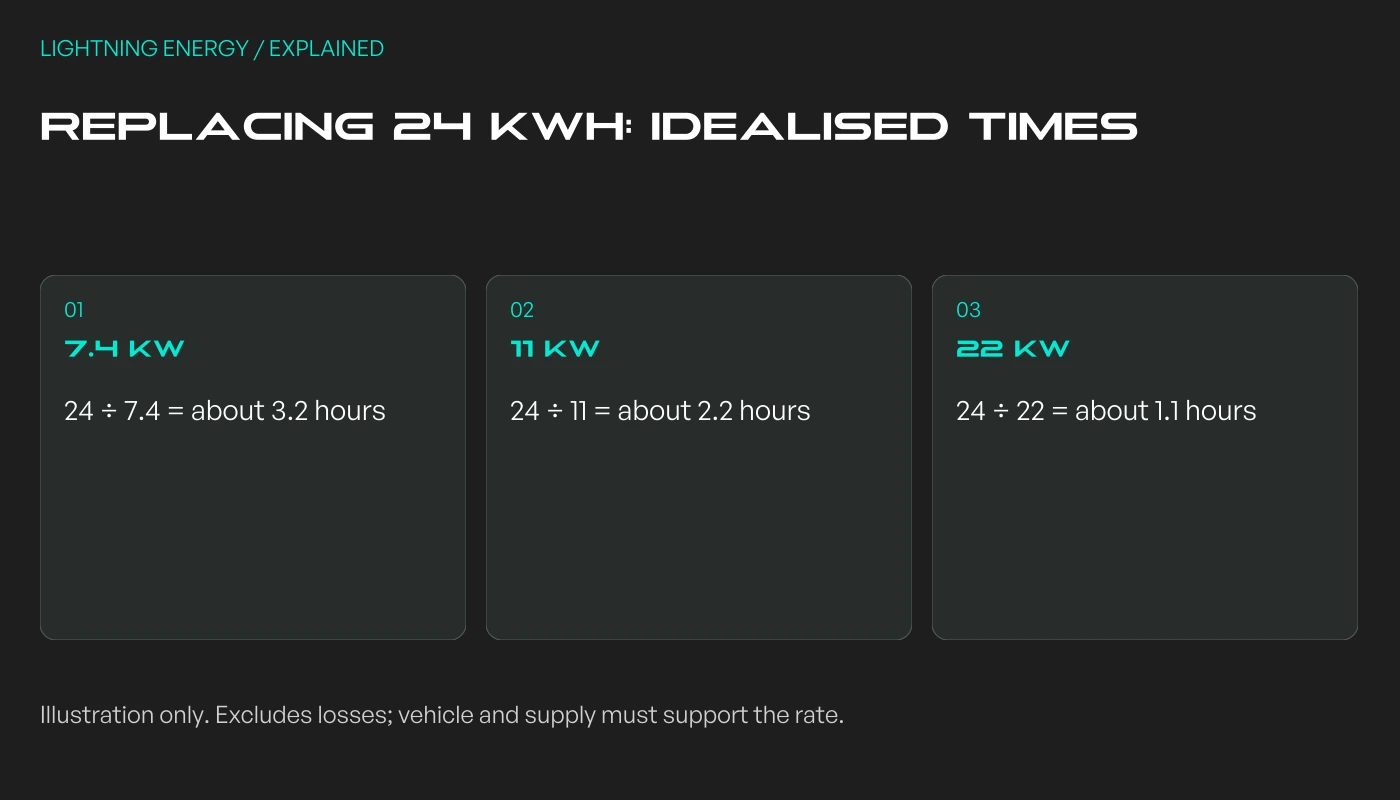
Suppose your next trip requires replacing 24 kWh.
At a constant 7.4 kW, the arithmetic is 24 divided by 7.4, or about 3.2 hours.
At 11 kW it is about 2.2 hours; at 22 kW, about 1.1 hours.
These idealised times exclude conversion losses, interruptions and any reduction in charging power.
The 22 kW example requires a car and installation that both support that rate.
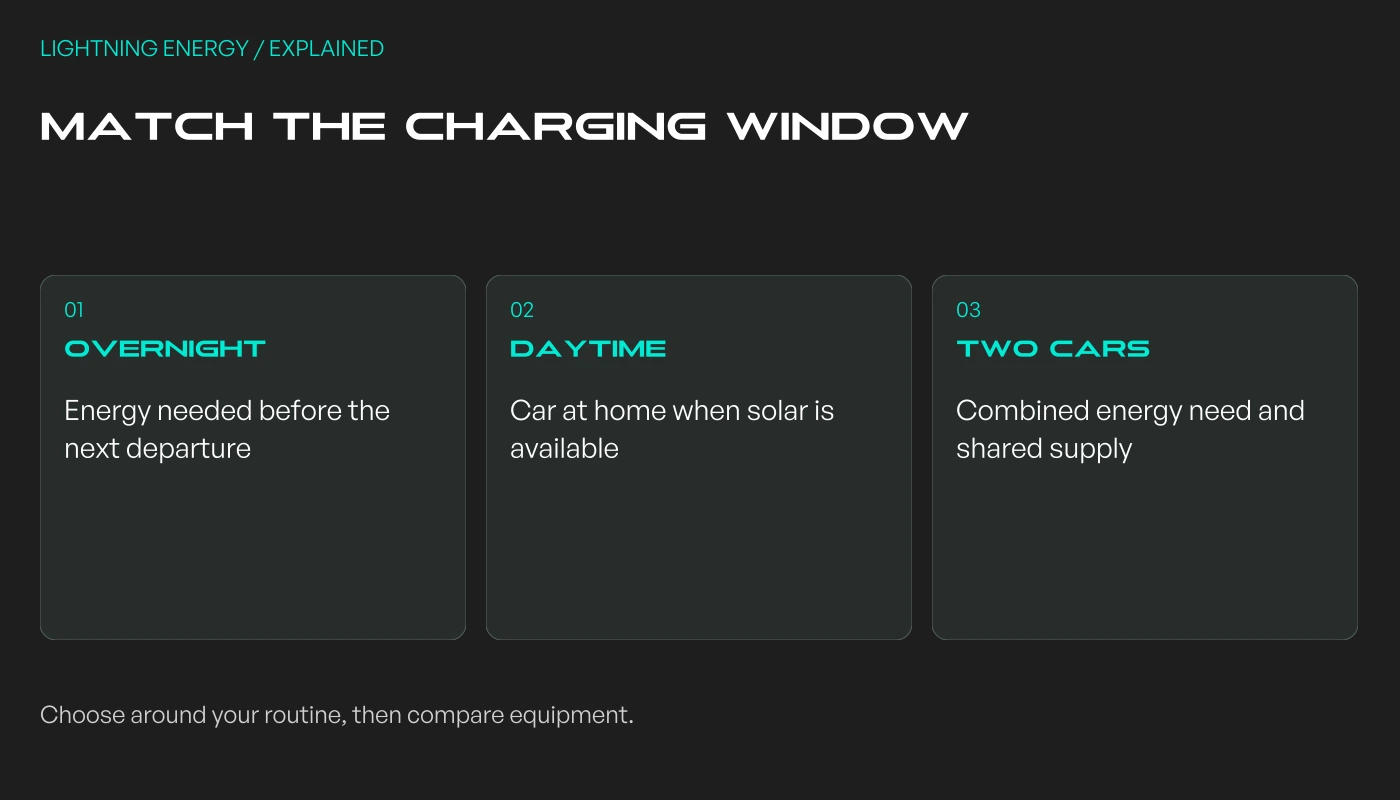
For an eight-hour overnight parking window, both of the slower examples leave considerable time.
A short turnaround between long trips creates a different requirement.
Build the comparison around your week, including its busiest day.
Our guide to EV energy use explains why electricity bought at the meter can exceed energy shown by the car.
Use measured charging data when available.
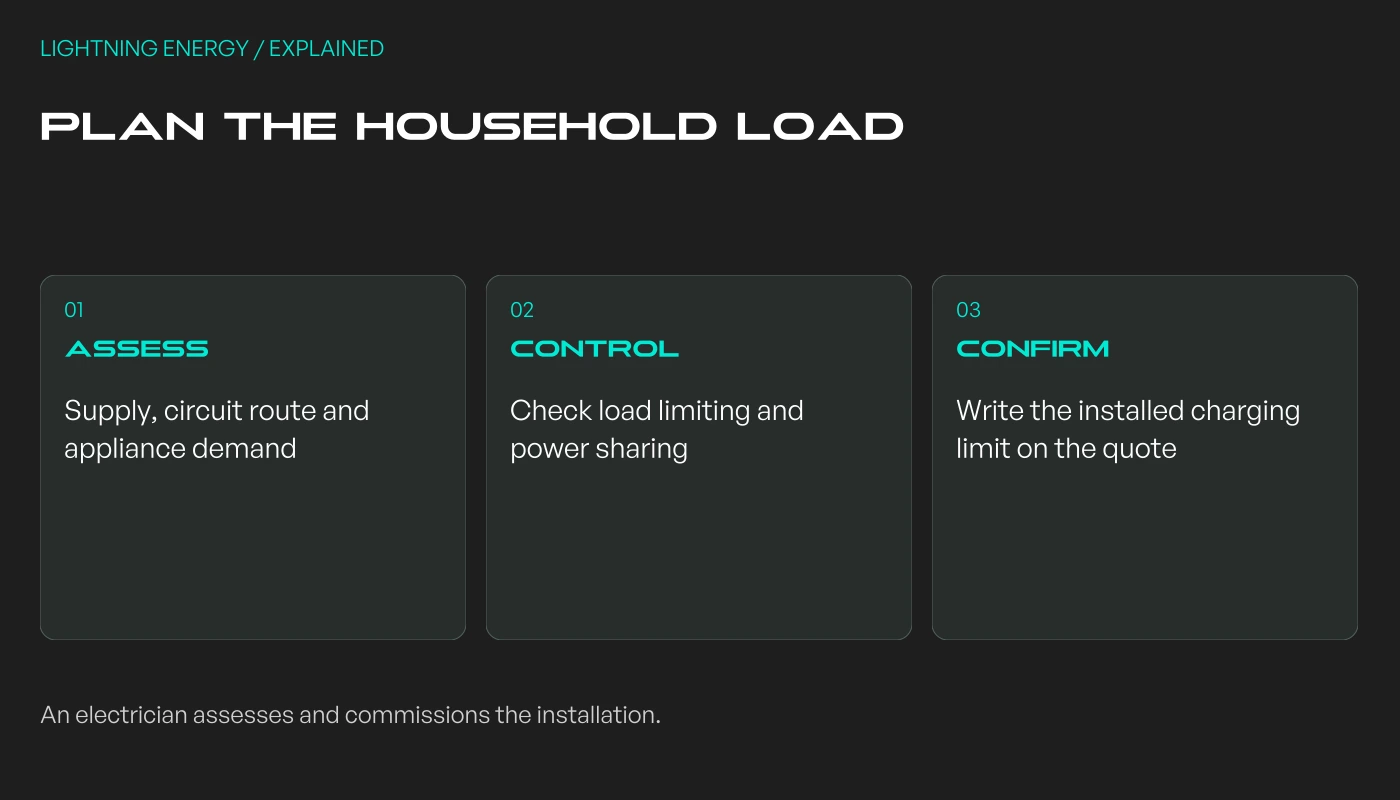
An electrician should assess the supply, switchboard, circuit route and other appliances.
Avoid deciding supply capacity by opening electrical equipment yourself.
Ask for the assessment and any required network work in writing.
Powercor identifies several possible responses to extra demand: managing when appliances run, limiting the charger, upgrading electrical equipment or upgrading the supply where available.
The appropriate combination depends on the property.
Three-phase supply planning is useful when electric heating, cooking and another vehicle are also on the horizon.
A future plan should include those loads, rather than simply choosing the largest wallbox.
Fast charging is not the same as solar-only charging.
If the car is away during the day, its overnight charge cannot directly use that day's rooftop generation.
Battery storage introduces another cost and control decision.
For a car parked at home, ask how the proposed controls measure surplus solar and respond to clouds.
Record whether a departure-time target can draw grid electricity and how the charger interacts with a home battery.
With two cars, compare the total energy both need before departure. Power sharing between chargers may matter more than the maximum rating of either unit alone.
Send your vehicle model and year, usual arrival and departure times, typical daily kilometres, existing solar and battery details, and photographs of the parking area.
Explain whether a second EV is a firm plan or only a possibility.
Ask for separate prices for the charger, installation, any supply upgrade and monitoring or load-control equipment.
Also check cable reach in your normal parking position, internet requirements and who provides aftercare.
Choose the design that meets your routine with a sensible margin. Talk to Lightning Energy about home EV charging to compare the vehicle, house and charging window together.
Available times
Book a consultation and we'll map solar, storage, hot water, and the rebates around your bills and your goals.
Question 1 of 6
