
Why Panel Capacity Can Be Higher Than the Solar Inverter Rating
Learn why solar panel capacity can exceed inverter output, how clipping affects generation, and which design and eligibility checks matter in Australia.
Learn why solar panel capacity can exceed inverter output, how clipping affects generation, and which design and eligibility checks matter in Australia.

A solar quote can legitimately show more panel kilowatts than inverter kilowatts. The panel figure is a DC rating under standard test conditions; the inverter figure describes its AC output capability.
Those numbers do different jobs. A larger array can improve production when sunlight is weaker, while the inverter can limit output during stronger conditions. Whether that combination is suitable needs a complete design check.
Our system-size guide helps relate the equipment to household use rather than treating either nameplate as an energy forecast.
Panel capacity is the sum of the modules' rated DC power. Inverter capacity limits conversion to AC within its operating conditions. The approved export limit governs electricity sent from the property to the grid.
A restriction at one stage does not mean the other figures must be identical. Household consumption and, where installed, storage can also change the relationship between solar generation and grid export.
The Australian Government sizing guide explains these separate design considerations.
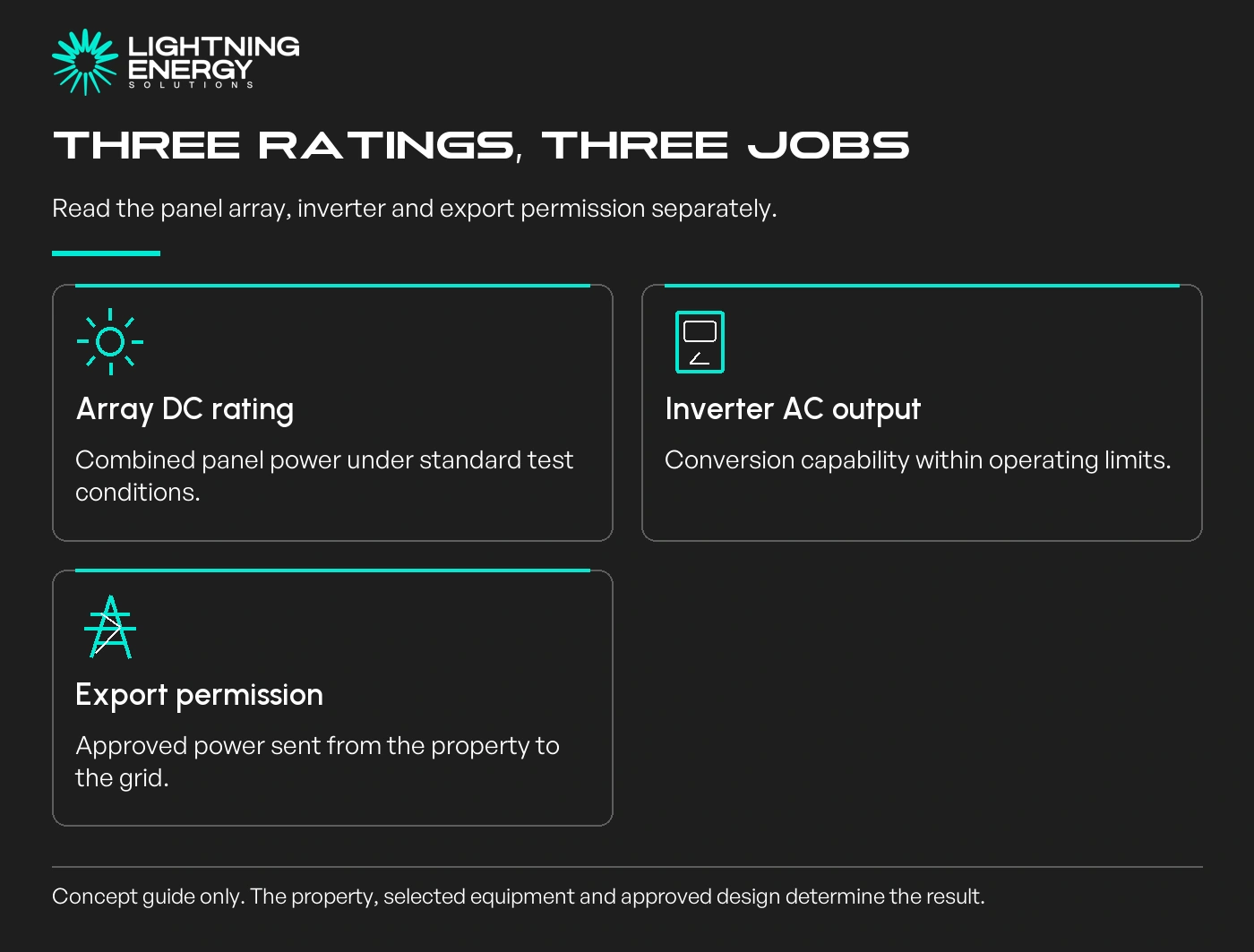
For example, a 6.6 kW array and 5 kW inverter are different ratings, not evidence that 1.6 kW is permanently wasted. The array is not producing its nameplate output continuously throughout the day.
This example is explanatory, not an approval for your property. Exact panel and inverter limits, roof design and network conditions still apply.
When available DC power exceeds what the inverter can convert in the relevant operating mode, output can reach a ceiling. The generation trace may develop a flat top during that period.
That is often called clipping. Its significance is the energy affected over time, not simply the difference between two capacity labels or a screenshot of the highest-output hour.
Lower-light periods and differently oriented roof faces can produce a different annual result from a uniformly sunny north-facing array. Compare the full year with the same weather and roof assumptions.
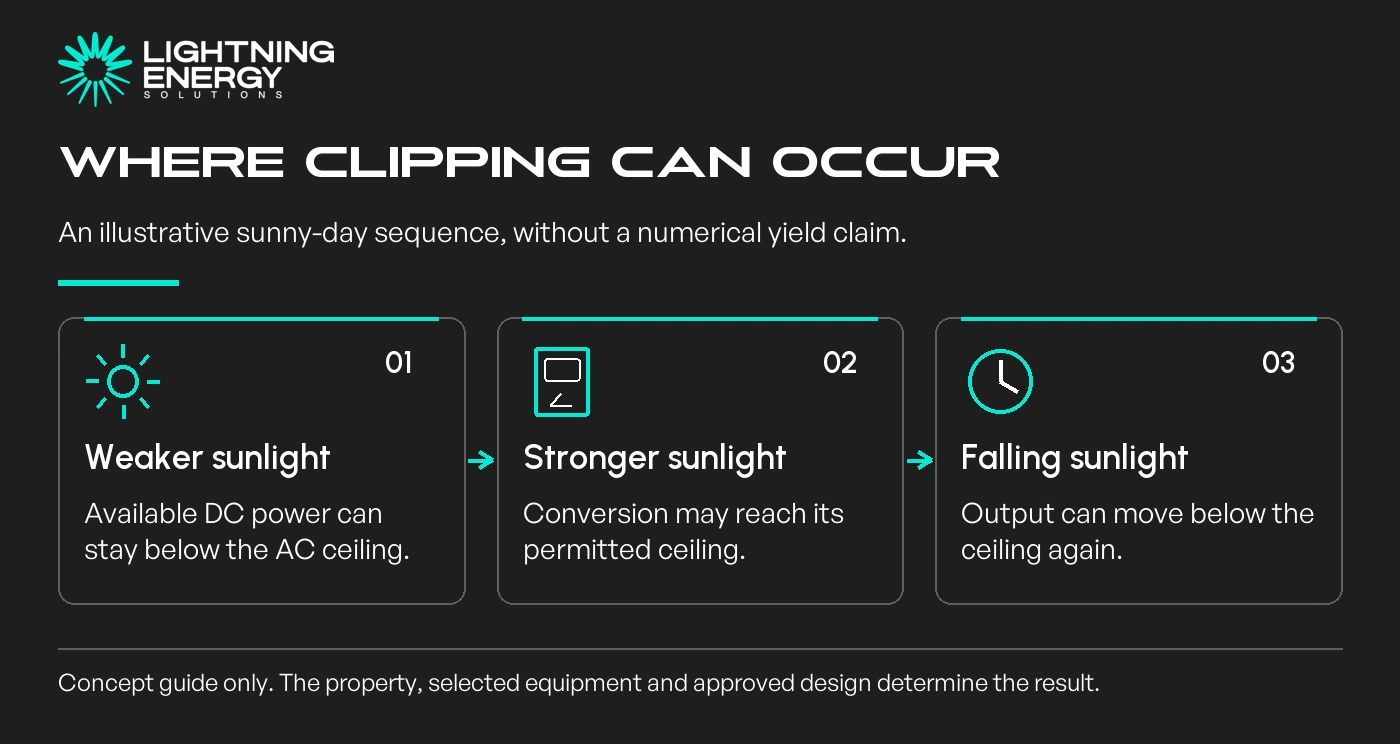
A flat trace can also reflect an export-control setting or another operational limit. Our export-limit guide explains why a screenshot alone cannot diagnose the cause.
SAA's technical requirements distinguish systems without batteries from systems with connected batteries. Manufacturer array limits still apply, as do relevant standards and connection conditions.
For systems without batteries, version 1.9 says inverter nominal AC output must be at least 75% of array peak power. Its connected-battery provision permits a different ratio within manufacturer limits.
Read SAA's February 2026 technical requirements. The designer must check the applicable version when the system is designed and installed.
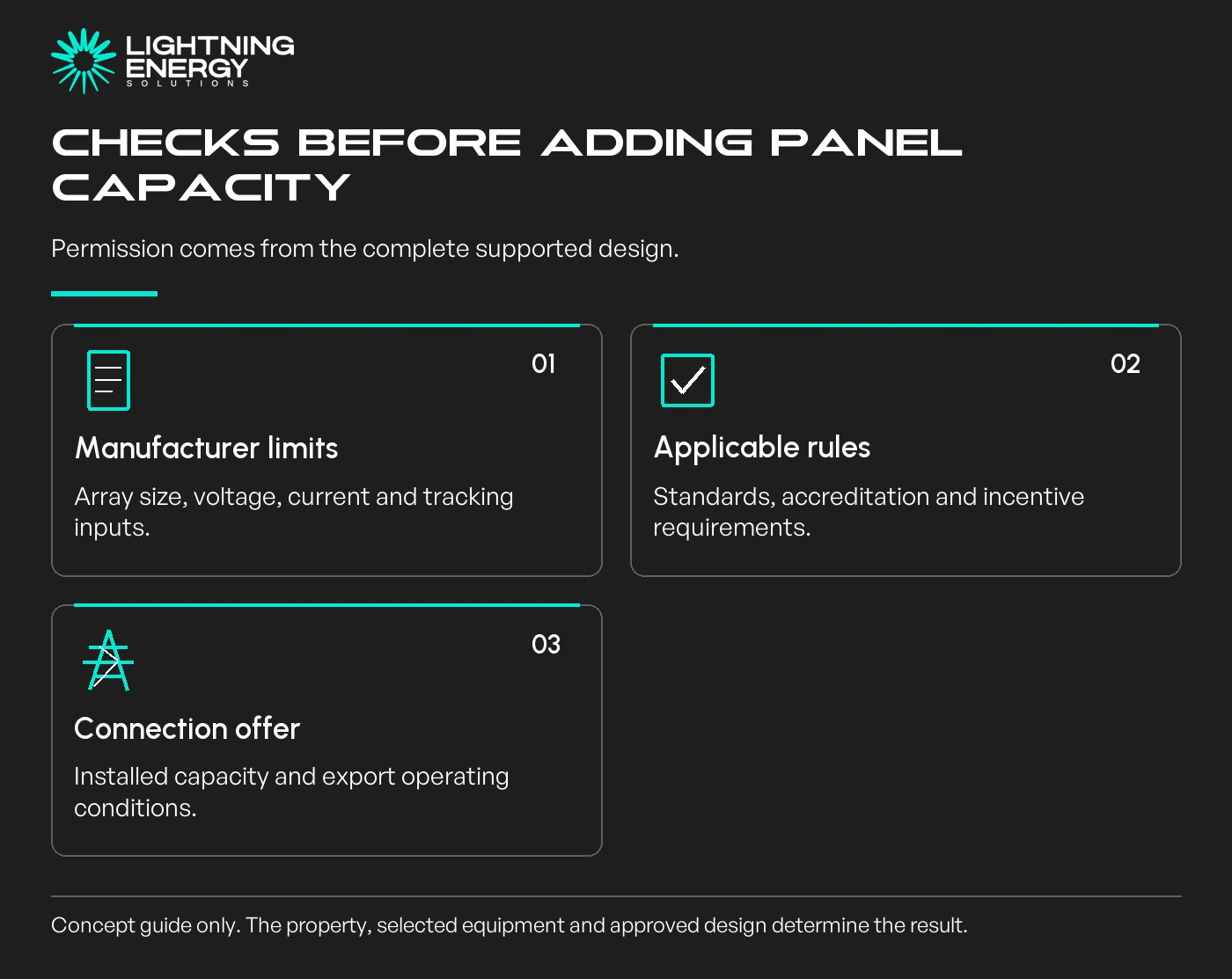
A manufacturer permitting a larger array does not, by itself, establish that every proposed installation meets incentive or network requirements. Nor does a future intention to buy a battery mean one is currently connected.
Check the inverter's DC voltage, current, tracking inputs and permitted array size together. These are professional design checks, not instructions to add extra panels to an existing circuit.
Ask for two otherwise comparable proposals: the smaller array and the larger supported array. Request monthly generation estimates, explained clipping assumptions and the expected division between self-use and export.
The Clean Energy Regulator sets eligibility requirements. An existing system's upgrade needs its own assessment.
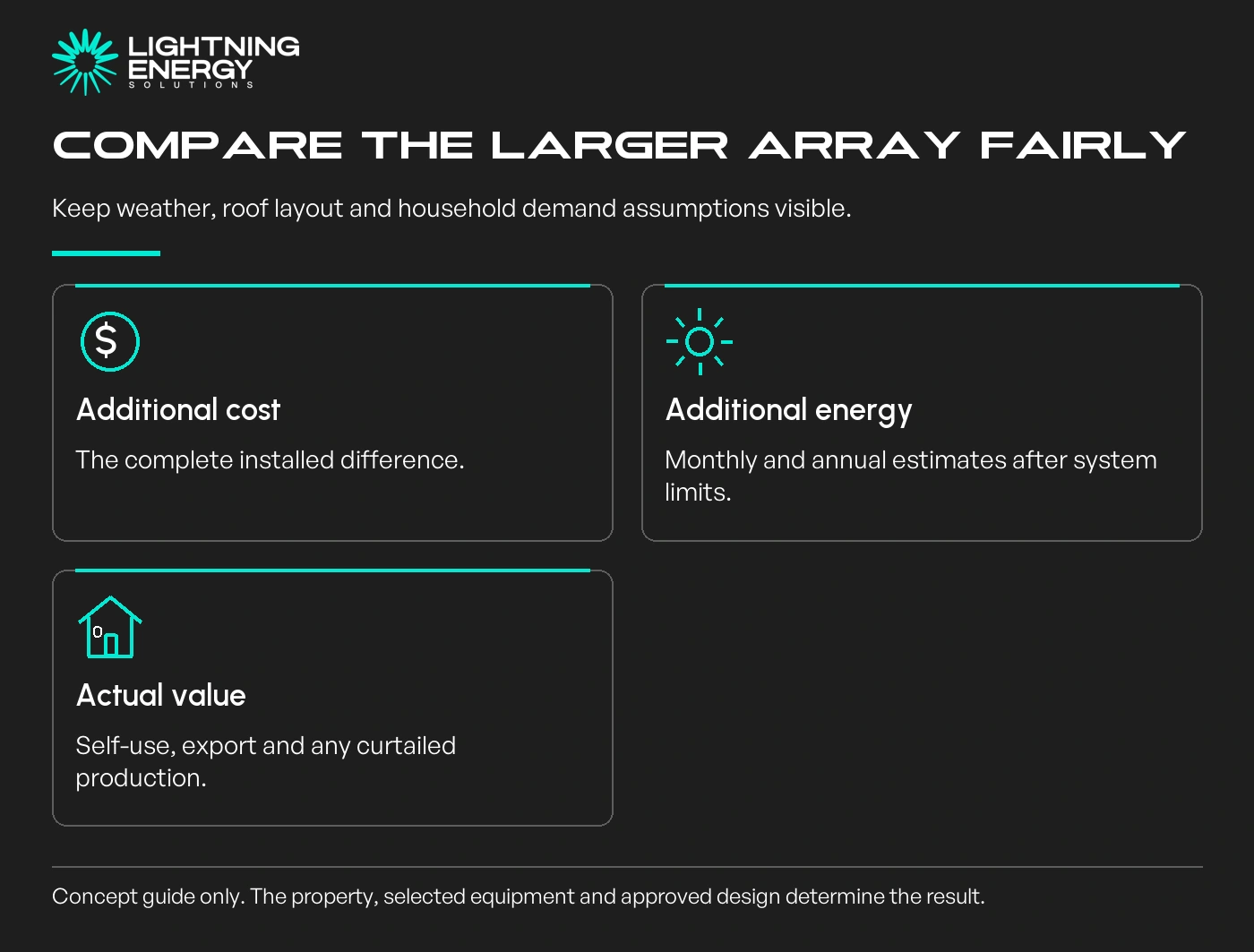
If extra panels mainly add curtailed midday production, their benefit may be limited. If they improve usable generation outside the peak, a larger array may be worthwhile despite some clipping.
Our solar team can explain the trade-off, but no universal annual clipping percentage should substitute for the actual design.
Request the design calculation, including the applicable limits and expected additional annual energy. That is a stronger basis for choosing equipment than insisting every kilowatt label match.
Available times
Book a consultation and we'll map solar, storage, hot water, and the rebates around your bills and your goals.
Question 1 of 6
