
Why Your Electricity Bill Might Rise After a Battery Is Installed
If your bill rises after battery installation, compare dates, rates, demand and operating data before assuming a fault or changing protected settings.
If your bill rises after battery installation, compare dates, rates, demand and operating data before assuming a fault or changing protected settings.

A higher electricity bill after a battery is installed deserves investigation, but it does not identify the cause. Changed rates, longer billing periods, new appliances and battery settings can all affect the result.
Start with comparable evidence. The question is not simply whether the latest dollar total is higher; it is which part of the bill changed and whether the installed system is operating as intended.
Record the number of billed days, season, meter-reading basis and any previous balance. A long winter bill cannot be fairly compared with a short mild-weather bill using the total alone.
Victoria's bill guide separates supply charges, usage charges, account balances and credits. Use those lines to identify whether the increase comes from energy, rates or an amount carried forward.
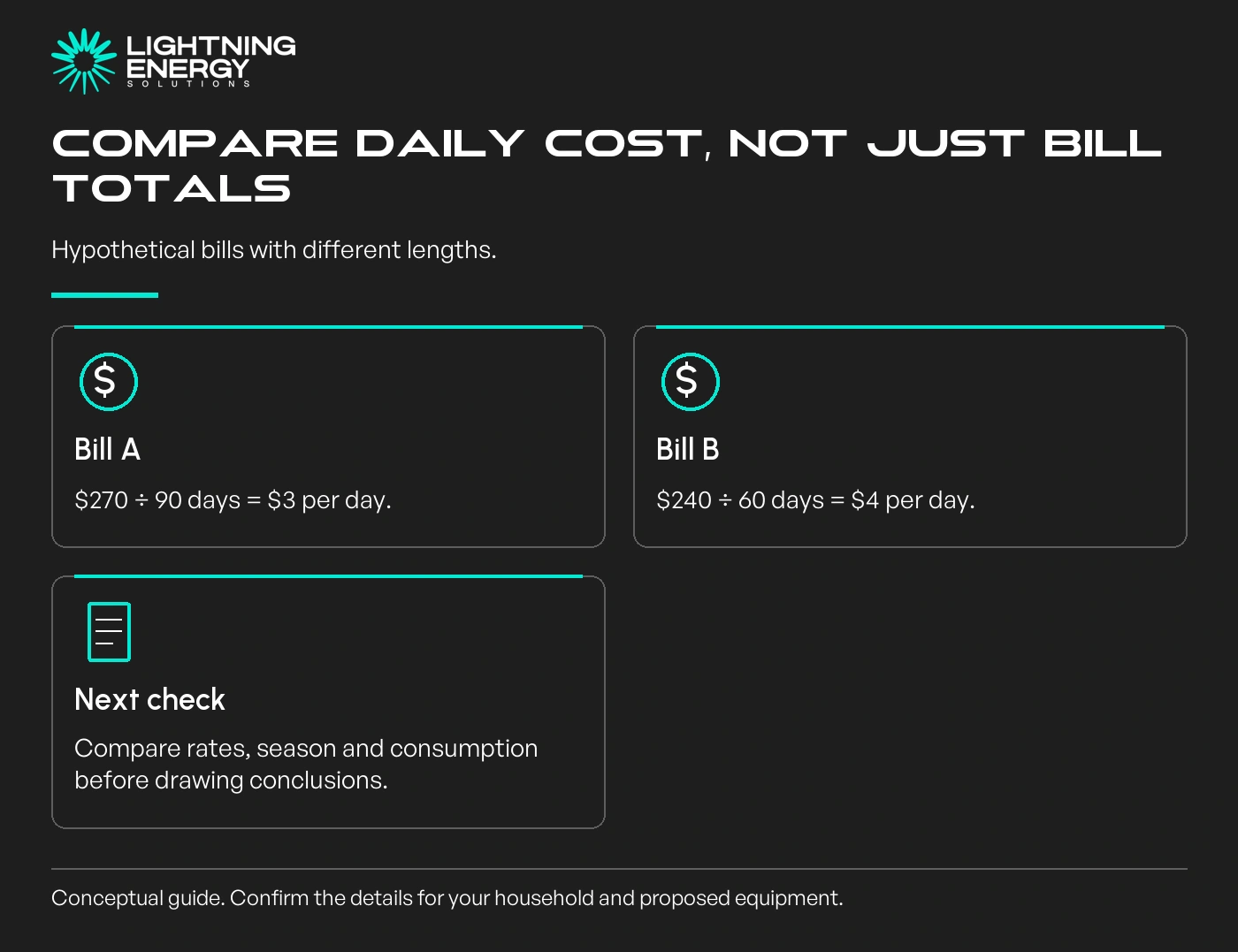
For a hypothetical example, $270 over 90 days is $3 a day, while $240 over 60 days is $4 a day. The smaller total in that example actually represents the higher daily cost.
Our energy-bill explainer provides context for why market headlines do not directly determine an individual retail bill.
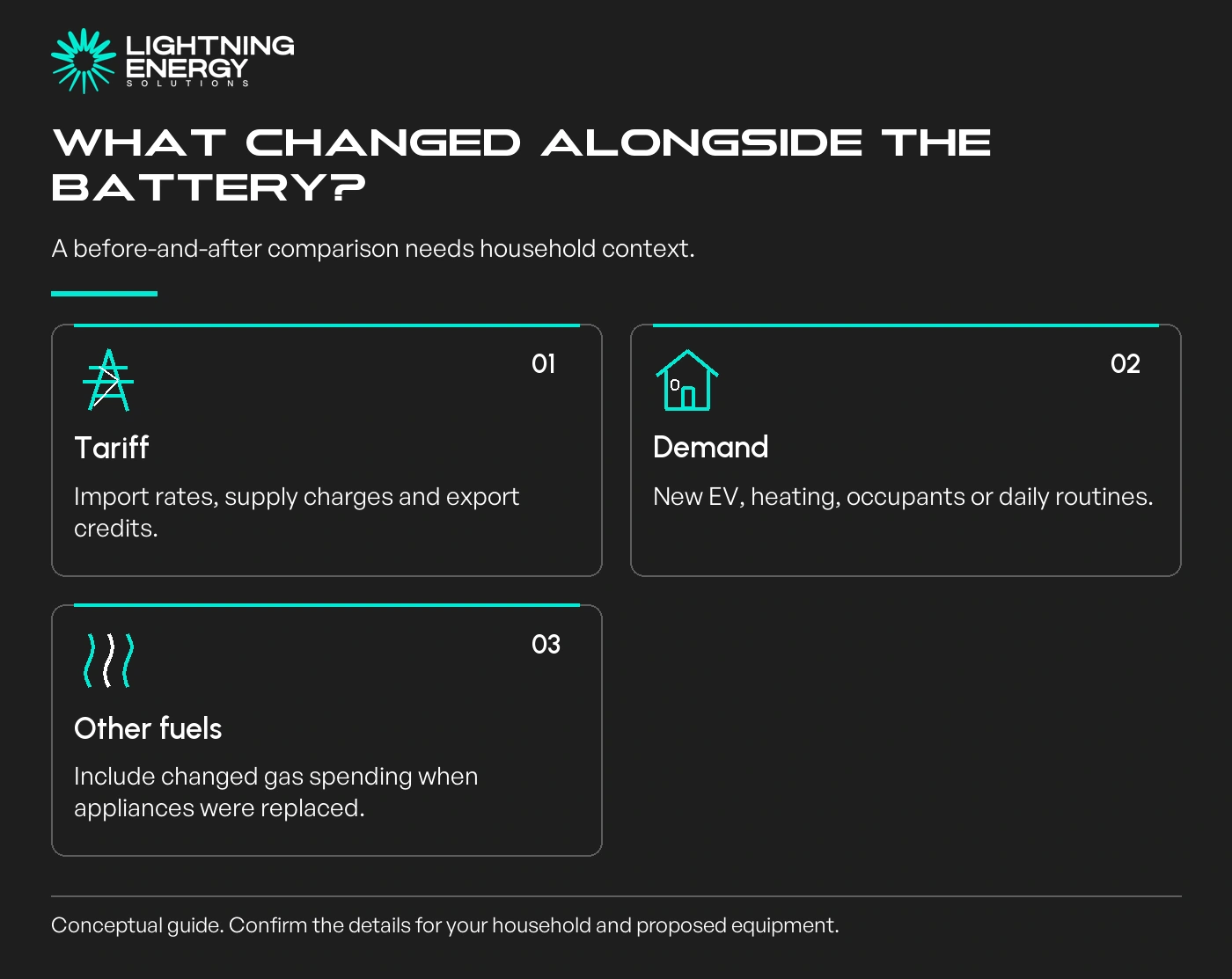
Compare the old and new import rates, time windows, supply charges and export credits. Check whether a new retailer offer or VPP arrangement began at the same time as the battery.
List changes in household demand too: an EV, electric heating, extra occupants or more time at home. A working battery can reduce imports relative to the new household demand while the overall electricity bill still rises.
If gas heating was replaced, compare the household's gas and electricity costs together before deciding whether the overall change increased energy spending.
The electrification guide explains why appliances and storage should be planned together.
Look at the documented operating mode, backup reserve and charging schedule. A higher reserve leaves less stored energy available for ordinary bill reduction; it may be intentional rather than a fault.
Tesla's Australian reserve guidance makes that trade-off explicit. Other systems need their own owner instructions and provider settings checked.
Grid charging can raise imported kWh while shifting those purchases to cheaper times. Whether that helps the bill depends on the actual rates, losses and later use, so extra imported energy alone is not a complete diagnosis.
Ask the installer or automation provider to explain unexpected behaviour. Do not change protected inverter, export or network settings to chase an apparent saving.
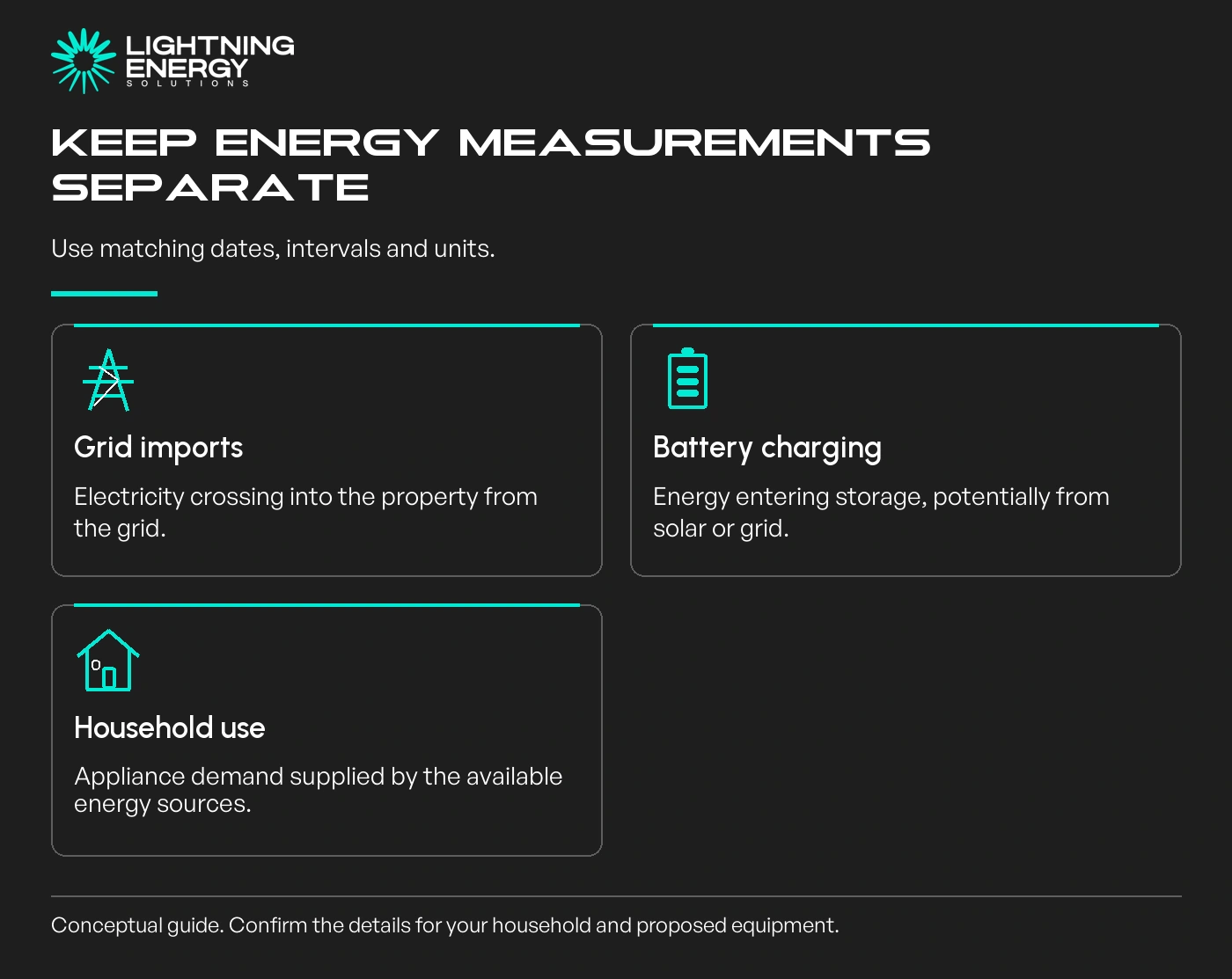
Compare the same dates, intervals and units. Battery charge, household consumption and grid imports are different quantities; adding or comparing the wrong totals can create an apparent discrepancy.
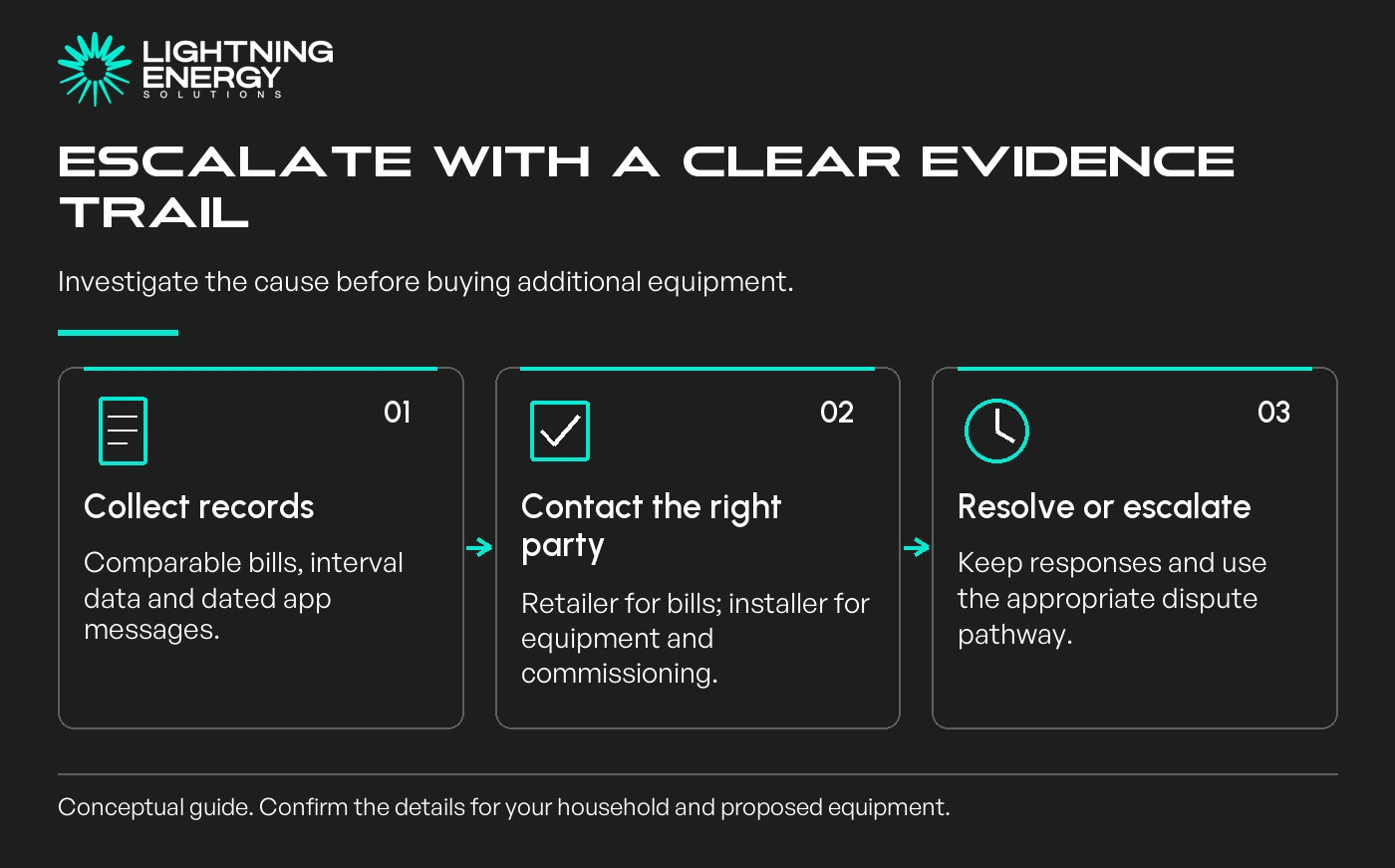
Save relevant screenshots with timestamps and request interval meter data from the retailer or distributor's customer service. Note periods where the app was offline or the installation was not yet commissioned.
An example of useful evidence is a specific evening when substantial grid imports occurred despite the battery showing available charge. That can be investigated against reserve, output limits and the actual circuit arrangement.
Send billing or tariff questions to the retailer and equipment or commissioning concerns to the installer. Keep their responses, reference numbers and any agreed follow-up date in one record.
EWOV asks customers to first attempt resolution with their energy company. It offers independent help for disputes within its scope; a product-supply issue may need a different consumer-protection pathway.
Do not buy more battery capacity until the cause is understood. Extra modules will not correct an incorrect tariff, missing credit or unresolved installation fault.
Plan your battery upgradeBring comparable bills, the equipment schedule and dated app records. We can review the installation-related questions and identify which matters need a retailer or provider response.Available times
Book a consultation and we'll map solar, storage, hot water, and the rebates around your bills and your goals.
Question 1 of 6
