
Three phase now or later when electrifying your home?
Assess whether three phase belongs in your electrification plan by checking concurrent loads, appliance requirements, load management and network upgrade scope.
Assess whether three phase belongs in your electrification plan by checking concurrent loads, appliance requirements, load management and network upgrade scope.

Three phase may be useful for an electrified home, but adding electric appliances does not automatically mean every property needs it. The decision needs an electrical assessment of the present supply and the proposed equipment.
Separate a genuine capacity or equipment requirement from a preference for a larger connection. Ask what problem the upgrade solves, what work it includes and whether a supported alternative meets the same need.
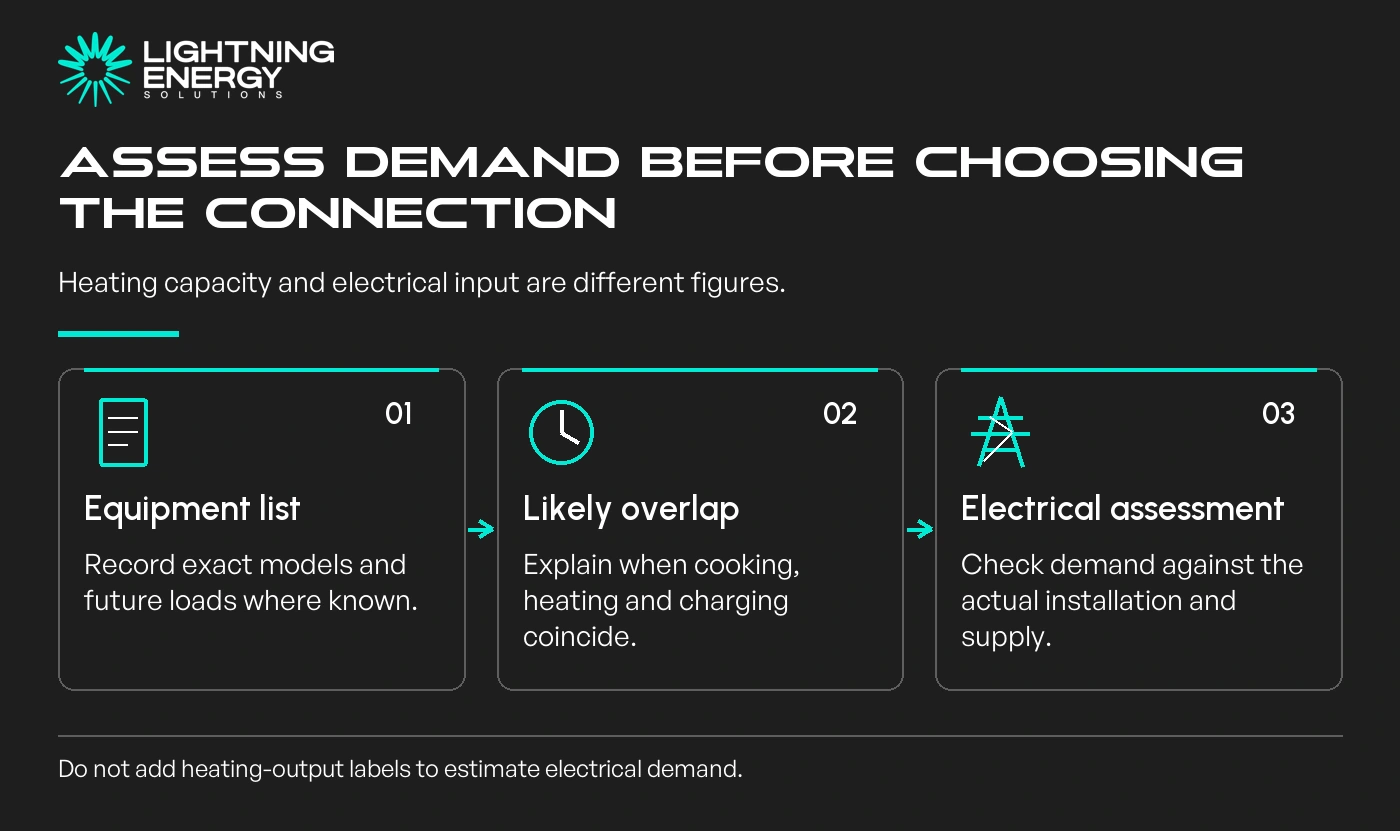
List planned cooking, hot water, heating, cooling and EV charging, including the exact models where selected. Electrical input requirements matter; an air conditioner’s advertised heating capacity is not its electrical draw.
Describe likely overlap, such as evening cooking while space heating runs and a car arrives home. An electrician must assess demand under the applicable requirements rather than add brochure capacities indiscriminately.
The home electrical planning guide distinguishes equipment demand from the condition and capacity of the existing installation.
For an illustrative household, overnight EV charging may have more scheduling flexibility than dinner preparation. That makes it worth discussing control options, but does not itself establish that the current supply is sufficient.
Ask which conclusion comes from measured usage and which comes from the design allowance for future loads.
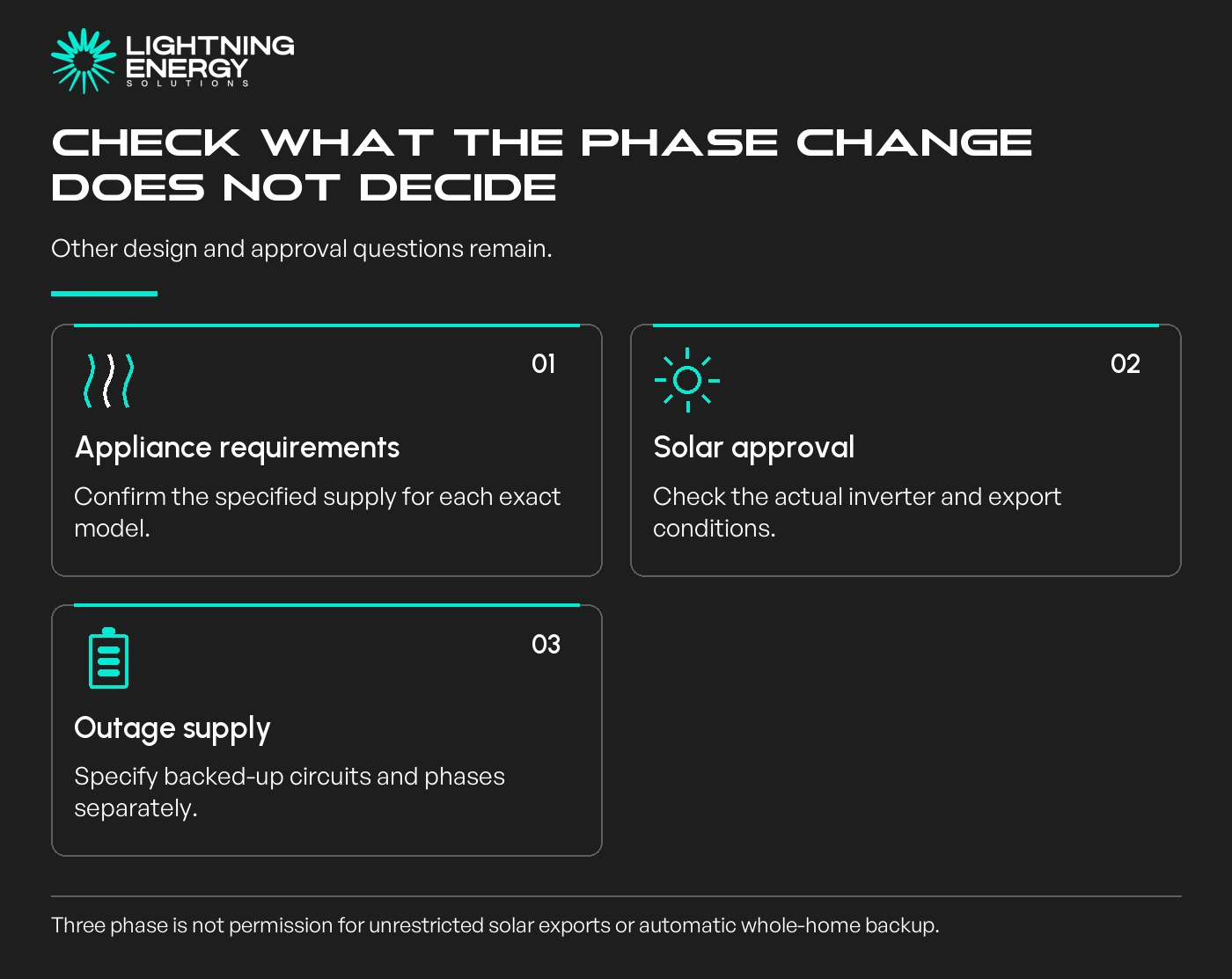
Some equipment is specified for a particular supply arrangement. Confirm the required phase configuration for the selected outdoor unit, charger, inverter or other appliance before accepting substitutions.
A three-phase connection also needs appropriate circuit allocation and assessment of loading across phases. It does not make every individual appliance able to draw the entire combined supply capacity.
CitiPower and Powercor identify phase changes, increased capacity and metering as distinct possible supply alterations. Your registered electrical contractor coordinates the relevant application.
For solar equipment, confirm the actual network connection and export conditions. Do not assume changing phases automatically approves a particular inverter size or unrestricted exports.
If blackout operation matters, specify it separately. The battery design must explain which circuits and phases receive backup, rather than implying that a three-phase grid connection settles that question.
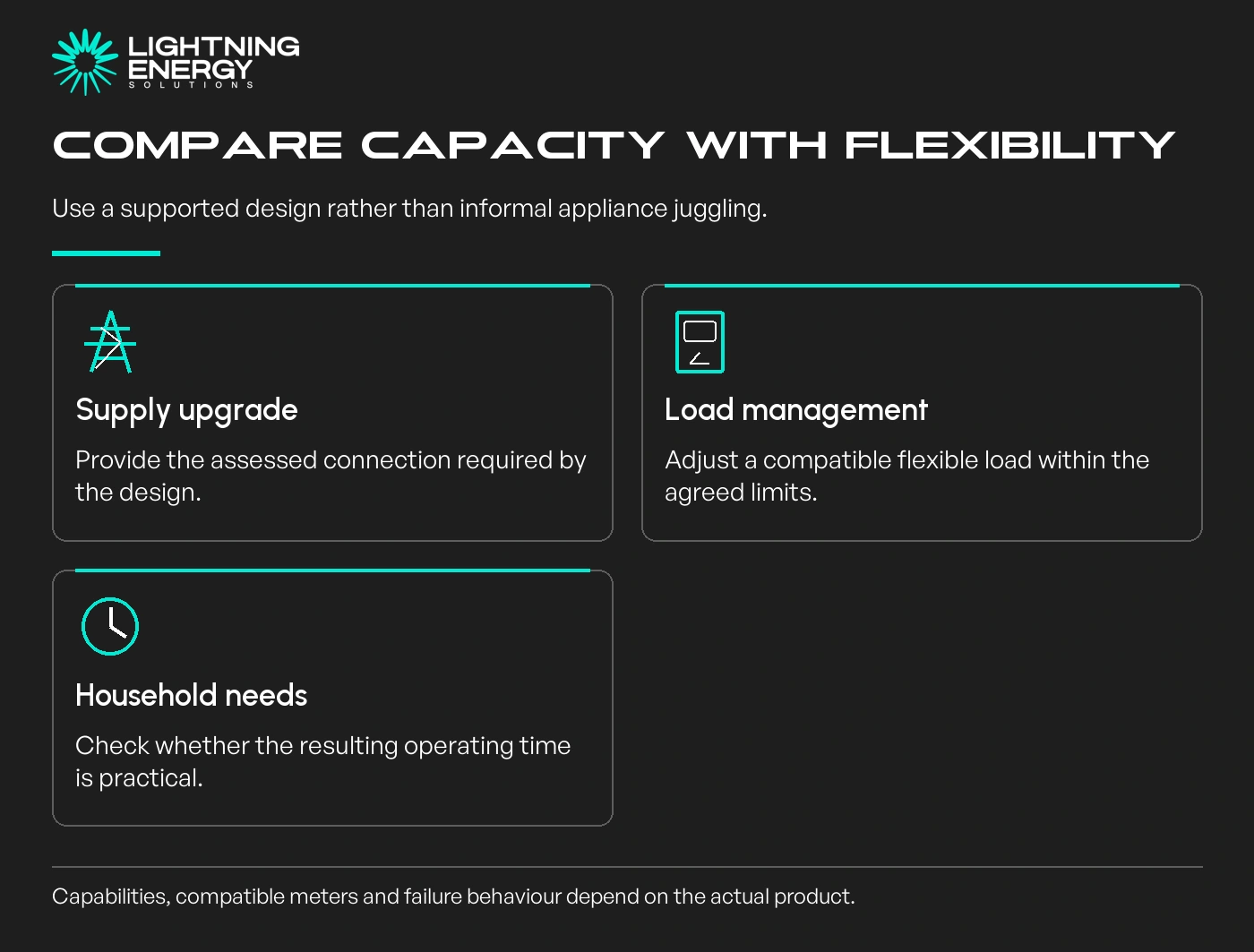
Where supported, load management can adjust a flexible appliance’s demand as other household loads change. The equipment, measurement and commissioning need to be designed together.
Tesla’s Australian documentation, for example, describes Dynamic Power Management that adjusts a compatible Wall Connector’s charging rate using a separately installed approved meter.
Tesla power-management information.
That is a specific product capability, not a promise that every charger or household controller can do the same job. Confirm compatibility and what happens if a required component fails or communications are lost.
Ask whether the resulting charging time meets your daily travel needs. A lower rate can be entirely practical for one household and unsuitable for another with short parking windows.
Do not treat a phone reminder to avoid using appliances together as equivalent to an assessed, compliant load-management arrangement.
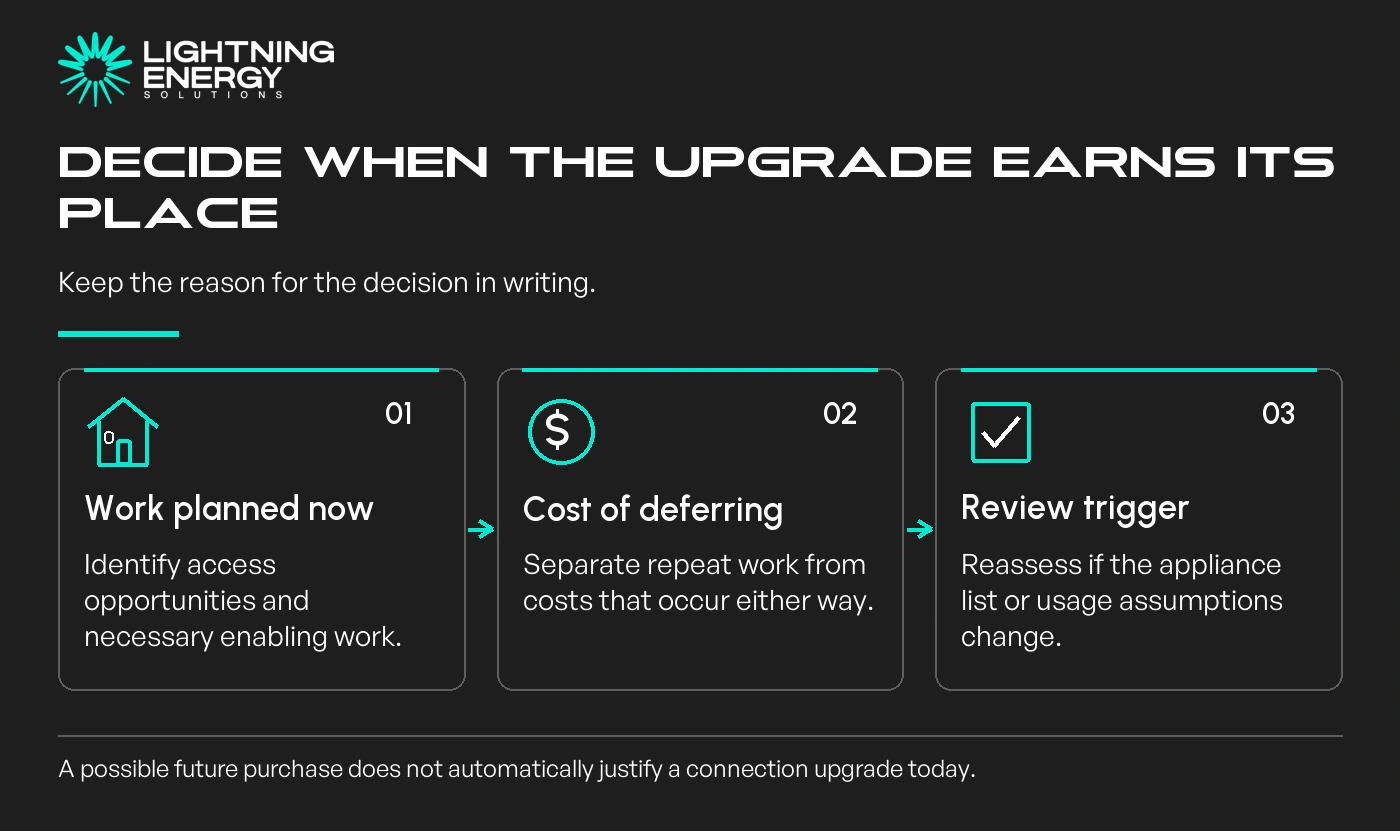
Obtain separate scopes for proceeding with the present supply and for upgrading it. Include the board, mains, metering, network work, required inspection and making good where applicable.
Ask which costs would be repeated if the upgrade were deferred. A renovation with accessible cable routes may change that comparison, while an uncertain future purchase may not justify work now.
Clarify appointments, supply interruption and dependencies on the retailer or distributor. The actual connection process and site determine timing; a generic installation promise is not enough.
Record the assumptions that justify deferring an upgrade, such as a selected charger limit or an appliance model. Review the assessment if those assumptions change.
Choose three phase when it has a demonstrated role in the design. If the assessed existing supply meets the planned use safely and practically, retaining it can be a reasonable decision.
Provide the existing supply details and future appliance list when you request an electrical assessment. Ask for a reasoned comparison of the upgrade and any suitable managed-load alternative.
Available times
Book a consultation and we'll map solar, storage, hot water, and the rebates around your bills and your goals.
Question 1 of 6