
Adding Battery Storage to a Solar System with Microinverters
Adding a battery to microinverter solar? Check existing equipment, supported controls, monitoring and outage solar behaviour before choosing storage.
Adding a battery to microinverter solar? Check existing equipment, supported controls, monitoring and outage solar behaviour before choosing storage.

You can assess battery storage for a home with microinverter solar without assuming the rooftop equipment must be replaced. The important question is which complete battery arrangement supports your existing installation.
Normal grid operation and blackout operation need separate answers. A battery that stores electricity while the grid is available does not automatically keep every microinverter operating during an outage.
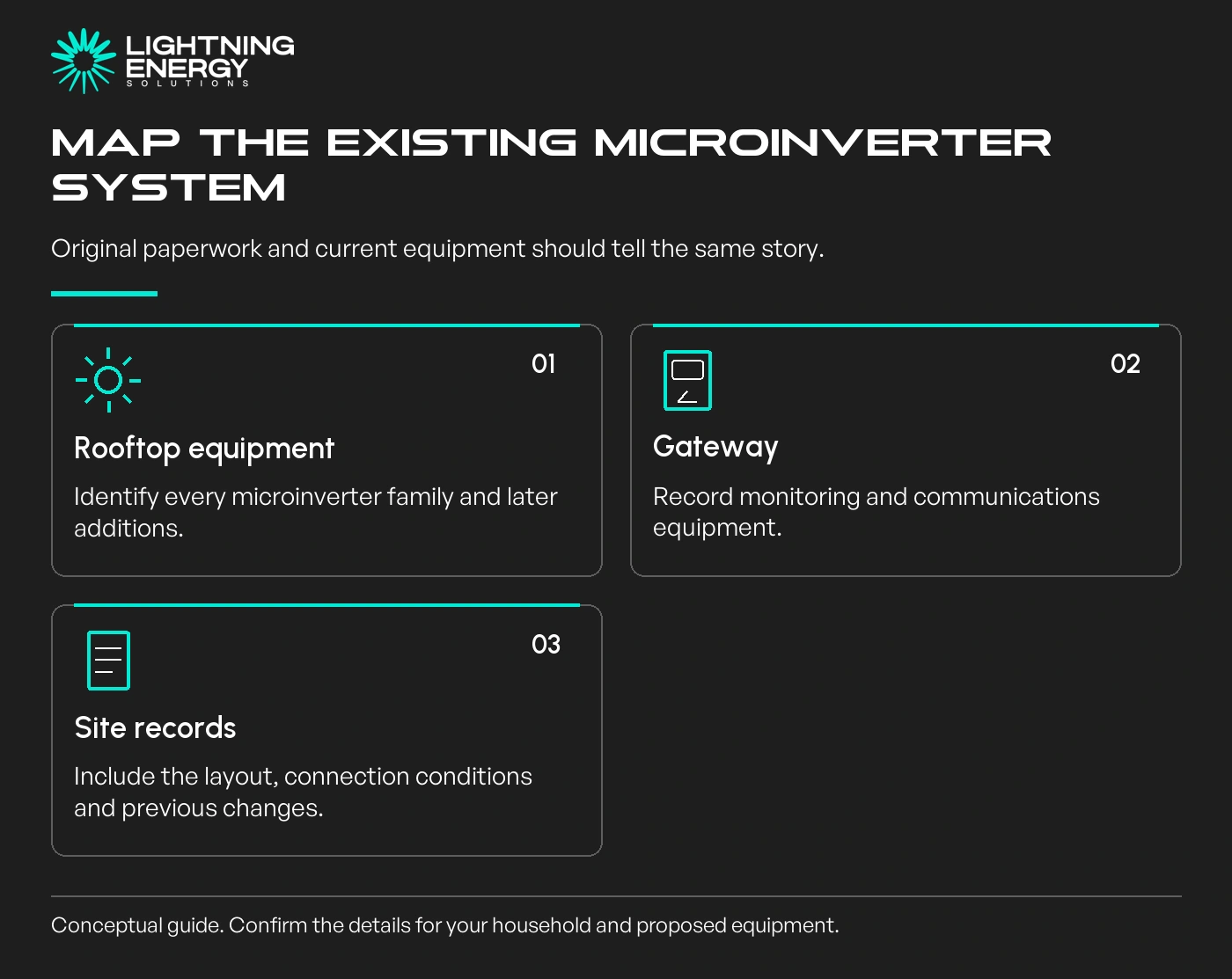
Start with the microinverter model or models, panel layout, monitoring gateway and installation documents. Older installations may have mixed equipment after repairs or extensions.
Ask the installer to check the information against the site. The app's brand name alone may not reveal the generation, communications equipment or changes made over time.
With microinverters, conversion to AC happens at the rooftop equipment. Battery options are therefore assessed around the existing AC solar supply and the proposed system controls.
Our solar inverter guide explains how this differs from a central string inverter.
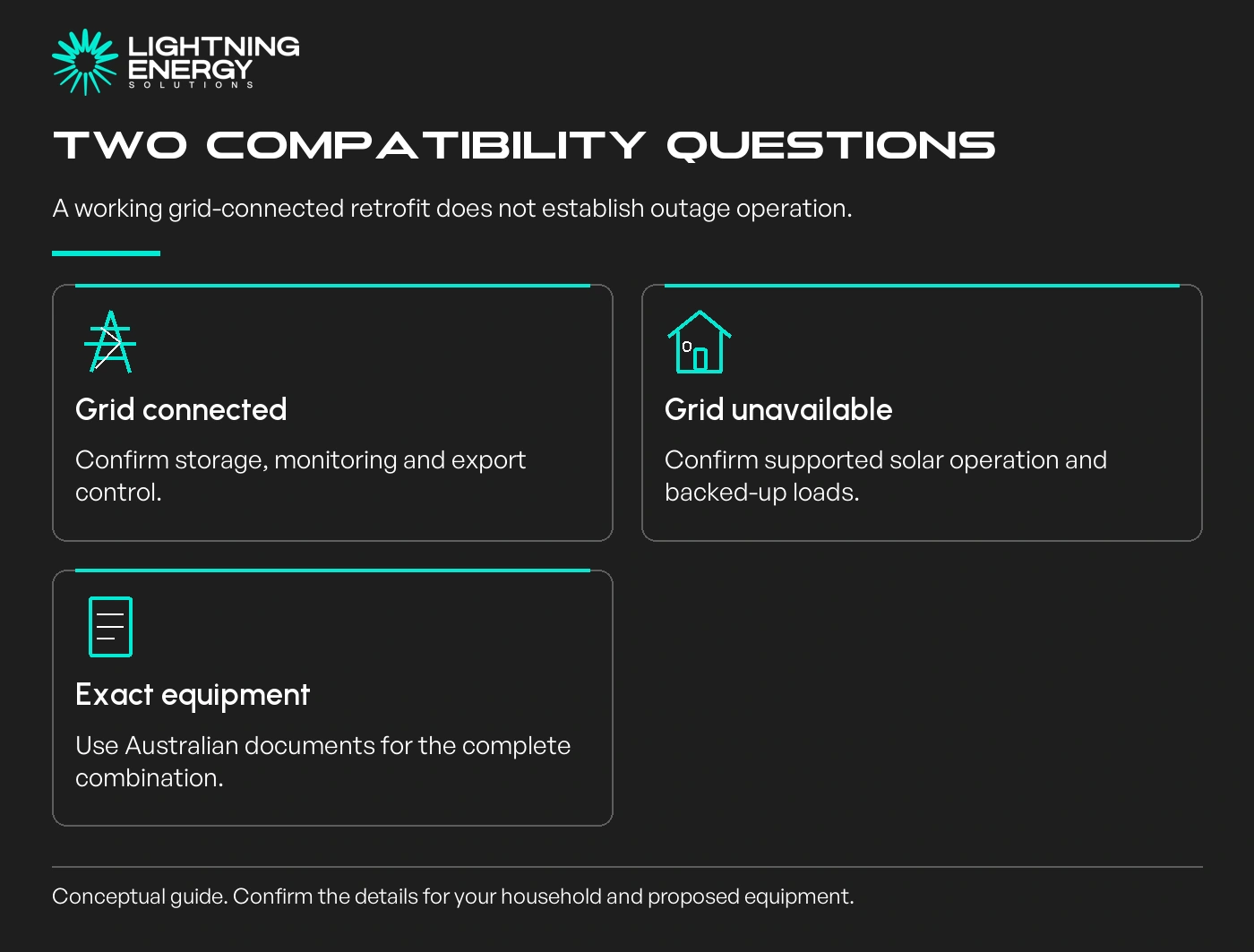
Use manufacturer documents for Australia, with the actual equipment family and software requirements. A video showing a successful overseas installation is not enough to establish support here.
Enphase's Australian documentation distinguishes grid-tied configurations from supported grid-forming configurations. Its listed combinations identify microinverter families, batteries and the required gateway or system controller.
This is a reason to specify the complete arrangement, not a promise that all old microinverters work with every new battery. Ask the installer to record the applicable configuration and required changes.
For a different battery brand, request the same evidence from the relevant manufacturers. Shared AC electricity does not, on its own, confirm coordinated backup operation.
Find out which app shows solar production, battery charge, household demand and grid imports or exports. Existing panel-level monitoring may remain separate from the battery app.
Ask who commissions the measurements and checks their direction and accuracy. Confusing monitoring can make a correctly operating system appear to be charging from the wrong source or exporting unexpectedly.
The proposal should also explain how the combined installation follows the approved export conditions. Adding a battery creates another controllable energy source; its operation needs to fit the whole site.
Our export-limit guide explains why inverter ratings and allowed exports are different questions.
A supported backup system must manage the transition away from the grid and supply only the intended loads. It must also manage solar output relative to household demand and available battery charging capacity.
For example, Enphase describes its IQ System Controller 3 INT as the component required for its supported backup arrangements. Buying battery capacity alone is not the complete scope.
Enphase Australia: IQ System Controller 3 INT.
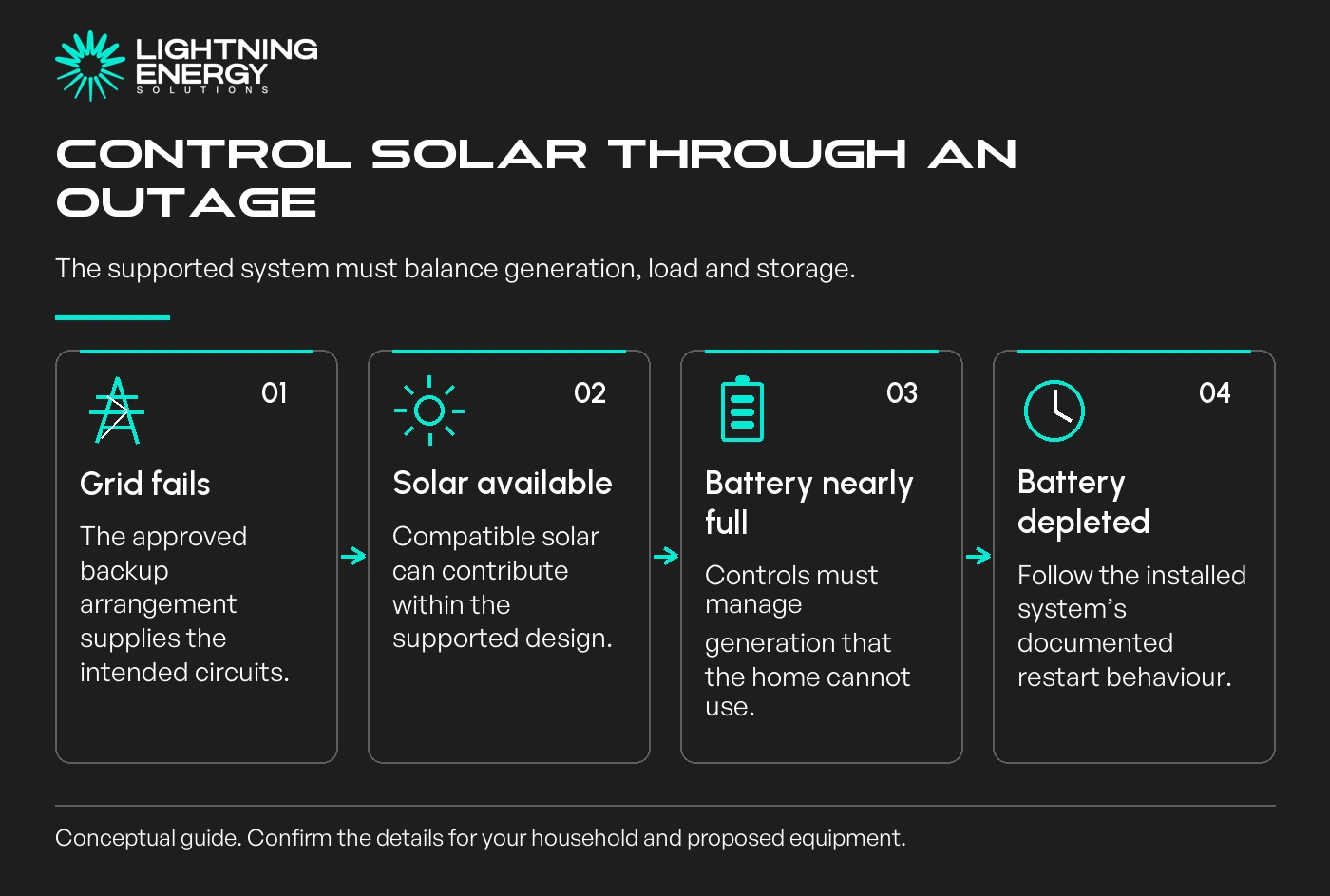
Imagine a hypothetical outage on a sunny afternoon with a nearly full battery and little household demand. Ask how your proposed system controls generation, rather than assuming every available solar watt must be stored.
Also ask what happens after battery depletion. The restart conditions and any owner actions should come from the exact installed system's instructions.
A homeowner seeking greater evening solar use may need a different proposal from someone seeking sustained outage support. Establish that priority before adding expensive backup hardware or replacing working rooftop equipment.
If the existing installation cannot support the outage behaviour you need, compare an alternative design or reduced backup scope. Waiting can be sensible when the technical answer remains unresolved.
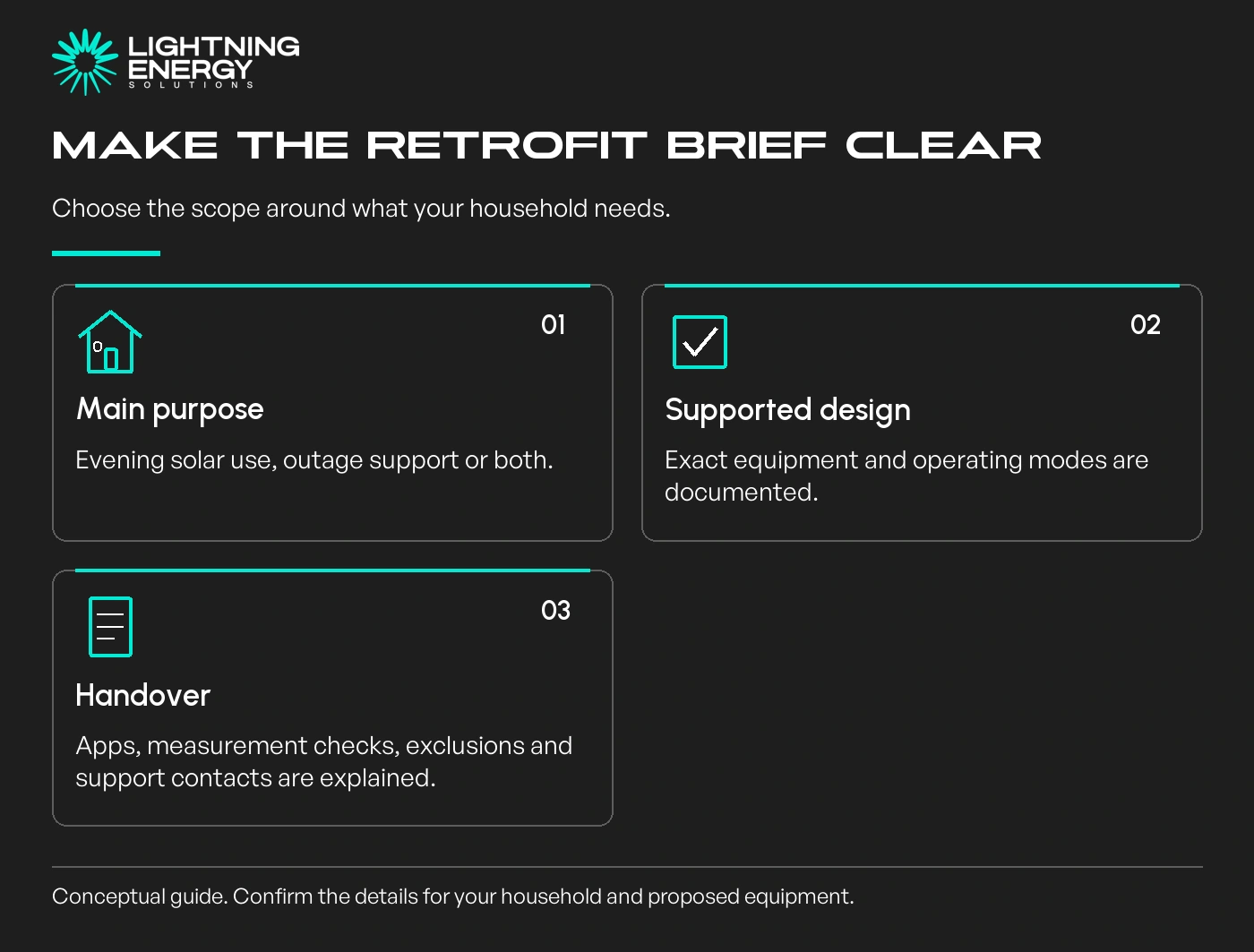
Keep warranties, support contacts and the new system diagram together. A good battery retrofit should leave you knowing who supports the original solar equipment and who supports the new controls and storage.
Plan your battery upgradeSend us your microinverter and gateway details, plus your backup priorities. We can assess supported options and explain what the retrofit would include.Available times
Book a consultation and we'll map solar, storage, hot water, and the rebates around your bills and your goals.
Question 1 of 6