
Plug-in Solar Fire Risks: What Australia’s Safety Debate Means for Households
Plug-in solar fire warnings explained: the evidence, WA’s proposed safeguards and the checks Australian households should make before buying.
Plug-in solar fire warnings explained: the evidence, WA’s proposed safeguards and the checks Australian households should make before buying.

Plug-in solar is back in the headlines, this time over fire and electric-shock risks.
For Australian households, the practical question is whether a particular product and connection method can be used safely and lawfully at their property.
This is a desk-researched safety explainer, checked on 12 November 2026. It separates the latest warnings, published test evidence and draft Australian rules. We have not tested the products discussed.
The ABC report describes concerns from electrical trade groups about a rushed rollout, misuse and insufficient safeguards.
Their concerns include people connecting multiple systems and batteries extending the period during which power can feed into household wiring.
The report describes warnings about possible harm, rather than documenting a wave of Australian plug-in solar fires.
The same report says advocates want a pathway by mid-2027. That is an advocated timetable, not a confirmed national permission to connect equipment today.
Our assessment is that a purchase decision needs more than a reassuring sales label or an alarming headline. The exact equipment, its protective functions and the rules at the installation address all matter.
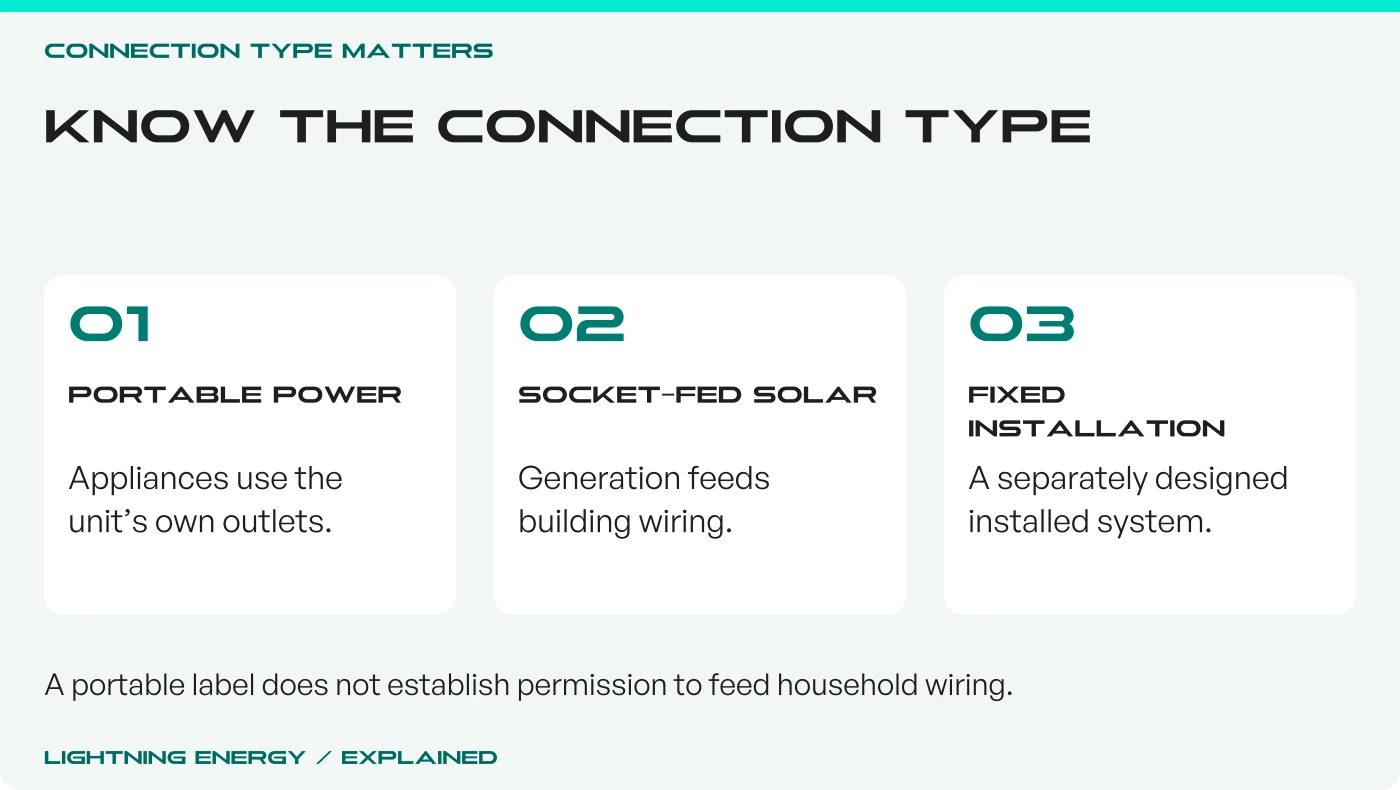
A portable power station supplying appliances from its own outlets is a different arrangement from a generator feeding electricity into a building through a wall socket.
A permanently installed solar and battery system is another arrangement again.
A product being portable does not establish that it may supply household wiring. Ask the seller to explain the intended connection in plain language and provide the relevant Australian compliance documentation.
For the broader policy background, read our balcony solar legality guide. This article focuses on the safety questions raised by the latest debate.
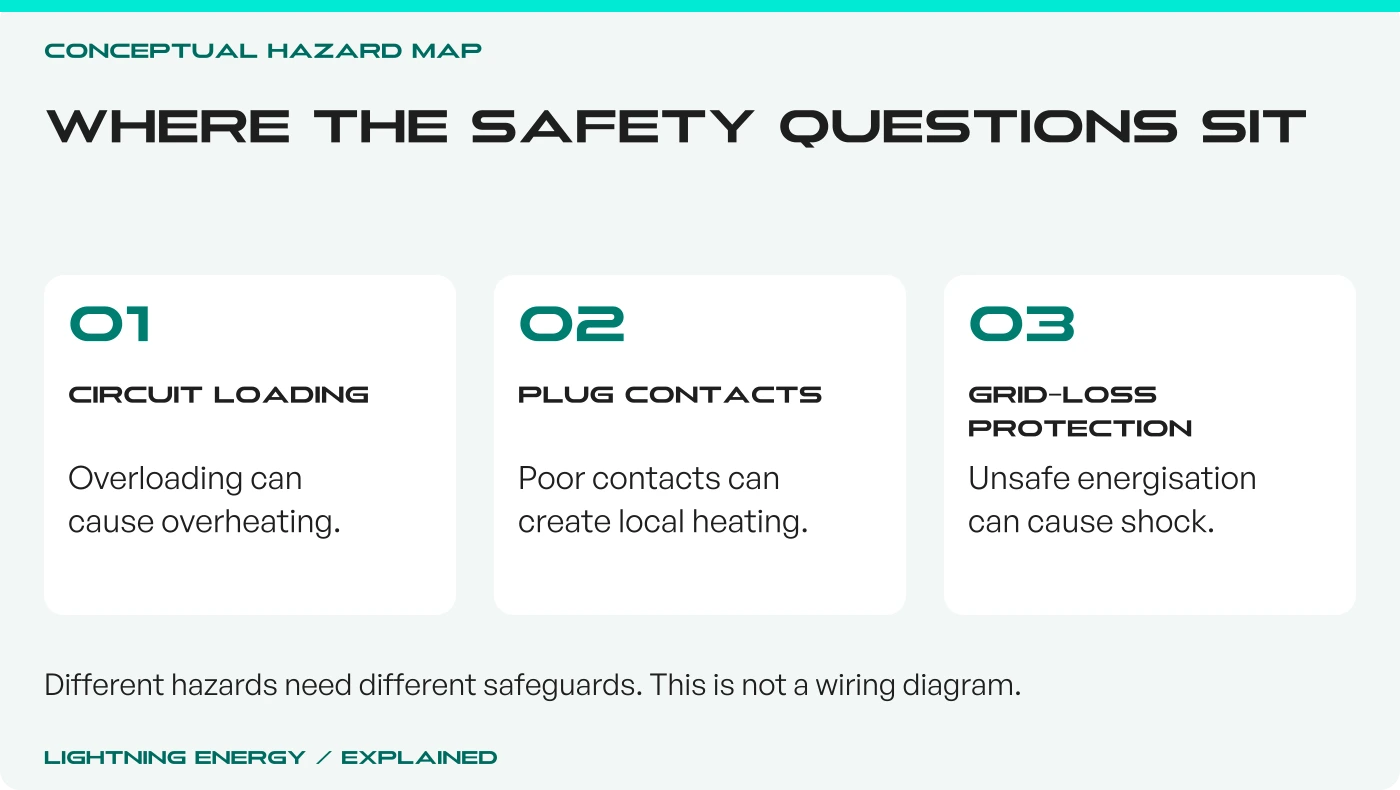
The Ontario Electrical Safety Authority hazard notice identifies overloaded circuits, poor plug contacts and unsafe backfeeding among the risks of plug-in generation.
An overloaded circuit or high-resistance connection can overheat.
Equipment that does not stop energising a circuit appropriately when the grid fails can create an electric-shock hazard.
These are separate failure mechanisms, requiring different protections.
That notice explains hazards in Ontario; it does not set Australian law. We use it here to explain why circuit suitability, connection quality and protective behaviour need attention, rather than to predict a fire rate for Australia.
A small advertised output does not answer every safety question. Nor does the presence of a battery tell you whether the complete system is compliant. Ask for documentation for the complete configuration being sold.
A UK government electrical safety study, published in June 2026, tested representative plug-in photovoltaic devices against UK household conditions and fault scenarios.
The study found safe operation within the tested conditions, without unacceptable thermal effects or sustained unsafe energisation.
It also found differences in product performance, including export limitation and electromagnetic compatibility.
Its recommendations included a UK-specific product specification, consumer guidance and registration.
Those findings support careful product requirements.
They are not Australian product approval or a blanket safety finding for every plug-in battery.
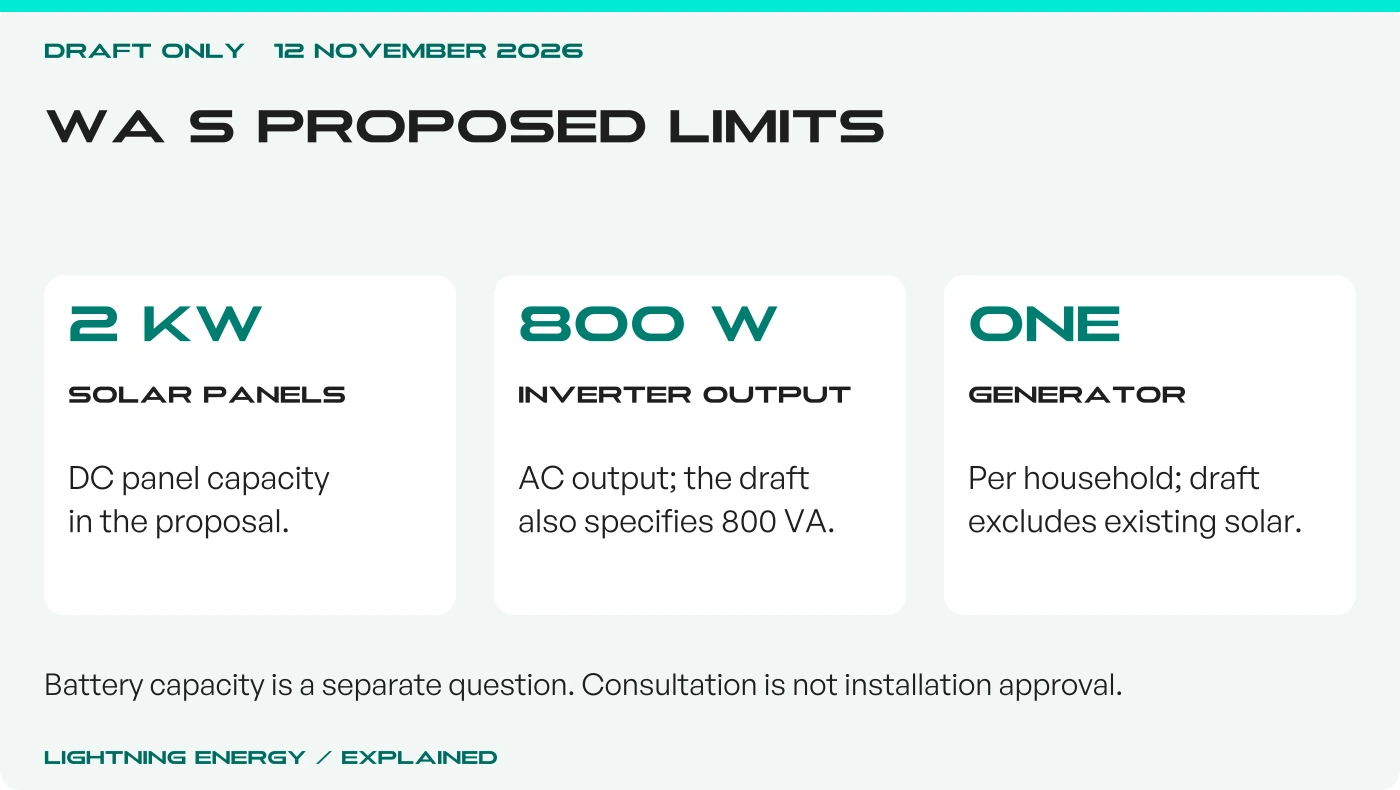
The WA consultation proposes panels up to 2 kW DC and an inverter output up to 800 W AC. Feedback closes at 5 pm AWST on 9 December 2026.
The official FAQ says imported plug-in systems cannot yet be installed under this proposed pathway. A consultation document should not be presented as current permission.
The draft technical standard limits its scope to one plug-in generator per household and excludes sites with existing fixed generation. Its rated apparent-power limit is 800 VA.
Under that draft, a battery forms part of the same generator when connected on the DC side of the same inverter.
Separate solar and battery inverters count as separate generators.
These details remain subject to the consultation process.
WA proposes no upper battery-capacity limit, but that does not mean no safety conditions.
The FAQ discusses battery chemistry, testing, protection and placement requirements.
Power in kW and stored energy in kWh describe different things.
People in other states should check their own regulator and network requirements. WA consultation material is not a national authorisation, and overseas availability does not settle local compliance.
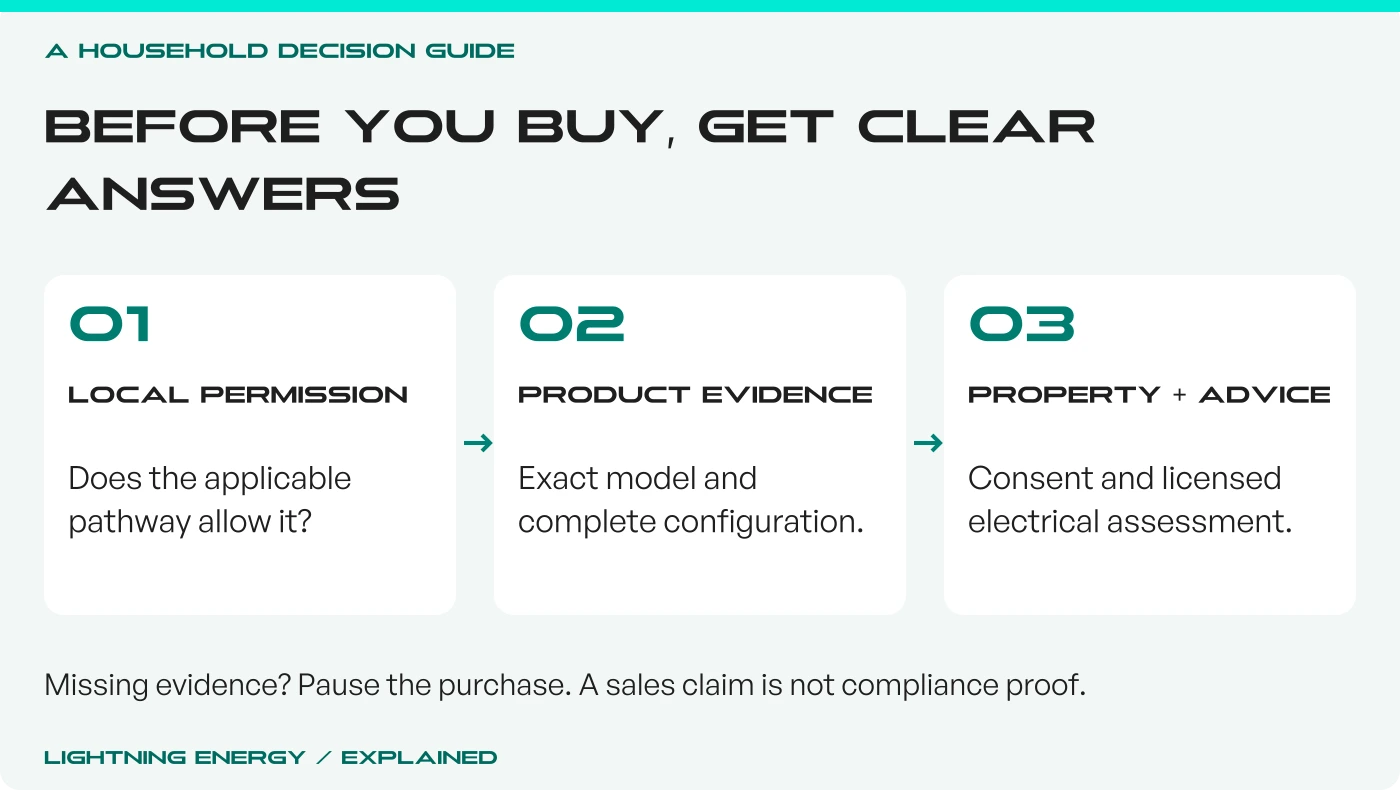
Our suggested starting point is a written evidence pack: the exact model, intended connection method, applicable Australian approvals, warranty provider and the party responsible for assessing the property.
Ask a licensed electrician about the proposed use and existing installation.
An assessment does not override a prohibition or turn an unapproved product into an approved one.
Avoid buying on the assumption that a future rule change will cover today’s purchase.
Renters and apartment owners also need to resolve property permissions. See our solar and battery options for renters before committing to equipment or balcony mounting.
Keep the invoice, product documents and written advice together.
Our installation handover checklist explains the value of a clear record of what was supplied and approved.
The plug-in debate does not establish that a professionally installed home battery has a defect.
Assess the actual model, installation, any recall notice and any fault symptoms.
Avoid making a replacement decision from a headline about a different connection type.
For general household planning, our battery and garage safety checklist covers questions to discuss with your installer.
Electrical faults require qualified assessment, not a DIY experiment.
A useful rollout needs clear product requirements, clear connection rules and instructions people can realistically follow. Equally, a useful safety discussion needs to identify the equipment and conditions behind each claim.
Before accepting a quote, ask: what exactly am I buying, what permits its use at this address, and who has checked the proposed arrangement?
Those answers are more useful than either a universal promise of safety or a universal prediction of fire.
Cover photograph: Rudy23, cropped by Conny, Wikimedia Commons.
German balcony example; no defect, fire or Australian approval is implied. Added cover layout is shared under the same licence.
Available times
Book a consultation and we'll map solar, storage, hot water, and the rebates around your bills and your goals.
Question 1 of 6
