Solar’s Price Shift: How Batteries Are Rewriting Australia’s Cheapest Power Hours
Batteries are buying more daytime electricity and supplying more evening power. Here is what the changing wholesale pattern means for Australian solar owners and household bills.
LLuke CoveLightning Energy9 October 2026 · 5 min read
Australia’s battery boom is changing a familiar energy story: cheap power in the sunshine, expensive power after sunset. Storage is becoming a bigger customer during the day and a bigger supplier later on.
For households, the useful question is what that change means for the electricity you buy, the solar you export and the energy you can shift. The answer depends on your home and your electricity plan.
The new signal in the midday market
In an 8 October analysis, David Leitch at RenewEconomy reported that midday NEM prices over the preceding 30 days had risen from around zero a year earlier to roughly $25–30/MWh. Evening prices fell from about $130 to $95/MWh.
That is a short spring comparison, not a forecast for every season or region. Leitch’s analysis links the changing daily pattern to growing battery charging and discharge. Weather, generation availability and demand also affect outcomes.
Read the RenewEconomy analysis. These are reported wholesale observations, not changes to household tariffs.
A battery sits on both sides of the market
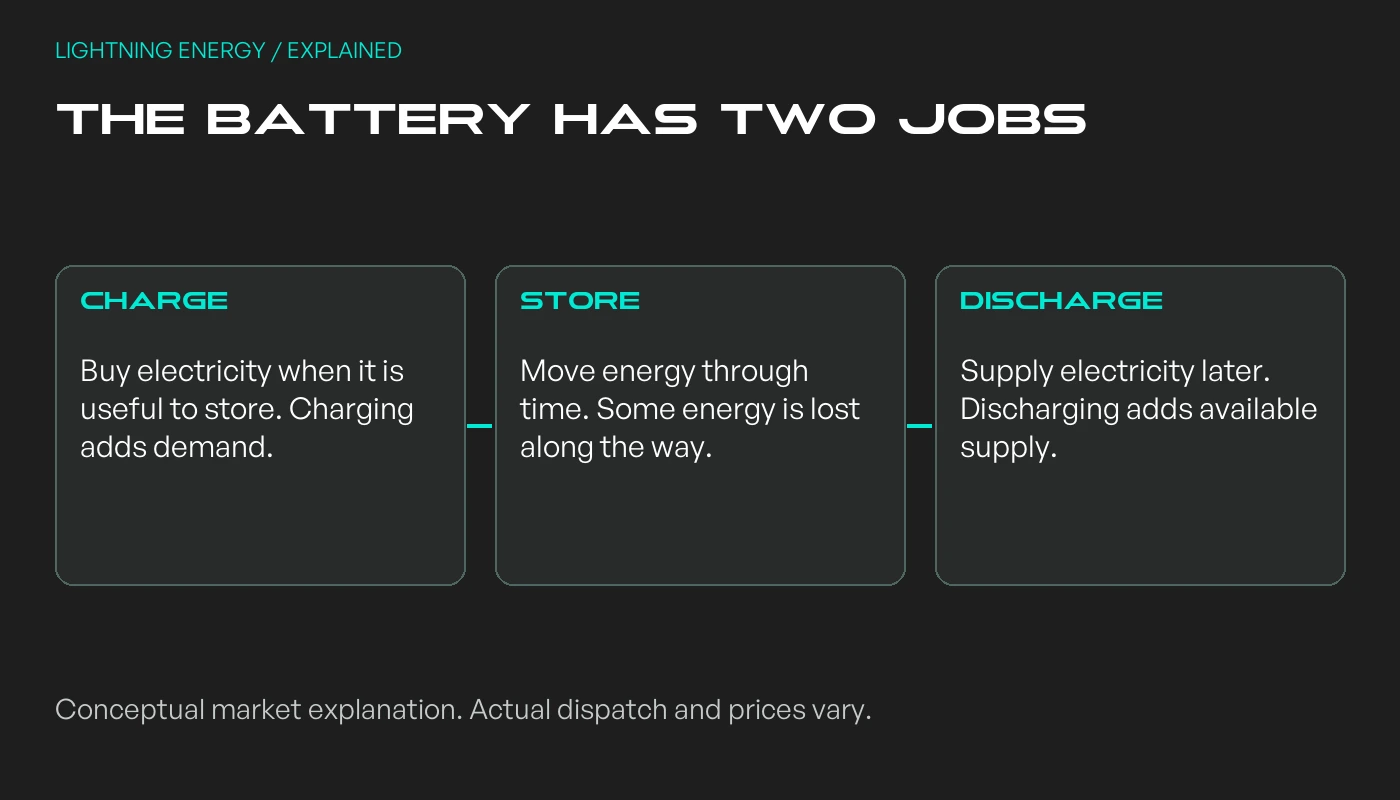
Think of storage as a time-shifting customer. When charging, it buys energy. When discharging, it supplies energy. More charging can strengthen demand during sunny hours; more discharge can ease the evening supply squeeze.
This helps explain why a higher midday price can coexist with a less expensive evening. Looking at just one hour misses the other half of the battery’s job.
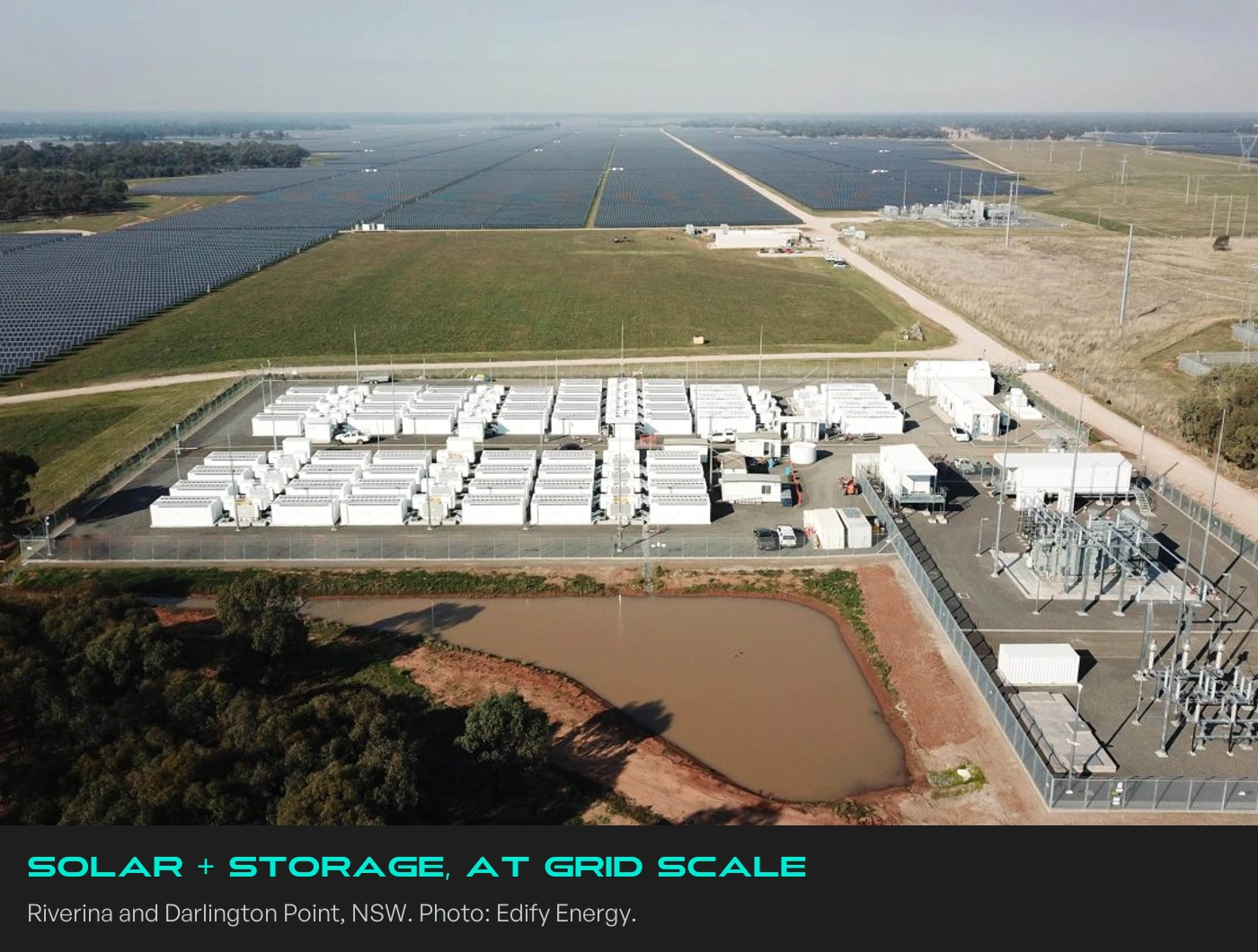
Photo: Edify Energy, Riverina and Darlington Point project page. Illustrative grid-scale storage photograph; not a Lightning Energy installation.
It illustrates the equipment behind this market shift, not the cause of any particular price result.
The official data also shows storage gaining influence
AEMO’s Quarterly Energy Dynamics report puts average NEM battery discharge at 476 MW in Q2 2026, compared with 162 MW in Q2 2025. That is almost three times as much average output.
AEMO also reports that battery charging set the price in 41% of daylight dispatch intervals, while battery discharge set prices in 46% of evening peak intervals. These are price-setting frequencies, not shares of total electricity supply.
The April–June report is separate evidence; it does not independently reproduce the September–October comparison.
Original Lightning Energy concept graphic. It explains market behaviour without claiming that batteries alone determine prices.
Does this mean electricity bills are going up?
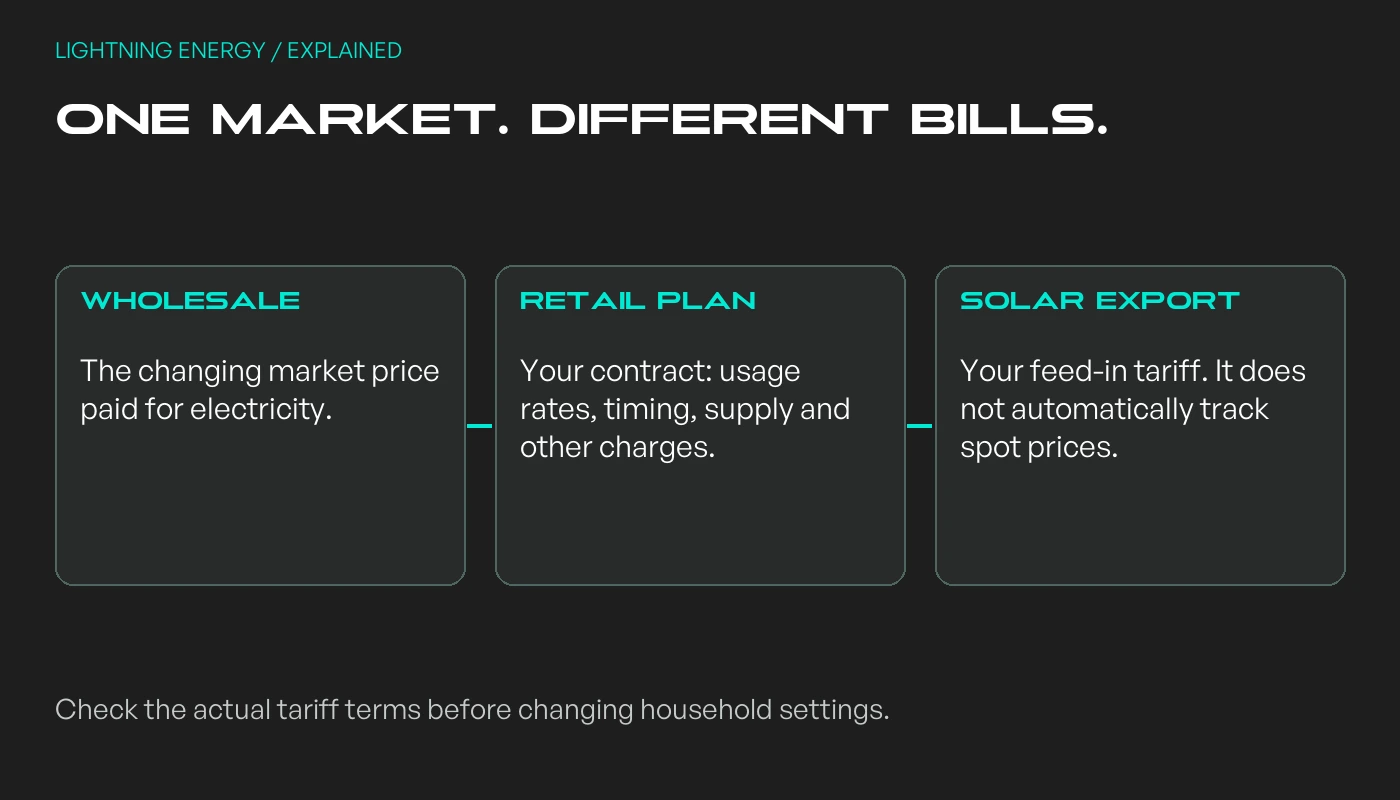
A spot-market movement does not automatically change the rate on your bill. Your retail contract matters, along with network charges, supply charges and other costs.
The Australian Energy Regulator reported lower wholesale prices across NEM regions in 2025 as renewable supply and battery activity grew.
Its assessment also explains why retail prices do not follow wholesale changes immediately or dollar for dollar.
A cheaper evening can matter even when the middle of the day costs more.
Our guide to retail bills and wholesale prices explains that gap. Avoid reading a wholesale price in dollars per megawatt-hour as a new retail offer in cents per kilowatt-hour.
Original Lightning Energy explanation. These prices are connected through the market but are not interchangeable.
What solar owners should check first
Start with your export arrangement. A fixed feed-in tariff does not rise automatically because wholesale midday prices have increased. A time-varying or market-linked offer needs its own terms checked.
Then compare the full plan: import rates, daily supply charges, export rates, applicable time windows and any demand charge. A bigger export headline can be outweighed by other costs.
Your available options depend on location and retailer.
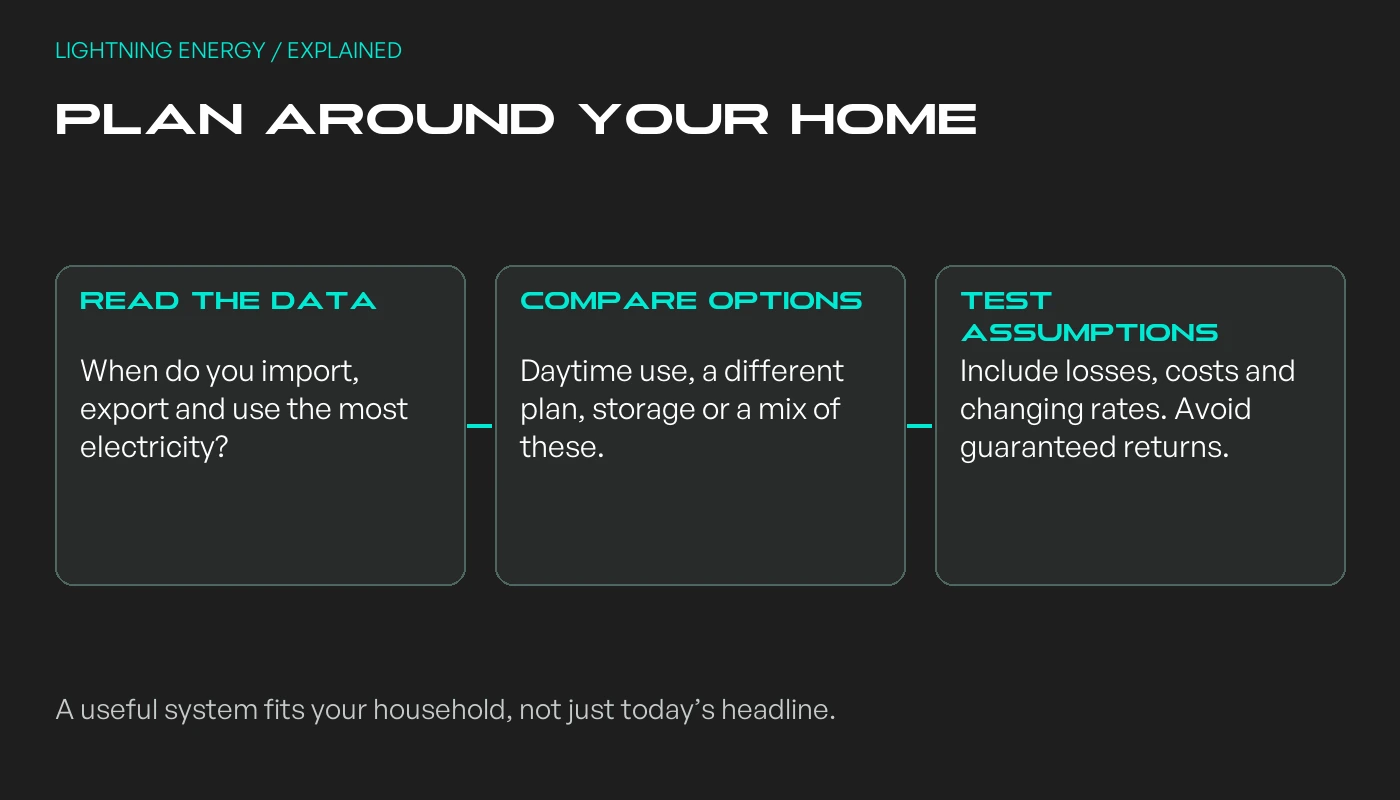
For a solar system, our practical starting point is the household’s interval data. Look for recurring surplus generation and the times you buy power. That reveals opportunities that an average market price cannot.
Is a home battery still worth considering?
A home battery decision needs a household calculation. Avoided imports, export opportunities, equipment cost, usable capacity, losses and your preferred backup reserve all belong in the discussion.
For example, a household that is empty all afternoon may have different storage needs from one with daytime heating, cooling or EV charging. The same roof and battery size will not produce the same outcome in both homes.
Compare battery options against actual consumption. Ask for sensitivity checks with different electricity rates and export rewards, rather than a single payback number that assumes today’s settings last forever.
If you have an EV, consider charging arrangements in that comparison. Moving an existing flexible load may be part of the answer; the right choice depends on when the vehicle is home and what your tariff allows.
Original Lightning Energy planning graphic. No savings, payback or export-income guarantee is implied.
A national story with regional differences
The NEM figures discussed here apply to the interconnected eastern and southern market. Western Australia and the Northern Territory have separate electricity systems. Even within the NEM, regional outcomes and household offers differ.
Our view: storage is making the timing of electricity more important to understand. A good household plan connects solar production, daily routines and the actual retail contract, then stays useful when market conditions change.
This article is original Lightning Energy analysis, checked 9 October 2026. The linked reporting and official publications use different periods. Photography is credited to Edify Energy; explanatory graphics are original.
Book a consultation and we'll map solar, storage, hot water, and the rebates around your bills and your goals.
Loading consultations…
Lightning EnergyPlan your next energy upgrade.
⚡
Hi, I’m Lightning Energy’s project guide. I’ll ask a few practical questions, explain what usually matters for your project, and help you decide on a useful next step — no guesswork or sales pressure.
First, what kind of property are we planning for?