
Home Battery or Generator for Regional Outages? Compare the Job
Compare battery backup and generators for regional Australian outages, including usable energy, starting loads, fuel, carbon monoxide and safe installation.
Compare battery backup and generators for regional Australian outages, including usable energy, starting loads, fuel, carbon monoxide and safe installation.

For a regional home, backup planning starts with the jobs that must keep working: refrigeration, communications, selected lights, water pumps or another essential load.
A battery and a generator have different constraints. Neither should be selected from a headline power figure without checking the loads, duration and safe installation requirements.
This guide was checked on 4 November 2026. It is a planning comparison, not a wiring guide or a guarantee of continuous supply during an emergency.
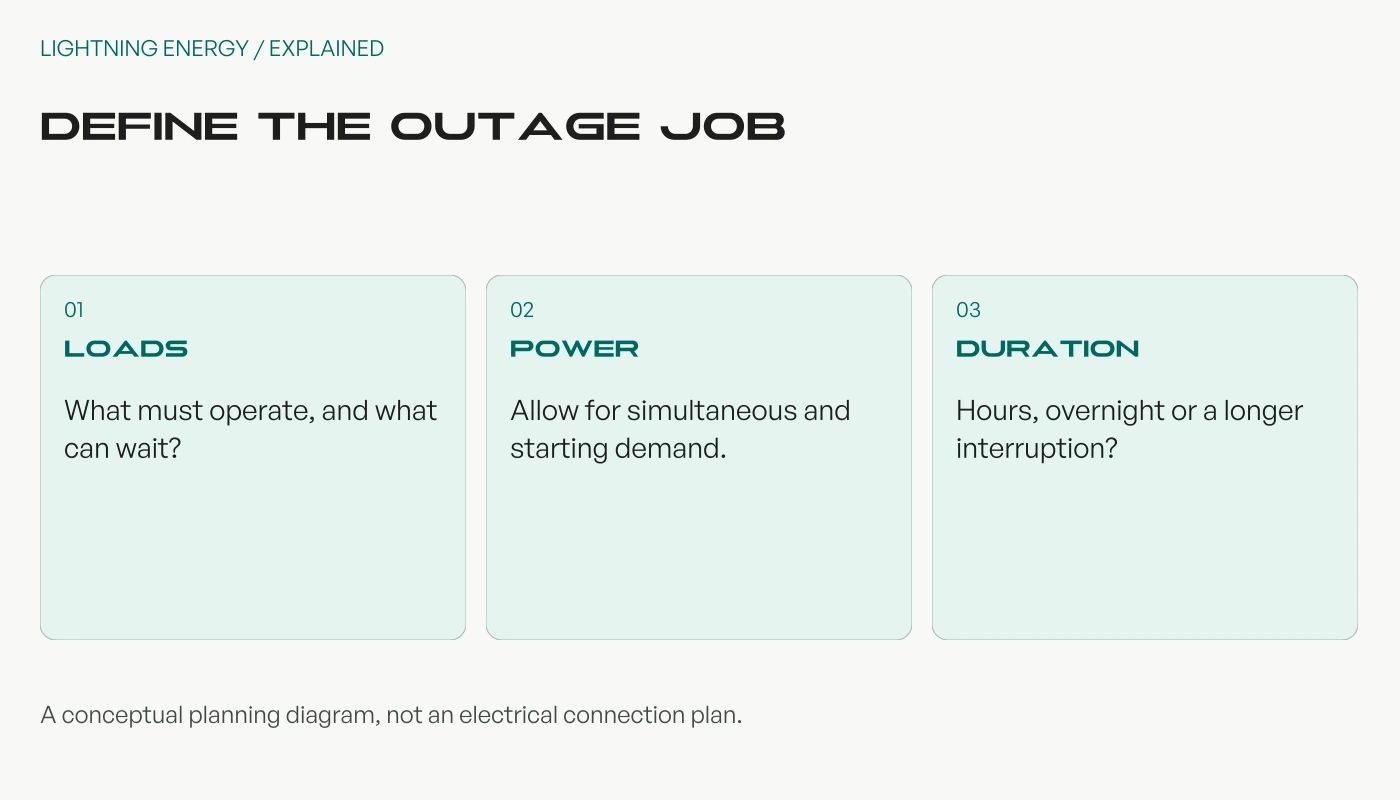
Identify what must run, what can wait and what has a high starting demand. A water pump can be a different design problem from a modem and a few lights.
Ask a licensed electrician to assess continuous power, starting requirements and the proposed backup circuits. Do not assume a whole-home promise includes every appliance operating together.
Our backup test guide explains why the handover should demonstrate the agreed loads. Include equipment that is easy to overlook, such as a garage door or communications hardware.
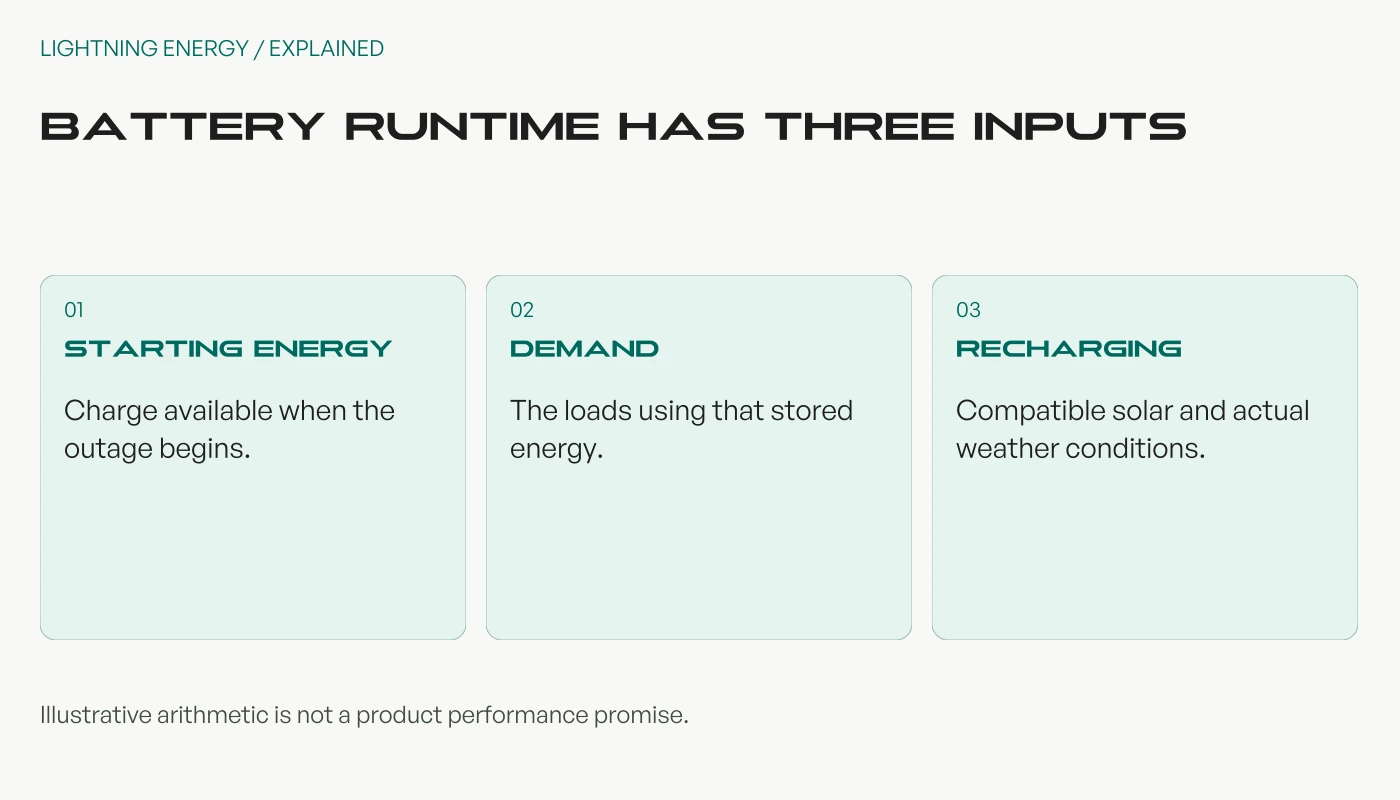
Battery power in kilowatts describes an output limit. Available energy in kilowatt-hours helps determine how long loads can run. Those are separate checks.
For illustration, 8 kWh available for backup divided by a steady 1 kW load gives eight hours before allowing for losses and other limits. That is arithmetic, not a runtime claim for a particular product.
The starting charge level, reserve settings, temperature and system design can change the result. Check which energy figure is actually available rather than using the largest number on a brochure.
Solar recharging during an outage depends on a compatible backup design and available sunlight. Existing rooftop solar does not automatically keep running when the grid is down.
A generator may help with longer interruptions where a suitable fuel supply and safe operating arrangement are available. Runtime still depends on fuel, load, maintenance and the model’s operating instructions.
Ventilation is critical. Victorian health guidance warns that petrol and diesel generators produce carbon monoxide, which can be fatal and cannot be detected by smell.
Operate generators outdoors in a well-ventilated location away from doors, windows and vents, following the manufacturer’s instructions. A garage is not a safe operating location simply because its door is open.
Source: Victorian Department of Health generator and carbon-monoxide guidance.
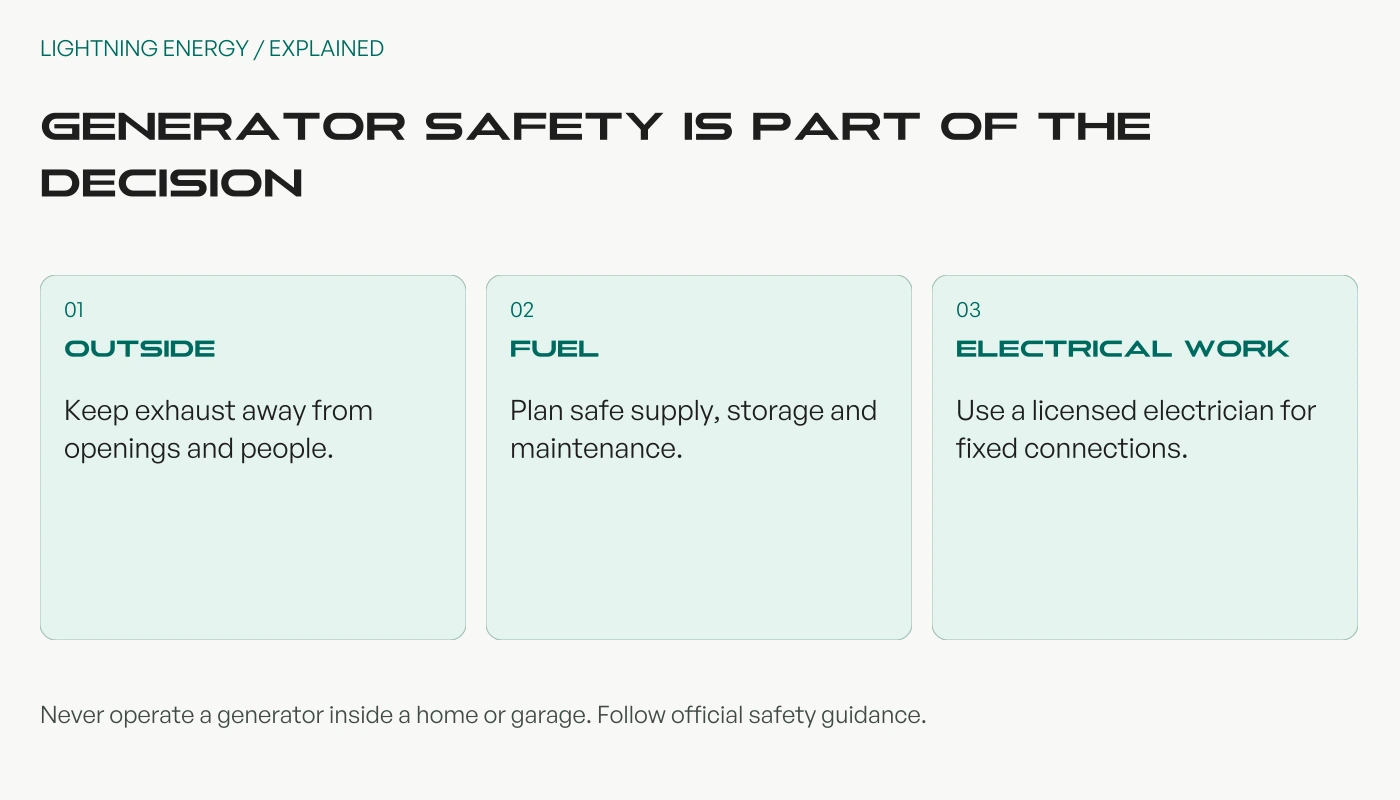
A generator connection to fixed household wiring requires an appropriate design and a licensed electrician. Never plug a generator into a household power point to energise the home.
Energy Safe Victoria’s generator safety reminder explains the risks and the need for safe connection arrangements.
Do not assume a generator can be connected to any battery inverter. If both are proposed, ask for manufacturer-supported compatibility and a documented system design.
Our guide to battery backup and UPS limitations explains why a backup label is not a guarantee of uninterrupted power for sensitive equipment.
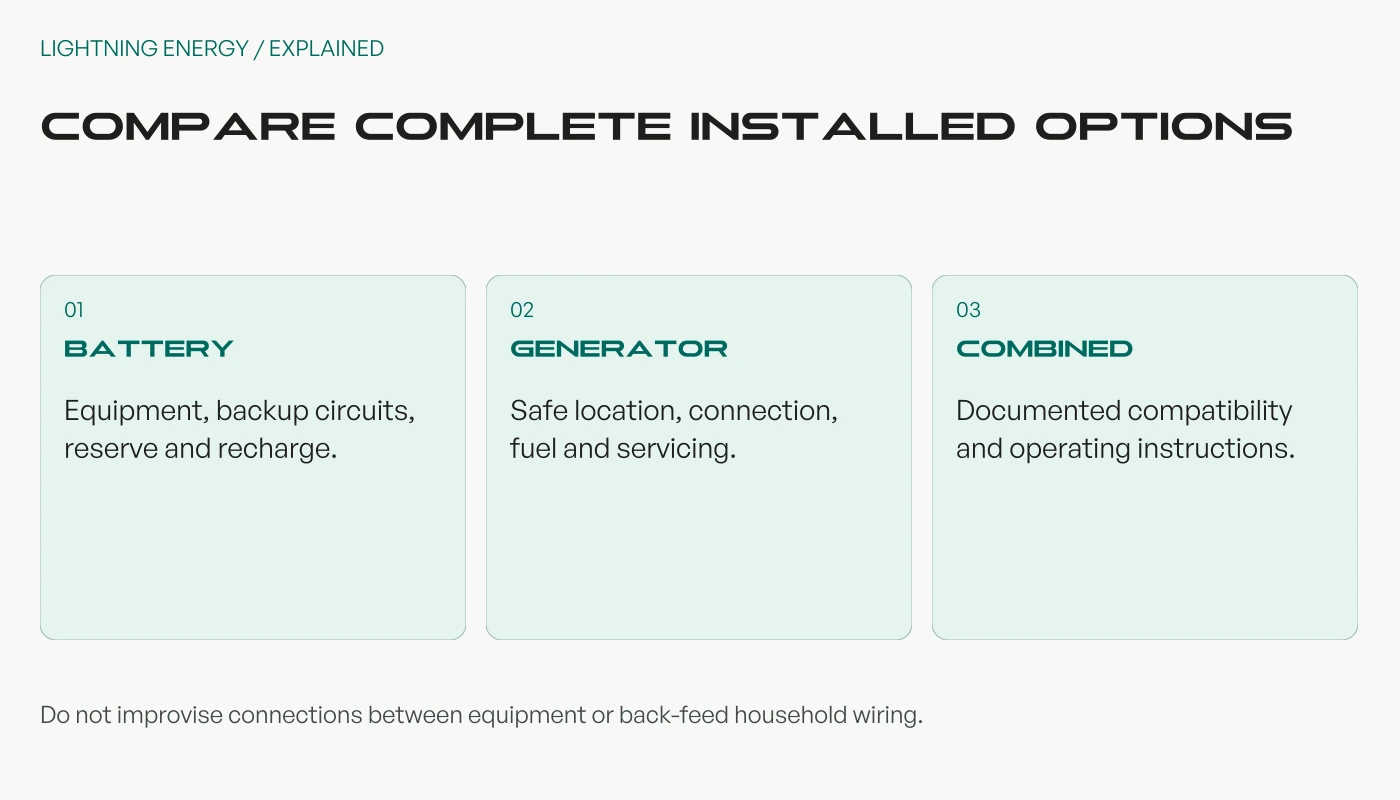
Compare the installed cost and ongoing responsibilities. A battery may also serve everyday energy needs. A generator requires a workable fuel and maintenance plan even if it is used infrequently.
Ask who services each system, how faults are reported and how the household will practise the agreed procedure safely. Keep instructions accessible when mobile reception or internet access is unavailable.
For medical equipment, agree a continuity plan with the equipment supplier and treating team. Do not rely on a general household battery or generator comparison to establish that a medical device will remain powered.
Backup equipment does not make it safe to remain during a bushfire evacuation. Follow emergency-service instructions and keep power planning separate from the decision to leave.
Use our battery quote checklist.
Then contact Lightning Energy with the property’s load list and outage history. Ask for a design that explains what works, for how long and under which conditions.
Available times
Book a consultation and we'll map solar, storage, hot water, and the rebates around your bills and your goals.
Question 1 of 6
