Sydney VPP Incentives for Bigger Batteries: Why 28 kWh and 50 kWh Mean Different Things
Comparing a 30–50 kWh battery in Sydney? Understand the NSW VPP capacity cap, the federal battery discount and why larger storage does not guarantee a bigger reward.
LLuke CoveLightning Energy22 November 2026 · 5 min read
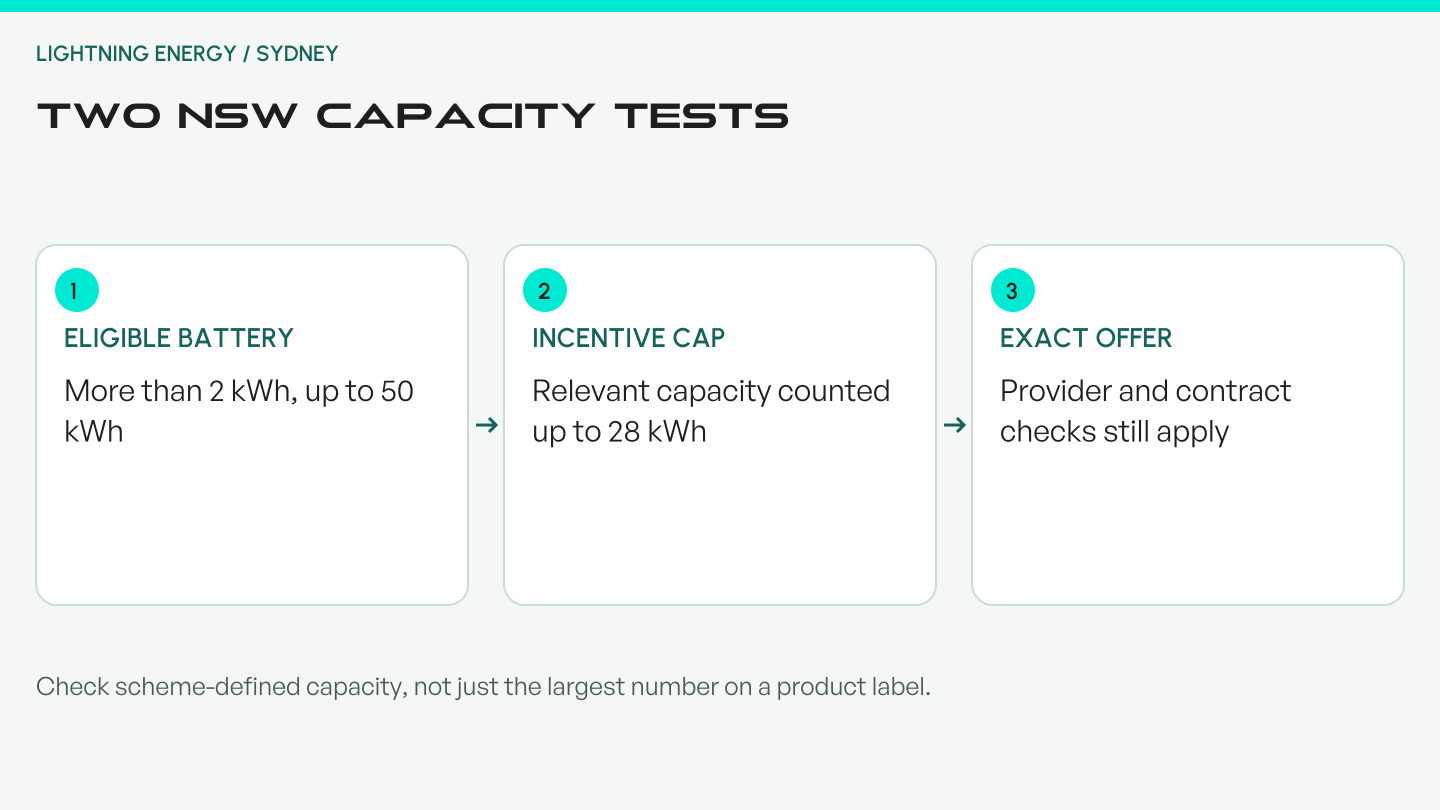
A Sydney battery larger than 28 kWh is not automatically excluded from the current NSW VPP incentive. The program’s battery-size eligibility limit and the capacity used to calculate the incentive are different tests.
That distinction matters when comparing a larger battery quote. Extra storage may suit the household, but it does not automatically earn proportionally more VPP joining support.
Rules and sources checked on 22 November 2026. This guide explains the decision process; eligibility and the final installation scope need to be confirmed for your property.
Separate battery eligibility from the incentive calculation
From July 2026, the eligibility ceiling expanded to 50 kWh.
The incentive calculation still caps the relevant capacity at 28 kWh. The government page describes capacity made available to the grid, so ask the provider to show the capacity used for your offer.
A 40 kWh label does not therefore imply an incentive calculated on all 40 kWh. Equally, the old claim that anything above 28 kWh cannot qualify is no longer an adequate summary.
Have the provider identify the exact battery configuration and scheme-defined capacity. Nominal, usable and grid-available energy should not be used interchangeably on the quote.
Check scheme-defined capacity, not just the largest number on a product label.
Check the other eligibility limits too. The NSW page excludes apartment-building batteries and off-grid systems from this incentive; the IPART factsheet also excludes households with registered life-support equipment.
Use a capacity-only example, not a promised dollar payment
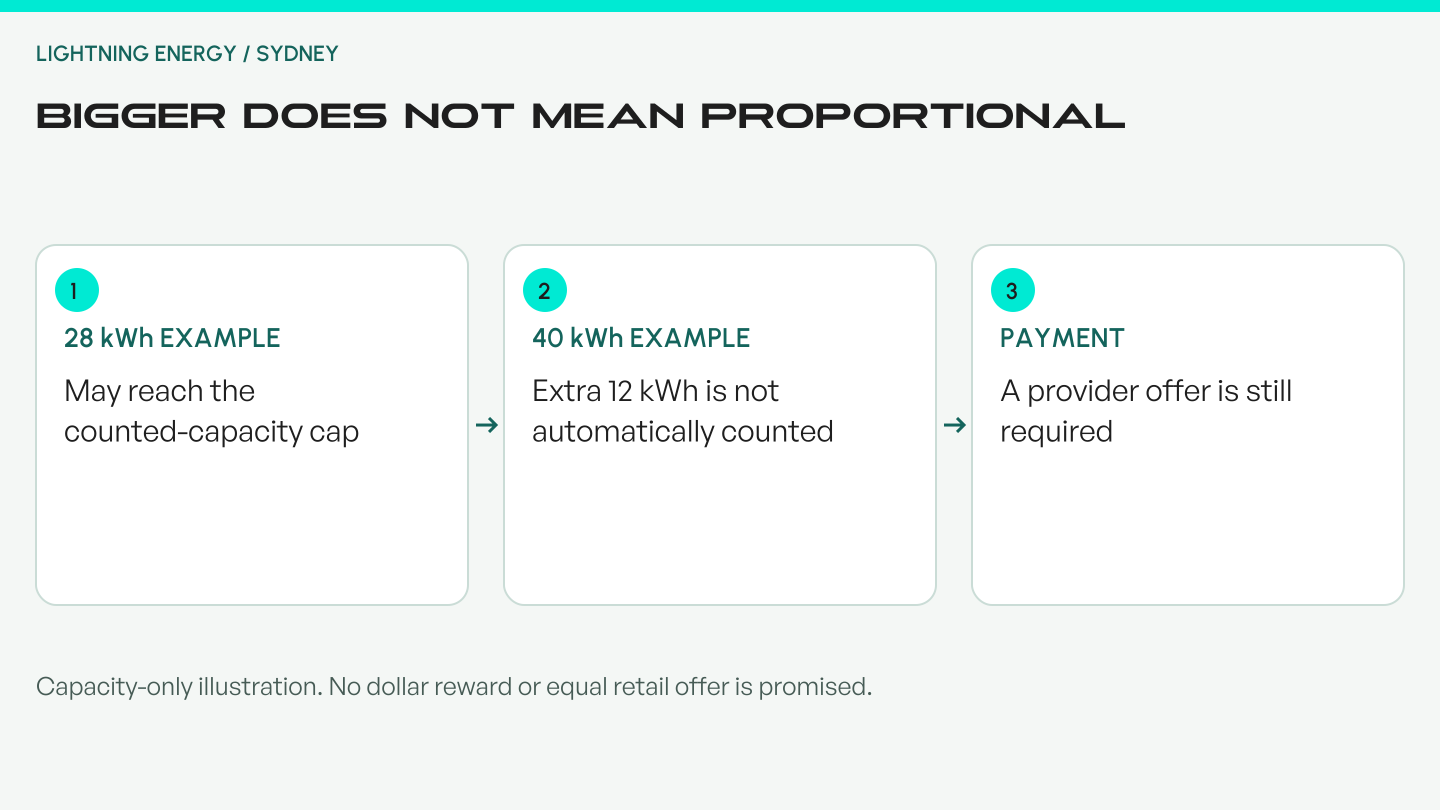
Consider two hypothetical eligible batteries with 28 kWh and 40 kWh of relevant capacity available. The calculation cap means the larger system does not automatically receive a payment based on the additional 12 kWh.
This illustration does not promise equal retail offers. Provider deductions, certificate values, eligibility, reserve arrangements and the contract can affect the amount passed to the customer.
Ask for a written offer stating the counted capacity, total incentive, payment method and timing. Avoid multiplying a headline dollar-per-kWh number by the battery’s largest advertised capacity.
Federal STCs are limited to the first 50 kWh of usable capacity; the overall system must also meet the nominal-capacity eligibility range.
Capacity bands and the installation date affect the certificate calculation.
The current taper gives a smaller marginal certificate entitlement above the lower capacity bands. Ask the retailer to show the calculation for the exact installation rather than applying one full rate to every kWh.
A federal rebate estimate and a NSW joining incentive should appear as separate quote lines. Each must independently meet its rules, even when both can be used for the same eligible system.
Check what the VPP can do with your battery
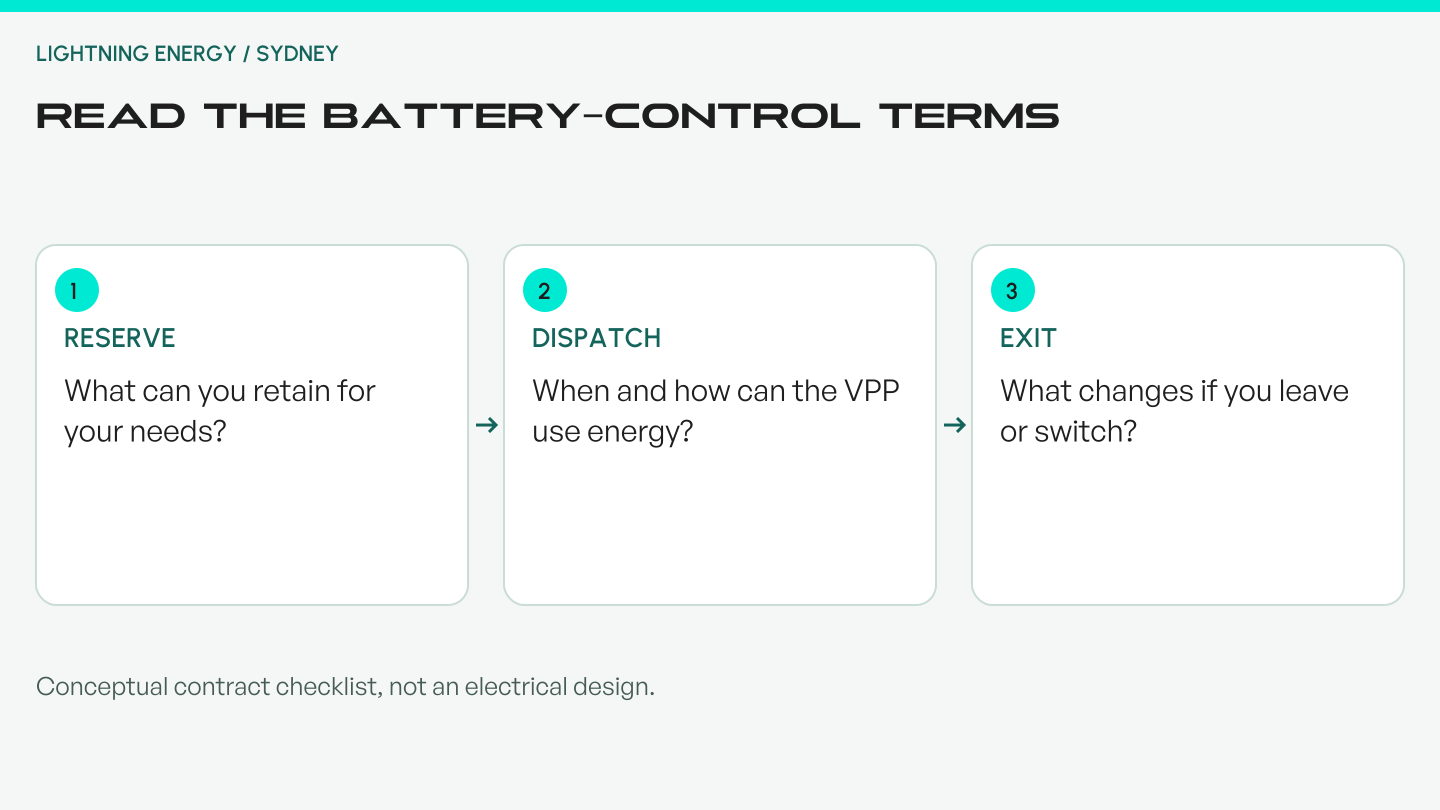
Ask how much energy the provider can dispatch, whether the battery can be charged from the grid and what reserve you can retain. Request the relevant contract clauses, not only a sales summary.
If outage backup matters, check whether the reserve behaves as expected during normal VPP operation. Also confirm which circuits the installation actually backs up.
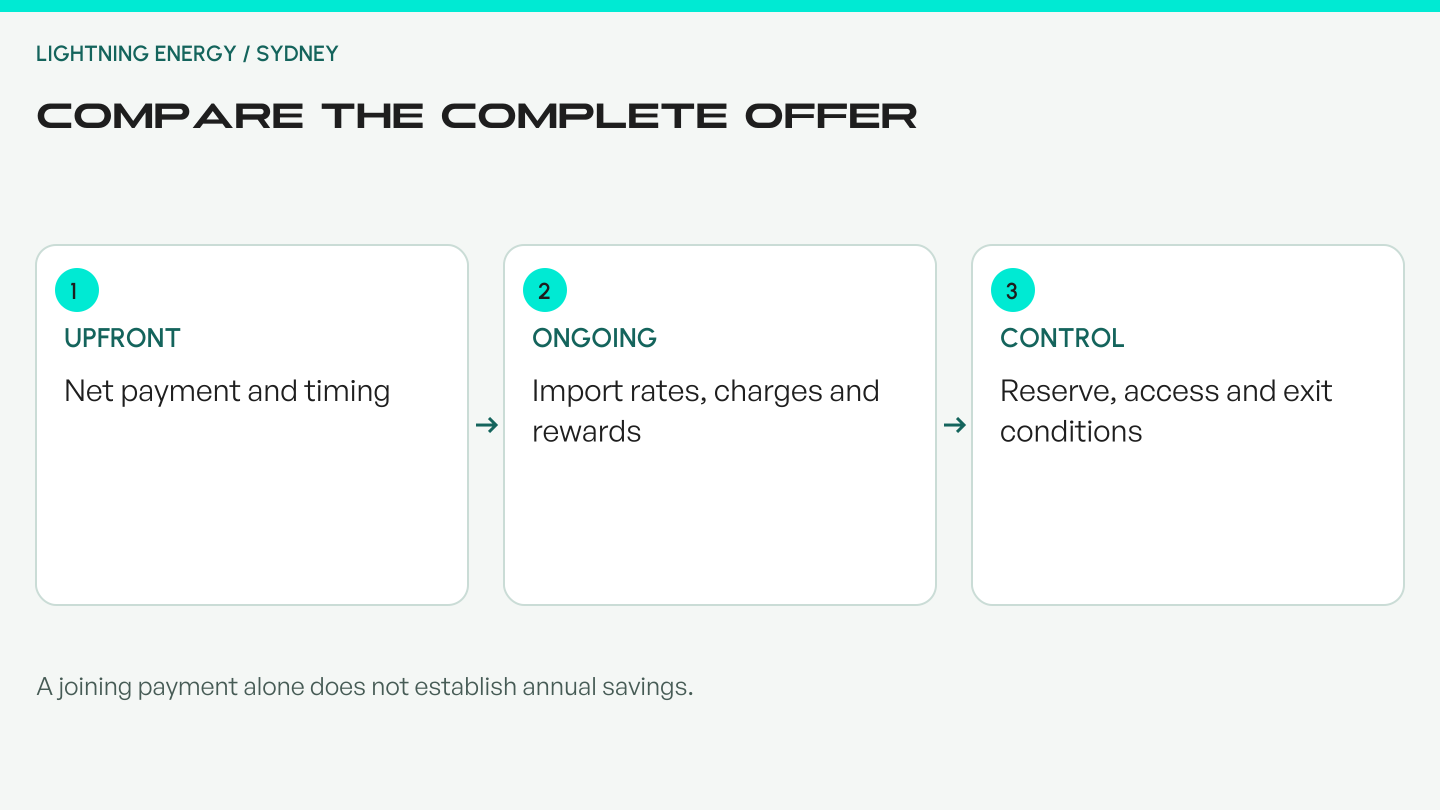
Compare the electricity plan’s import rates, daily charge, export payments and fees. A larger joining payment does not prove a lower annual bill.
Ask about term length, withdrawal, changing retailers and any repayment or clawback conditions. Keep a copy of the terms that applied when you accepted the offer.
Conceptual contract checklist, not an electrical design.
Size the battery for the household before choosing a reward
Use evening and overnight consumption, available solar exports, tariff structure and backup needs to assess storage. Do not assume a larger eligible capacity is the most economic capacity.
Look at winter as well as summer. A large battery that is frequently underused needs a different justification from one that regularly serves measured demand.
Check the inverter’s charge and discharge power separately from storage energy. More kWh does not necessarily mean more simultaneous appliance capacity or a faster charge.
If a retailer proposes future expansion, ask how it affects approvals, warranty, compatibility and prior incentive claims. A modular product does not make every later claim available.
A useful comparison table for two VPP offers
Compare the exact model, scheme-defined capacity, counted incentive capacity, net joining payment, payment timing and contract length. Then add the ongoing electricity rates and battery-control conditions.
Mark unconfirmed entries as unknown. Do not fill them with a rival provider’s offer or a payment reported by another household.
Choose the battery and the VPP on the complete arrangement. The capacity cap is one part of the calculation, not a recommendation to buy a particular size.
A joining payment alone does not establish annual savings.
Frequently asked questions
Can a 40 kWh battery qualify for the NSW VPP incentive?
It may, subject to the current eligibility and provider requirements. The battery-size ceiling is 50 kWh, while the incentive calculation caps relevant capacity at 28 kWh.
Will a 50 kWh battery receive twice a 25 kWh battery’s incentive?
Not automatically. The 28 kWh calculation cap prevents a simple proportional assumption, and actual customer offers depend on the provider and contract.
Cover: existing Lightning Energy website photography, used as installation or home-energy context. The pictured property is not claimed to be in the suburb discussed or to have received a particular incentive.
Book a consultation and we'll map solar, storage, hot water, and the rebates around your bills and your goals.
Loading consultations…
Lightning EnergyPlan your next energy upgrade.
⚡
Hi, I’m Lightning Energy’s project guide. I’ll ask a few practical questions, explain what usually matters for your project, and help you decide on a useful next step — no guesswork or sales pressure.
First, what kind of property are we planning for?