
How Battery Size and Installation Date Affect the Federal Discount
Battery discount calculations depend on usable capacity, installation date, certificate tiers and the value offered. See a clearly labelled example.
Battery discount calculations depend on usable capacity, installation date, certificate tiers and the value offered. See a clearly labelled example.

The federal battery discount is not a fixed percentage of every installation quote.
The certificate calculation uses eligible usable capacity and the factor applying when the battery is installed, with different support levels across capacity bands.
The certificate-related discount then depends on the value offered and any disclosed charges. Keep those stages separate when comparing a larger battery or a later installation date.
A product name may refer to nominal capacity, usable capacity or a rounded marketing size. Ask the retailer to identify the usable capacity used in the certificate calculation and the exact approved configuration.
The federal calculation supports only the first 50 kWh usable capacity of an otherwise eligible system. Capacity beyond that does not keep earning battery certificates under the program.
Our federal eligibility guide covers the other conditions. This calculation is not a substitute for that eligibility check.
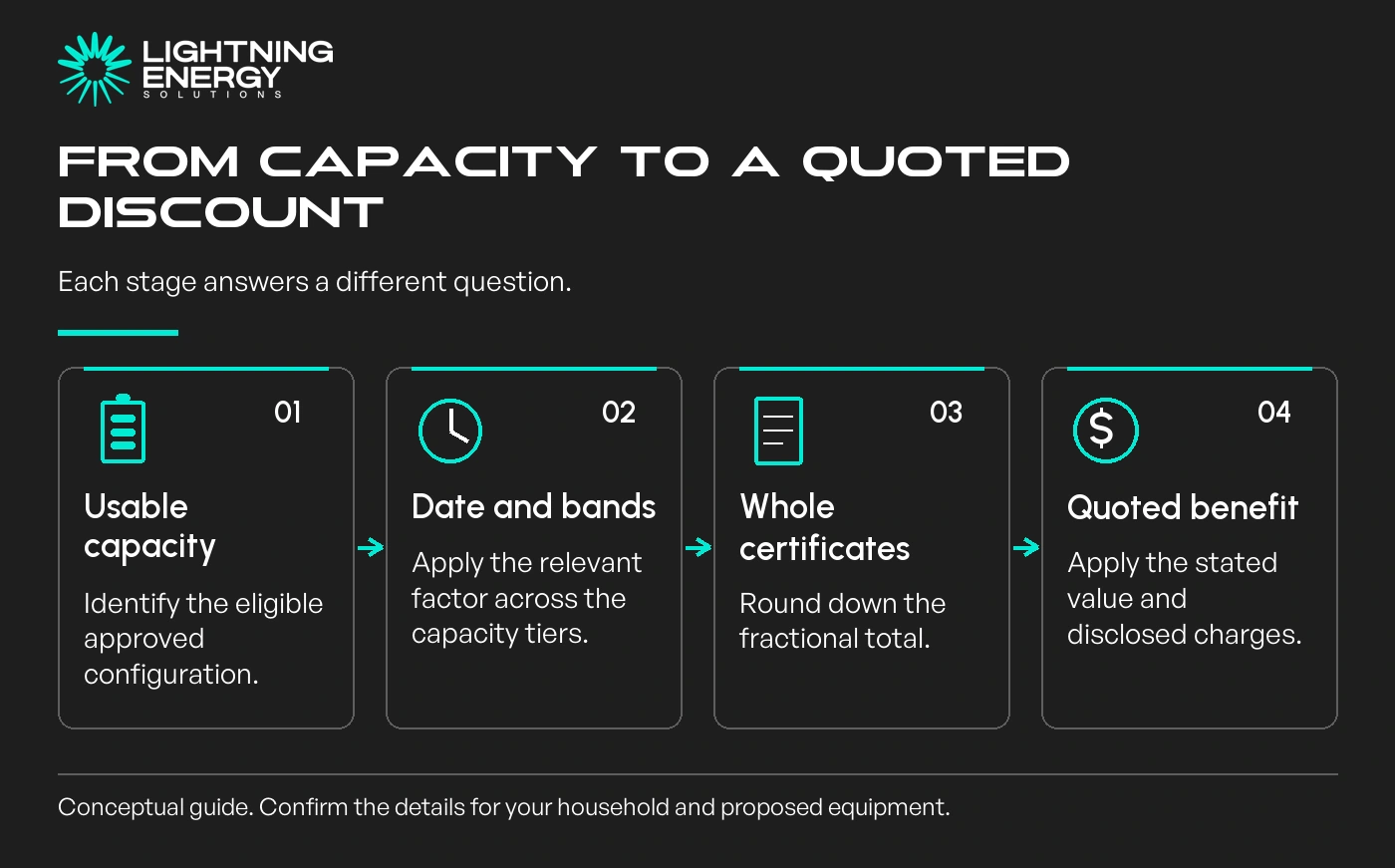
DCCEEW lists a factor of 6.8 for installations in May–December 2026. Under the current tiers, the first 14 usable kWh receive the full factor, the next 14 receive 60%, and usable capacity above 28 up to 50 receives 15%.
DCCEEW factors and capacity bands.
The reduced factor applies to the capacity within each later band, not retrospectively to the entire battery. A larger battery can therefore earn more certificates while receiving less support per additional kWh.
Consider a hypothetical eligible system with 20 kWh usable capacity, installed and certified during May–December 2026. The first 14 kWh produce 14 × 6.8 = 95.2 before rounding.
The remaining 6 kWh produce 6 × 6.8 × 60% = 24.48. Together, that is 119.68, giving 119 whole certificates after the fractional total is rounded down.
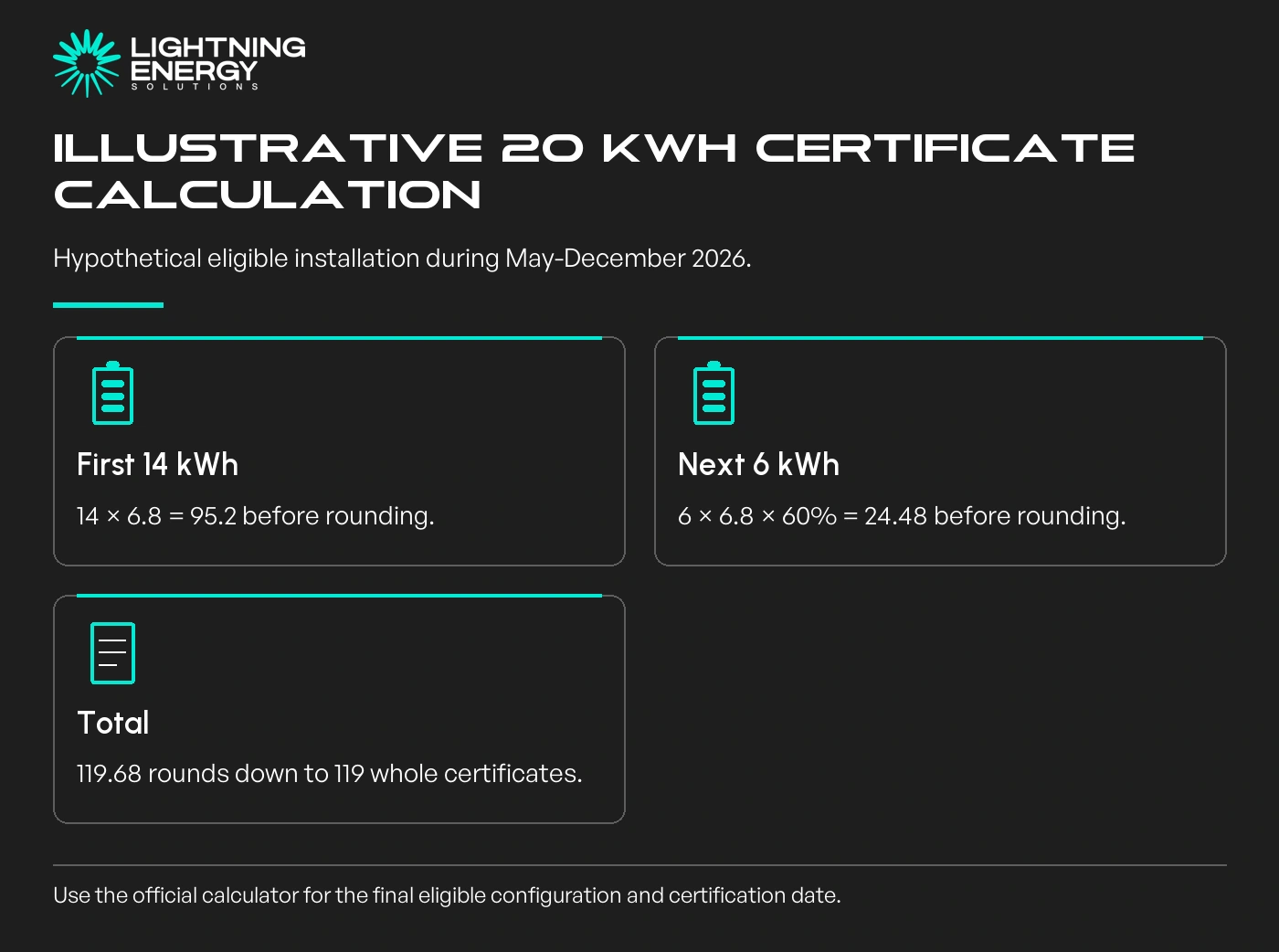
DCCEEW confirms the rounding approach. Use the official calculator and final installation details for an actual claim; this example only explains the arithmetic.
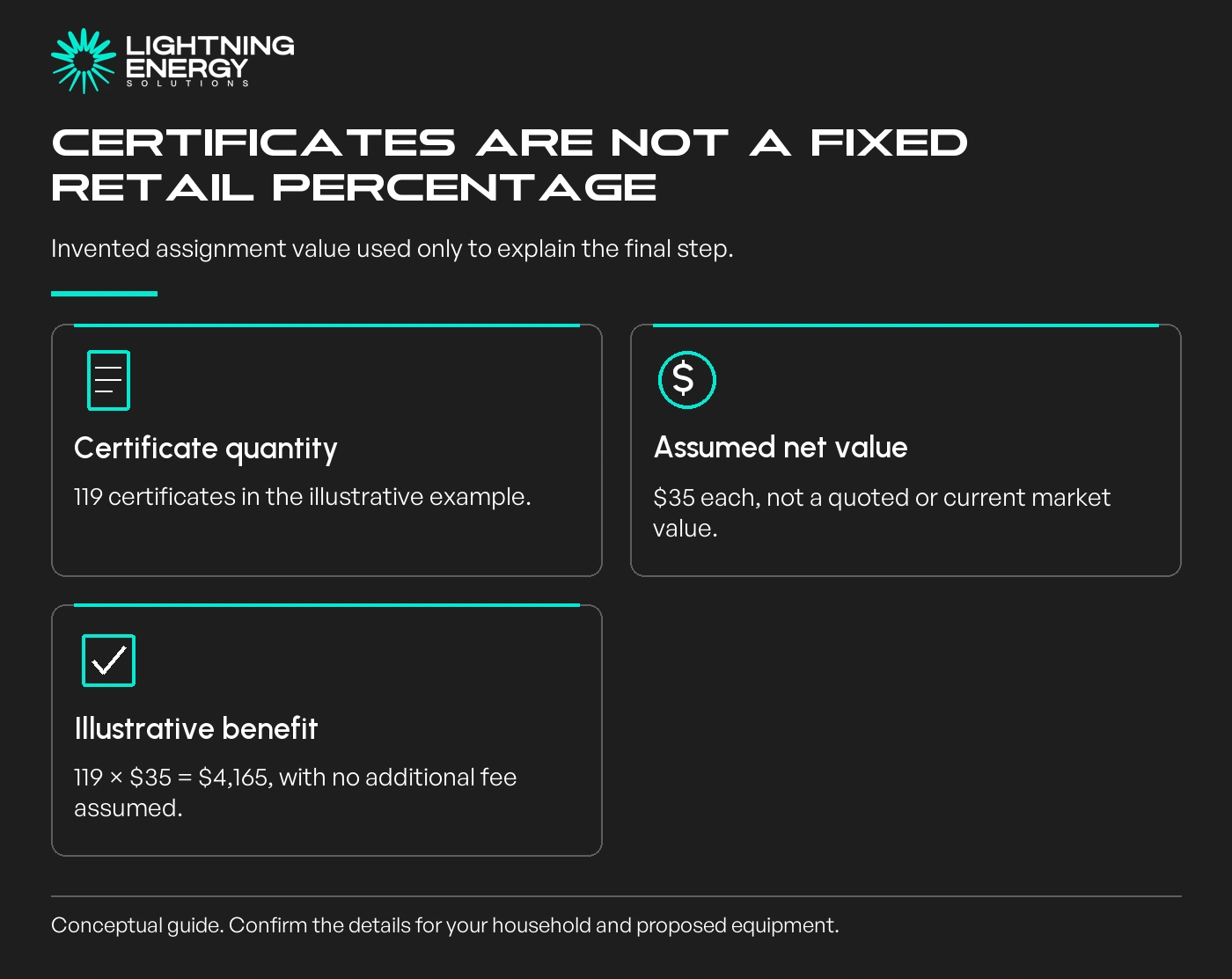
For illustration only, suppose those 119 certificates were assigned at an assumed net value of $35 each. The calculated benefit would be $4,165. That $35 is invented, not a current market price or guaranteed offer.
If a quote separately deducts administration costs, include those once. Ask whether the quoted value is already net of fees so that your comparison does not subtract them twice.
Compare final installed prices for the same battery design, including backup and required site work. A larger certificate line does not necessarily mean a cheaper or more suitable complete installation.
DCCEEW defines installation for scheme purposes by electrical compliance certification. A deposit date or promised delivery slot should not be assumed to preserve a particular factor.
The published January–June 2027 factor is 5.7. Using the same hypothetical 20 kWh and tiers gives 100.32 before rounding, or 100 certificates, subject to the rules remaining applicable when installed.
That comparison is about certificate quantity only. Equipment prices, household need and the contract's treatment of delays can change the overall decision.
Do not buy extra capacity solely to increase the discount. Additional storage still costs money and needs useful charging opportunities and demand to deliver value.
The battery value guide explains why seasonal energy use matters more than maximising a headline rebate.
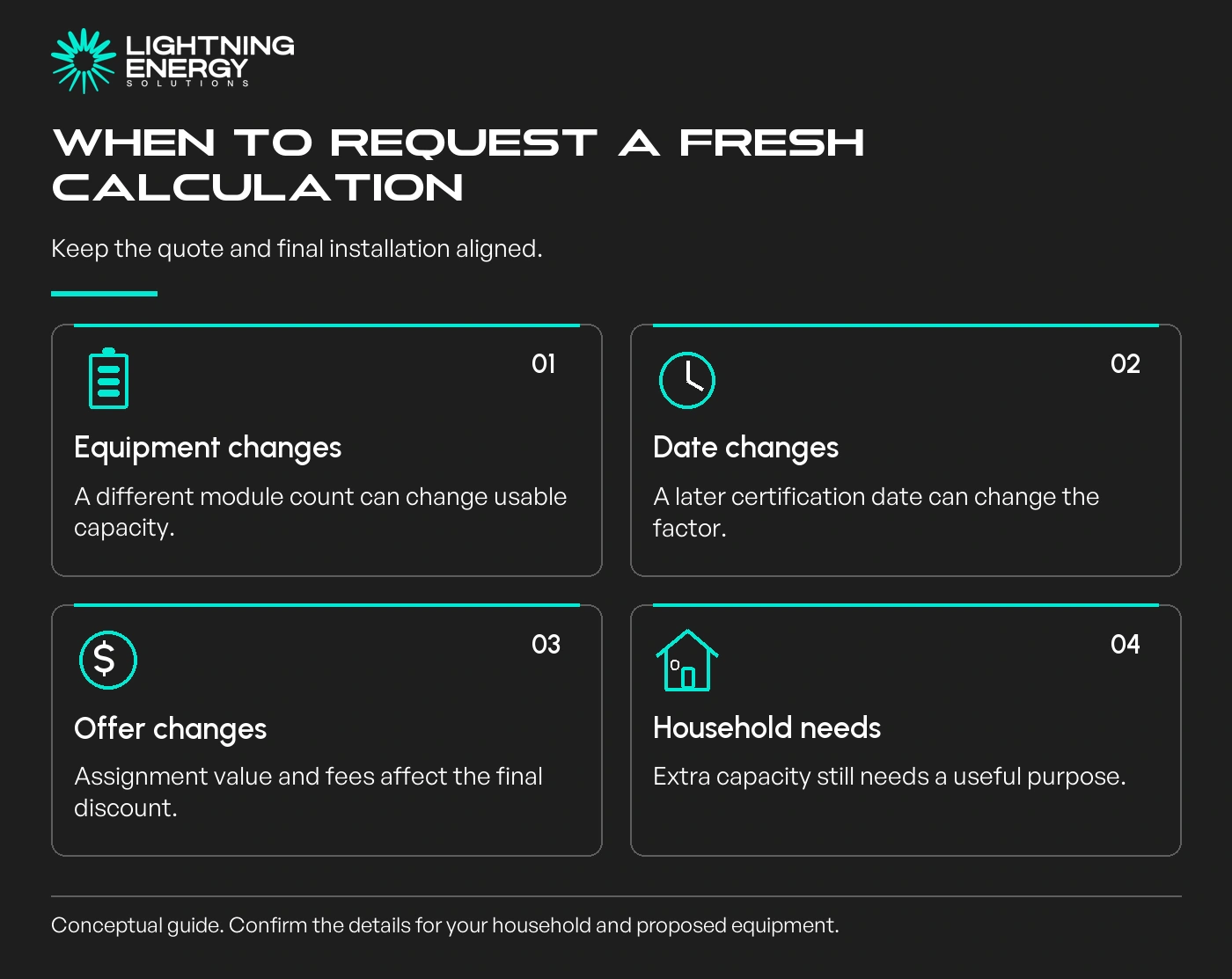
Before accepting a revised quote, request a fresh calculation if the model, module count, certification date or assignment terms change. Keep the version you agreed to with the final installation records.
Plan your battery upgradeBring the gross price, usable capacity, expected certification date and certificate discount from your quote. We can help separate the battery design decision from the incentive arithmetic.Available times
Book a consultation and we'll map solar, storage, hot water, and the rebates around your bills and your goals.
Question 1 of 6
