
Battery Subsidy Cuts Under Consideration: What Australian Buyers Need to Know
Treasury is reportedly considering battery subsidy cuts. We separate the proposals from current federal rules, January 2027 changes and optional VPP participation.
Treasury is reportedly considering battery subsidy cuts. We separate the proposals from current federal rules, January 2027 changes and optional VPP participation.

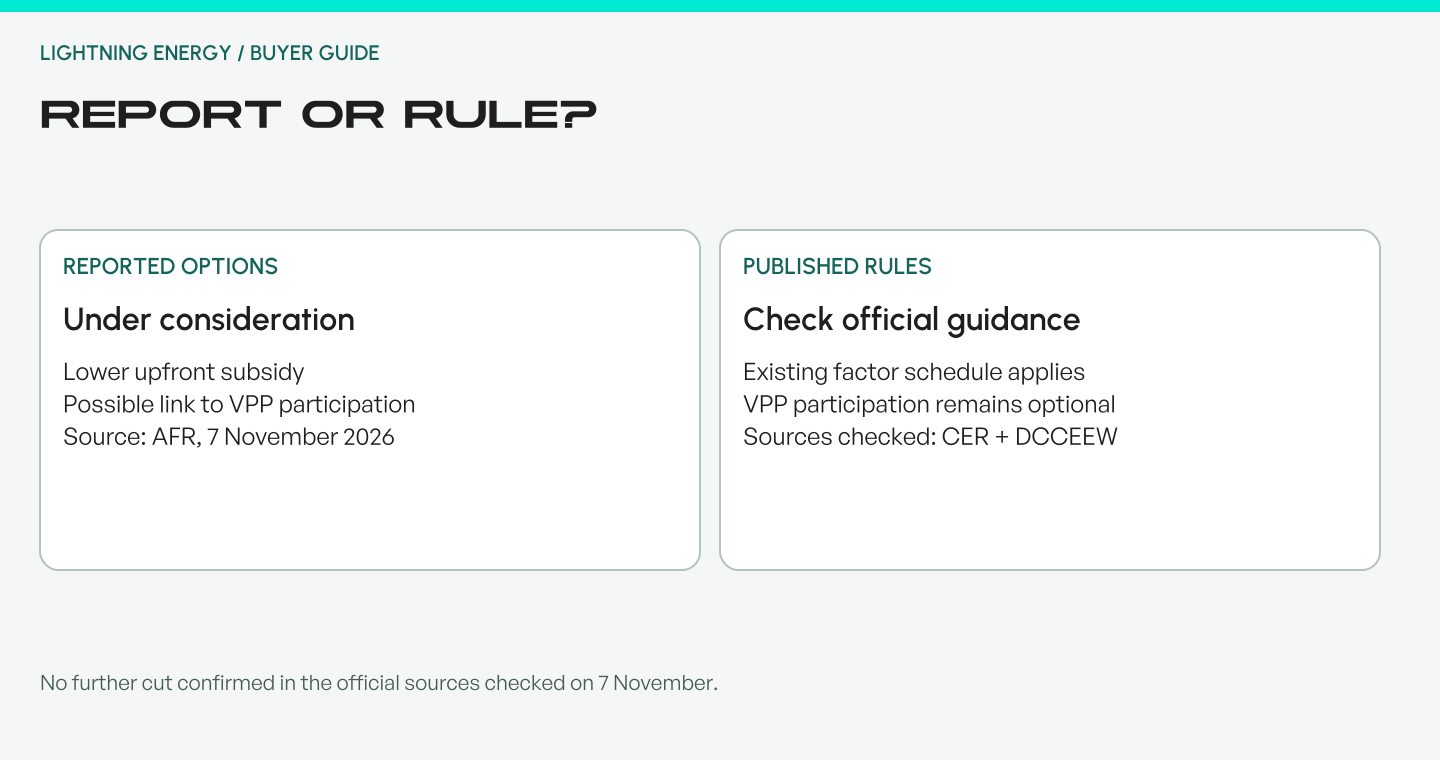
Could Australia’s home battery discount be cut again? A new Treasury report has put that question back on the table. Buyers need to distinguish a policy option from a change that has actually been adopted.
Checked on 7 November 2026: the official program pages we reviewed still show the existing federal battery discount rules. We found no announcement adopting the additional cuts described in today’s report.
The Australian Financial Review report, by Ryan Cropp on 7 November, describes possible budget savings.
It cites unnamed sources familiar with the discussions.
The reported options include reducing the upfront subsidy or linking support to participation in a virtual power plant. These are reported proposals, not a confirmed new rebate rate or commencement date.
For someone comparing quotes this weekend, that distinction matters. A headline about budget discussions cannot tell you the final terms of a future policy, whether it will proceed or how any transition would work.
The CER schedule sets the base factors.
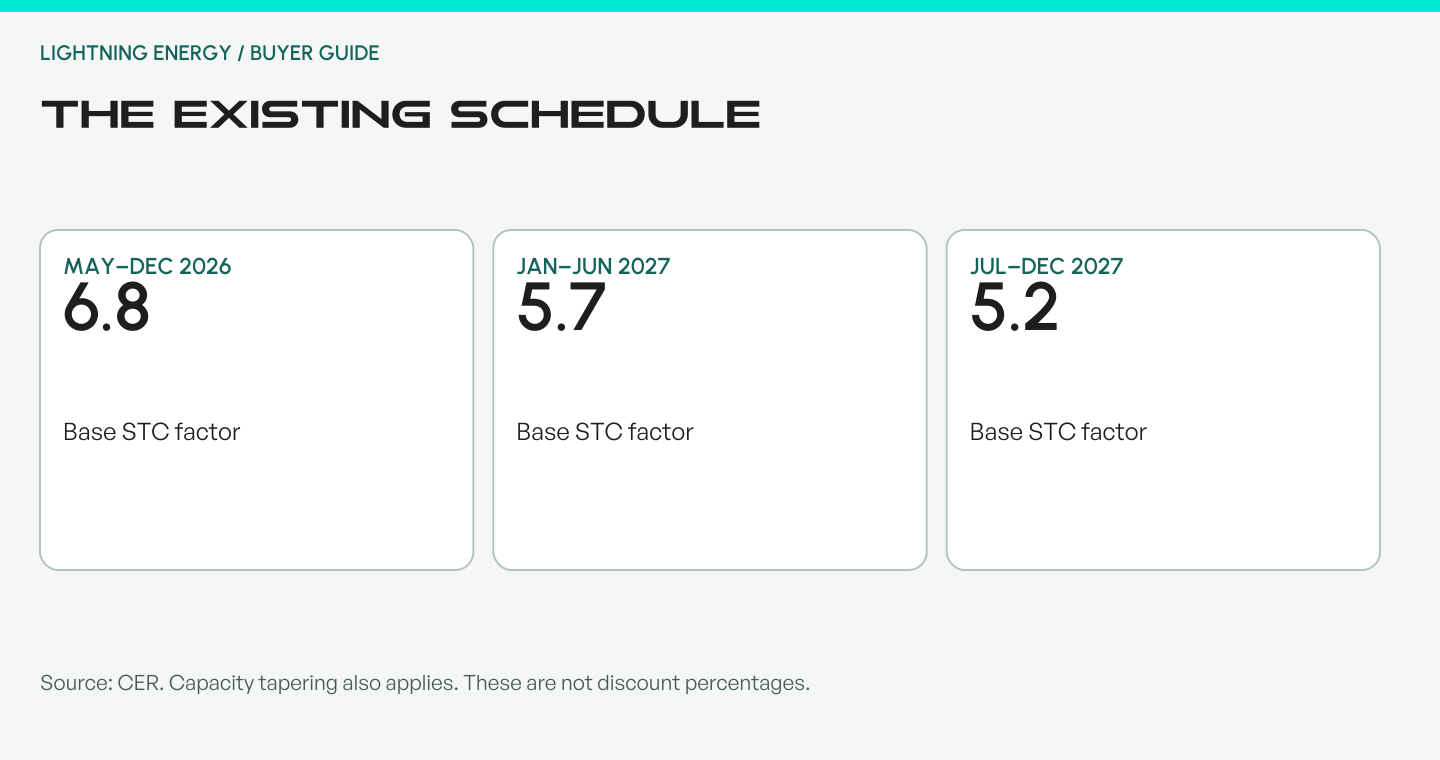
The factor is 6.8 for May to December 2026.
The factor is 5.7 for January to June 2027 and 5.2 for July to December 2027.
That January step is already in the published schedule. It is separate from the new Treasury options reported by the AFR. The figures are certificate factors, not a percentage discount off every installed quote.
The same schedule applies capacity bands: 100% of the factor for the first 14 kWh of usable storage, 60% for the next 14 kWh, and 15% for capacity above 28 kWh up to 50 kWh.
For the calculation behind a particular quote, see our battery size and installation date guide. Ask the retailer to show its calculation for your exact system.
The department’s STC guidance says the applicable factor depends on when the battery is installed and certified.
A purchase date alone is not the date test described by that guidance.
Ask the retailer what happens to your final price if installation slips into a different period. Request the answer in the contract, including who carries any change in the assumed incentive.
Do not assume either that a deposit protects you from every future policy change or that it gives the retailer an unrestricted right to increase the price. Read the actual price and variation clauses before committing.
If a salesperson says the rebate is ending on a new date, ask for the official announcement and the rule that applies to your installation. The news report alone does not establish a new deadline.
See the CER VPP guidance.
On-grid systems must be VPP-capable to claim STCs.
Joining a VPP is currently optional under that federal requirement.
A VPP coordinates connected batteries through software. Participation can allow an operator to draw on stored energy to help the grid. The particular agreement determines how that works for the household.
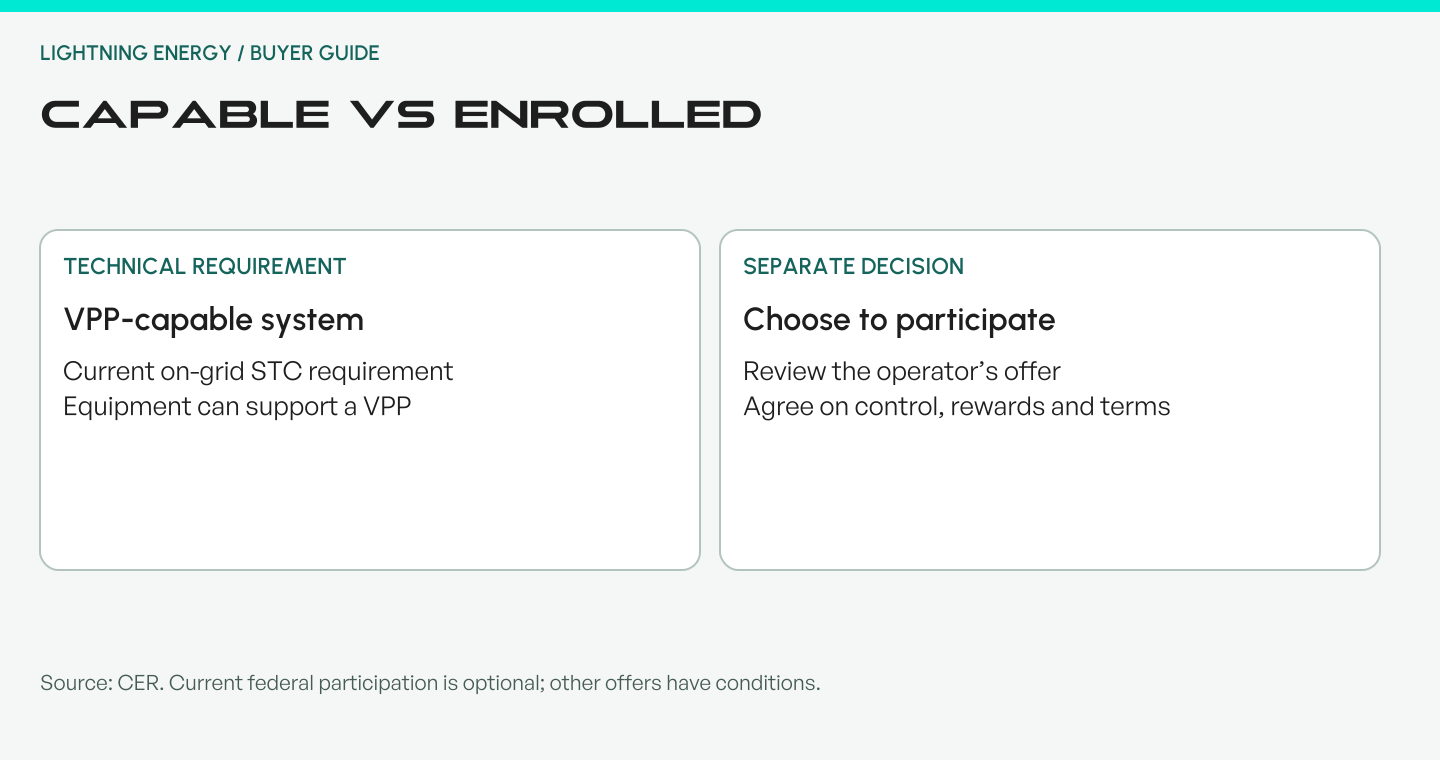
If the reported policy option eventually becomes a formal proposal, the questions will include which VPPs qualify, what participation means and how customers can leave. Those details cannot be assumed from the report.
For now, compare the written offer. Check the electricity tariff, rewards, dispatch permissions, backup reserve, exit conditions and warranty implications. A headline reward is only one part of the arrangement.
Our VPP contract guide works through those questions.
NSW households should also distinguish the federal discount from the separate NSW VPP incentive.
Start with the equipment and work, then assess the discount. Ask for the controller and battery model codes, usable storage, backup hardware, included circuits and switchboard work. Compare the same scope between suppliers.
Have the retailer itemise the gross installed price, assumed certificate count, dollar discount and your final payment. Ask which assumptions can change and when the quote expires.
DCCEEW explains that an upfront discount commonly involves assigning the right to create STCs.
Retailer administration charges can affect the amount passed through.
The certificate mechanism is not a guarantee of an identical dollar saving from every supplier.
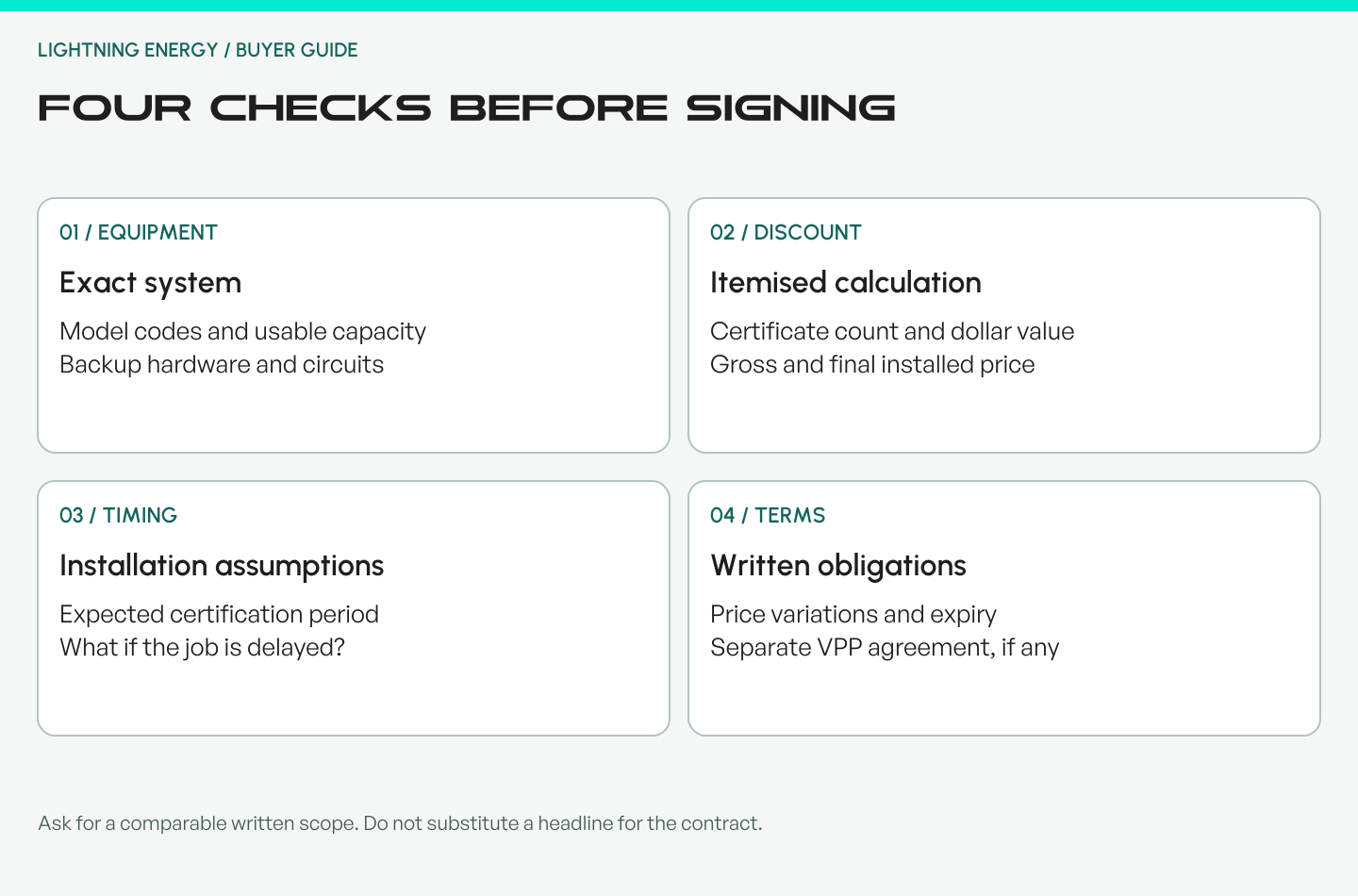
Use our home battery quote checklist to keep those details in one place. A clear written scope is useful whether the policy stays as it is or changes later.
A policy headline is a reason to check the numbers, not a substitute for a household assessment. Compare recent interval data, solar surplus, evening use, backup priorities and the proposed system’s installed cost.
A larger battery with a larger discount can still be a poor fit if your home rarely uses that capacity. A smaller system can also disappoint if it cannot cover the loads or backup duration you actually need.
Ask for a comparison under the relevant published installation periods. Keep any further, unannounced subsidy change as a separate uncertainty rather than quietly building a guessed cut into a savings claim.
Installation quality and aftercare remain part of the purchase. Avoid choosing an unsuitable system or accepting unclear contract terms simply because a news story makes the decision feel urgent.
Bring your bill, interval data if available and backup priorities to a Lightning Energy solar and battery assessment. We can discuss the equipment scope and the incentive assumptions in a written quote.
News source: AFR, 7 November 2026.
Current rules: CER battery page.
Participation: CER VPP guidance.
Discount mechanism: DCCEEW STC explanation.
This is a dated policy explainer, not a forecast of the government’s final decision or a personalised savings estimate. Recheck official rules when signing and before installation if your project timing changes.
Cover photograph: Fox ESS Australia, used as an illustrative battery installation. It does not imply that the pictured system or customer is connected to the reported Treasury discussions. Diagrams are original conceptual explanations.
Available times
Book a consultation and we'll map solar, storage, hot water, and the rebates around your bills and your goals.
Question 1 of 6
