
Four-Hour Battery Plan Takes a Big Step in QLD
Blackstone’s federal referral describes 500 MW / 2,000 MWh, while its website still lists 1,000 MWh. What the milestone means, and why the distinction matters.
Blackstone’s federal referral describes 500 MW / 2,000 MWh, while its website still lists 1,000 MWh. What the milestone means, and why the distinction matters.

Queensland’s Blackstone battery project has reached a federal environmental milestone.
The bigger story is the storage duration: a 2,000 MWh proposal could deliver four hours at 500 MW, but the developer’s website still shows half that energy capacity.
That difference matters. Before treating it as a completed four-hour battery, it is worth separating the project described in the referral, the public marketing figures and the steps needed to put electricity into the grid.
The EPBC public portal lists a referral decision for Blackstone BESS, project 2026/10624. Its indexed decision table records “Approval Not Required”, with a completed date of 2 October and publication date of 11 October 2026.
The referral describes 500 MW / 2,000 MWh at Swanbank, Queensland, beside the existing Blackstone substation. It lists financing, contracts and connection agreements among subsequent steps, with operation targeted for Q1 2029.
Primary source: Blackstone’s EPBC referral.
These are the proponent’s plans, not confirmation those steps have happened.
RenewEconomy’s 13 October report describes the decision as not a controlled action.
We have not independently inspected the signed decision notice.
An environmental decision is an important milestone. It should not be confused with a completed build, a fully funded project or a confirmed date for commercial operation.
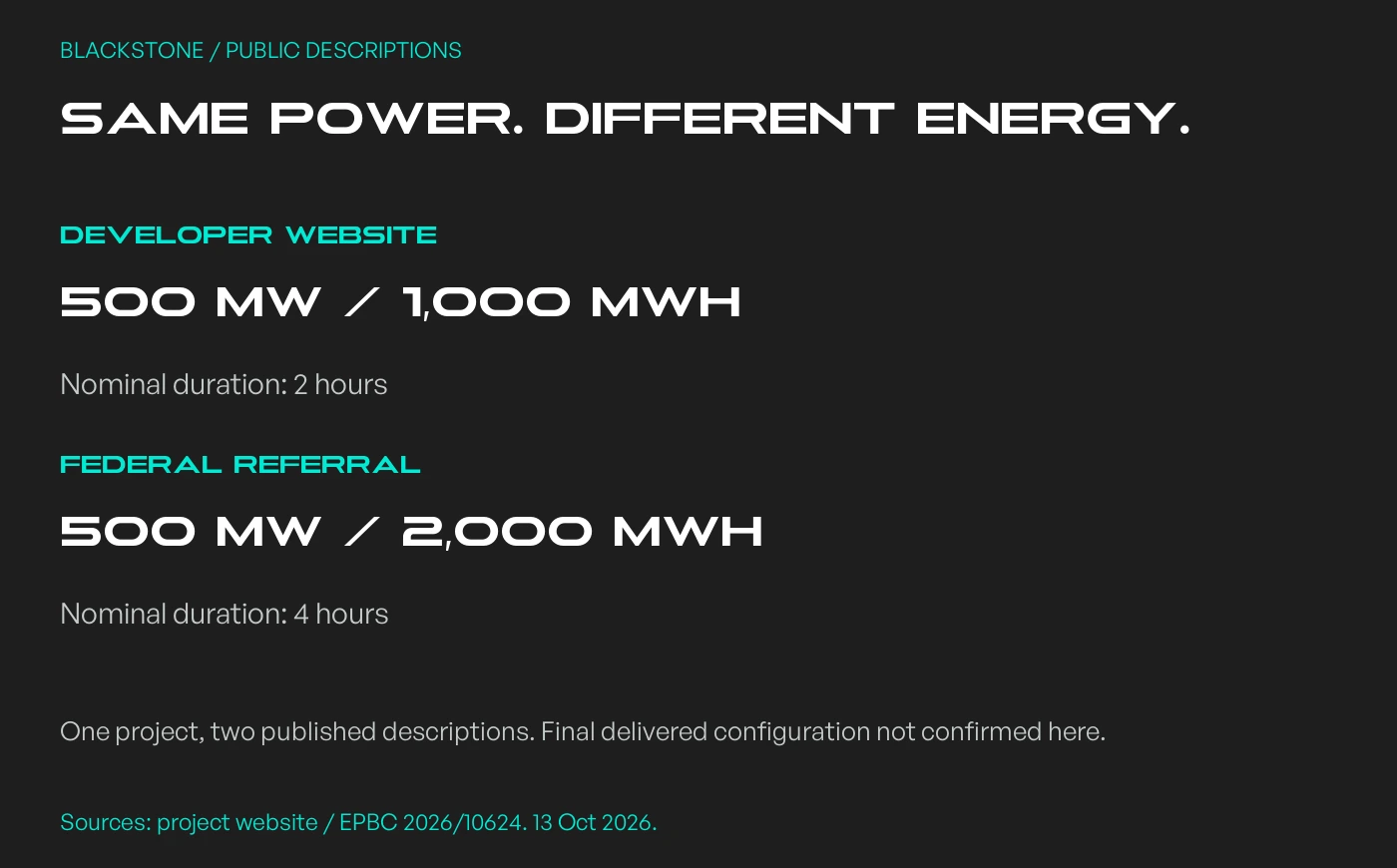
The Blackstone project website still advertises up to 500 MW / 1,000 MWh. Octopus Australia’s project list also carries that figure.
Neither should be silently replaced with a confirmed 2,000 MWh construction specification.
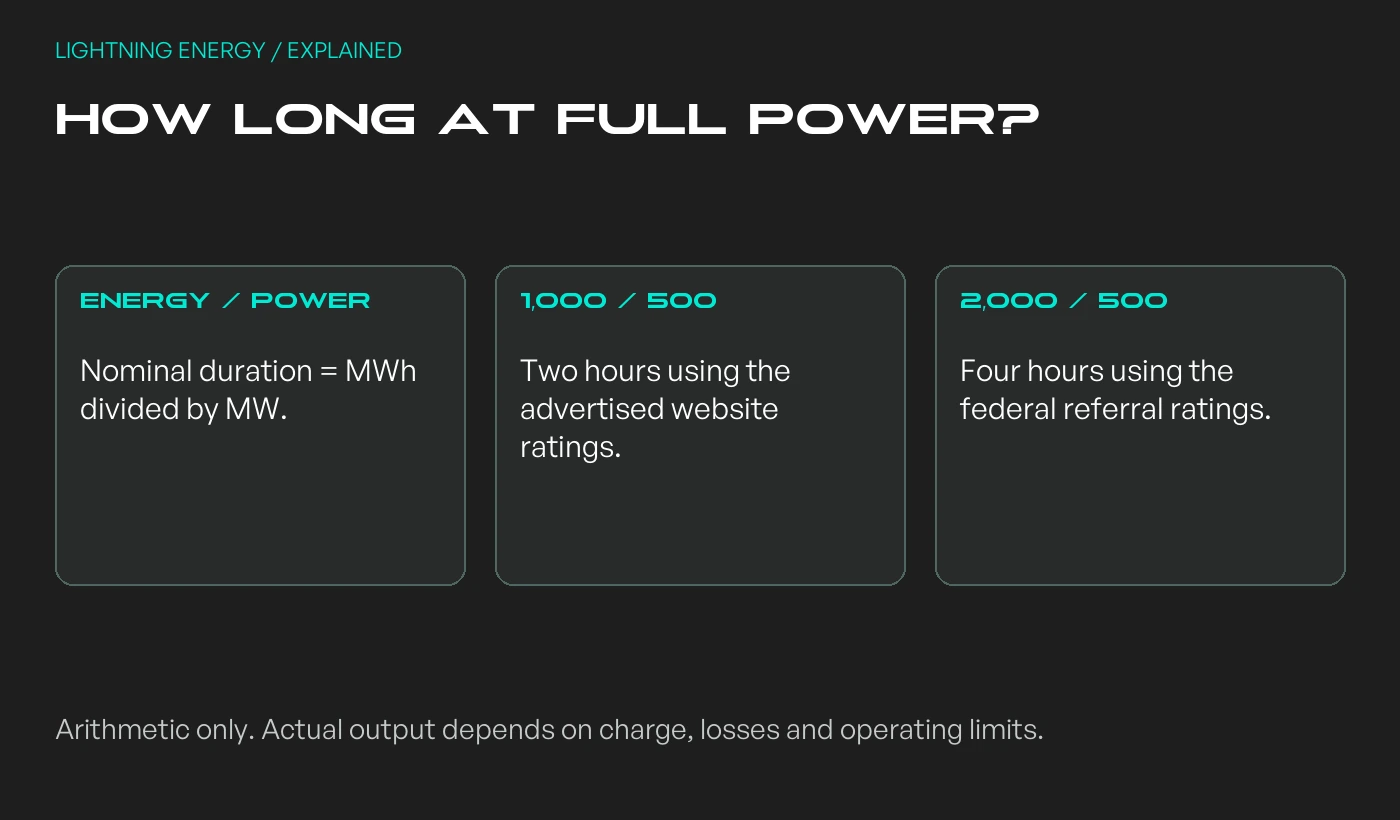
Power and energy answer different questions. MW describes the rate at which a battery can charge or discharge. MWh describes the amount of energy. Dividing energy by power gives a simple nominal duration.
At 500 MW, 1,000 MWh represents two hours and 2,000 MWh represents four hours. That is arithmetic using the published ratings, not a prediction of actual dispatch or a claim about guaranteed usable output.
Losses, operating limits, reserved capacity and the starting charge level matter in practice. A battery may also run below its maximum power or respond to changing market and network conditions.
Think of generation and storage as different jobs. Solar panels produce electricity when conditions allow. A battery stores energy supplied to it and releases some later; it does not create an additional source of energy.
A longer-duration design can sustain a given output for longer, provided enough energy is available. That can be useful when demand remains high after solar production falls, rather than only for a brief spike.
Our new rooftop-solar record article looks at the daytime side of this equation. Storage adds a timing option, but network capacity and operating constraints still matter.
There is also a cost question. Extra storage has to earn its place through useful services. One headline about a large battery cannot establish an ideal duration for every grid location, business or home.
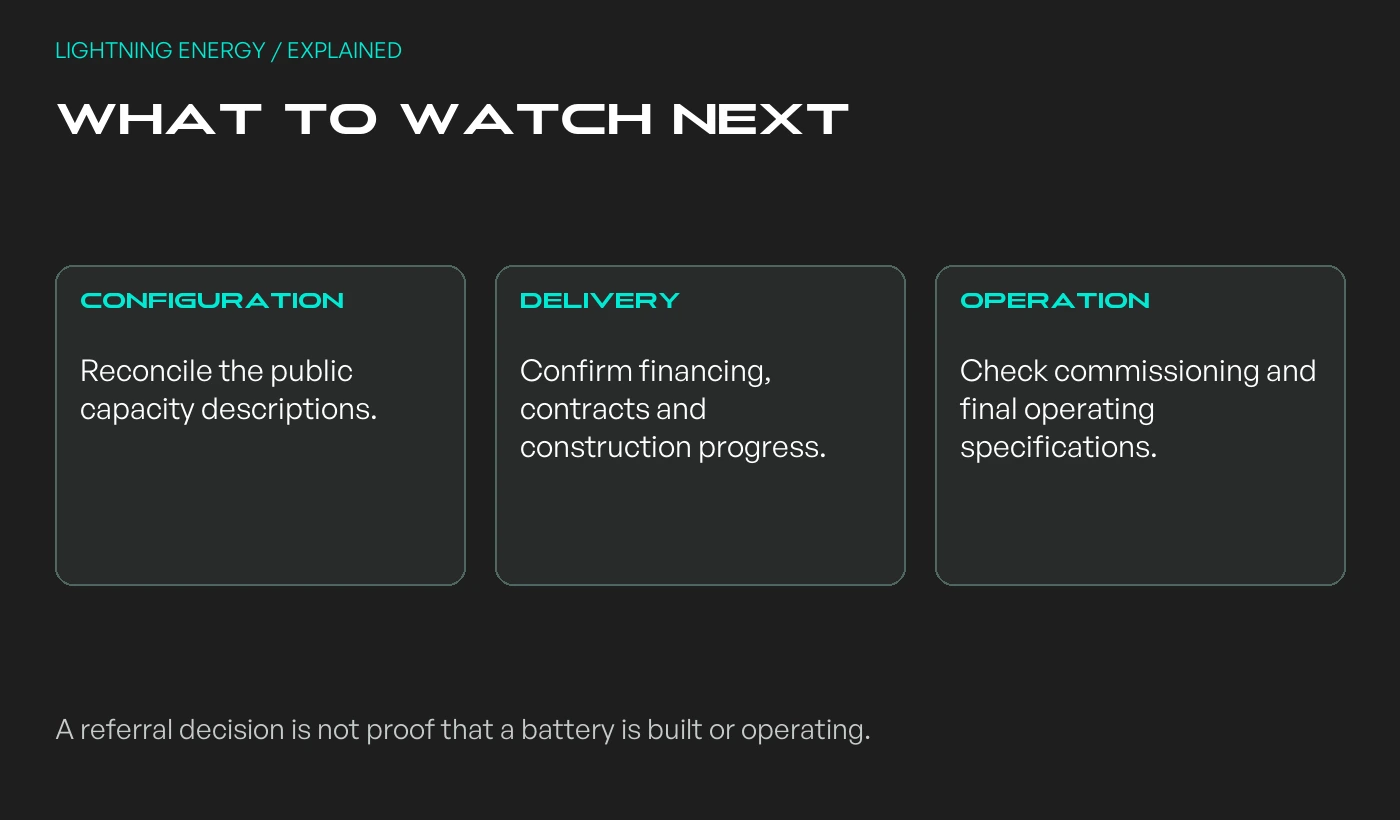
The clearest next update would reconcile the 1,000 MWh and 2,000 MWh descriptions. Confirmed financing, construction commencement, commissioning and final operating specifications would then show how the plan is progressing.
The referral also identifies mine-remediation work and mapped koala habitat. A historically industrial location is not the same as a site without environmental considerations; detailed works and mitigation still deserve attention.
For this reason, we are describing a project milestone and a proposed configuration. We are not reporting Blackstone as operational, nor claiming it will immediately cut a particular household’s bill.
The same power-versus-energy distinction helps when comparing home batteries. A large kWh number does not tell you which appliances can run together or how much power the inverter can supply.
The Australian Government’s battery guide explains storage and backup considerations. Backup requires a suitable design; owning a battery alone is not enough.
For an existing solar system, start with measured surplus production and evening imports. Then consider usable capacity, power output, the electricity plan, warranty conditions and what you want backup to cover.
Our battery quote guide helps turn those questions into a written scope.
Household design should follow the home’s needs, not the rating of a utility-scale project.
Blackstone is a useful reminder that battery headlines need both numbers and a clear project stage. The four-hour proposal is significant; the final build and operating outcome still need to be confirmed.
Original Lightning Energy reporting and explanation, checked 13 October 2026. Public source descriptions may change. The cover uses an aerial image published on the project website; it does not show a completed Blackstone battery.
Available times
Book a consultation and we'll map solar, storage, hot water, and the rebates around your bills and your goals.
Question 1 of 6
