
Can a New Battery Work with an Older Hybrid Inverter?
An older hybrid inverter needs more than a matching battery brand. Check exact models, generations, firmware and support before buying new storage.
An older hybrid inverter needs more than a matching battery brand. Check exact models, generations, firmware and support before buying new storage.

An older hybrid inverter can work with a new battery only when the exact combination is supported. The word hybrid tells you about its intended role, not which batteries you can connect today.
Model generations matter. A battery from the same manufacturer, or one with a similar capacity, is not automatically a replacement for the product your inverter originally supported.
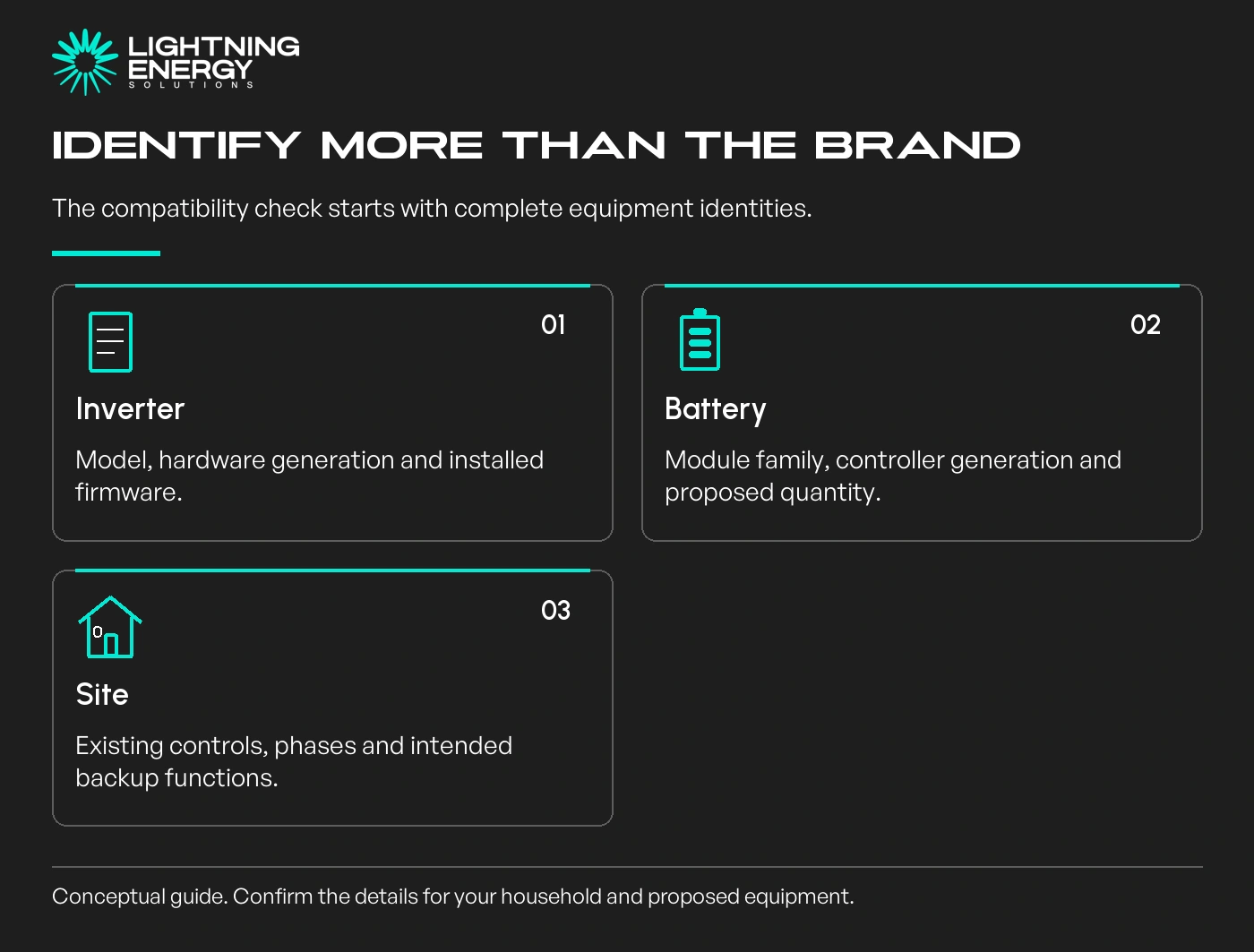
Record the inverter's full model and hardware generation, not just the brand or the largest number on the front. Ask the installer to identify its current firmware and any required upgrade path.
Then identify the proposed battery modules, battery controller and intended number of modules. These details belong on the quote, alongside the equipment already on site.
Our hybrid inverter guide provides the background. The next step is a model-level compatibility check.
Manufacturers may publish separate lists for different battery families and controllers. BYD's download centre, for example, separates its HVS/HVM products and BCU2.0 documentation, with Australian-market documents listed as well.
The HVS/HVM compatibility matrix includes inverter models, module quantities and minimum firmware versions for both inverter and battery controls. Finding a brand name in that document is only the beginning.
BYD's download centre for current compatibility lists.
Ask the installer to identify the exact row and any applicable footnotes, then confirm that the combination is supported for the Australian installation. Save the dated document with the proposal.
A global compatibility list is not, by itself, proof of local network approval or current Australian product availability. Those checks belong beside the technical match.
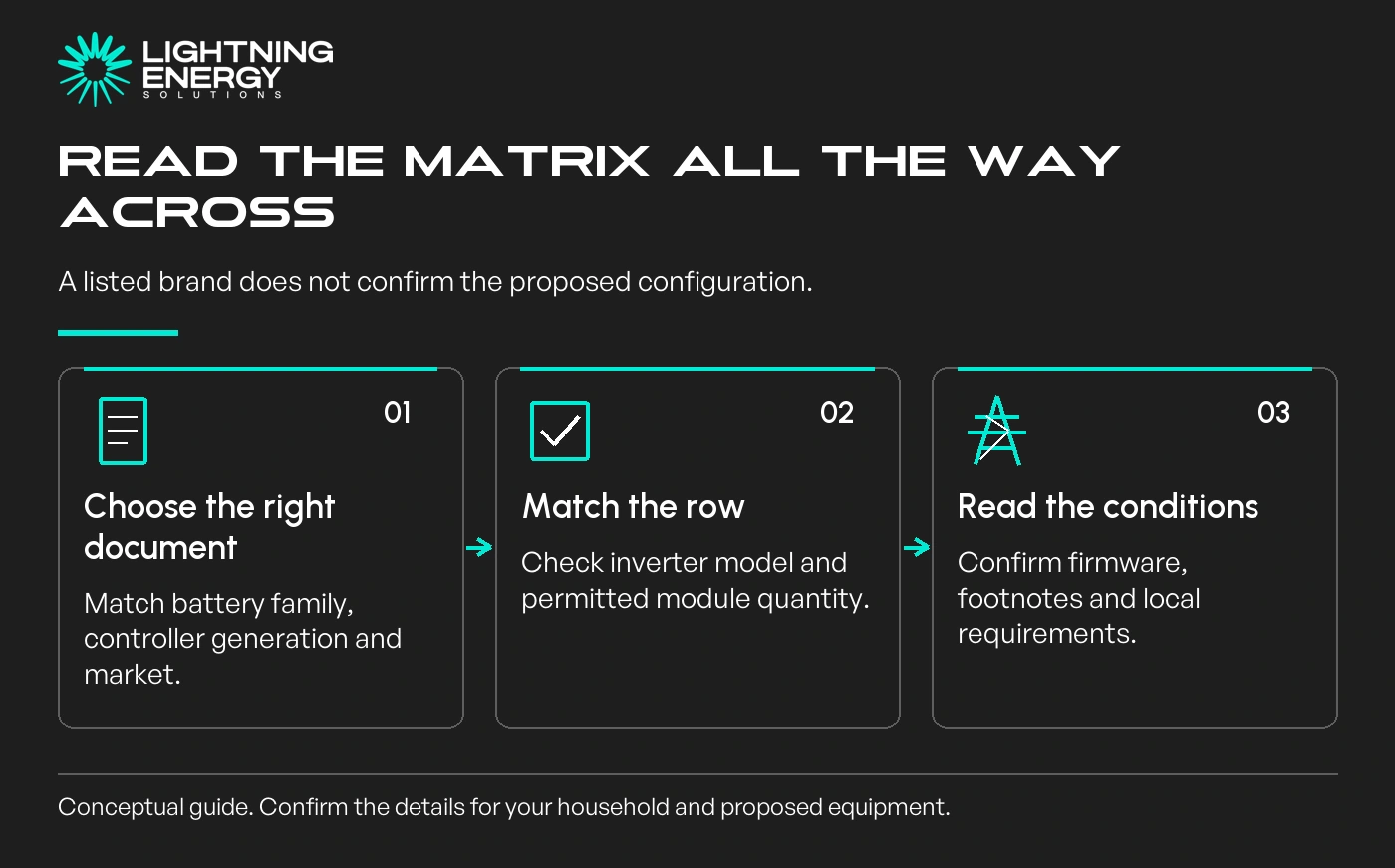
Battery and inverter operating ranges must be compatible. They also need supported communication, control behaviour and a configuration that the manufacturer permits.
The battery controller and inverter exchange information to manage charging, discharging and operating limits. A nominal voltage number or a connector that looks familiar does not establish that relationship.
Consider a hypothetical quote for four battery modules. If the supported configuration for that inverter requires a different module count or firmware version, changing the quote is part of the design process.
Do not accept an undocumented workaround as equivalent to a supported pairing. The installer should explain any software work, required controls and commissioning checks before you purchase.
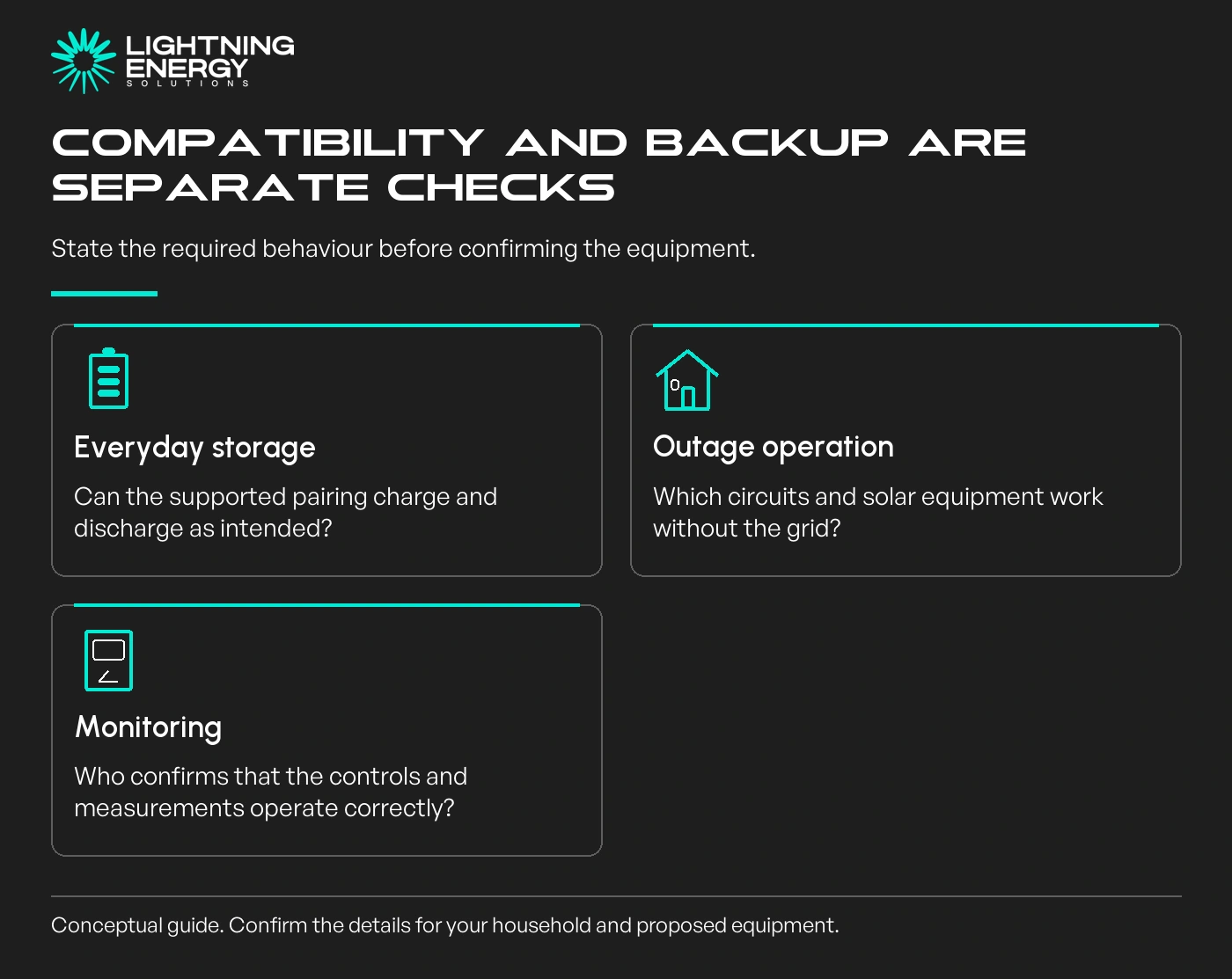
Compatibility for normal battery use does not settle the backup question. Ask separately about the backup controller, eligible circuits, output limits and whether solar can charge the battery during an outage.
Some homeowners want evening solar use without backup. Others are buying mainly for outages. Those briefs can lead to different installation scopes even with the same battery modules.
Our backup planning guide helps define the features that need explicit confirmation.
Get written confirmation of applicable Australian warranty terms and who handles faults involving both products. Record any requirements for registration, monitoring or firmware maintenance.
If an old inverter is no longer supported, retaining it at any cost may create a poor outcome. Ask for the cost and practical consequences of a supported replacement or a separately assessed AC-coupled option.
That comparison should include labour, controls, approvals and support responsibilities. It should not assume that the cheapest cabinet creates the cheapest functioning system.
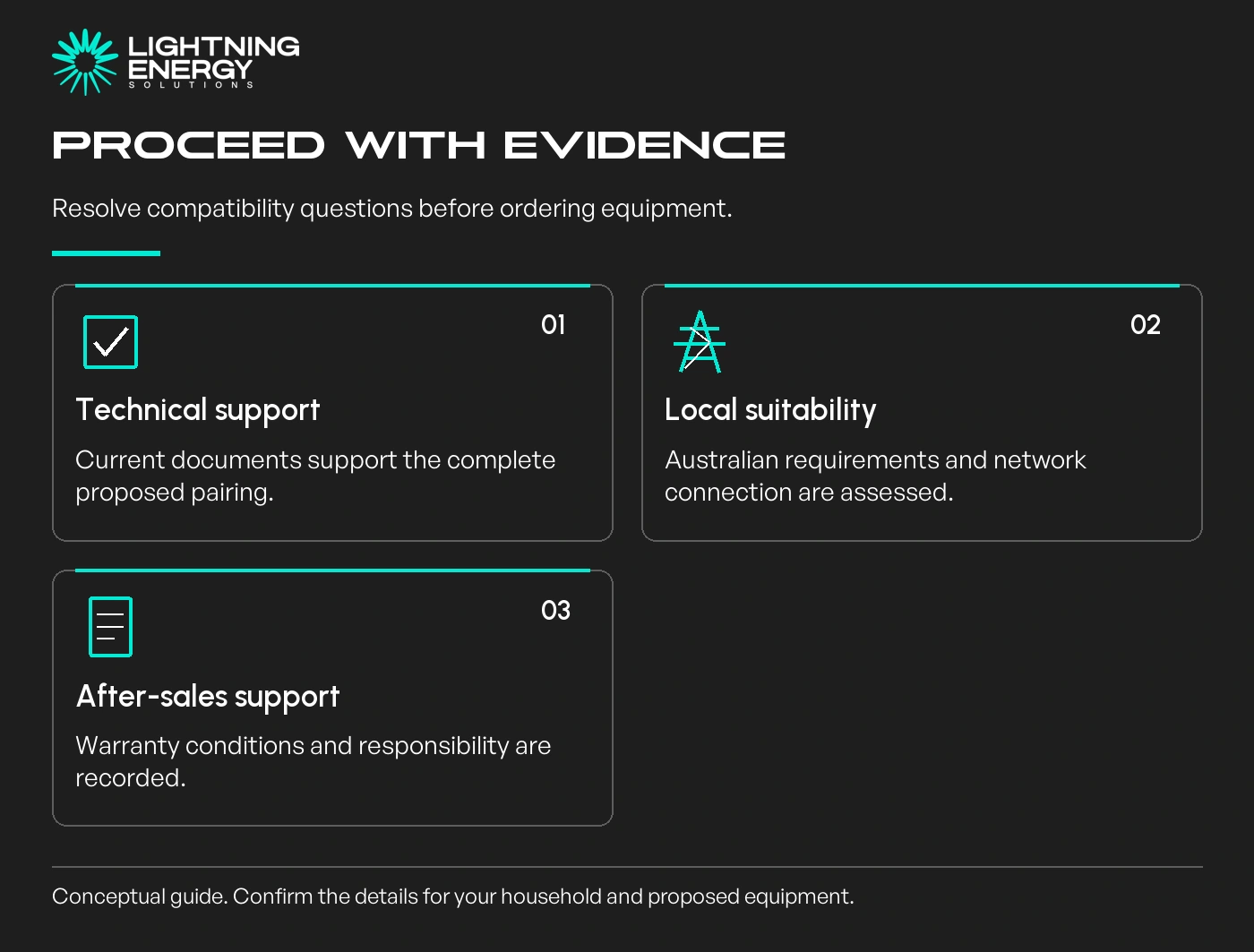
Pause if the installer cannot identify the equipment, produce the relevant compatibility evidence or explain an unresolved manufacturer restriction. A battery ordered before those checks can leave you with an expensive design problem.
For a battery retrofit, the useful answer is a documented, supported configuration that meets your household brief. A reassuring brand match is not enough.
Plan your battery upgradeShare the full inverter model and any original installation documents. We can assess supported battery options and explain where an upgrade may be needed.Available times
Book a consultation and we'll map solar, storage, hot water, and the rebates around your bills and your goals.
Question 1 of 6