Expanding Commercial Solar Past 100 kW: Can Your Existing Site Qualify?
Expanding an existing commercial solar system beyond 100 kW can now fall within the expanded Small-scale Renewable Energy Scheme, but the incentive does not simply apply to every panel already on the roof. The boundary between existing and new capacity is central to the assessment.
LLightning Energy TeamLightning Energy27 October 2026 · 5 min read
Expanding an existing commercial solar system beyond 100 kW can now fall within the expanded Small-scale Renewable Energy Scheme, but the incentive does not simply apply to every panel already on the roof.
The boundary between existing and new capacity is central to the assessment.
There is also a timing distinction.
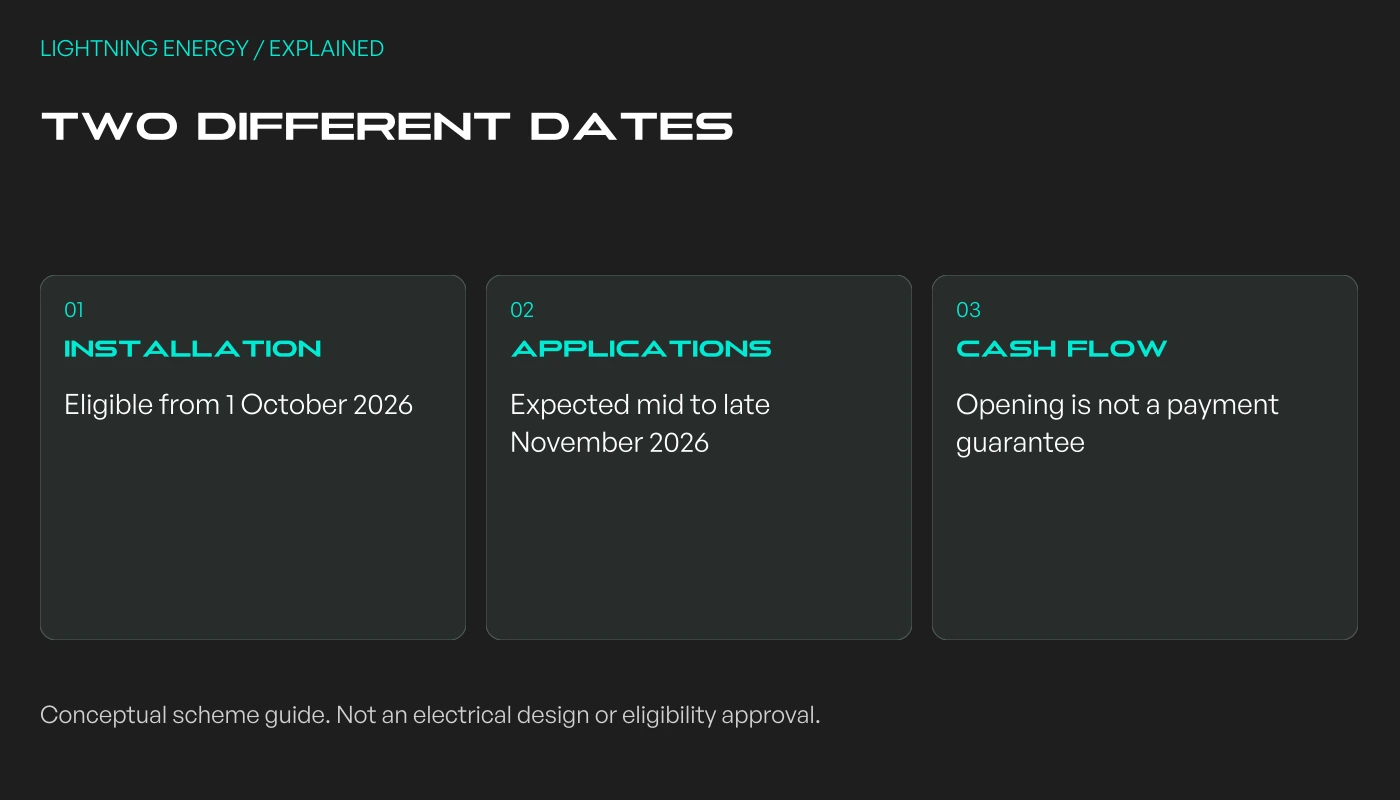
As checked on 27 October 2026, eligible installations can date from 1 October 2026, while the regulator expects certificate applications to open in mid to late November.
Installation eligibility and an open application channel are different things.
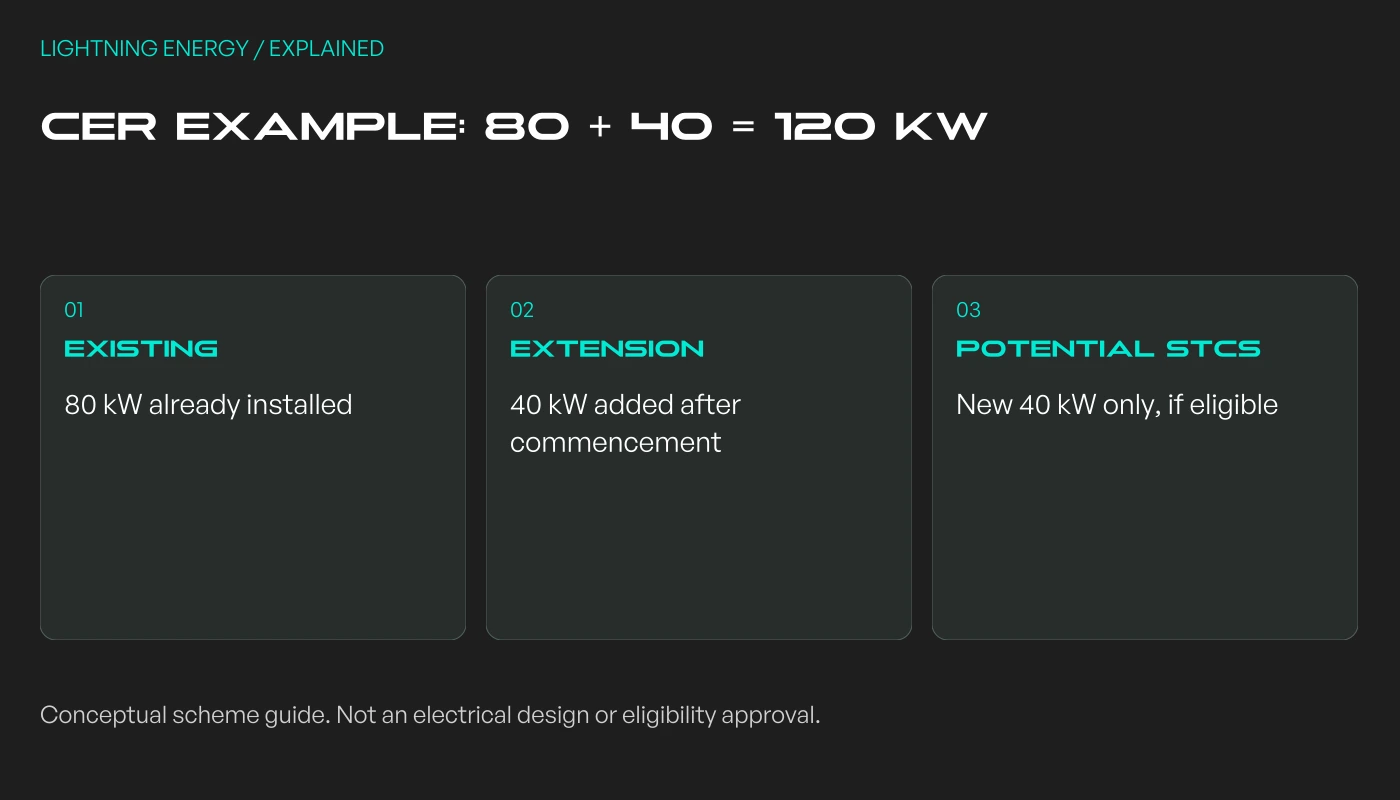
Its example expands an existing 80 kW system by 40 kW.
Where the extension forms part of the same electrically connected system and other requirements are met, the combined 120 kW system may qualify, with certificates applying to the new 40 kW only.
Use that as an eligibility illustration, not approval for your site. A commercial solar discussion should begin with existing equipment, commissioning records and a clear proposed scope.
Conceptual scheme guide. Not an electrical design or eligibility approval.
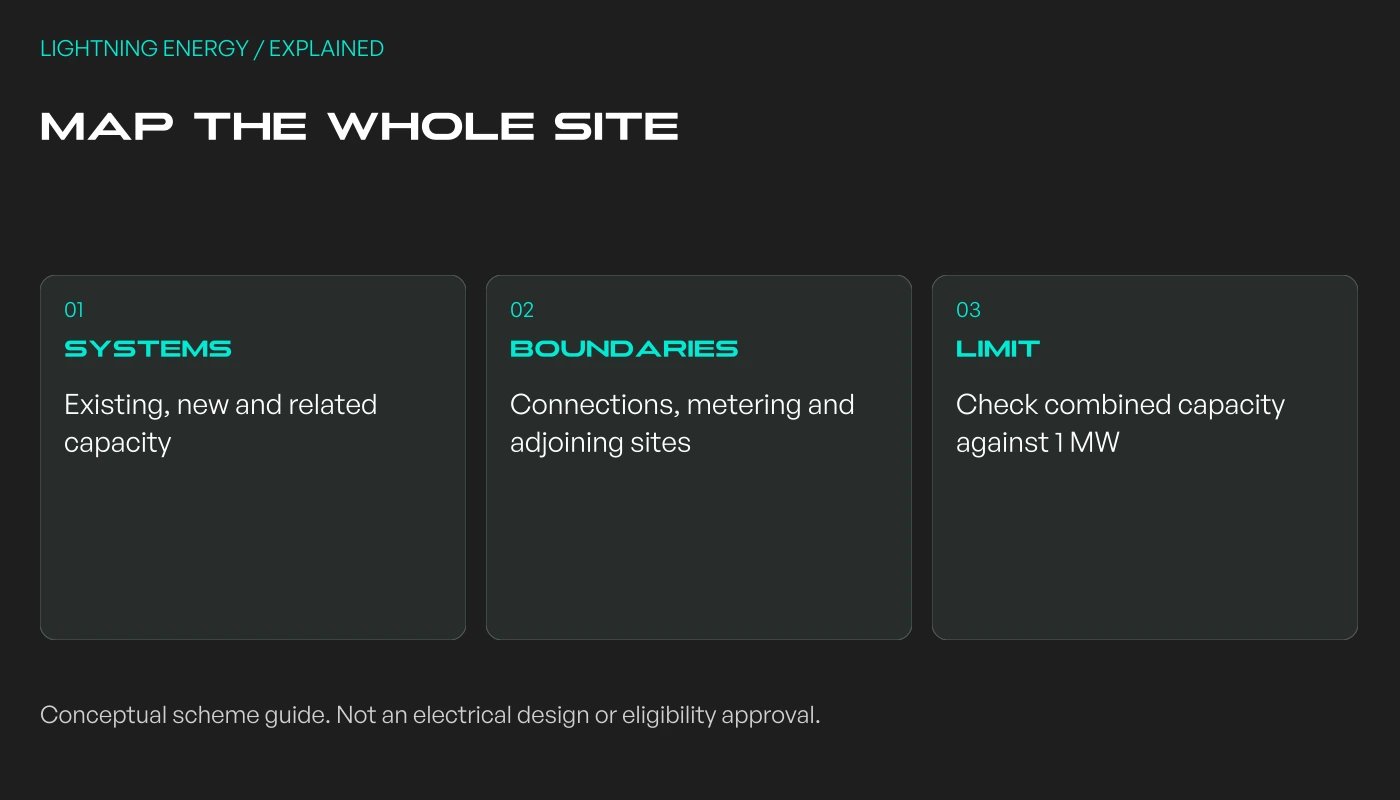
Check related capacity before relying on the 1 MW ceiling
The department's scheme explanation describes the expanded range above 100 kW and up to 1 MW and the fixed five-year deeming arrangement for eligible mid-scale solar through 2030.
Existing and related generation matters when assessing that ceiling.
Ask the designer to identify connected systems, adjoining-site relationships, metering and any accredited power station, rather than treating each roof or invoice as automatically separate.
The regulator says existing LRET power stations remain in that scheme. A project cannot claim both STCs and LGCs for the same generation capacity. New work alongside existing generation needs a documented boundary.
Conceptual scheme guide. Not an electrical design or eligibility approval.
Plan the cash flow around actual application timing
The CER mid-scale solar page is the place to recheck application availability. The expected mid-to-late-November opening is not a guaranteed payment date.
If a supplier offers an upfront certificate discount, ask who carries the timing and eligibility risk, what evidence must be supplied and what happens if the estimated certificate count changes.
Show gross project price, certificate quantity, assigned value and customer payment separately.
Our STC assignment guide explains why assigning rights and receiving a discount are linked but distinct steps.
Do not use the smaller-system year-end deeming schedule as a shortcut for the mid-scale calculation. Ask for the applicable official calculator result and the assumptions retained with the quote.
Conceptual scheme guide. Not an electrical design or eligibility approval.
Build the evidence pack while the project is designed
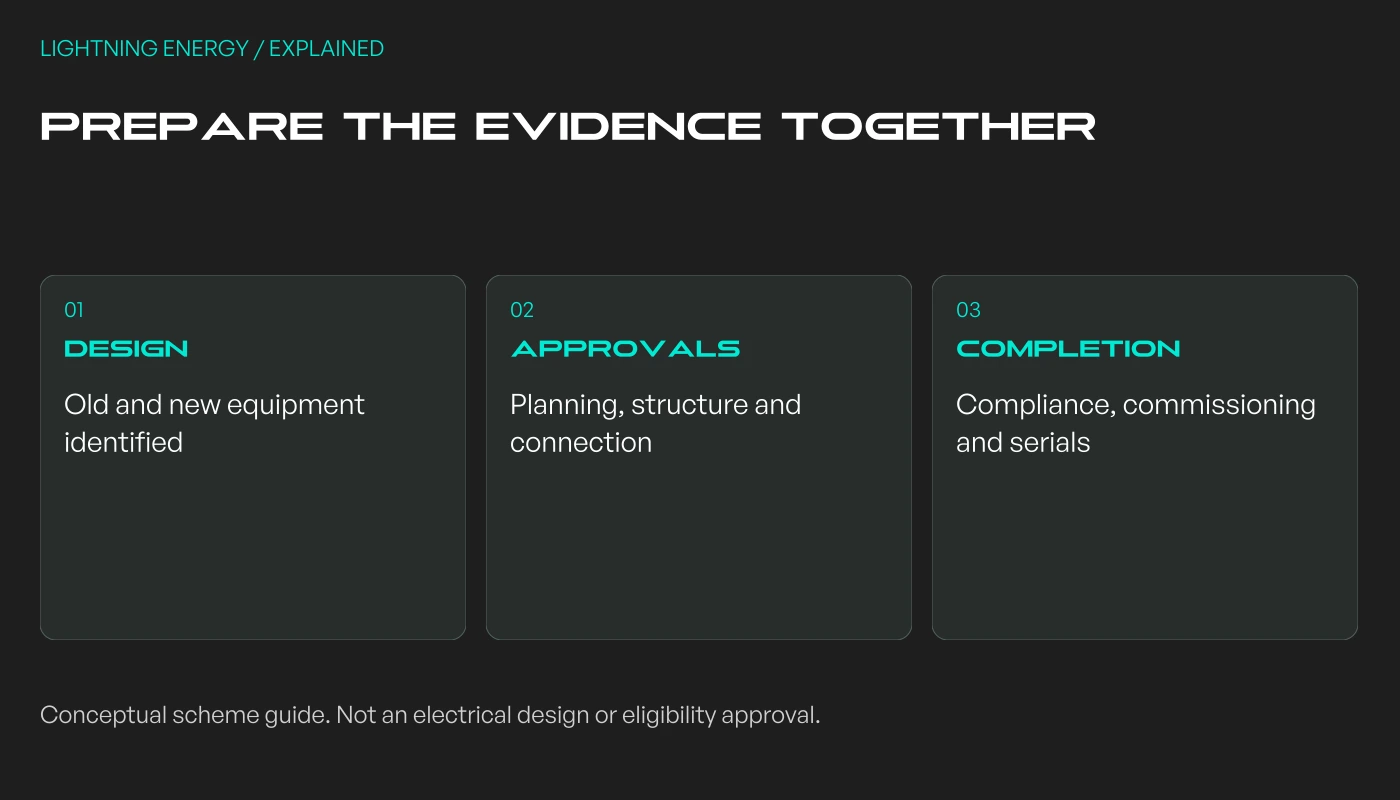
Keep the existing system records and the new design together. The file should let another reviewer understand which equipment existed before the extension and which equipment is being added.
Assign responsibility for planning, structural engineering, network approval, metering, electrical compliance, commissioning and serial-number records.
These tasks are easier to organise before equipment arrives than to reconstruct after installation.
For staged work, ask whether the existing connection approval covers the specific proposed device. Do not infer that a single meter proves one system, or that separate meters necessarily establish unrelated systems.
If a business battery is part of the project, give it its own eligibility and operating assessment. A solar extension approval does not establish every aspect of a storage proposal.
Conceptual scheme guide. Not an electrical design or eligibility approval.
Make the investment case work beyond the certificate line
Compare the added generation with daytime business demand, export constraints and planned electrical loads. Additional panels that mostly export have a different commercial value from generation used on site.
Ask for scenarios using consistent tariffs and operating hours, including foreseeable changes such as EV charging. Keep any savings estimate conditional on those assumptions rather than presenting it as guaranteed income.
Contact Lightning Energy with the existing system documents and expansion plan. The next step is a site-specific assessment and a written incentive pathway, with current application guidance checked again before a claim is made.
Book a consultation and we'll map solar, storage, hot water, and the rebates around your bills and your goals.
Loading consultations…
Lightning EnergyPlan your next energy upgrade.
⚡
Hi, I’m Lightning Energy’s project guide. I’ll ask a few practical questions, explain what usually matters for your project, and help you decide on a useful next step — no guesswork or sales pressure.
First, what kind of property are we planning for?