
GoodWe ESA vs Sigenergy SigenStor: Which System Fits a Growing Electric Home?
GoodWe ESA vs Sigenergy SigenStor in Australia: compare named 6 kW systems, usable storage, backup, expansion, EV charging options and warranty conditions.
GoodWe ESA vs Sigenergy SigenStor in Australia: compare named 6 kW systems, usable storage, backup, expansion, EV charging options and warranty conditions.

GoodWe ESA and Sigenergy SigenStor both offer modular home storage. The useful comparison is how a specified system handles your next electric car, heat pump or longer evening load, rather than which brand advertises the biggest stack.
This Australian desk comparison was checked on 7 November 2026. It compares two named single-phase configurations using manufacturer documents. It is not a hands-on test, installed-price comparison or promise of future compatibility.
Our starting point is approximately 16 kWh of usable storage with a 6 kW nominal inverter. These are comparison configurations, not a recommendation that every household needs that size.
For GoodWe, we use the GW6K-EHA-G20 power module with two GW8.3-BAT-D-G20 batteries. Each battery has 8.32 kWh rated energy and 8.0 kWh usable energy: 16.0 kWh usable in this example.
For Sigenergy, we use the SigenStor EC 6.0 SP with two BAT 8.0 modules, without an EV DC charging module. The corresponding SigenStor-6S-16 configuration provides 15.6 kWh usable storage.
Do not substitute the similarly named SigenStor-6S-16.78 or a different battery generation. A system identifier, controller model and battery module code belong on the quote together.
Both selected controllers have 6 kW nominal on-grid output. GoodWe specifies 6 kVA nominal backup output; Sigenergy specifies 6 kW nominal backup active power. Actual installation settings and loads still matter.
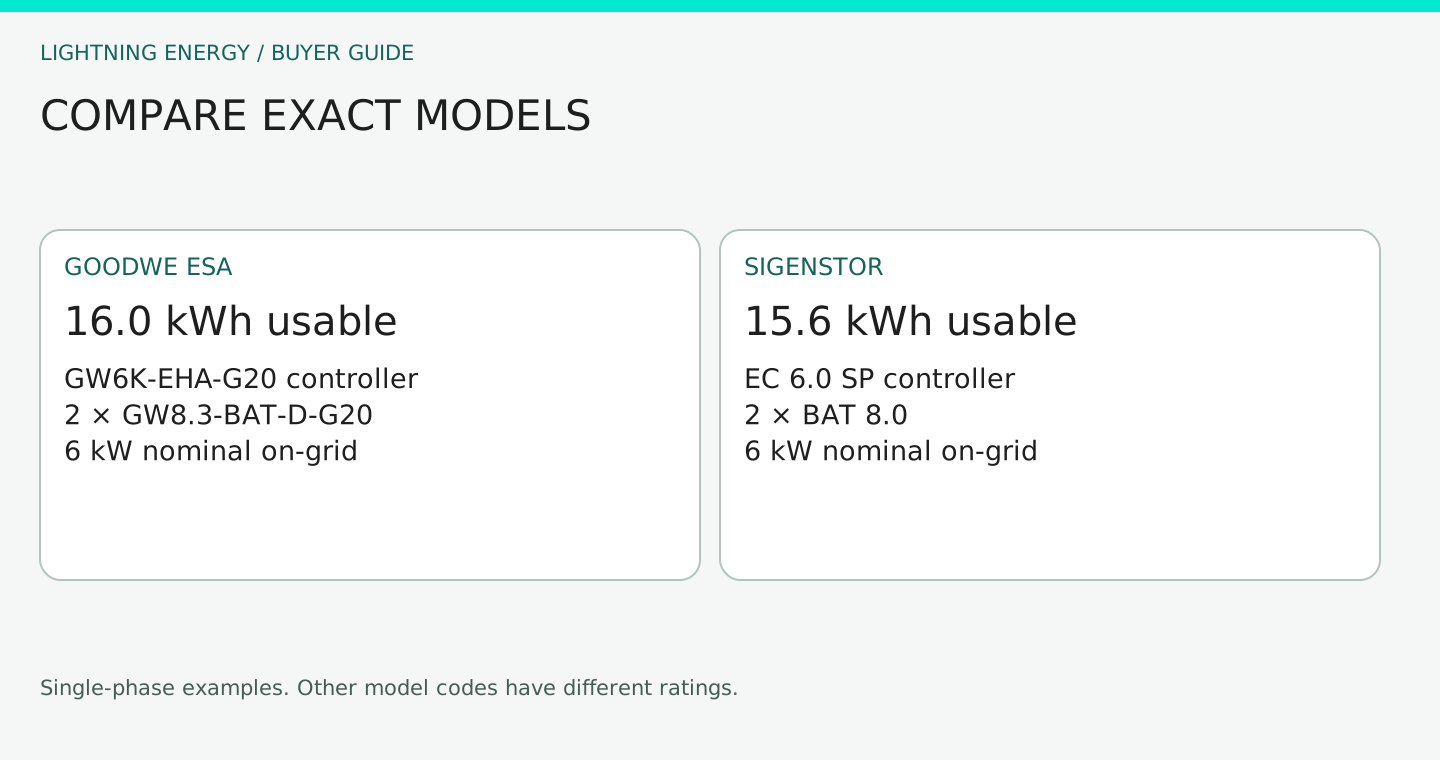
The 0.4 kWh storage difference is unlikely to settle a household decision on its own. Compare usable capacity, the delivered system price, backup scope and the cost of the upgrade you actually expect to make.
Our GoodWe ESA product guide explains the broader range.
The Sigenergy SigenStor guide explains its broader family.
Specifications here apply to the named equipment, not every model in those ranges.
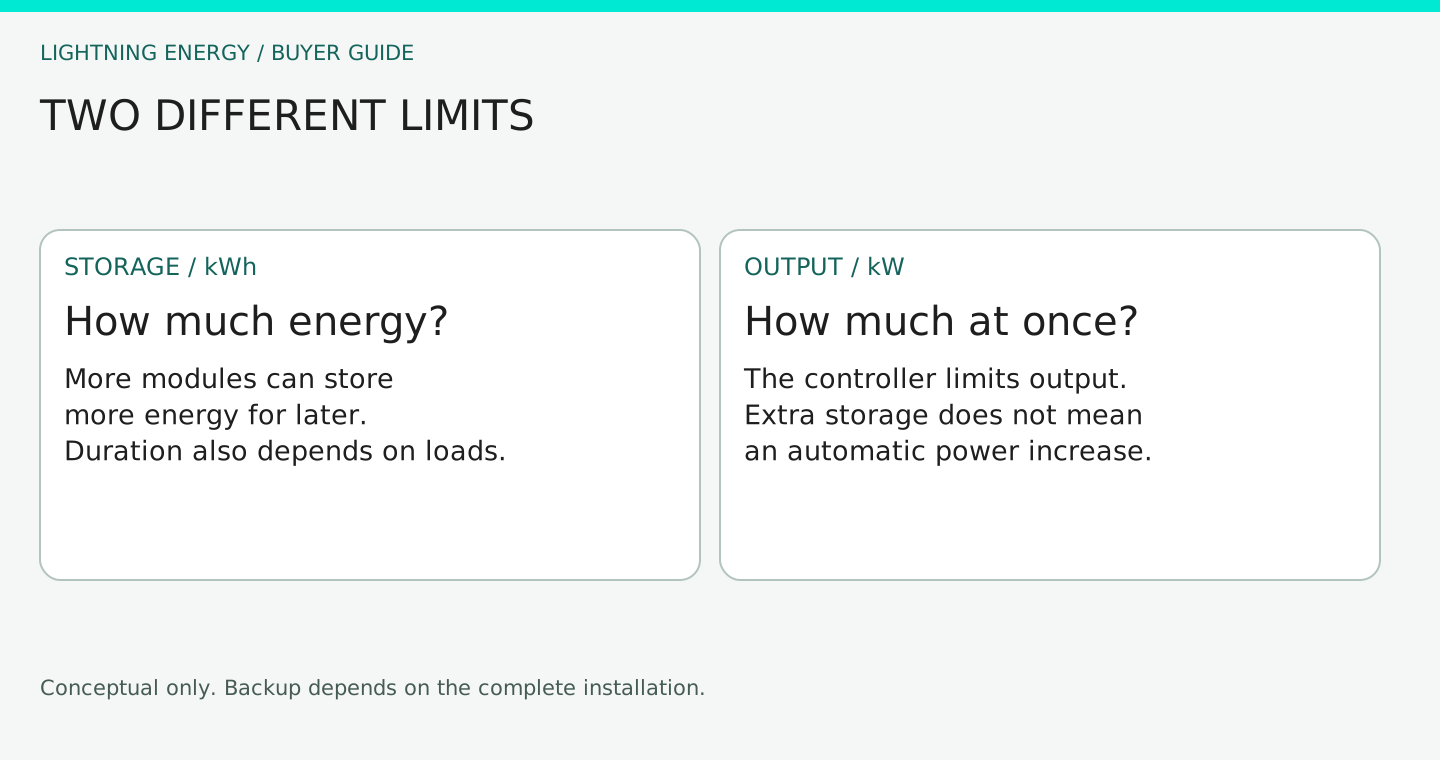
More kWh can help cover a longer evening. More kW can help run larger simultaneous loads. Adding storage modules does not automatically increase the selected controller’s AC output rating.
Picture an induction cooktop, air conditioner and EV charger operating together. The combined demand may exceed a battery inverter’s output even when the battery has plenty of energy remaining.
With the grid available, grid supply may cover the difference within the installation’s limits. During an outage, the backup design must keep the connected load within the equipment’s operating limits.
GoodWe’s selected ESA power module provides a backup output. That does not make every circuit in an existing switchboard automatically backed up. The design must identify the protected circuits and their starting loads.
For SigenStor backup, include the appropriate Sigen Energy Gateway and the required installation work. A price for a controller and battery stack alone is not an equivalent backup-system quote.
Our selected GoodWe 6 kW model has a 50 A maximum grid-current rating in the current datasheet. Do not apply the family’s advertised 63 A figure to every model.
We have not ranked short-duration peak output.
Sigenergy’s linked controller sheet and its 3–6S system package give different peak figures.
Ask for the dated specification and supported starting-load assessment for the exact supplied system.
These are single-phase examples. A three-phase house needs a separate design: which circuits remain powered, how phases are treated and whether any three-phase appliance can run during an outage must be stated explicitly.
GoodWe’s current battery warranty supports capacity expansion and says total capacity is based on actual battery capacity. It also specifies a balancing procedure during expansion. Adding modules remains installer work.
Sigenergy describes module-level optimisation and mixing old and new batteries. Treat that as a product-family capability, then obtain written confirmation for your installed module generation and proposed addition.
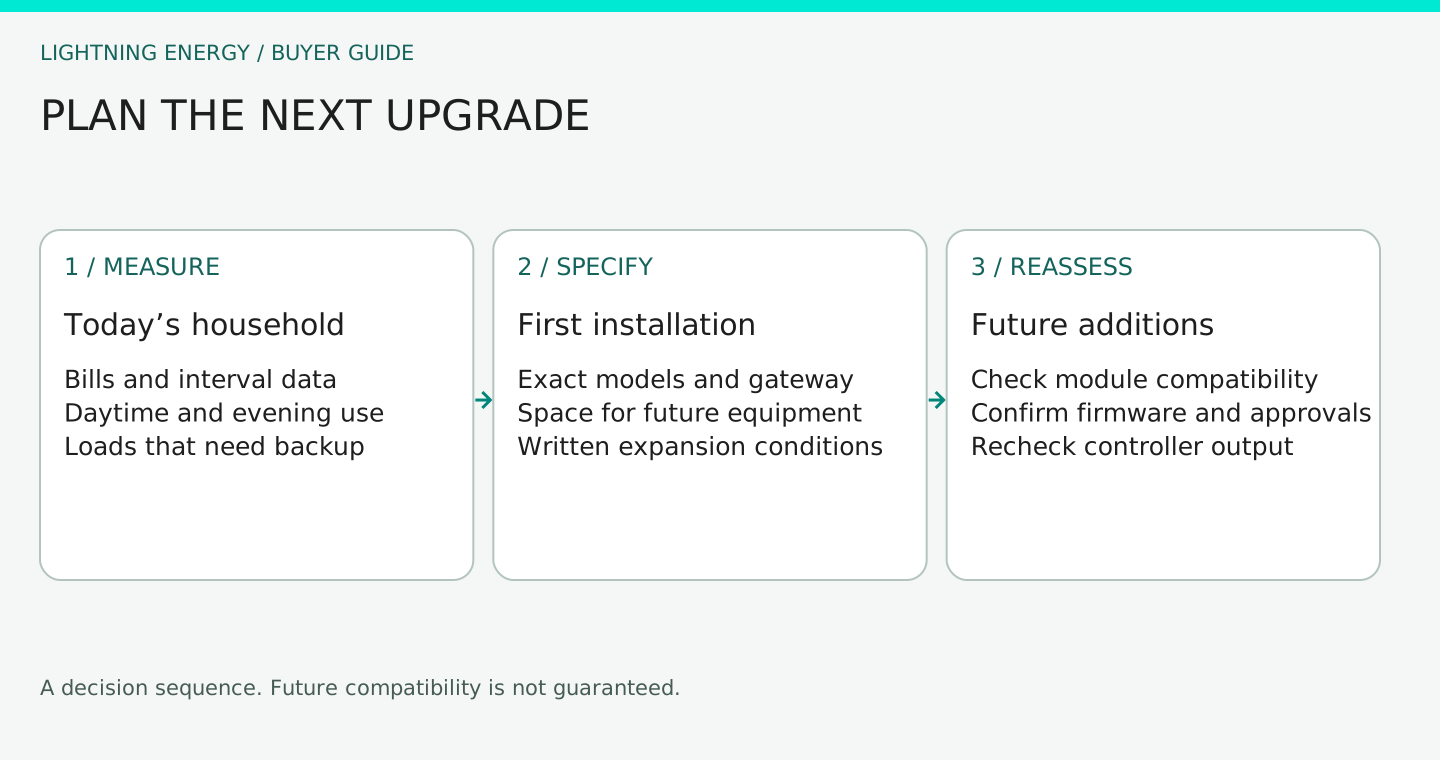
For either brand, request the permitted module count, physical arrangement, firmware requirements, approval pathway and expansion labour cost. Do not treat the largest family marketing number as the limit of your particular stack.
A useful expansion plan reserves compliant installation space and identifies the extra hardware. It should also explain whether your original controller can support the future load or would itself need changing.
If the aim is to charge an EV from daytime solar, compare an appropriately controlled AC charger first. Charging speed, the car’s onboard charger, solar surplus and household supply capacity all affect the result.
SigenStor offers an optional EV DC charging module. It is not included in the two-battery comparison configuration above and needs its own equipment, compatibility and installation assessment.
Sigenergy’s Australian product page qualifies V2X support by vehicle capability, standards and future announcements. A “V2X ready” label is not proof that your particular car can power your home or export to the grid today.
Get written confirmation of the vehicle, charger, firmware and Australian approvals before paying for bidirectional capability. Our EV charging options can help frame the ordinary home-charging part of that decision.
The current GoodWe warranty for the selected battery family provides ten-year product cover. Its performance cover is limited by time or energy throughput, whichever comes first, and includes a one-full-cycle-per-day condition.
Sigenergy’s Australian and New Zealand warranty gives the energy controller and battery pack ten-year product cover, with separate performance conditions. Its EV DC charging module has a different, three-year warranty period.
Sigenergy also sets internet-connectivity conditions. Extended disconnection can change operating mode and warranty coverage. Read those clauses before choosing a site with unreliable connectivity.
Ask who handles the claim, which labour and travel costs are included, what proof of purchase is required and how faults are reported.
Keep the warranty version supplied with the installed equipment; statutory consumer rights remain relevant.
There is also a model-specific safety check. The Clean Energy Regulator’s recall notice identifies Sigenergy single-phase 8, 10 and 12 kW controllers. Those are not the 6 kW controller used in this comparison.
That distinction is not a blanket safety clearance. For any purchase or existing system, have the retailer check the actual model and serial number against current recall instructions and approved equipment records.
GoodWe ESA merits a close look when the priority is a modular solar-and-battery system with a clearly specified backup design. Check the exact power module, storage modules and the practical expansion arrangement.
SigenStor merits a close look when its optional EV DC architecture is a specific part of your plan. Confirm that the extra hardware and vehicle capability are useful now, and price them separately from the basic battery system.
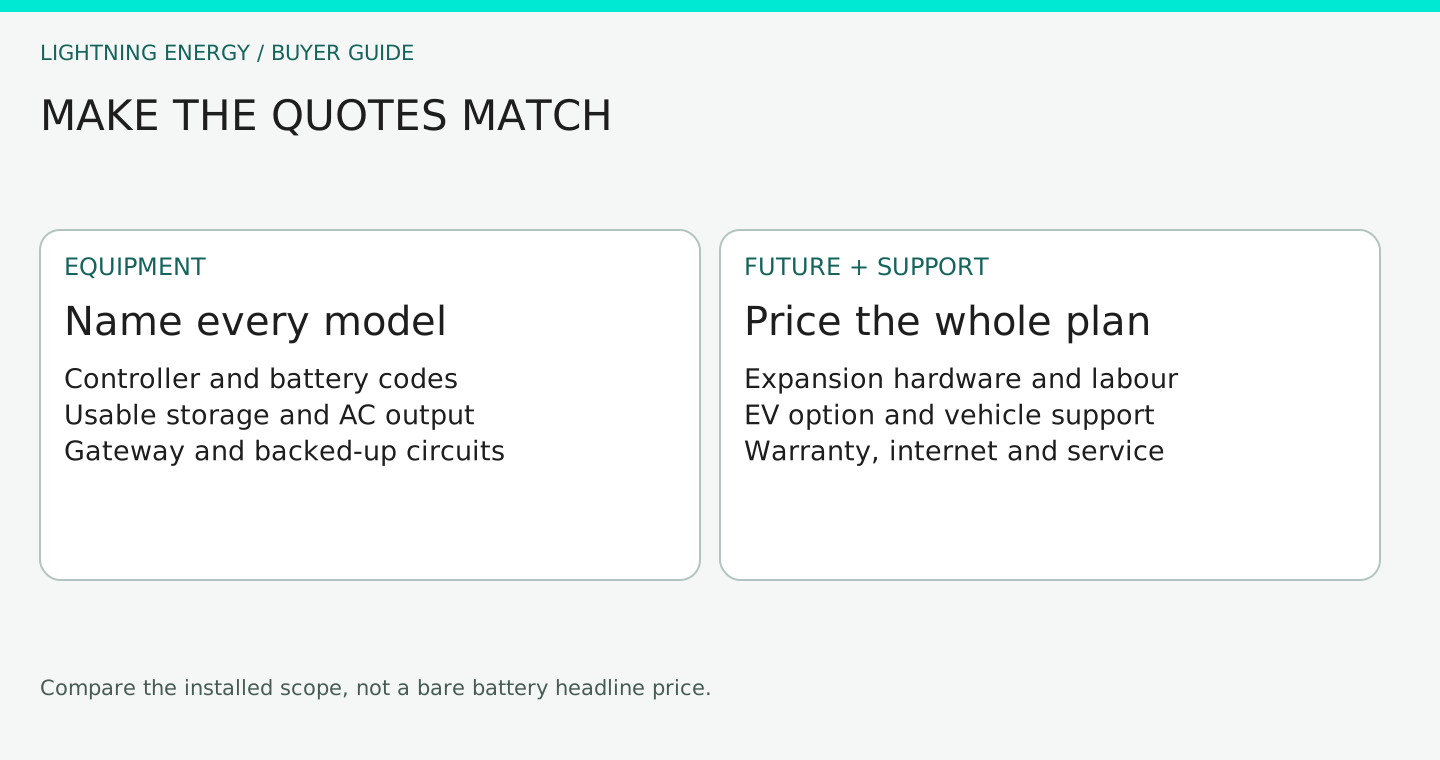
There is no defensible universal winner without comparable installed quotes and your load data. A lower initial price can lose its advantage if the future controller, gateway or switchboard work was omitted.
Bring recent electricity bills, interval data if available, switchboard photographs and your planned electric appliances to a Lightning Energy quote assessment.
Ask for both present-day scope and the next upgrade in writing.
We checked the GoodWe Australian ESA datasheet, version 2.1 dated 9 October 2026, and the ESA product page.
GoodWe warranty references: current battery warranty.
Also see the current inverter warranty, both checked on 7 November.
Sigenergy references: SigenStor Australian product page.
The energy controller datasheet and Energy Gateway.
We also checked the Australian and New Zealand SigenStor warranty.
Confirm the version applicable to equipment delivered under your quote.
Safety reference: Clean Energy Regulator recall notice.
No installation tests, independently measured efficiency or customer savings are claimed.
Cover: official GoodWe ESA single-phase family product image, shown for identification.
The pictured stack is not a claim that the two-module comparison configuration has that appearance.
Interior diagrams are original conceptual explanations.
Available times
Book a consultation and we'll map solar, storage, hot water, and the rebates around your bills and your goals.
Question 1 of 6
