Home Batteries by Postcode: What Sydney and Melbourne Totals Mean for Evening-Peak Sizing
Four Sydney and Melbourne postcodes have added 99–156 MWh of home storage since July 2025. The useful next step is sizing for your own evening demand, not copying your neighbours.
LLuke CoveLightning Energy13 November 2026 · 4 min read
Your neighbours’ batteries are adding up to something big. In parts of western Sydney and Melbourne, the combined storage installed behind household meters now rivals the capacity of a grid battery.
That is a striking neighbourhood headline. It is not a sizing guide for your home.
If your priority is bringing evening grid use under control, the useful starting point is your own household’s demand after sunset. You need a plan for your dinner, heating and overnight loads—not a battery chosen to match the street.
Four postcodes show how quickly home storage is growing
RenewEconomy reports that self-described energy analyst Kanav Verma ranked 2,473 Australian postcodes using Clean Energy Regulator home-battery data. The ranking covers storage capacity added since the federal home-battery scheme began in July 2025.
Peter Hannam’s report, published on 5 November 2026, gives these leading totals.
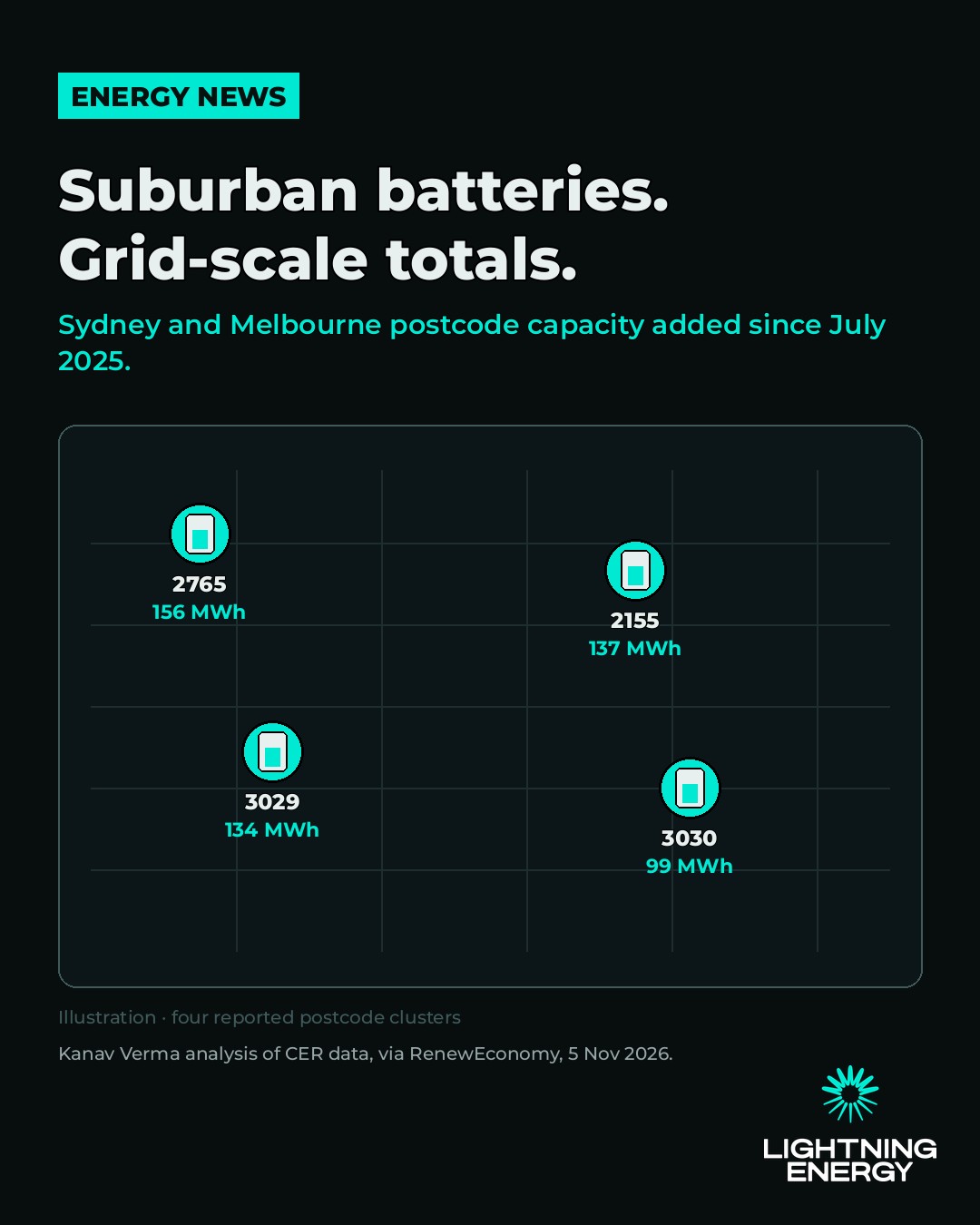
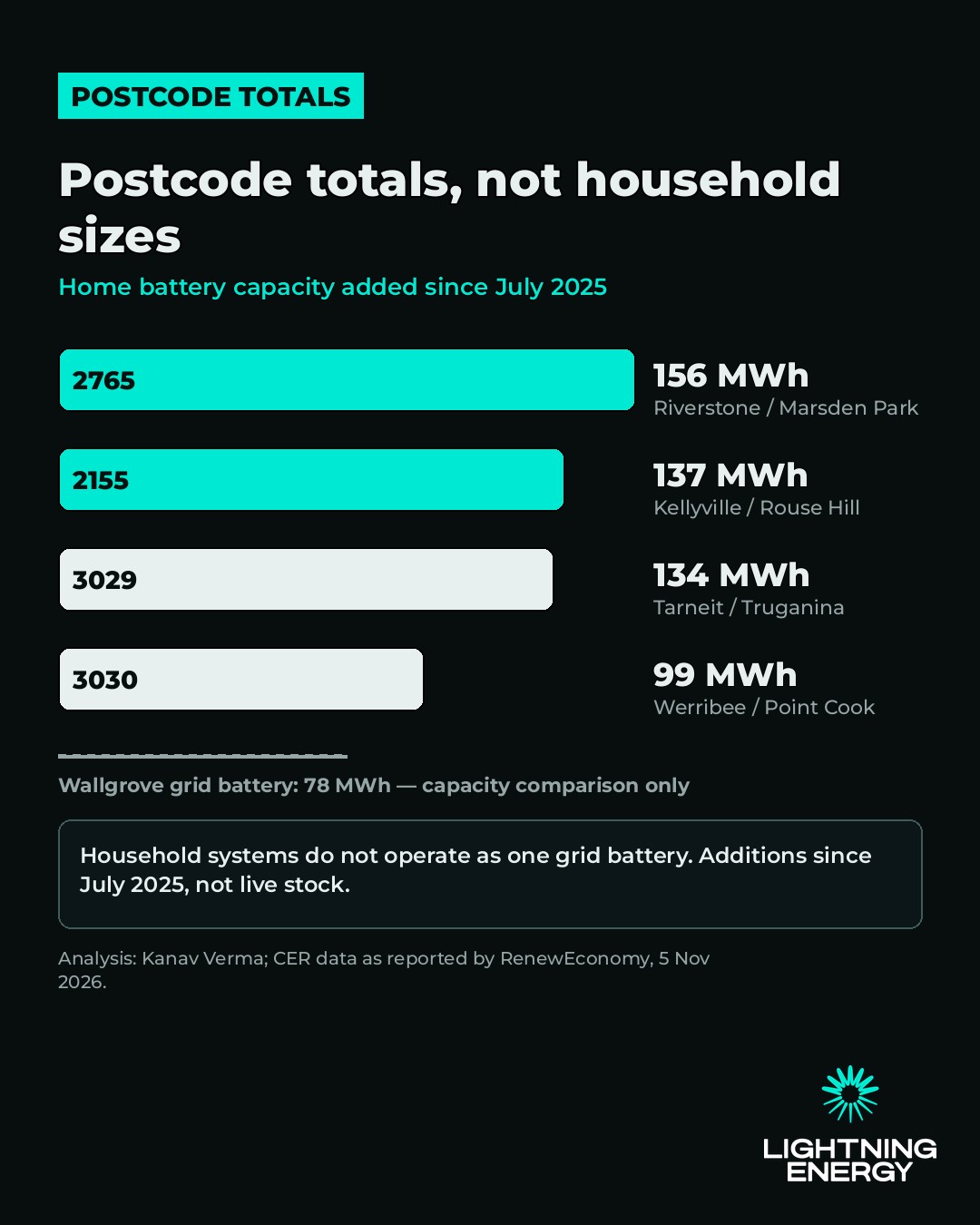
Postcode 2765, covering Riverstone and Marsden Park in western Sydney, had added 156 megawatt-hours (MWh) of household storage.
Nearby postcode 2155, covering Kellyville and Rouse Hill, had added 137 MWh.
Melbourne’s western suburbs followed: postcode 3029, covering Tarneit and Truganina, had added 134 MWh, while postcode 3030, covering Werribee and Point Cook, had added 99 MWh.
These are postcode totals, not individual battery sizes. They are Verma’s analysis of regulator data, as reported by RenewEconomy, rather than a separate analysis conducted for this article. They describe additions over that reporting period, not a live count of every battery operating today.
Similar storage capacity does not mean the same grid service
The report compares postcode 2765’s 156 MWh with the 78 MWh Wallgrove grid battery at Eastern Creek, roughly 16 kilometres away.
That comparison is about stored-energy capacity. It does not mean thousands of household batteries operate as one coordinated power station.
As Verma explains in the report, grid batteries respond to the market every five minutes. The 4,202 batteries he identifies in postcode 2765 mostly serve their own homes. Pooling their operation is a separate matter.
For you, the practical point is simple: a large suburb total says nothing about how much energy your household needs tonight. It also does not show whether your particular battery will have enough charge when your evening demand arrives.
What AEMO’s evening-peak finding actually says
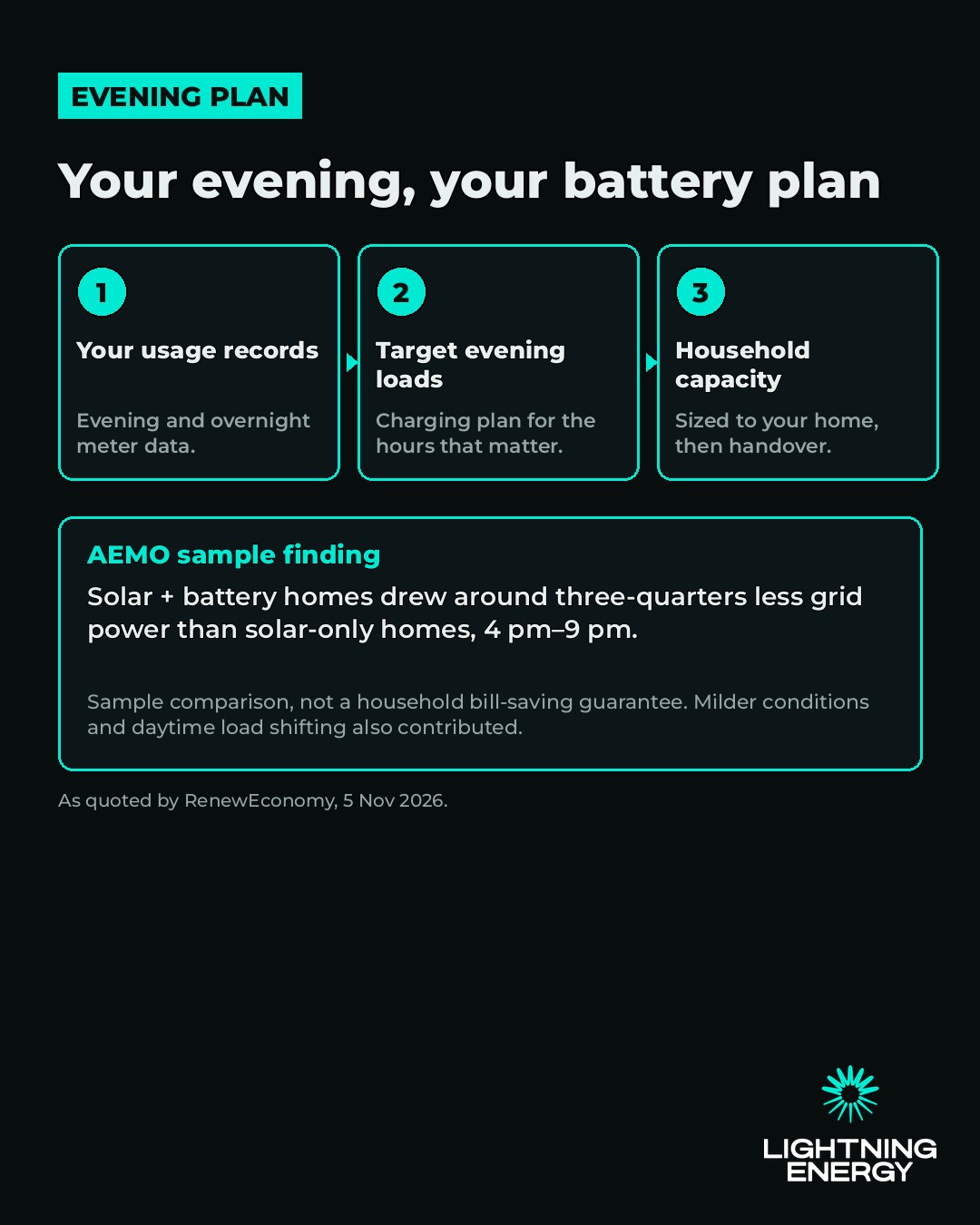
RenewEconomy quotes the Australian Energy Market Operator’s latest quarterly markets report: sample analysis suggests households with rooftop solar and batteries drew around three-quarters less power from the grid during the evening peak, from 4 pm to 9 pm, than households with rooftop solar alone.
That is a comparison of sampled households and grid draw during a defined time window. It is not a promise that your electricity bill will fall by three-quarters, nor a claim that every household will achieve the same result.
AEMO says battery uptake contributed to lower evening-peak operational demand across the National Electricity Market, alongside milder conditions and increased daytime load shifting. Batteries were one contributor, not the only cause.
The report also says utility-scale batteries set NEM wholesale prices through charging and discharging for 48% of the September quarter, compared with 18% a year earlier. That is a wholesale-market price-setting measure—not a household discount, a measure of electricity supplied, or evidence of a particular home battery’s performance.
Start with your evening use, not your postcode
A proper installer starts with your household’s electricity-use records and the outcome you want. For an evening-peak plan, that means separating the demand you want the battery to cover from the rest of your daily use.
Your plan should make the target period clear. A household focused on dinner-time demand is planning for a different task from one seeking coverage through the night as well.
The source’s 4 pm–9 pm window is useful context, but it should not replace your own usage pattern or electricity tariff. The installation plan needs to fit your home rather than treating a market-wide research window as a universal setting.
Build one plan for capacity, charging and future loads
The next step is a household-specific design. A proper installer sets out the usable storage proposed, the loads it is intended to support and the charging assumptions behind that choice. The plan should distinguish an ordinary evening from a higher-demand one, without promising a fixed bill outcome.
Installation and handover should connect the equipment to that original purpose. A proper installer explains the operating settings, the planned charging and discharging behaviour, and how to review the household’s actual results after commissioning.
The postcode figures show the scale of household storage being added in Sydney and Melbourne. They do not tell you which capacity to buy.
Start with your evening-use records and a clear goal for the hours you want to cover. A household-specific battery plan is a calmer next step than copying the biggest system on the street.
Source: Peter Hannam, “Chart of the day: Batteries in the ‘burbs are starting to compete with utility-scale storage”, RenewEconomy, 5 November 2026. Linked above. Postcode figures are attributed to Kanav Verma’s analysis of Clean Energy Regulator data; AEMO findings are quoted as reported by RenewEconomy.
Book a consultation and we'll map solar, storage, hot water, and the rebates around your bills and your goals.
Loading consultations…
Lightning EnergyPlan your next energy upgrade.
⚡
Hi, I’m Lightning Energy’s project guide. I’ll ask a few practical questions, explain what usually matters for your project, and help you decide on a useful next step — no guesswork or sales pressure.
First, what kind of property are we planning for?