Home Battery Prices Are Falling Because of a Stock Glut. Here's How to Buy Smart
A stock glut is pushing home battery prices down, industry voices tell RenewEconomy. That can be a good time to buy, if a proper quote shows a solid installer, a current model and clear warranty support.
LLuke CoveLightning Energy28 November 2026 · 6 min read
You want a home battery at a fair price, and you want it to still have someone behind it in ten years. Those two things can go together. A stock glut is pushing wholesale prices down, which is why many household quotes look sharper than they did earlier this year. It is a good time to buy, as long as you buy smart.
The story comes from RenewEconomy, in a report by Giles Parkinson published on 25 November 2026. The figures and quotes below are from that report, including a LinkedIn post by Rami Fedda that RenewEconomy published in full.
Why battery prices are falling
Rami Fedda is co-founder and supply director of wholesaler Solar Juice, with 29 years in the industry. In the LinkedIn post RenewEconomy published, he wrote that instability has always gone with solar, then added: "But after 29 years in the industry, I can confidently say the last 18 months have been the most volatile I've experienced."
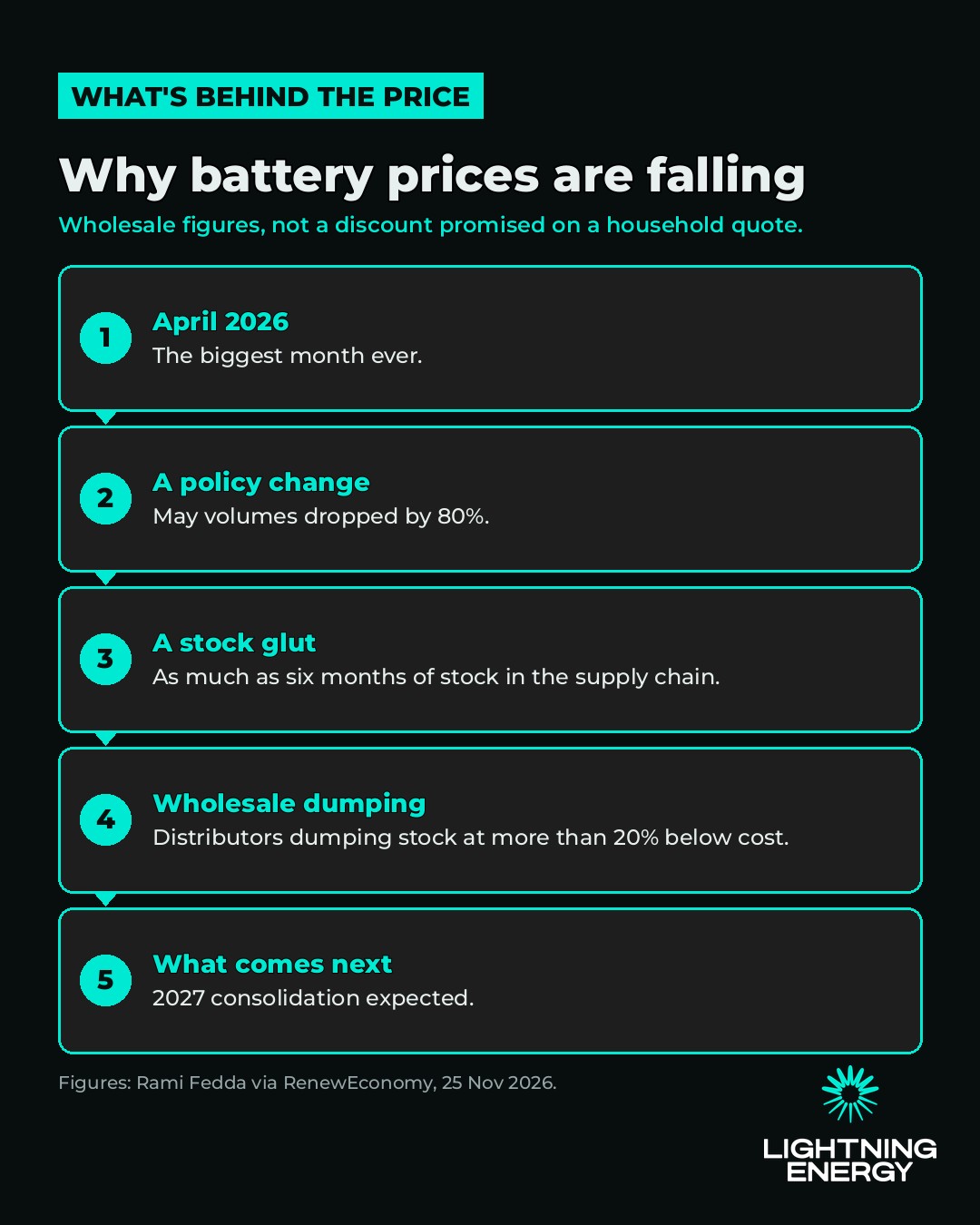
He points to the Cheaper Home Batteries Program as the reason the market flipped so fast. Attachment rates, he wrote, went from around 20 per cent on solar installations to over 100 per cent, "with battery installations now exceeding solar installations." April 2026 was, in his words, "our biggest month ever." One month later, "May volumes dropped by 80% compared to April following changes to the CHBP Policy." The market then stabilised at those lower levels, and "over the past two months we've started seeing some growth from the bottom."
The hangover is sitting in warehouses. "Some estimates suggest as much as six months of stock sitting in the supply chain," Fedda wrote. Distributors, he said, are "dumping stock at more than 20% below cost," and "almost every major brand is being sold at or close to cost."
That 20 per cent figure is Fedda's claim about wholesale stock. It is not a promised discount on a household quote. Even so, RenewEconomy reports him saying the situation is good for customers, for the moment.
The shakeout has already started
A battery is a long relationship, not a one-off purchase. Someone has to honour the warranty, supply parts and answer the phone in year eight.
Fedda wrote that he believes "consolidation in the Australian solar market is inevitable in 2027." He does not necessarily mean mergers. "I expect some manufacturers will withdraw from Australia altogether, while some distributors simply won't survive." He did not name those companies, and neither will we.
Nathan Avins of Tindo Solar, as reported by RenewEconomy, says the shakeout among installers and retailers has already begun, with cutbacks, companies going into administration, and phoenix activity, where a failed company reappears in another form. "The consumer is also going to pay in all of that," Avins wrote. His point was that it is "important to work with businesses and products who don't just sell on price but rather are able to provide additional value."
Today's pricing, plus the rebate that still applies, can be a strong position for a household that wants to own its power. The work is to lock in that price with a setup that will still be supported.
On the federal Cheaper Home Batteries rebate, eligible batteries currently get support of up to around 30% off. What you qualify for depends on your property and the current rules. A scheduled step-down takes effect on 1 January 2027. Further changes are being considered; today's published rules still apply. For a snapshot of the current position, see our post on what applies to Australian homes today under the Treasury review.
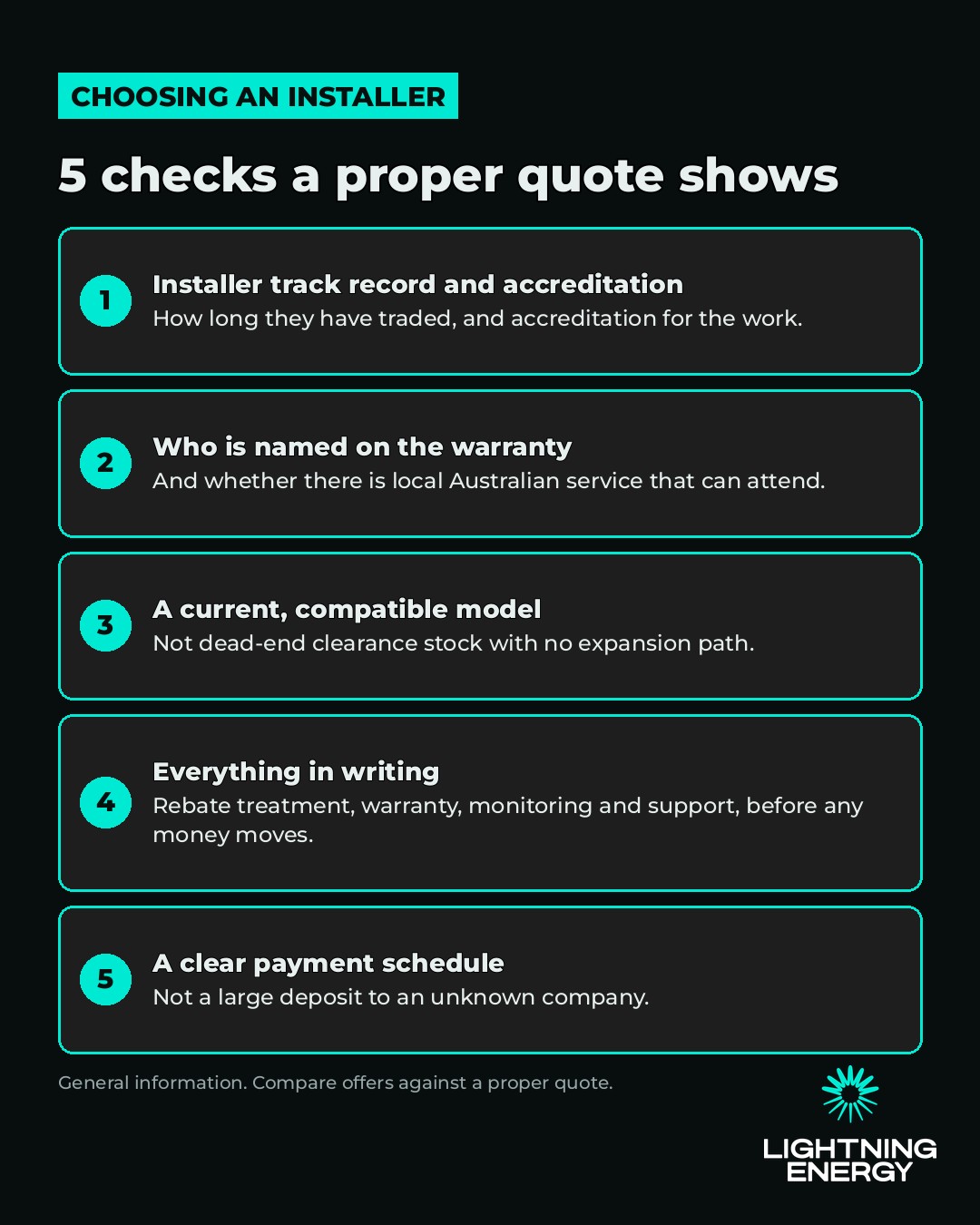
5 checks a proper installer or quote shows
Here is what a proper installer or quote shows when the price looks sharp. Use them to compare offers, not to talk yourself out of buying.
2. Who is named on the warranty, and whether there is local Australian service
A proper quote names the legal entity that issues the warranty: the manufacturer's Australian company, an overseas parent, or the installer. It also shows whether that brand has a local Australian presence and a service network that can actually attend the site. A warranty letterhead is one thing. Parts on a shelf in Australia, and a technician who can be sent, are another.
3. A current, compatible model, not dead-end clearance stock
Low warehouse stock can be a genuine current model at a better price, or leftover hardware with no expansion path and fading support. A proper quote names a current, compatible battery that works with the solar already on the roof, or with the solar being installed with it. It also makes the upgrade path clear. Clearance pricing is fine when the model itself is still a live product.
4. Everything in writing
Rebate treatment, warranty length and issuer, monitoring, and how support is handled should all be in the quote, in writing, before any money moves. If a promise matters, it belongs in the document. Our home battery quote checklist sets out the equipment, work and support a proper quote puts on paper.
5. A clear payment schedule, not a large deposit to an unknown company
A proper quote sets out who you are paying, and on what schedule. A modest deposit to a company you can identify, with a trading history you can check, is a normal part of a solid job. A large upfront payment to a business you cannot trace is not how a proper quote is structured. The payment terms should be as clear as the equipment list.
Where this leaves you
The glut is real, and so is the chance to buy well. Fedda's figures explain why quotes are sharper. Avins' warning explains why the cheapest line on a page is not the whole deal. Take today's pricing and the rebate that still applies, from an installer and a product that will still be there to honour the warranty.
A good battery purchase should feel like owning something solid: a fair price now, and a phone number that still picks up in a decade.
Source: Giles Parkinson, RenewEconomy, 25 November 2026, quoting Rami Fedda (Solar Juice) and Nathan Avins (Tindo Solar).
Book a consultation and we'll map solar, storage, hot water, and the rebates around your bills and your goals.
Loading consultations…
Lightning EnergyPlan your next energy upgrade.
⚡
Hi, I’m Lightning Energy’s project guide. I’ll ask a few practical questions, explain what usually matters for your project, and help you decide on a useful next step — no guesswork or sales pressure.
First, what kind of property are we planning for?