
EV Charging Cost per 100 km: Grid, Solar and Off-Peak Compared
Calculate EV charging cost per 100 km using grid rates, off-peak electricity and surplus solar. Includes clear examples, charging losses and whole-bill checks.
Calculate EV charging cost per 100 km using grid rates, off-peak electricity and surplus solar. Includes clear examples, charging losses and whole-bill checks.

Your EV charging cost per 100 km depends on how much electricity reaches the charging circuit and what that energy costs at the time. The same car can have very different costs across three charging routines.
This guide was checked on 28 November 2026. The numbers below are arithmetic examples, not current electricity offers, vehicle test results or promised savings.
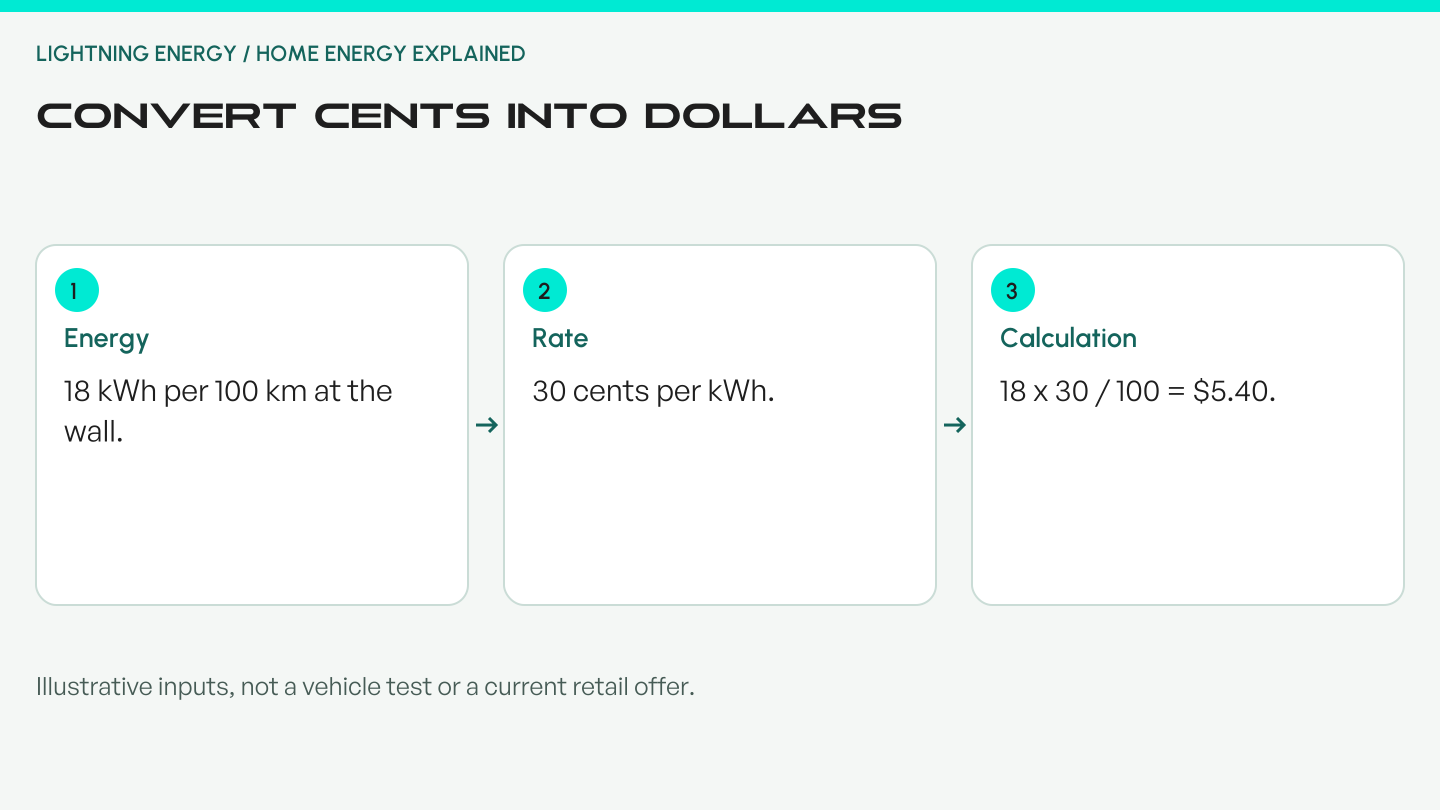
Energy cost in dollars per 100 km = charging electricity in kWh per 100 km x electricity rate in cents per kWh / 100.
If you measure 18 kWh at the wall for 100 km and pay 30c/kWh, the calculation is 18 x 30 / 100 = $5.40. Without dividing by 100, your result is in cents.
Use charging energy measured for the same distance and comparable starting and ending battery charge. A single trip and an unrelated full recharge will not produce a meaningful comparison.
Our dashboard versus meter guide explains why those readings can differ.
Allow for charging losses and relevant parked consumption. Do not add a guessed loss percentage to a wall-meter figure that already includes those losses.
Assume 18 kWh of charging electricity per 100 km in every example. Holding energy constant lets us isolate the effect of the rate; your car and driving conditions will produce different energy use.
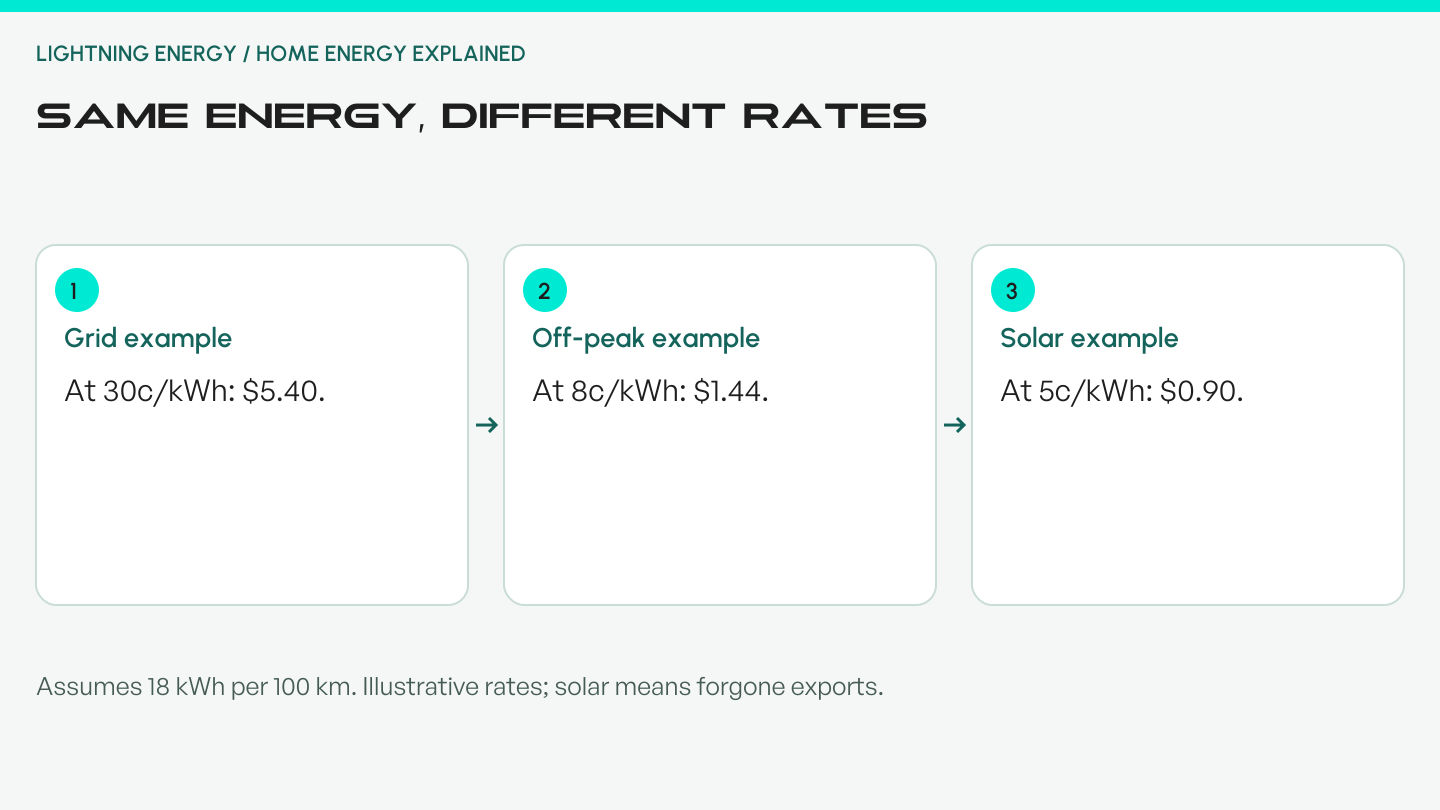
Grid example: 18 kWh at 30c/kWh costs $5.40. Off-peak example: the same energy at 8c/kWh costs $1.44. These rates illustrate the maths and do not identify an available retail plan.
Surplus-solar example: if 18 kWh would otherwise earn a 5c/kWh feed-in credit, using it for the car forgoes $0.90 of export revenue. This is an opportunity cost, not a separate charge on the bill.
The solar calculation assumes the energy could actually have been exported at that rate. Zero or negative export prices, curtailment and competing household uses change the comparison.
It also excludes the cost of buying and maintaining the solar system. A low marginal charging cost does not mean the equipment was free or that its purchase pays for itself.
A flat-rate plan uses one usage rate. Time-of-use plans vary across specified periods. If a session crosses a boundary, divide its energy between the relevant rates rather than applying the cheapest one to everything.
Energy Made Easy explains usage and supply charges. Daily charges continue even when you import little electricity.
For example, 10 kWh at 8c plus 8 kWh at 30c costs $3.20. That blended session is neither the all-off-peak result nor the all-standard-rate result above.
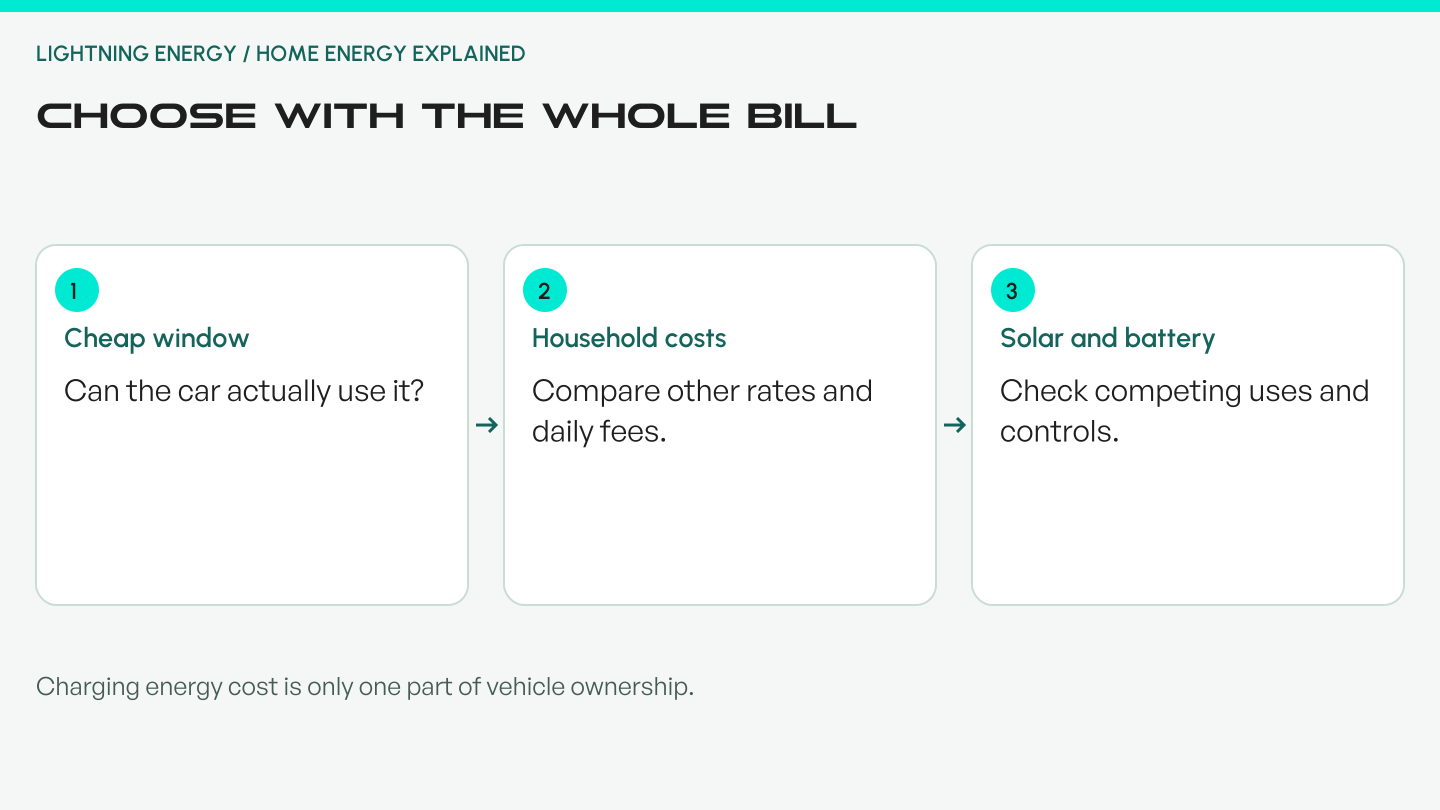
Check the offer for your postcode, meter, vehicle and charger. Read eligible hours, usage caps, fees and requirements for automated control. Include changes to the rest of your household bill.
Record kilometres, charging kWh, session times and the applicable rates. Separately log public charging costs so an occasional road trip does not disappear from the result.
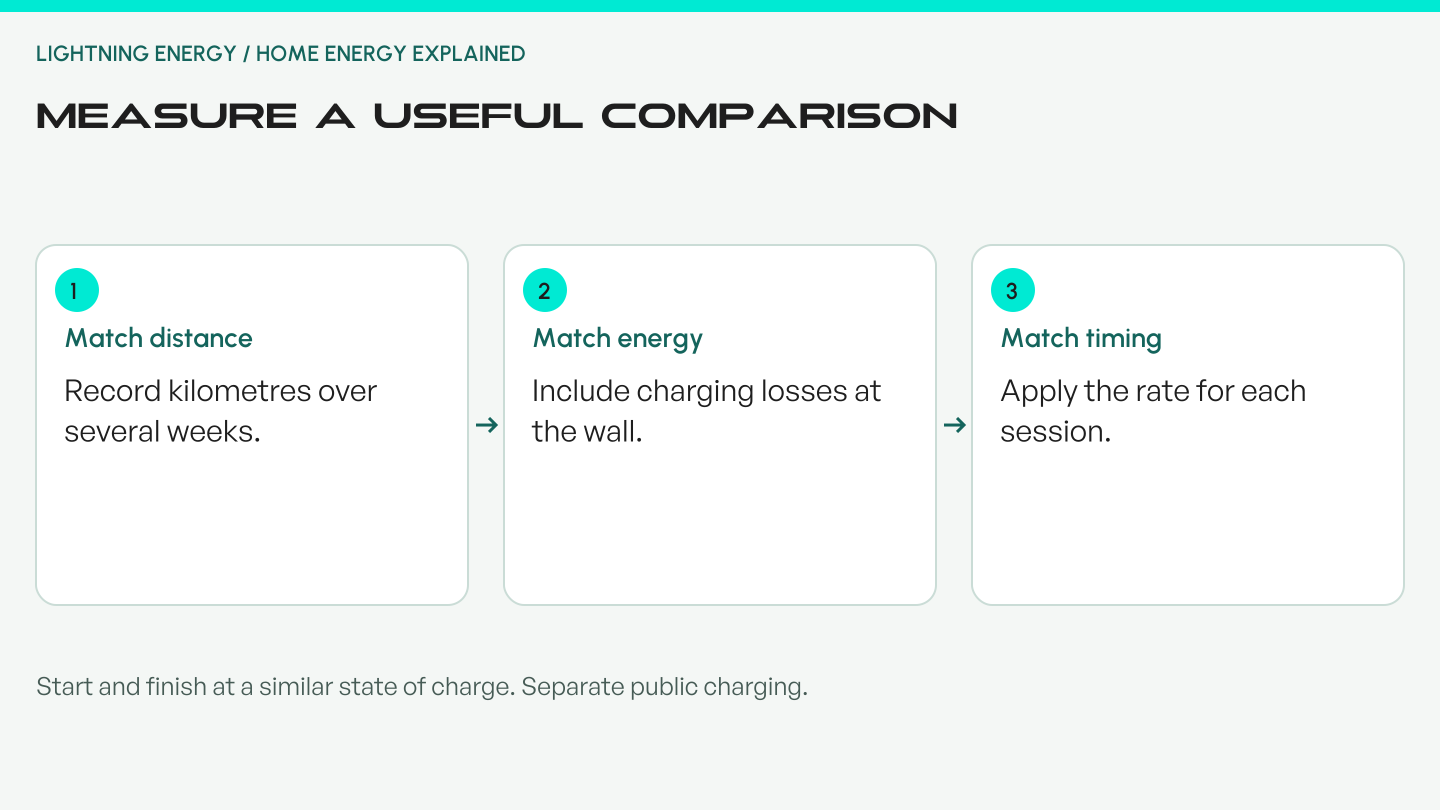
Add the charging costs over the period, divide by the kilometres driven and multiply by 100. Use similar starting and ending battery charge, or clearly record the difference.
If the car travels 1,000 km and the matched charging costs total $42, the result is $4.20 per 100 km. This is an illustrative calculation, not a forecast for a particular vehicle.
First check when the car is home and how much generation remains after household loads. A timer cannot guarantee surplus solar, and a fixed charging rate can still draw from the grid when clouds arrive.
Australian Government charging guidance discusses scheduling, rooftop solar and smart controls.
Ask whether the proposed charger supports surplus tracking with your meter and inverter. Get the minimum charging power, fallback behaviour and settings explained for the actual equipment.
Read our 7 kW versus 22 kW guide before choosing charging power.
Our future-load solar sizing guide helps assess generation alongside other planned appliances.
Stored energy used for the car may no longer be available for evening household loads or backup reserve. Account for storage losses and the value of that alternative use before assuming battery charging is cheapest.
Check the EV and home-battery control guide when agreeing charging priorities.
Fuel cost is only one part of ownership. Purchase price, insurance, servicing, tyres, depreciation and charging equipment belong in a separate total-cost comparison.
Bring your electricity plan, charging records and parking routine to an installer discussion. Lightning Energy can use those inputs to assess a charging layout and controls suited to your home.
Available times
Book a consultation and we'll map solar, storage, hot water, and the rebates around your bills and your goals.
Question 1 of 6