
LFP or NMC Home Batteries: Compare Safety, Warranty and Installation
LFP and NMC describe cell chemistry, but choosing a home battery also means checking the complete system, installation, warranty and local support.
LFP and NMC describe cell chemistry, but choosing a home battery also means checking the complete system, installation, warranty and local support.

LFP and NMC tell you something about a battery's cell chemistry. They do not tell you everything about the safety, usable performance or support of the finished home battery.
Use chemistry as one part of the comparison. Then assess the exact product, its controls, the proposed installation and the Australian warranty rather than choosing from a chemistry label alone.
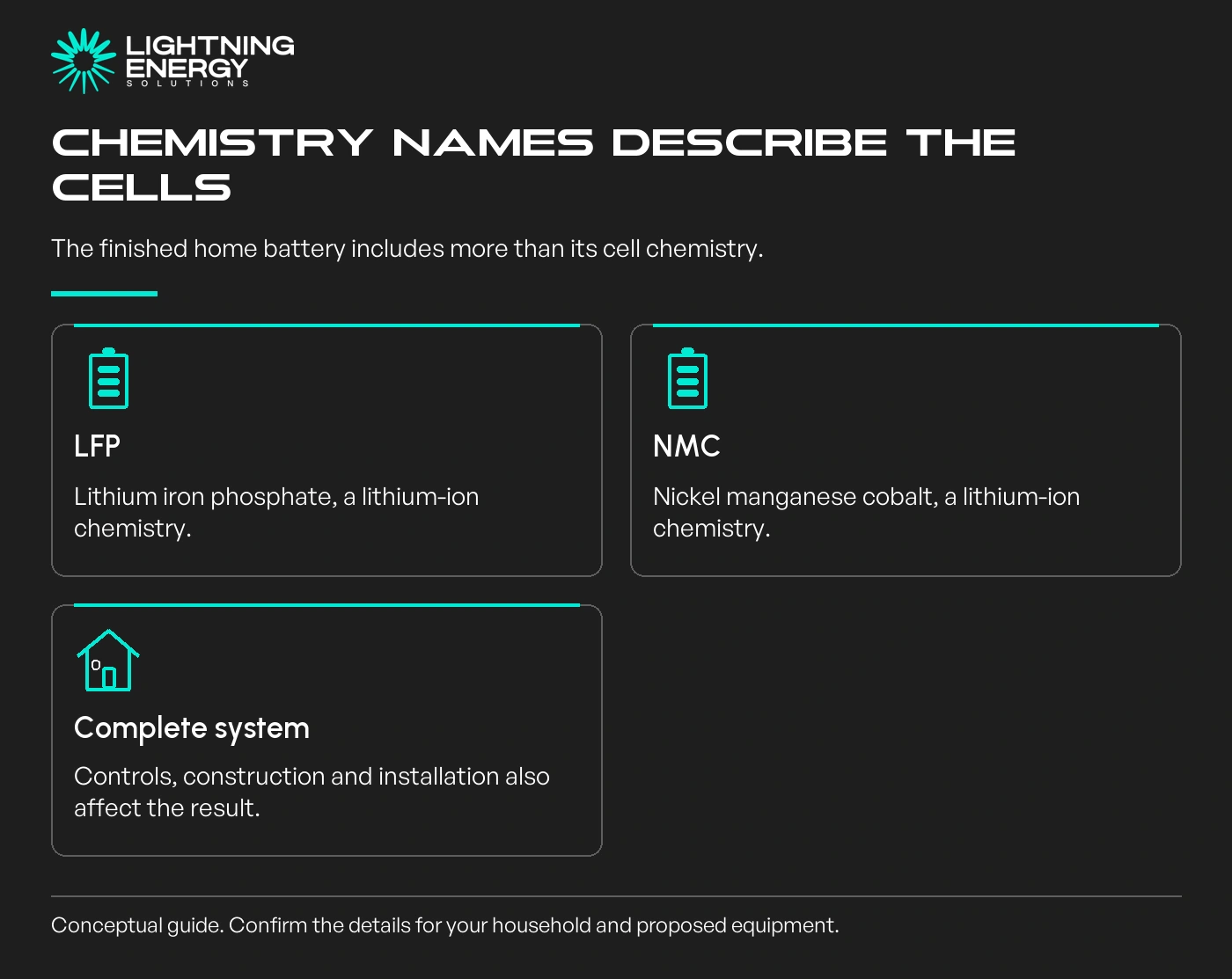
LFP stands for lithium iron phosphate. NMC stands for nickel manganese cobalt. Both names describe types of lithium-ion battery chemistry.
The Australian Government uses those definitions in its battery technology guidance. An EV's range or charging figures, however, should not be carried across to a home-storage product using the same chemistry.
Government battery chemistry definitions.
An ARENA community-battery report records projects favouring LFP for ground-mounted systems on fire-risk grounds, while NMC was used in some pole-mounted systems for its smaller size and weight.
Those project observations explain a trade-off; they do not rank residential products.
Different chemistries involve engineering trade-offs, but the finished system adds its own design decisions. Cell selection, pack construction, controls and operating limits all matter to the product you buy.
Our battery selection guide provides a broader comparison framework.
Request the exact model's Australian documentation and evidence of the applicable product approvals. Ask the installer to explain the battery management, temperature monitoring and protective functions at an owner-appropriate level.
Avoid promises that a chemistry cannot burn or needs no installation precautions. Equally, a chemistry name alone is not evidence that a properly assessed product is unsuitable for your home.
Energy Safe Victoria's guidance makes safe design, installation and inspection responsibilities explicit for battery systems. Those responsibilities remain regardless of the label on the cells.
Energy Safe Victoria: battery energy storage systems.
Consider a hypothetical comparison between two products with similar usable energy. One has clearer local documentation, a well-assessed location and a defined service pathway. Those differences deserve attention alongside chemistry.
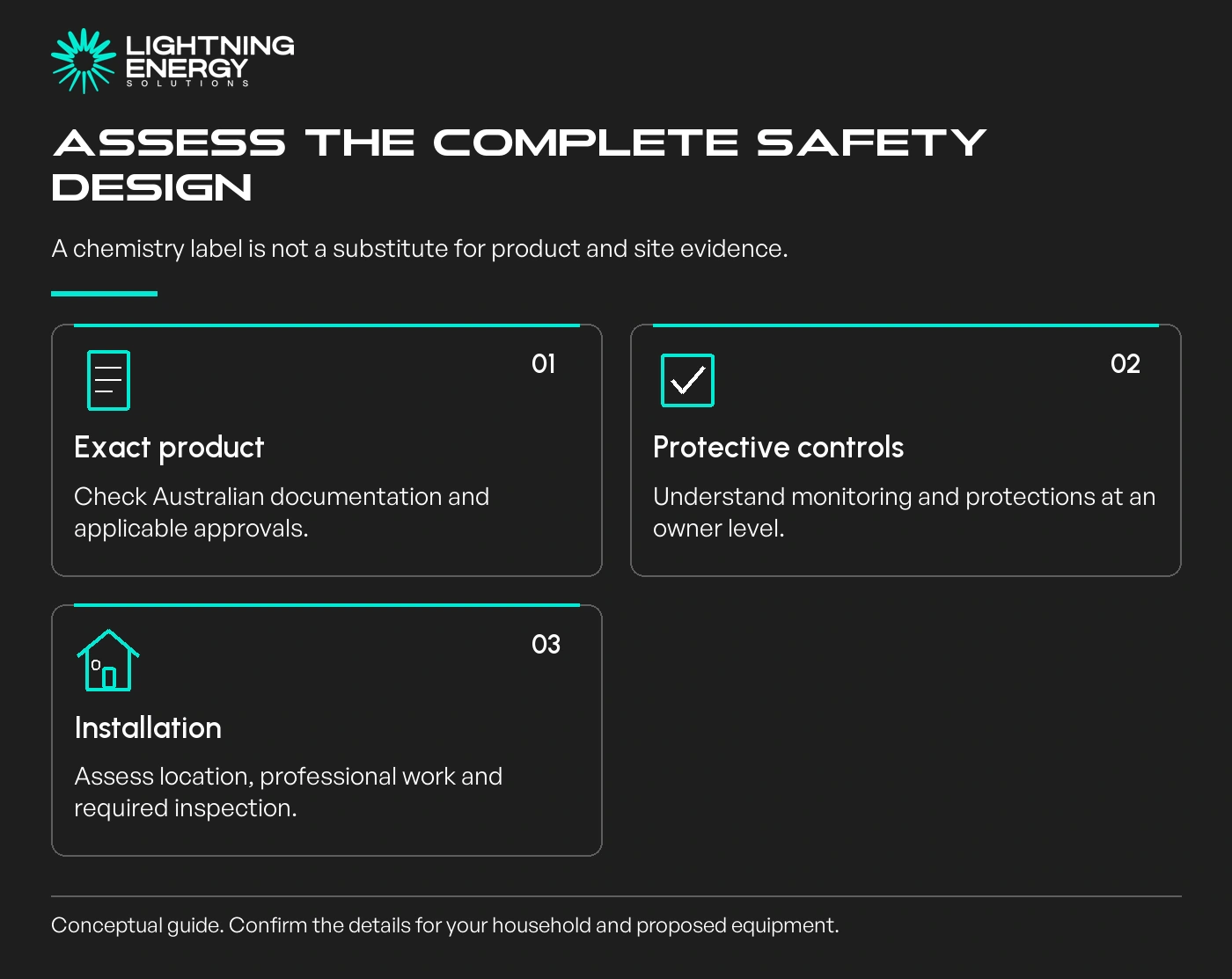
Ask for the permitted charging and discharging temperatures and any conditions that reduce power. Check whether the proposed position suits the manufacturer's location, access and environmental requirements.
A garage can face vehicle movement and storage changes. An outside wall can face strong sun, drainage or exposure. Product suitability needs an assessment of the actual place it will operate.
Do not assume the same clearance, enclosure or cooling arrangement applies across all LFP products or all NMC products. The installer should work from the selected system's requirements.
Use the quote checklist to record any protective or mounting work included in the proposed installation.
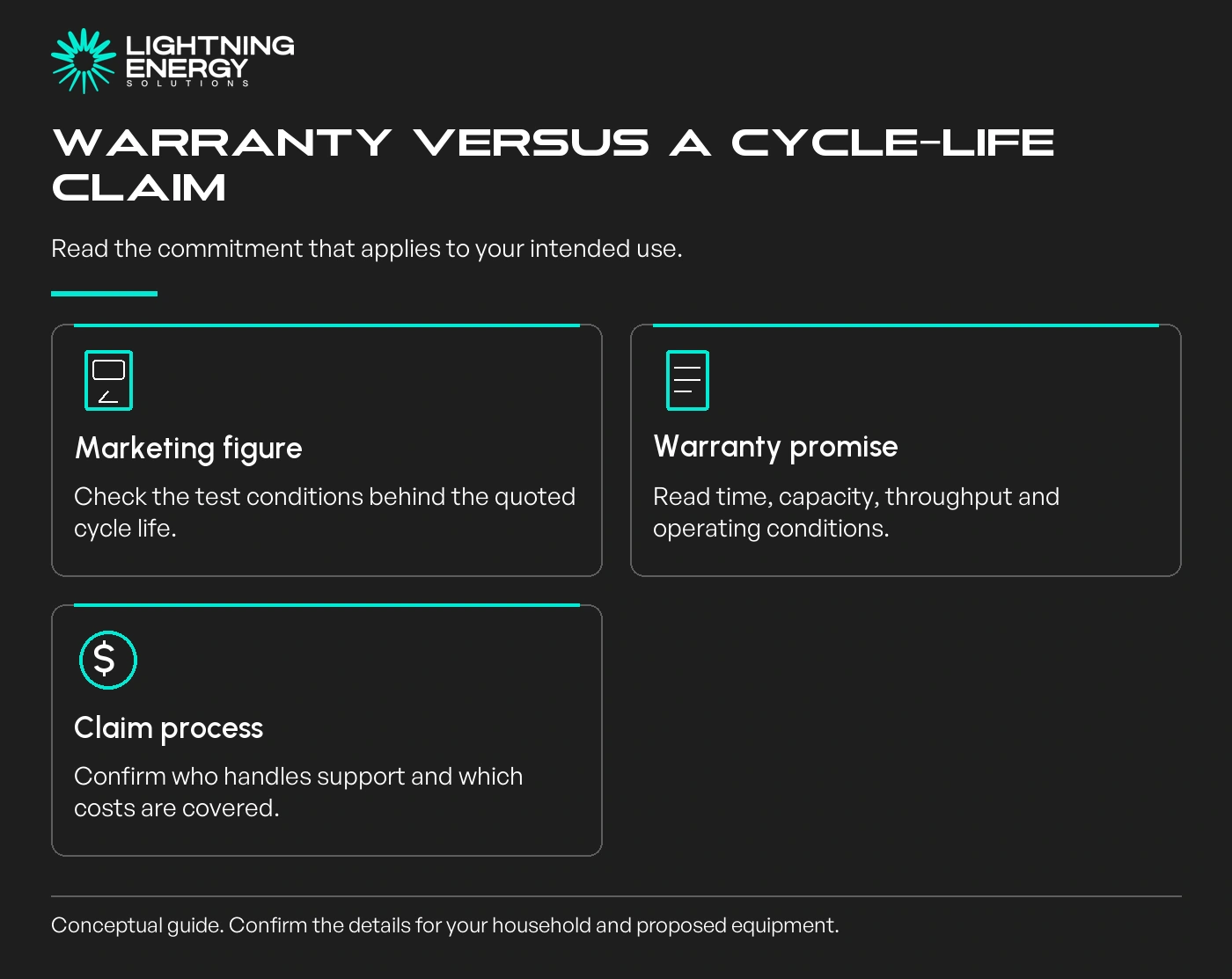
Read the Australian warranty for the exact product and intended operating mode. Compare the term, retained-capacity commitment, any throughput or cycle conditions, exclusions and the process for a claim.
A quoted cycle-life figure and a warranty are different things. Ask whether a laboratory or marketing figure describes the conditions under which you will actually use the system.
Also ask which costs are covered if equipment needs repair or replacement. Do not assume labour, access work or transport are included because the document names a long warranty period.
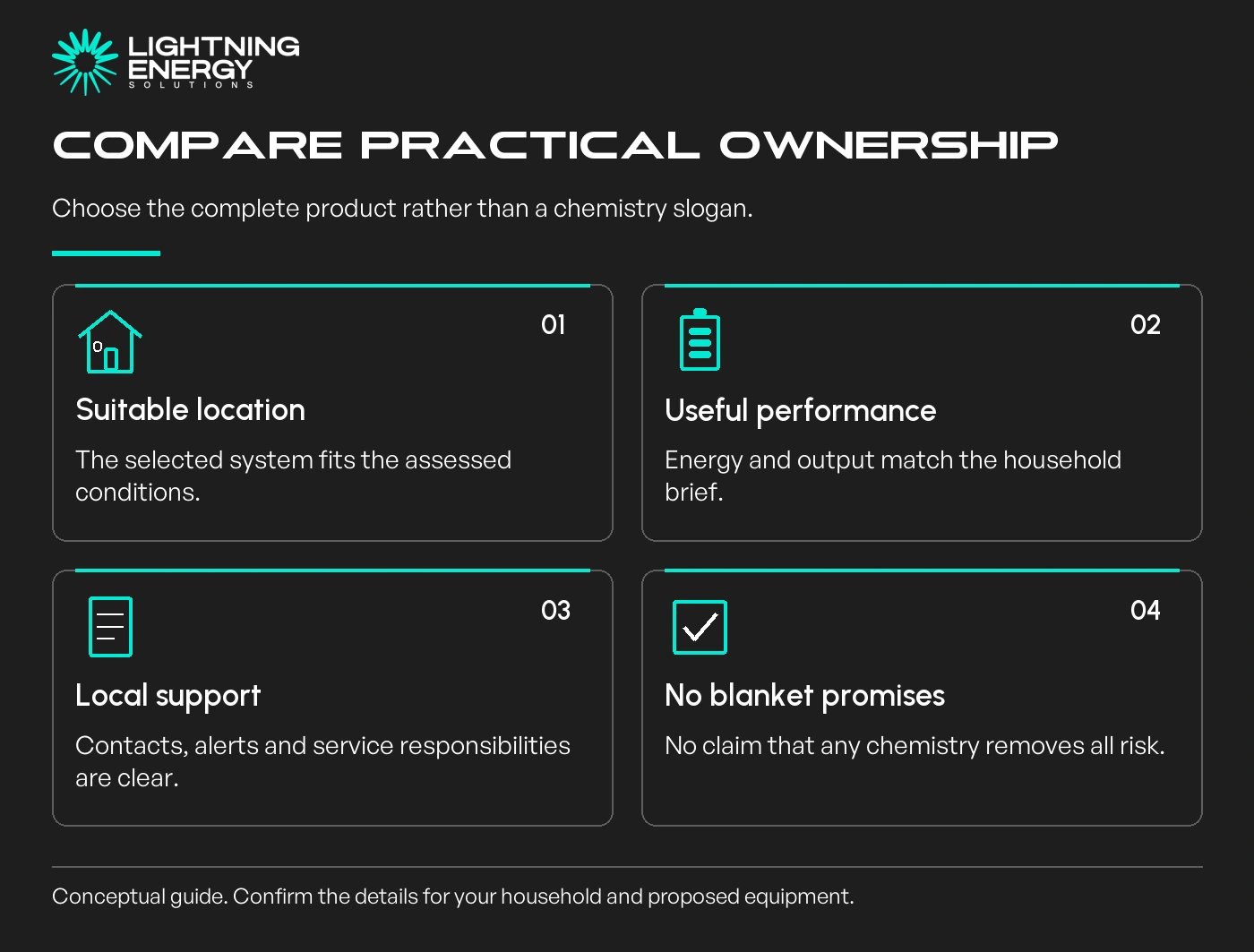
Keep a local support contact and the manufacturer's owner instructions. Ask how alerts are handled, who investigates faults and how the installer confirms that the system is working at handover.
The installation should leave you with clear emergency information and a practical way to obtain service. These are concrete ownership questions that a chemistry comparison often overlooks.
You do not need to replace a functioning battery simply because a newer product uses a different chemistry. Assess condition, suitability and support before treating a chemistry change as an upgrade in itself.
For a new home battery, compare complete supported systems against the same household requirements. That gives chemistry its proper place without allowing it to hide weak documentation or an unsuitable installation.
Plan your battery upgradeBring the exact model names and warranty documents from your quotes. We can help compare the complete systems and the installation scope each requires.Available times
Book a consultation and we'll map solar, storage, hot water, and the rebates around your bills and your goals.
Question 1 of 6