NSW Solar Plus Business Batteries: Why the 90-Day Timing Rule Matters
A business planning solar and a battery can lose sight of the calendar while comparing equipment. In NSW, the timing of new solar capacity can affect the battery incentive calculation.
LLightning Energy TeamLightning Energy31 October 2026 · 5 min read
A business planning solar and a battery can lose sight of the calendar while comparing equipment.
In NSW, the timing of new solar capacity can affect the battery incentive calculation.
This guide focuses on project sequencing, using official sources checked on 30 October 2026.
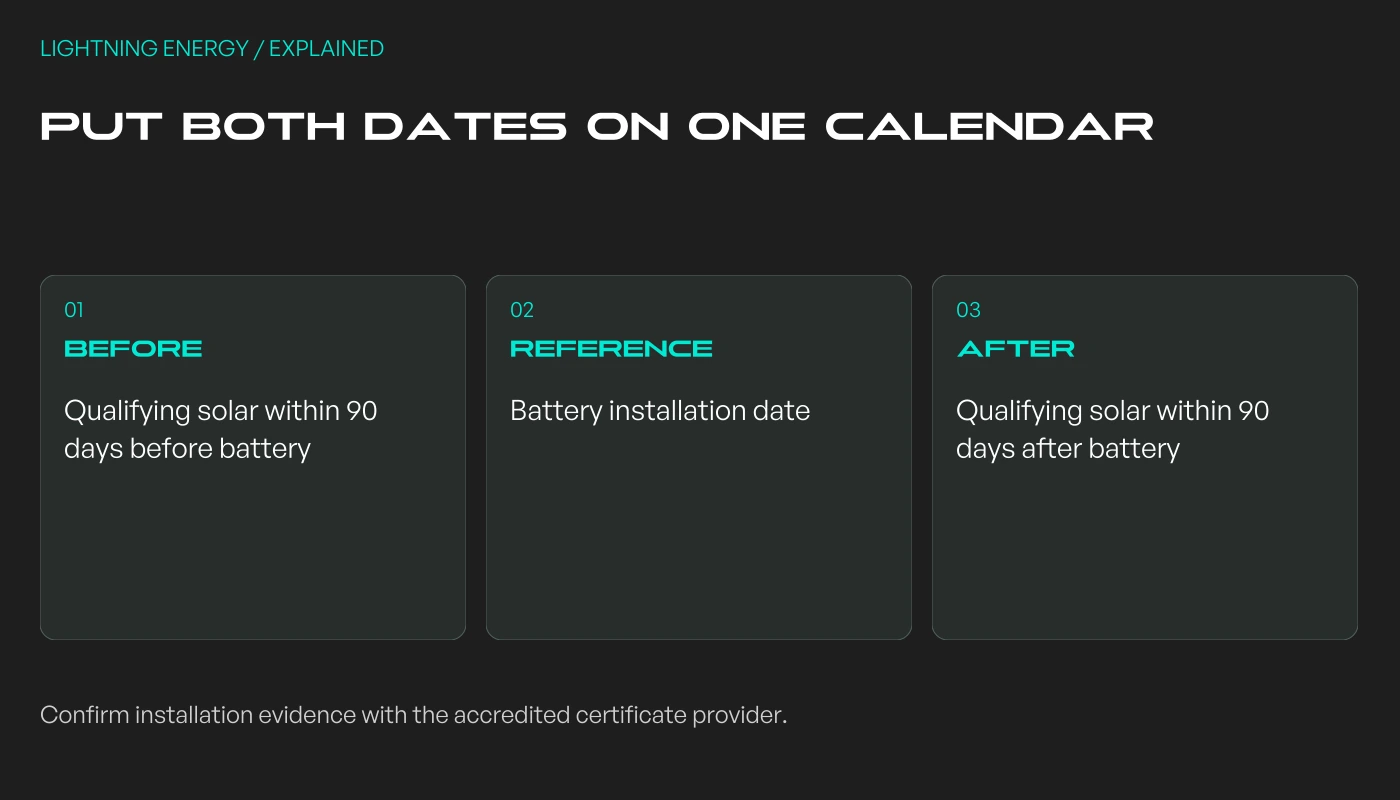
The NSW business battery programme offers a larger indicative discount when qualifying new or additional solar is installed within 90 days before or after the battery.
An existing solar system does not itself establish eligibility for that higher pathway.
The new solar capacity and the installation dates need to satisfy the applicable rules.
Treat the battery installation as the reference point.
Have the installer and accredited certificate provider confirm which completion records establish both dates.
A deposit, purchase order or expected delivery date is not a substitute for installation evidence.
Confirm installation evidence with the accredited certificate provider.
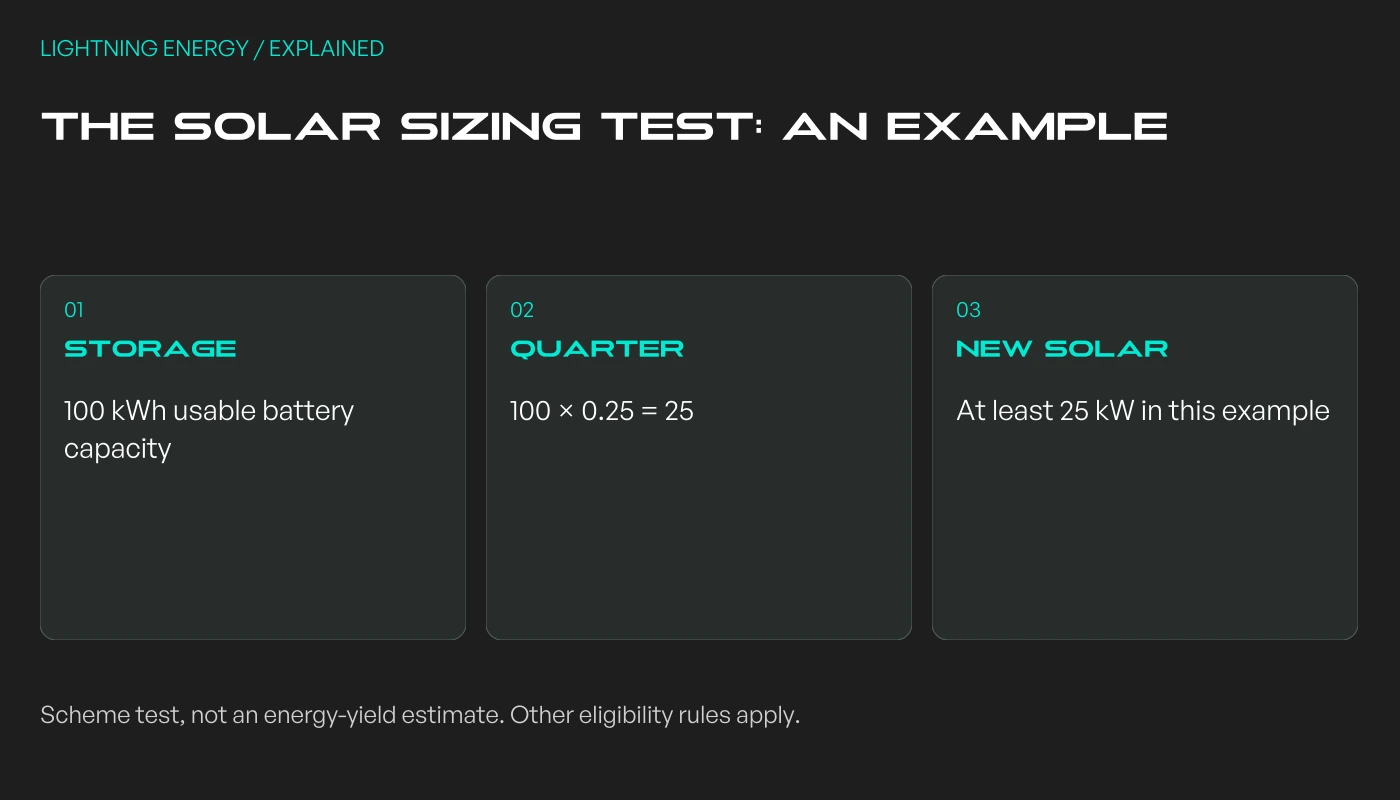
Solar PV capacity is expressed in kW and usable battery storage in kWh.
This is a scheme sizing test, not a claim that power and energy are interchangeable or that the panels generate a quarter of the battery's energy every hour.
For illustration, 100 kWh of usable battery capacity corresponds to a minimum 25 kW of qualifying new solar under this test.
Existing panels are not automatically counted as new capacity.
Ask the provider to show its calculation.
Scheme test, not an energy-yield estimate. Other eligibility rules apply.
Check the activity before ordering the equipment
IPART's scheme guidance distinguishes BESS4, above 20 kWh and up to 200 kWh usable capacity, from larger BESS5 systems.
A battery described as exactly 20 kWh is not automatically inside BESS4.
The same guidance identifies a $5,000 minimum payment per BESS4 implementation and requirements for approved equipment, installation and planning and network approvals.
Get the current fact sheet with the quote.
The rule also limits BESS4 usable capacity relative to inverter output.
The amount used in the incentive calculation can be capped separately.
Do not calculate your discount by multiplying a nameplate storage figure by an advertised dollar amount.
Your provider should identify the activity, exact equipment, usable capacity and incentive calculation in its written offer.
Check the whole installed price after the discount, including any electrical or building work.
Build a schedule that can survive a delay
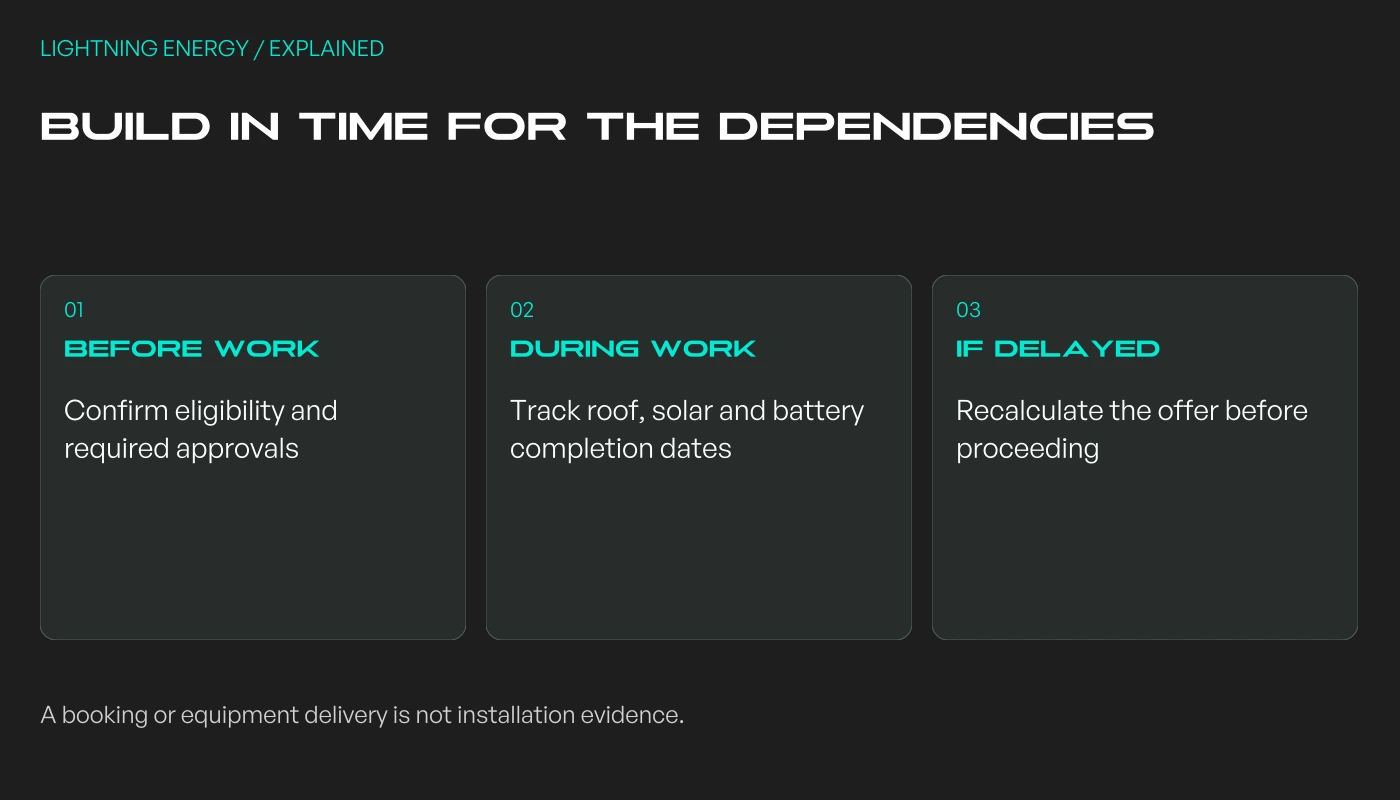
Draw up a shared programme for the roof work, network application, equipment delivery, solar installation and battery installation.
Assign one person responsibility for checking the incentive dates whenever the programme changes.
For example, if the roof needs repair after the battery date is booked, ask for the revised incentive calculation before agreeing to proceed.
The useful question is what the project costs under each achievable sequence.
Avoid placing either installation at the edge of the permitted window without contingency.
Weather, access restrictions and switchboard work can all disrupt a project.
A financial model should show the effect if the higher pathway is not met.
A booking or equipment delivery is not installation evidence.
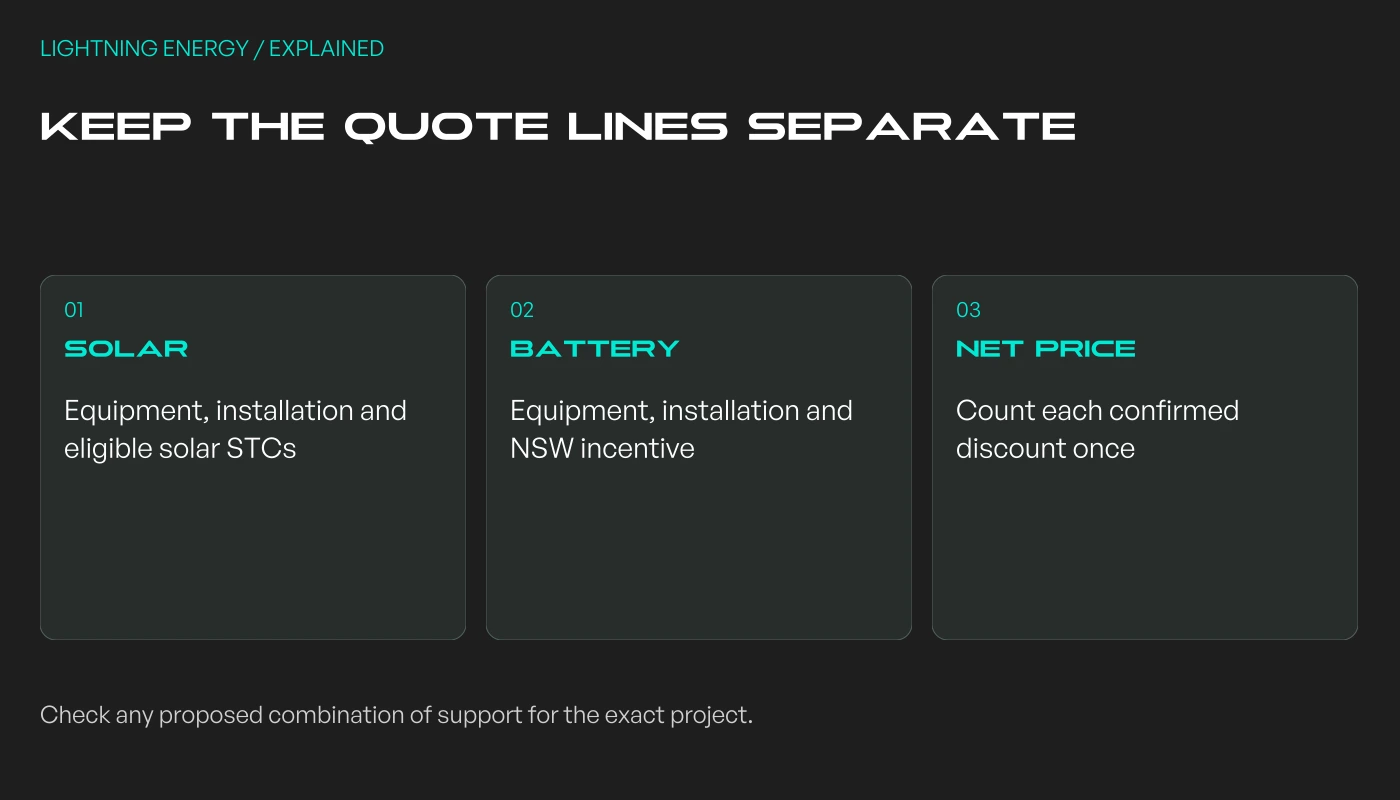
Keep solar support and battery support separate
Federal solar STCs and NSW battery incentives are different calculations. DCCEEW's mid-scale solar guidance covers eligible systems above 100 kW and no more than 1 MW installed from 1 October 2026.
That guidance includes site aggregation, approvals and other eligibility conditions.
Existing systems supported under the LRET remain under that scheme.
Do not assume an expansion receives support simply because its new panels are below 1 MW.
Reducing energy imports and reducing the billing demand peak are related but different objectives.
Ask what assumptions underpin each claimed saving.
Compare a battery-only option with the combined solar-and-battery design.
Include the full cost of the extra solar, approvals, maintenance and finance, then test lower savings and a delayed installation in the cash-flow model.
Before committing, ask for a dated project plan, confirmed scheme pathway and itemised net price.
Book a consultation and we'll map solar, storage, hot water, and the rebates around your bills and your goals.
Loading consultations…
Lightning EnergyPlan your next energy upgrade.
⚡
Hi, I’m Lightning Energy’s project guide. I’ll ask a few practical questions, explain what usually matters for your project, and help you decide on a useful next step — no guesswork or sales pressure.
First, what kind of property are we planning for?