
NSW Business Battery Discounts: Who Qualifies and What Changes the Quote?
NSW business battery discounts are available, but eligibility and a useful installation are separate questions. Here is how to assess the complete proposal.
NSW business battery discounts are available, but eligibility and a useful installation are separate questions. Here is how to assess the complete proposal.

NSW businesses have a new battery incentive to consider, but the useful question is the final installed offer for your site. A discount headline cannot tell you whether a battery suits your trading hours or electricity tariff.
This guide explains the scheme boundary and a practical way to compare proposals. It is a researched buying guide, not a claim that Lightning Energy has delivered a particular NSW project or secured a discount for your business.
The NSW Batteries for Businesses incentive opened on 1 September 2026. It supports eligible grid-connected business batteries from 20 kWh to 30 MWh, excluding residential buildings and data centres.
The state describes indicative discounts of 20–30% for battery-only installations and 30–40% with qualifying new solar. These are not guaranteed prices. Eligibility, equipment and installation conditions still apply.
Read the current NSW programme requirements.
Ask an installer offering the incentive to confirm the applicable pathway in writing.
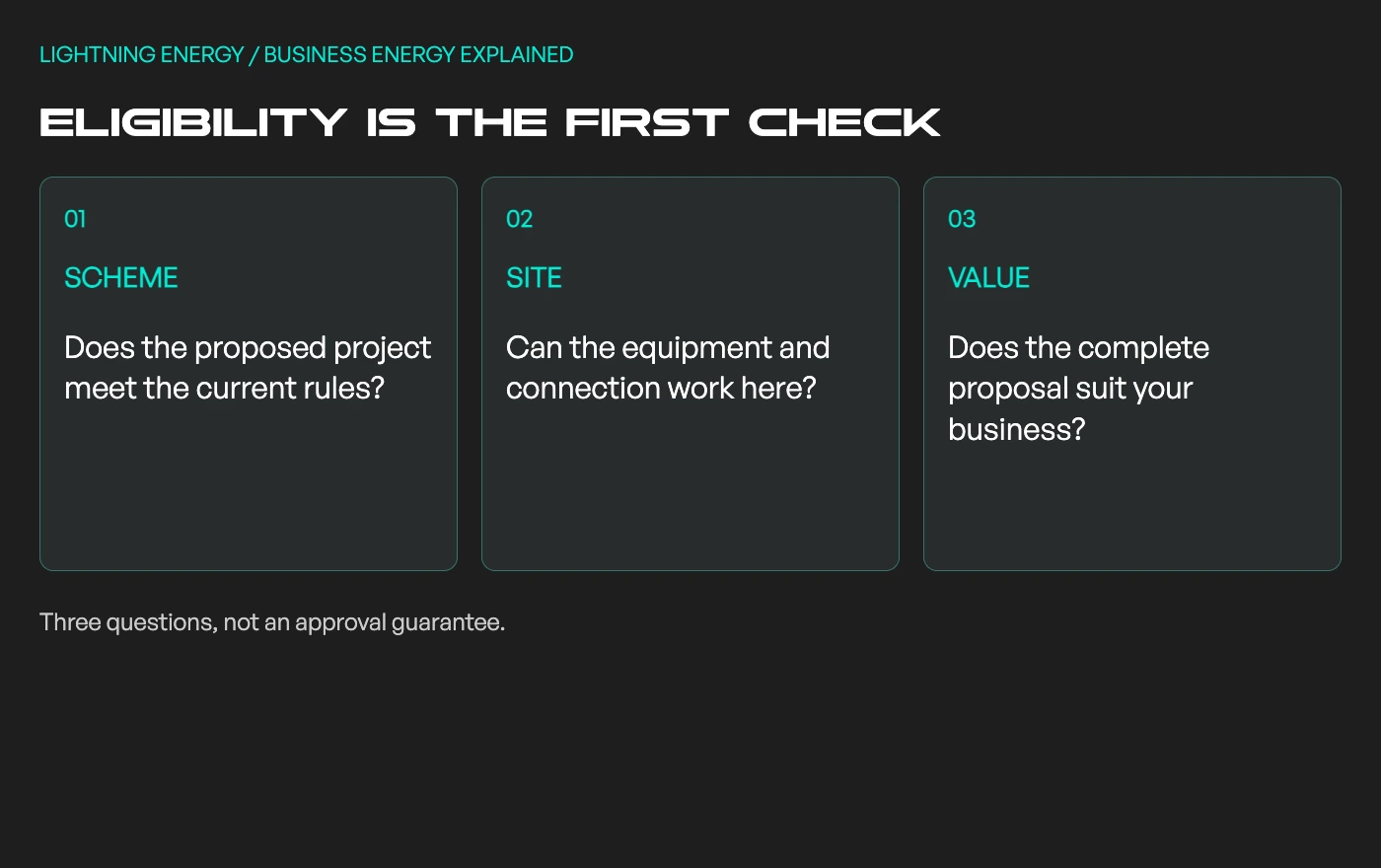
For the higher solar-linked discount, qualifying new or additional solar must be installed within 90 days before or after the battery.
Have the provider document the required sizing relationship; existing panels alone do not establish the higher rate.
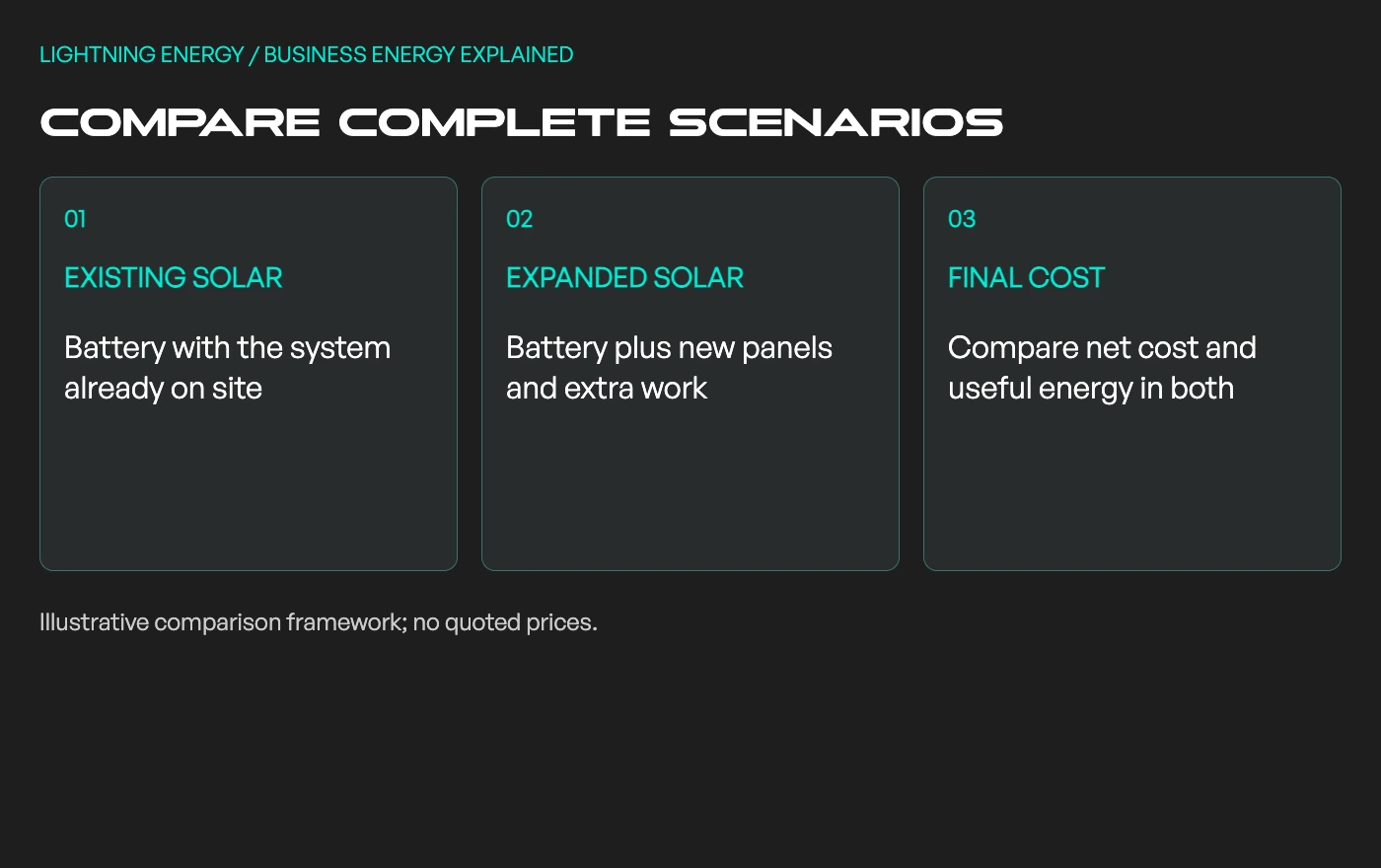
Compare two complete scenarios if new panels are proposed: the battery with the existing system, and the battery with an expansion. Include the extra equipment and connection work in the second scenario.
Adding panels only to improve the incentive can be a poor decision if the extra production has little useful destination. Ask what happens on quiet weekends and during seasonal closures as well as a normal working day.
Our commercial solar guide sets out the electricity data and installation details to assemble before requesting a proposal.
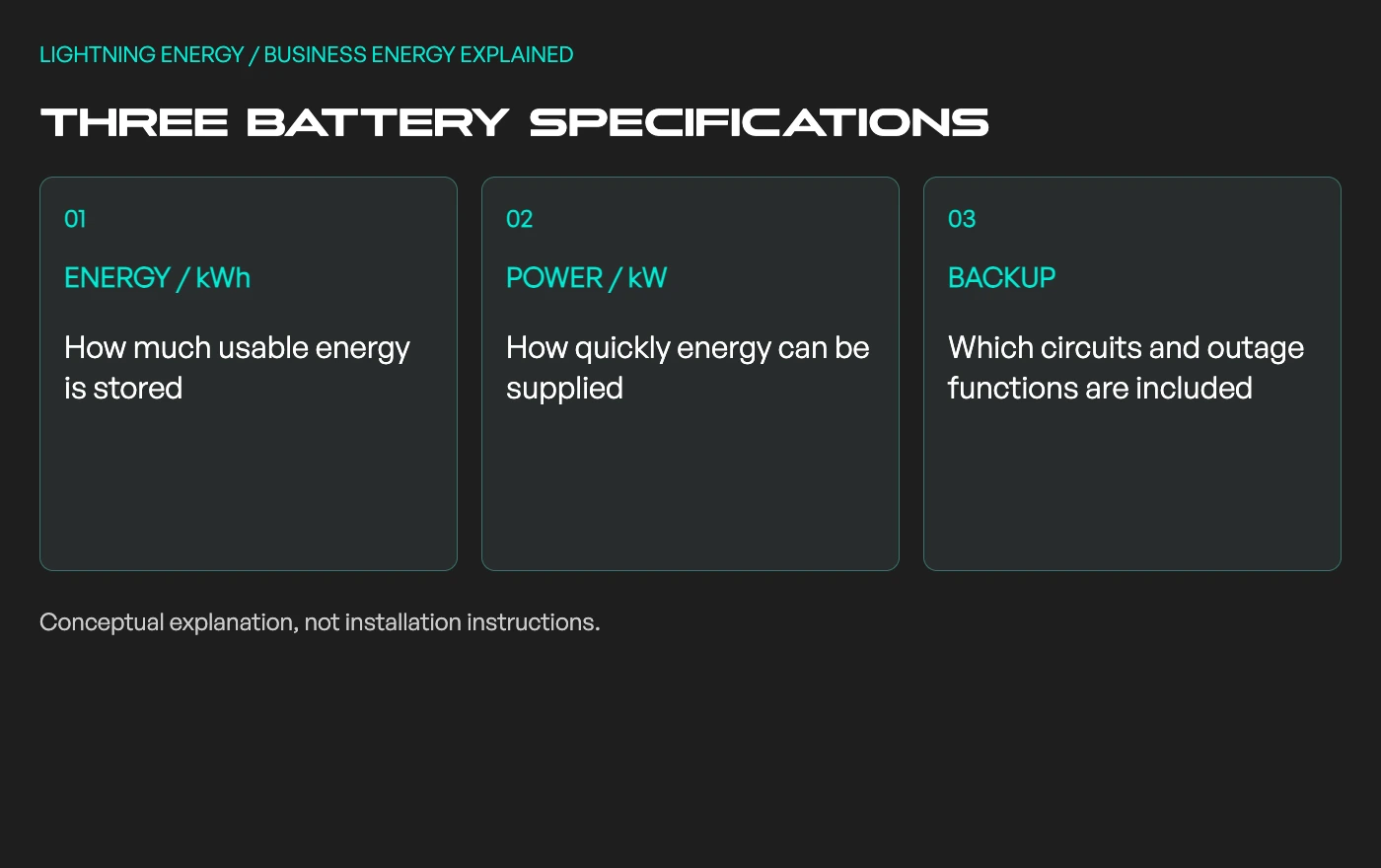
Energy capacity in kWh describes the energy stored. Power in kW describes the rate it can be supplied. A proposal should identify both, along with usable capacity and the proposed control strategy.
Imagine a hypothetical workshop whose largest load occurs as several machines start together. A large energy capacity alone does not show whether the battery can respond to that demand or reduce the relevant bill charge.
Ask the modeller to use your interval data and actual tariff. Show energy charges, demand charges and fixed charges separately. Compare the battery scenario with a realistic baseline that has no new storage.
If backup matters, identify the circuits and outage behaviour explicitly. A battery system does not provide a particular backup capability merely because the equipment can store energy.
Ask for equipment model numbers, installed scope, monitoring, switchboard work, connection requirements and exclusions. Put the gross price and each incentive on separate lines so the final amount payable is clear.
Combining state and federal support depends on satisfying both sets of rules. Do not simply add two advertised percentage discounts. Ask which certificate arrangements apply and who carries the risk if a claim is rejected.
Our solar and battery quote guide explains why usable storage and included hardware are better comparison points than the battery box price alone.
Record any commissioning deadlines and required approvals. If the project changes, ask whether the equipment, timing or capacity change also affects the incentive assessment before accepting the variation.
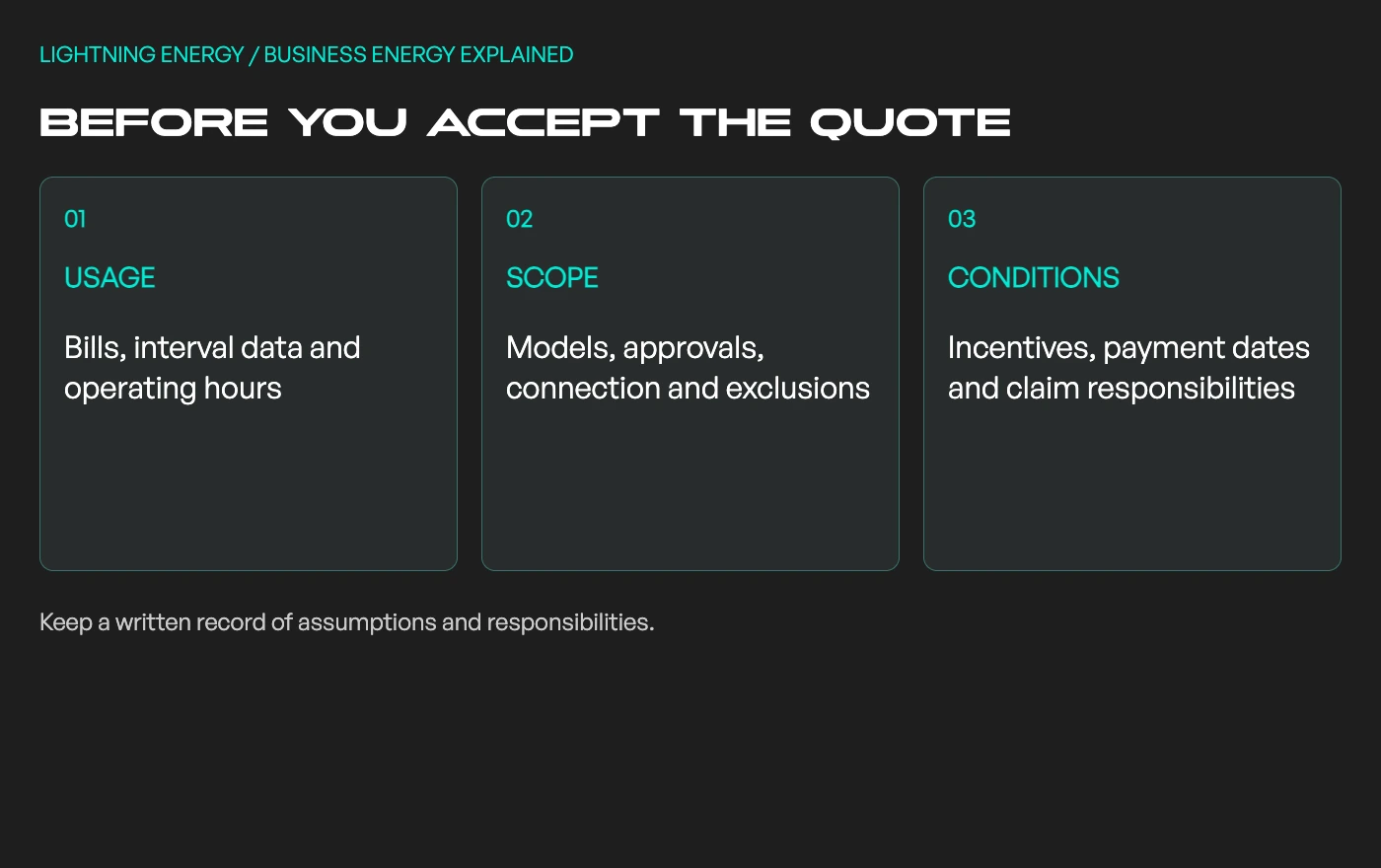
Collect recent bills, interval data, operating hours and planned load changes. Include roof ownership or lease constraints, existing solar details and the reason you want storage, such as shifting energy or specified backup.
Send the same information to each provider. This makes differences in the proposed equipment and modelling easier to investigate instead of comparing unrelated package prices.
The discount can improve a suitable project. The decision still rests on the site, operating plan, final cost and support arrangements.
Keep our commercial solar modelling guide beside the proposal.
Make the proposal easier to assessTalk to Lightning Energy about your energy plans. Confirm service availability and the relevant incentive pathway for your site before proceeding.Research checked 14 October 2026. Programme terms and provider offers can change. Follow the linked official requirements and obtain a project-specific eligibility assessment.
Available times
Book a consultation and we'll map solar, storage, hot water, and the rebates around your bills and your goals.
Question 1 of 6
