
Paying Cash or Financing a Home Battery: Compare the Total Cost
Compare paying cash and financing a home battery using total repayments, fees and contract terms, while keeping uncertain bill savings separate from commitments.
Compare paying cash and financing a home battery using total repayments, fees and contract terms, while keeping uncertain bill savings separate from commitments.

Compare cash and finance against the same installed battery proposal. Then compare the total amount paid, when it leaves your account and which obligations remain if the battery saves less than expected.
A manageable monthly repayment can still produce a higher total cost. Conversely, using all available cash may leave too little flexibility for the household. The equipment decision and the funding decision both deserve attention.
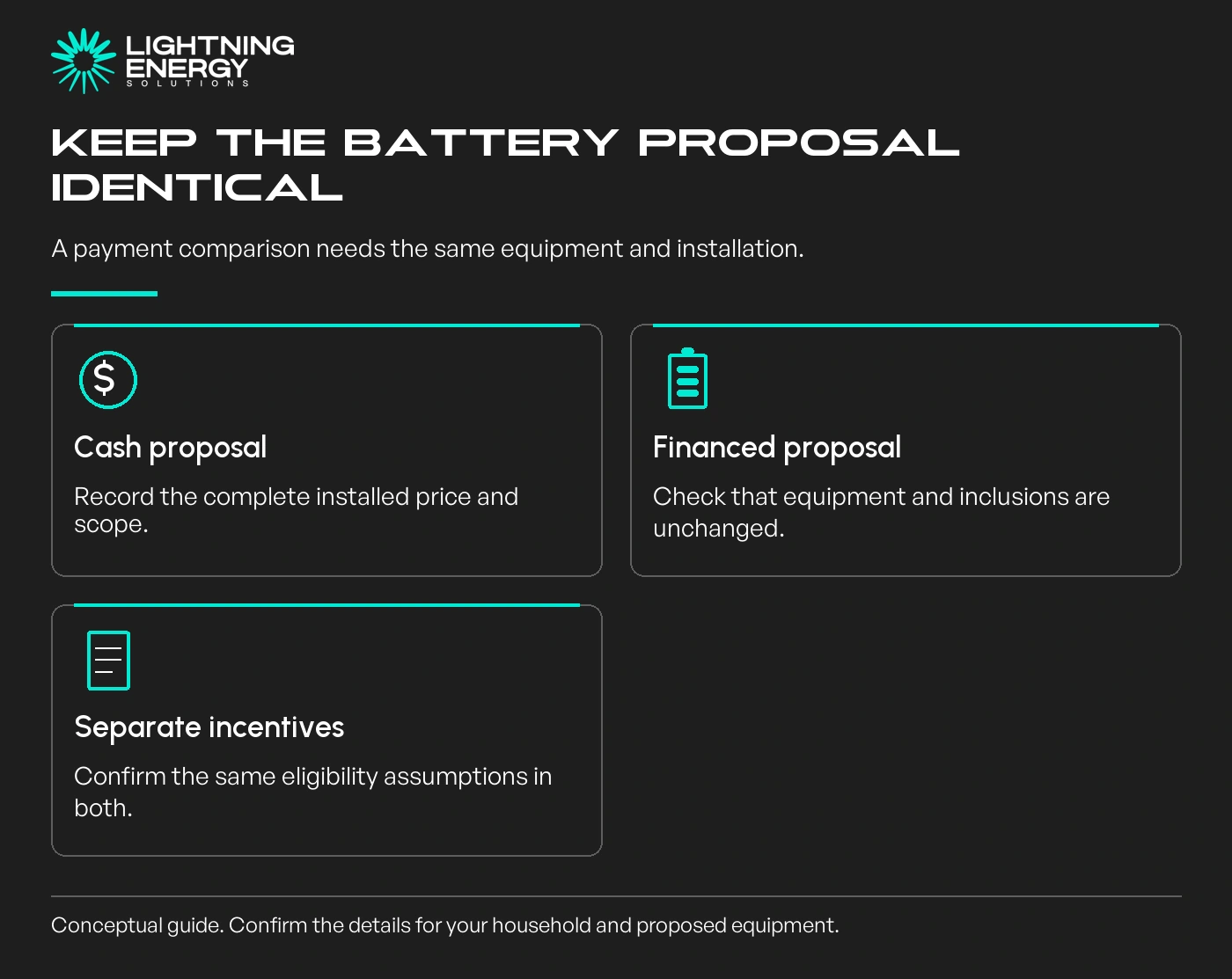
Request a written cash price and a written financed price for identical equipment and work. Confirm the same backup scope, electrical work, warranties and proposed incentives in each version.
Our battery quote checklist helps prevent a payment comparison from hiding a changed system. If one offer includes different equipment, resolve that difference first.
Check whether the displayed deposit reduces the amount financed and whether any establishment fee is paid immediately or added to the balance. Put all payments on the same timeline, including a final payment if one applies.
ASIC Moneysmart recommends checking interest, fees, loan term and repayment conditions. A longer term may reduce regular repayments while increasing the total cost. A comparison rate is tied to stated assumptions.
Moneysmart personal loan guidance.
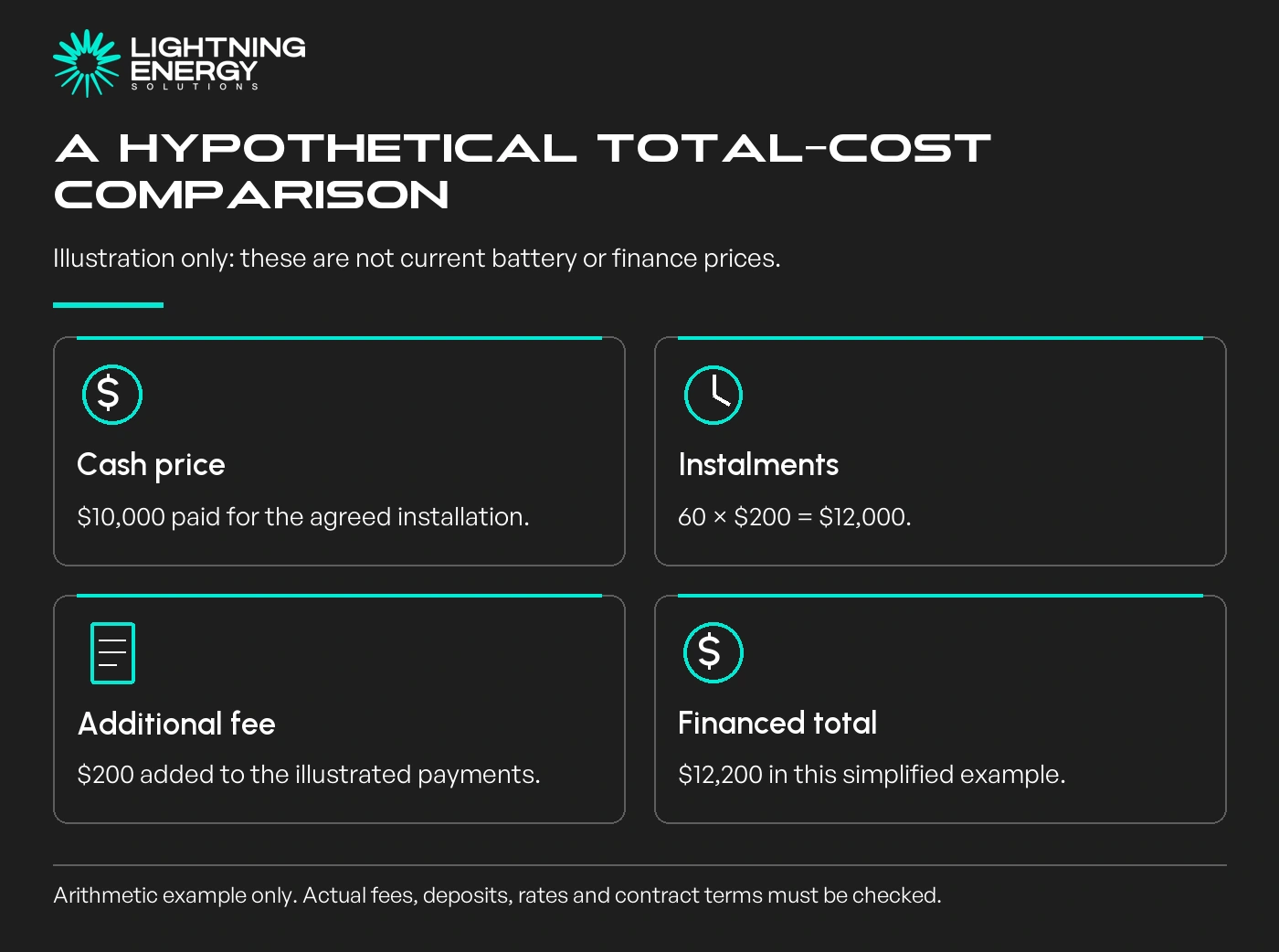
For a hypothetical illustration, a $10,000 cash purchase differs from 60 payments of $200 plus a $200 fee. The latter totals $12,200. Those figures are arithmetic only, not a current battery price or finance offer.
Ask the provider to disclose its own total payable and schedule. Include any deposit without counting it twice. For variable-rate finance, check how a change in rates would affect repayments or the total cost.
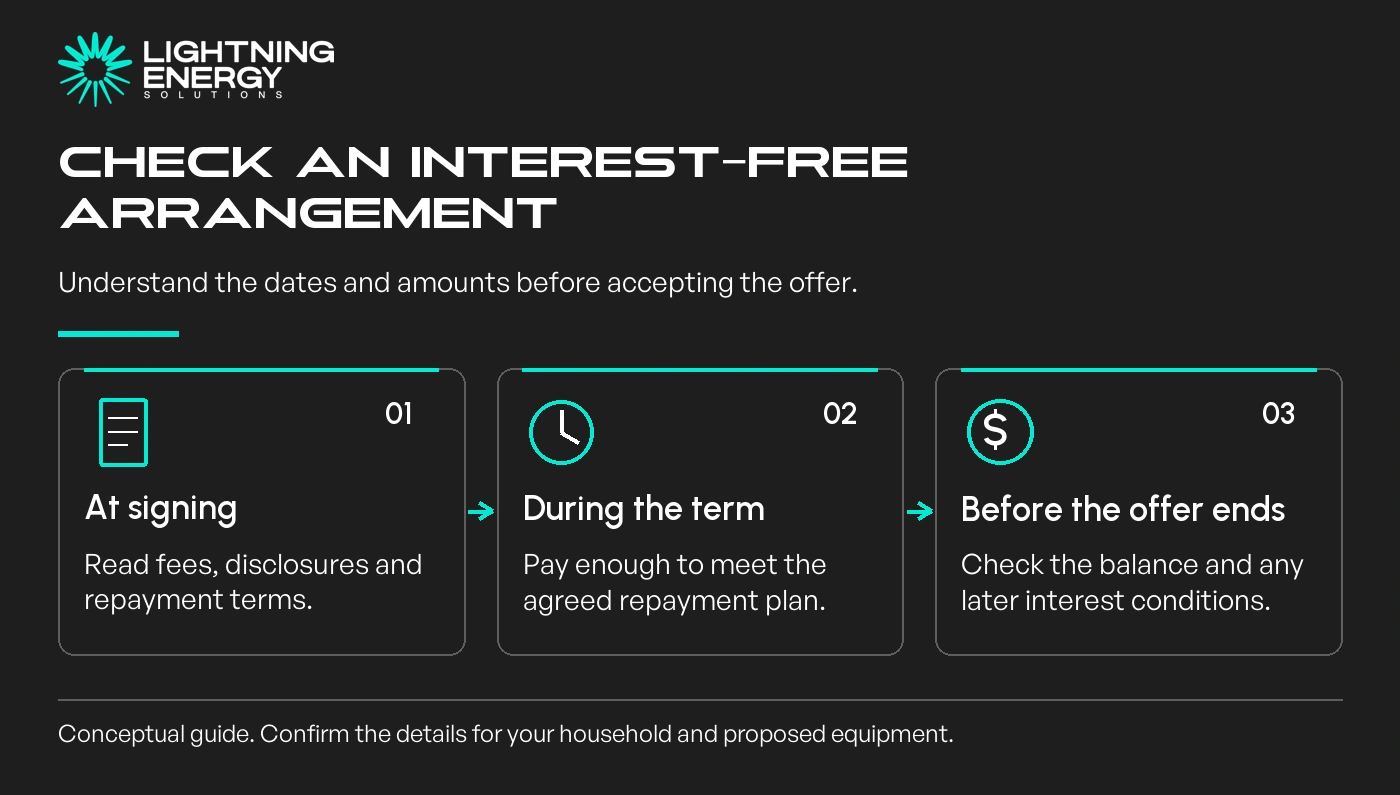
Interest-free does not necessarily mean fee-free. Moneysmart explains that fees can apply and that minimum repayments may leave a balance when the interest-free period ends. Read the relevant facts sheet and payment conditions.
Moneysmart interest-free guidance.
Find the date the promotional period finishes, the payment needed to clear the balance and the rate applying afterward. Also check late-payment conditions and whether extra repayments or early settlement attract a charge.
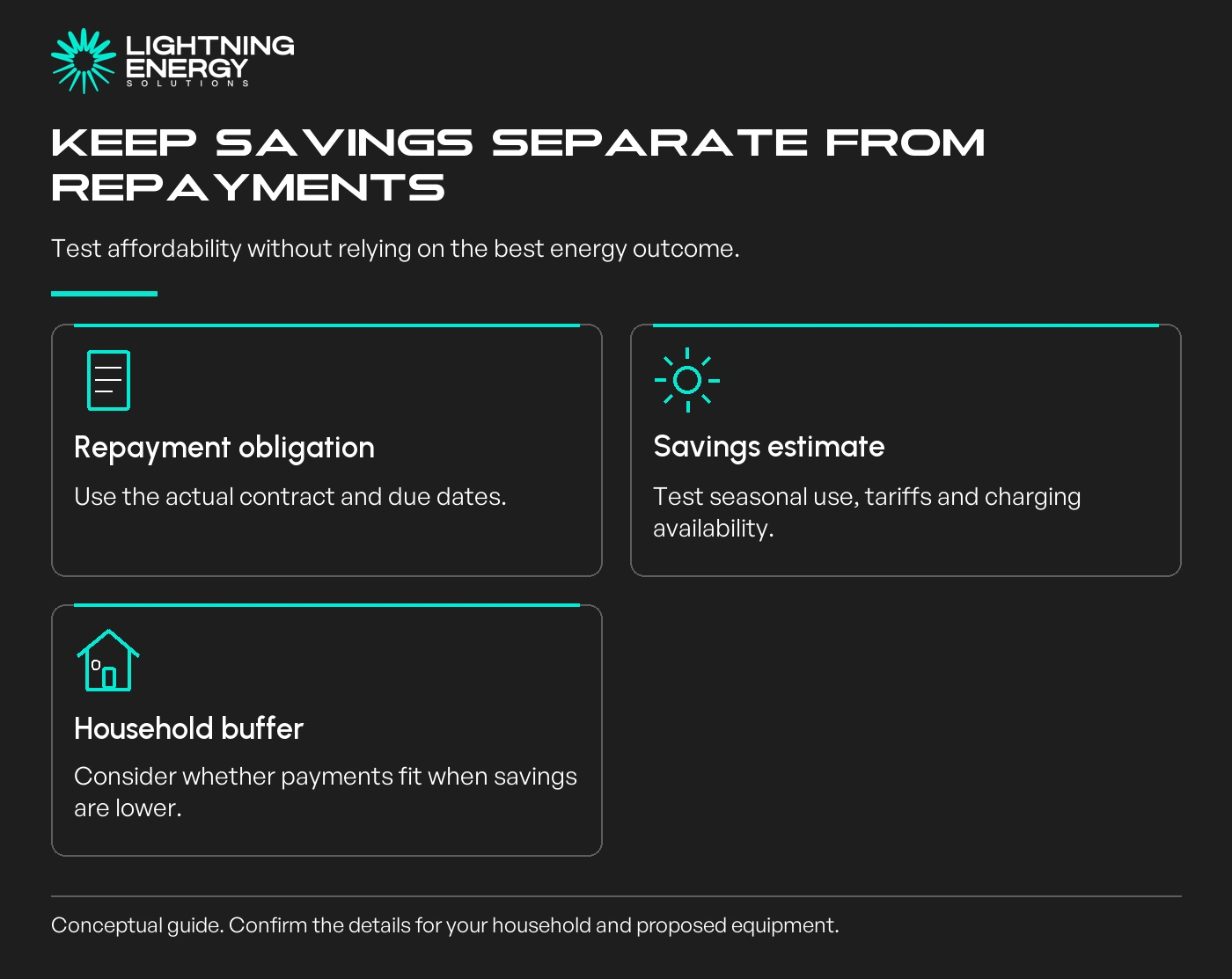
Do not rely on a future reminder to make the arrangement affordable. Put the repayment dates beside ordinary household commitments and test whether the payments still fit without unusually strong energy savings.
A finance repayment is a contractual commitment. Battery savings depend on energy use, tariffs, operation and available charging energy. An estimate that averages annual savings does not tell you what happens in a low-solar winter month.
Use the battery value guide as a starting point, then request a household-specific calculation. Compare a cautious savings case with the required payments.
If the proposal works only when every favourable assumption holds, consider a smaller installation, a later purchase or suitable daytime load shifting. Financing does not turn an unsuitable battery into a useful one.
Check the lender, fees, security arrangements, early-exit conditions and what happens if installation is delayed or changed. Ask who handles a dispute about the equipment and who handles the finance agreement.
Review the installed battery cost guide alongside the finance disclosure. The purchase should make sense at its complete price before a payment plan is selected.
This is a general comparison framework, not a recommendation for a loan. If the repayment decision is difficult, allow time for independent financial guidance rather than signing during the equipment sales conversation.
Plan your battery upgradeAsk Lightning Energy for a clear installed scope and price that you can compare consistently across your preferred payment options.Available times
Book a consultation and we'll map solar, storage, hot water, and the rebates around your bills and your goals.
Question 1 of 6