
RedEarth Energy Storage Administration: What Battery Owners Need to Know
RedEarth administration reports explained: company background, warranties, existing batteries, undelivered orders and practical next steps for Australian customers.
RedEarth administration reports explained: company background, warranties, existing batteries, undelivered orders and practical next steps for Australian customers.

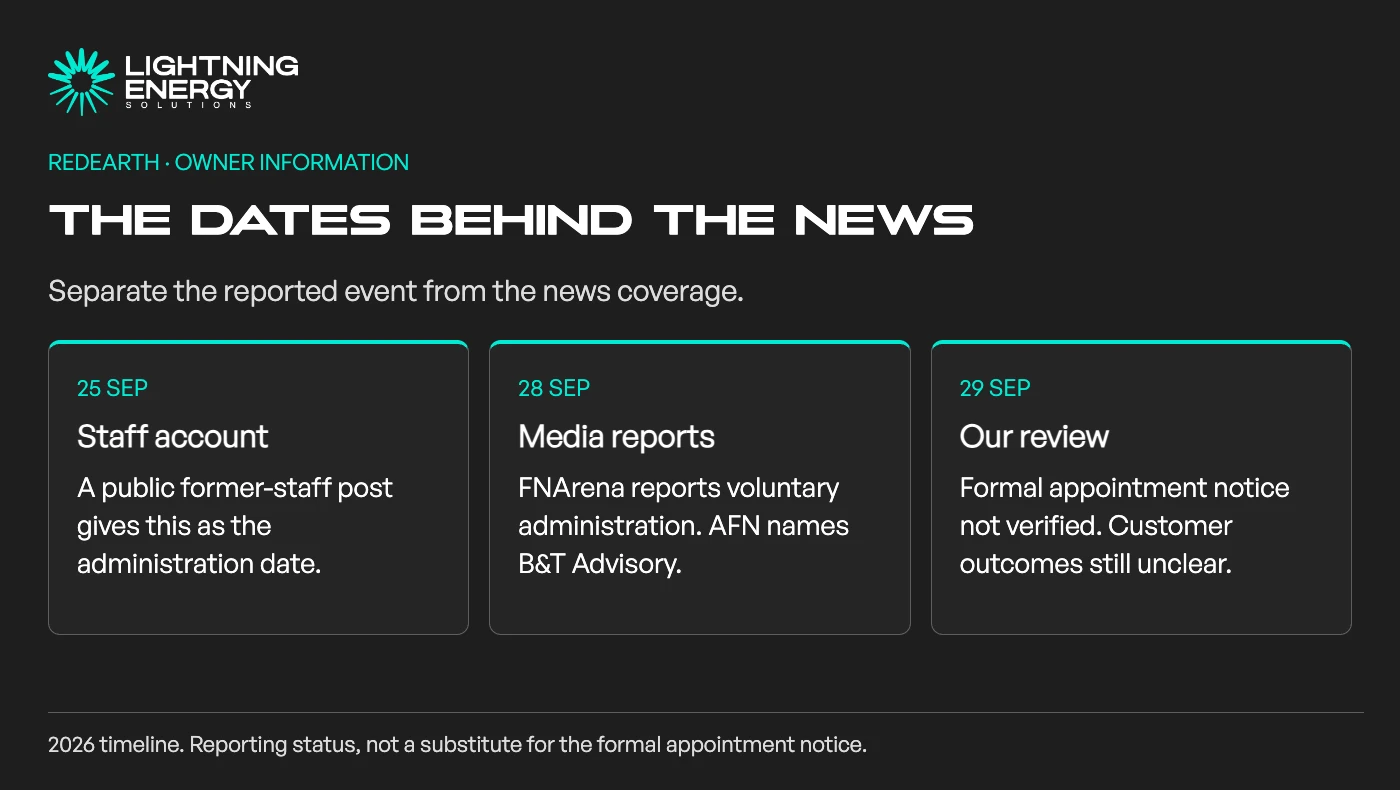
RedEarth Energy Storage has reportedly entered voluntary administration, raising questions for Australian battery owners, installers and customers waiting for equipment. The news was reported on 28 September 2026.
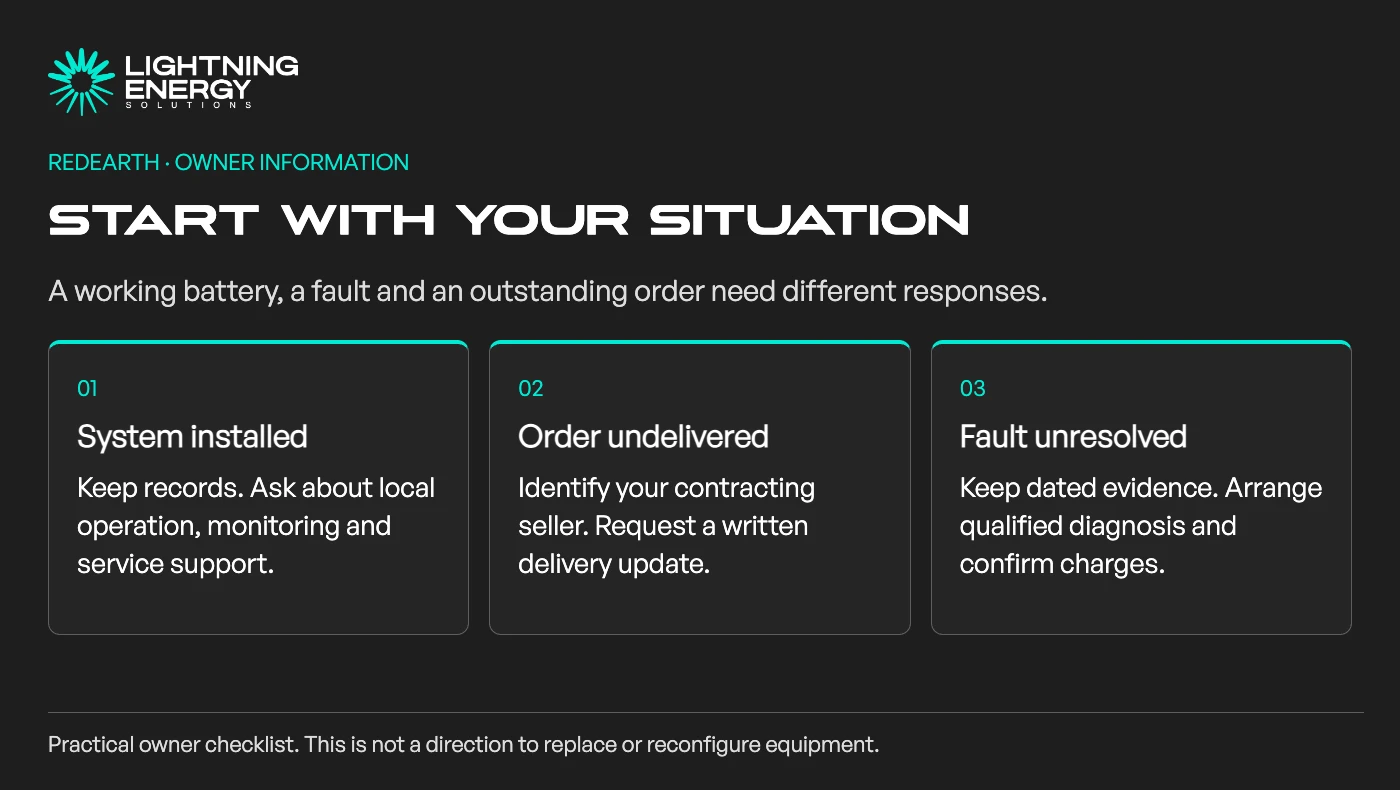
If you own a RedEarth system, I would start with your paperwork and the support arrangements for your exact installation. The administration news alone does not establish that your battery needs replacing.
This article was checked on 29 September 2026. It separates published reporting from confirmed company background and explains the questions that still need answers.
FNArena’s 28 September market report says RedEarth Energy Storage entered voluntary administration after financial difficulties and pressure from imported batteries.
Australian Financial News names Brisbane firm B&T Advisory as administrator.
It explicitly attributes its reporting to Australian Financial Review Street Talk.
That report describes serious cash-flow pressure and competition from lower-priced imported residential batteries. It also reports discussions with a potential buyer, without an agreed transaction or assurance that a sale would proceed.
Those are attributed media reports, not findings from an administrator’s investigation. A sale discussion is not a completed rescue, and a reported business difficulty does not establish a product defect.
A public post shared on former RedEarth staff member Jeremy Pearce’s profile gives Friday 25 September as the administration date. That is earlier than Monday’s news coverage.
The formal appointment notice and a creditor circular were not available for verification during preparation of this article. The reported date and administrator should therefore be treated as reported details pending that documentation.
RedEarth is a Brisbane energy-storage business, with a broader role than installing rooftop panels. Its website describes battery systems, energy-management software and solutions for homes, farms and commercial sites.
According to its company history, Charlie Walker, Chris Winter and Bruce Ebzery founded the business in 2013. Its published address is in Darra, Queensland.
ABN Lookup identifies Red Earth Energy Storage Limited, ABN 34 163 828 920 and ACN 163 828 920.
Match the entity on your contract, rather than relying on a trading name alone.
The published range includes Troppo batteries and systems such as BlackMax, Gecko, BushChook and Dingo. These names cover different applications and generations; they should not be treated as one interchangeable battery product.
RedEarth’s Yarra Valley case study describes a Dingo project with ProFX and Atrics Electrical.
The cover photograph comes from that case study. It shows an existing RedEarth project, not a Lightning Energy installation or evidence of any fault at the site.
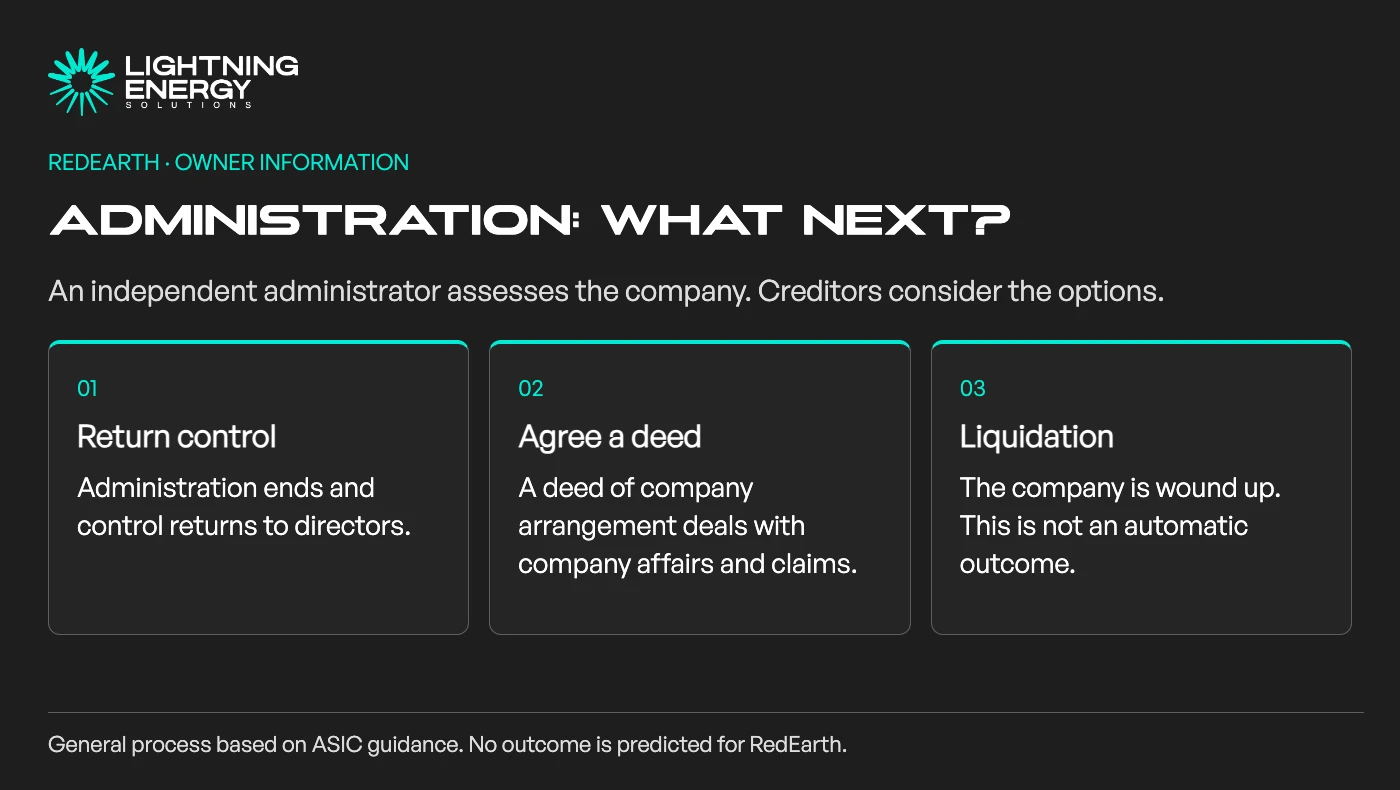
Voluntary administration is the relevant company process described in the reports. Calling it bankruptcy can obscure what is actually happening, while liquidation is a possible outcome rather than an automatic result.
An independent administrator takes control and investigates the company’s position.
Creditors can ultimately decide to return control to directors, approve a deed of company arrangement or wind up the company. A deed is an agreed arrangement dealing with the company’s affairs and creditor claims.
There is no verified basis here for saying every RedEarth warranty has been cancelled, or that every future claim will be paid. The practical outcome needs the administrator’s position and the documents for the particular system.
Separate the battery manufacturer’s warranty, any inverter warranty, installation workmanship and your contract with the seller. The business that sold your system may be different from the manufacturer.
The ACCC explains that insolvency can affect warranty and consumer-guarantee remedies.
Outcomes can change if trading continues or a buyer takes over selected liabilities.
Ask your original retailer to put the current service pathway in writing. Record who can diagnose the system, source parts and authorise work, and whether any visit involves a charge. Keep replies with the original warranty documents.
For wider context, our battery quote checklist explains why service responsibilities belong alongside the equipment list.
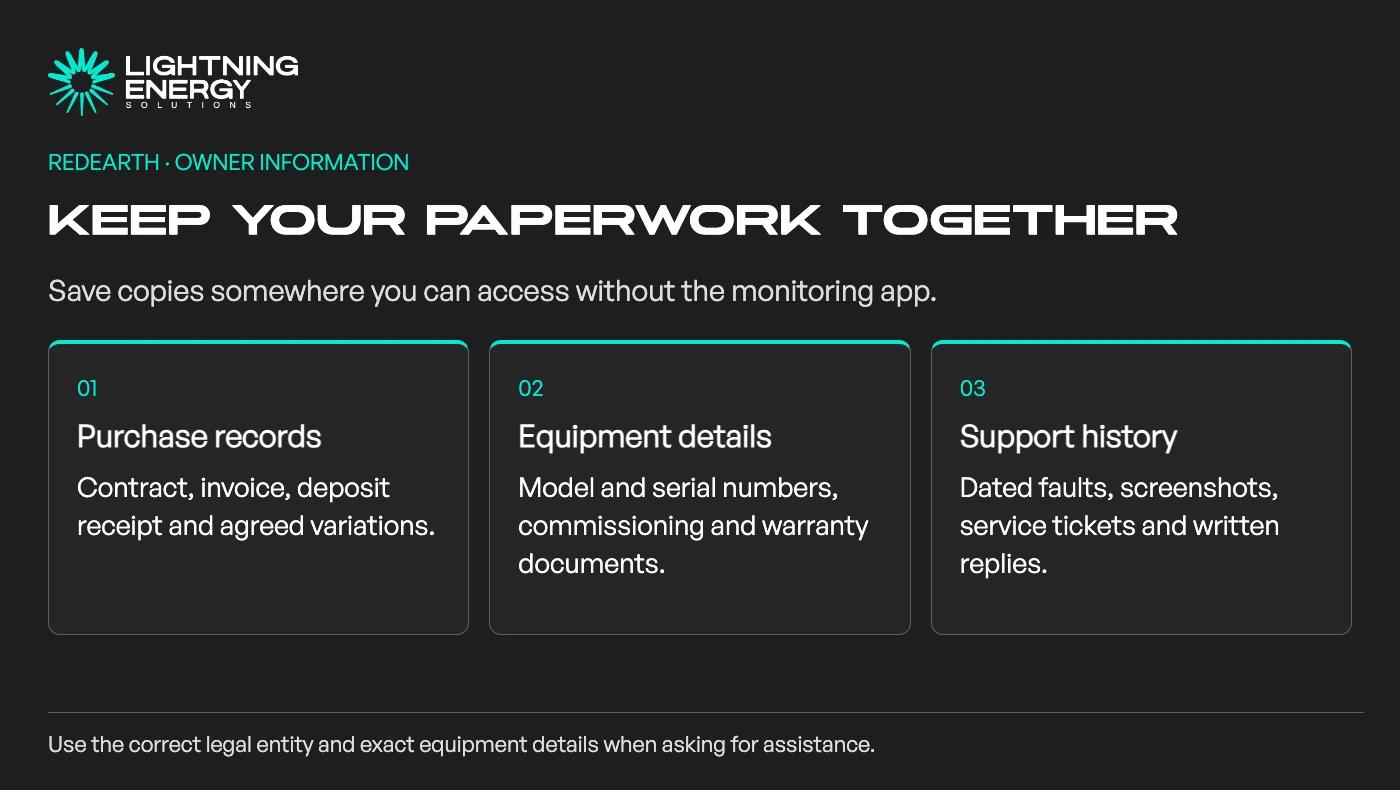
Save your invoice, contract, commissioning documents, model numbers, serial numbers and warranty registration. Keep copies of existing support tickets and dated screenshots of any faults or monitoring problems.
A working installation does not become a confirmed technical failure because of a corporate announcement. Equally, continued app access today does not guarantee the future of cloud monitoring, remote support or replacement parts.
Ask the installer which functions operate locally and which depend on an online service. For an off-grid property, make the support and contingency discussion a priority because the home may rely on the system for its electricity supply.
Do not open equipment or change installer settings to test a theory from social media. Faults need an appropriately qualified technician.
Our blackout backup guide explains why backup arrangements vary.
Find out who received the money and who agreed to supply the equipment. A deposit paid to an independent installer is a different starting point from a payment made directly to the company in administration.
Ask the seller for written confirmation of stock, delivery and installation arrangements before agreeing to changed payment instructions or a substitute product. Keep the original scope and every variation.
The ACCC says customers owed money may be unsecured creditors and recover only part of their payment, or nothing. A card or payment provider may be able to reverse some payments; time limits apply, so contact it promptly.
For a direct claim against the affected company, obtain the administrator’s verified instructions about registering a claim. This is general consumer information; a disputed contract may need individual legal advice.
RedEarth announced an ambibox partnership on 18 November 2024 to manufacture bidirectional EV chargers in Queensland.
Its original announcement included planned 2025 availability.
That historical timetable is not evidence of current stock, approvals or delivery. This review did not establish the present outcome for that project. Nor did it establish that the charger programme caused the administration.
If you have an order involving vehicle-to-home or vehicle-to-grid functions, get a written update covering the exact hardware, compatible vehicle, installation requirements and support arrangements.
Our EV charging information is a starting point for understanding the equipment involved, but it should not be read as confirmation that a particular RedEarth order can be completed.
I would avoid a rushed replacement purchase based on a headline. First establish whether you have an actual equipment problem, an unresolved order or uncertainty about future support. Those need different responses.
The wider lesson for a home battery purchase is to compare the complete support arrangement as well as capacity and price. No brand, country of origin or warranty headline removes business risk.
At publication, warranty handling, outstanding deliveries, long-term software support and any sale outcome remained unconfirmed in the material reviewed. A future administrator’s notice should carry more weight than speculation.
Need help understanding your system?If you are in Melbourne, send Lightning Energy the model details and a short description of the issue. We can discuss whether an assessment is within our scope. We are not RedEarth’s administrator and cannot promise warranty cover or refunds.Available times
Book a consultation and we'll map solar, storage, hot water, and the rebates around your bills and your goals.
Question 1 of 6