
Steady Heating or Timed Sessions: Finding a Schedule That Suits Your Home
Compare steady heating with timed sessions using occupancy, comfort, weather and electricity records, without assuming one schedule suits every home.
Compare steady heating with timed sessions using occupancy, comfort, weather and electricity records, without assuming one schedule suits every home.

There is no single heating schedule that is cheapest and most comfortable for every Melbourne home. Start with when rooms are occupied, how quickly they lose warmth and the tariff applying while the system runs.
A measured comparison can help. It should protect the household’s comfort and compare similar days, rather than declare a winner after one mild day and one cold night.
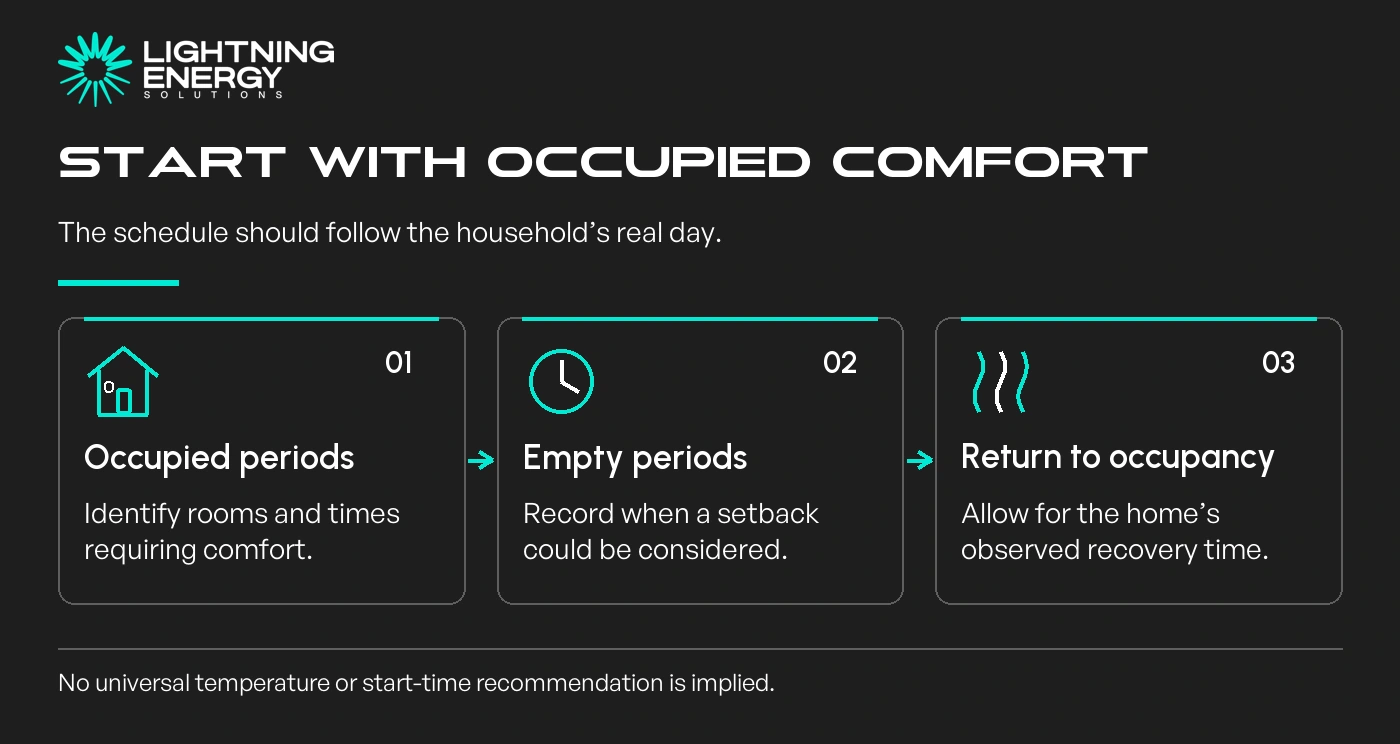
Mark when each room needs to be comfortable, including anyone home during the day or sleeping at different hours. A house empty for eight hours has a different brief from one occupied continuously.
Choose acceptable comfort for the people using those rooms. Do not frame an uncomfortably cold home as a successful energy experiment, particularly where occupants need more consistent conditions.
Ask your air conditioning installer which owner scheduling functions and zone combinations are supported. Make the trial within those limits rather than changing installer configuration.
The government’s smart-home guidance links useful thermostat scheduling to household routines, room use and compatible equipment.
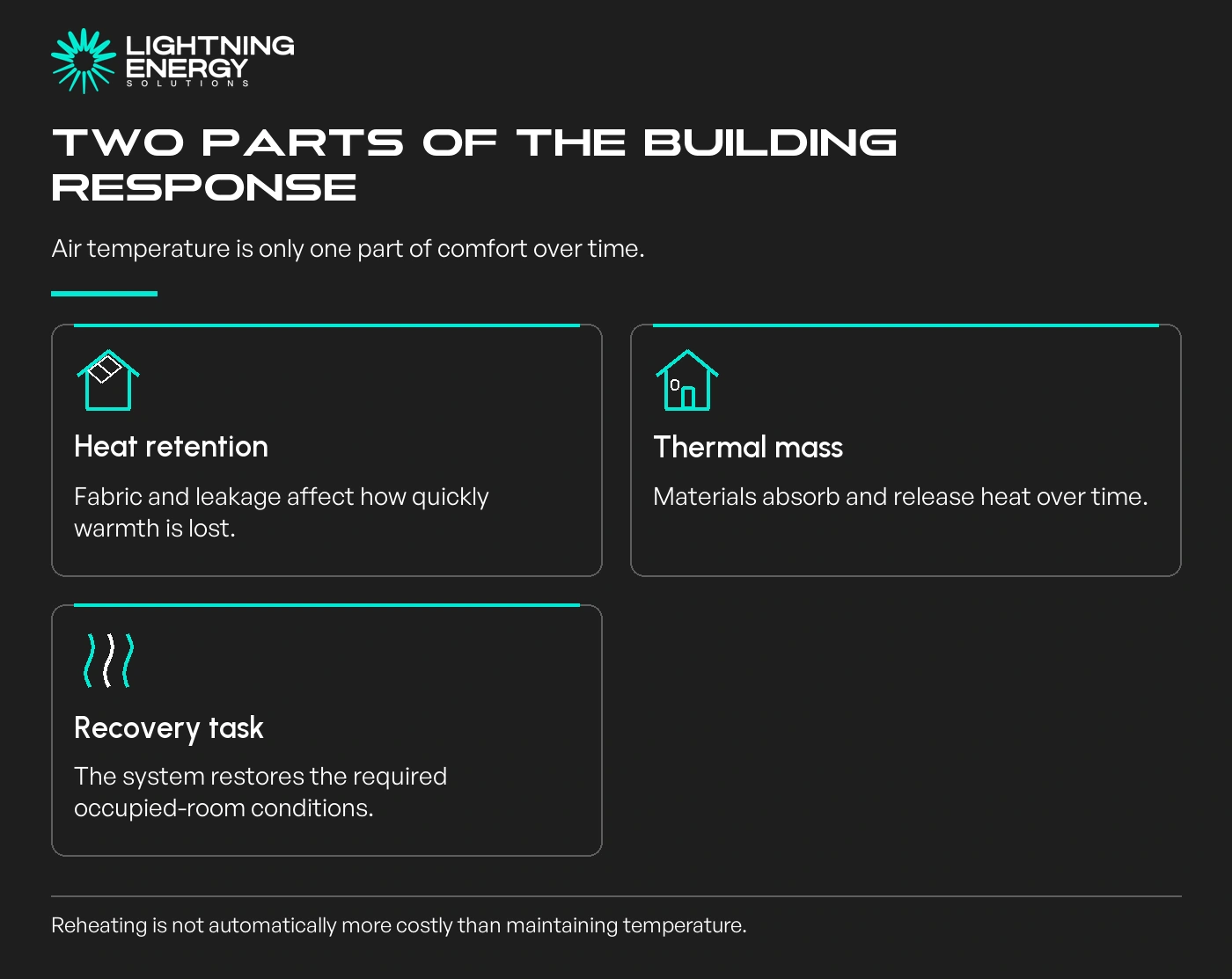
While a heated home is warmer than outside, it loses heat through its fabric and air exchange. Insulation and draught control affect that process, so two homes can cool down at different rates after heating stops.
Thermal mass affects how heat is stored and released. A quick change in air temperature does not necessarily mean all the building’s surfaces have reached the same condition.
YourHome explains thermal mass.
Maintaining a temperature during an empty period supplies heat that may not be needed for immediate comfort. Turning heating down changes the later recovery task. Neither observation alone calculates the overall bill.
Avoid the blanket claim that reheating always uses more energy than maintaining temperature. Also avoid promising that a long off-period will suit every building or occupant.
For an illustrative workday trial, compare the normal schedule with a modest setback while the house is empty, followed by a planned return to the usual comfortable setting before occupancy.
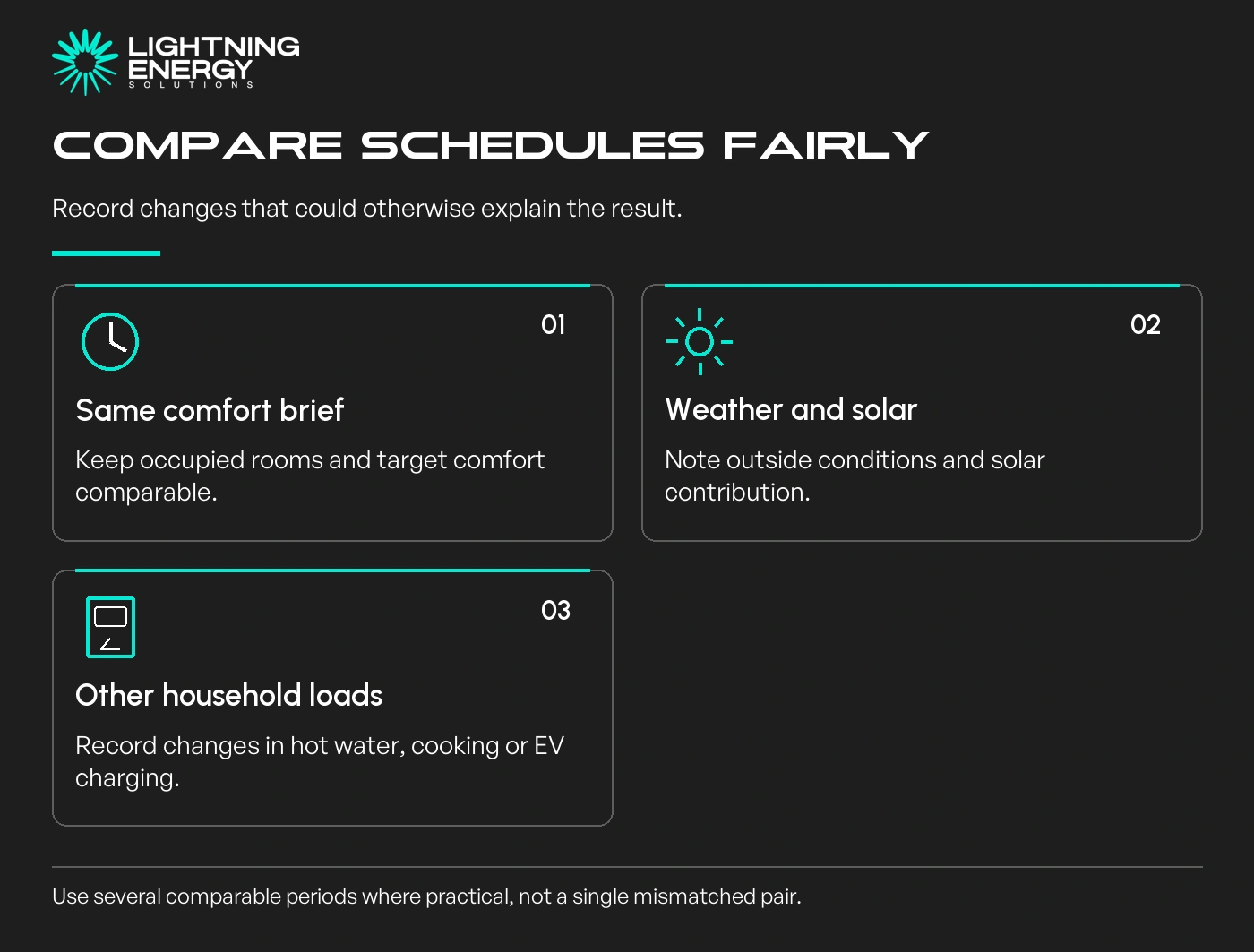
Record the same occupied rooms, set points and arrival time. Note how long recovery takes and whether anyone is uncomfortable. Change one part of the routine at a time.
Use several reasonably comparable days where possible, recording outdoor conditions and other large appliance use. Whole-house imports alone cannot isolate heating if EV charging or hot water also changes.
If solar contributes, record generation and exports as well as imports. A sunnier comparison day can make a schedule look better without proving the schedule caused the difference.
Use actual tariff periods when comparing cost. Lower energy consumption and lower operating cost are related questions, but a time-of-use plan can make the timing matter too.
Keep the option that provides acceptable comfort with a routine the household can use consistently. A complicated programme that nobody understands is unlikely to remain the operating plan for long.
If recovery is too slow, discuss an earlier start or a smaller setback before raising the occupied set point far above the desired temperature. Follow the normal controls and manufacturer instructions.
Where a room loses comfort quickly, consider the building assessment within your home upgrade sequence. Scheduling cannot replace missing insulation or repair a duct fault.
Government insulation guidance distinguishes heat-flow control, unwanted leakage and required ventilation.
Do not replace a working controller before testing the useful functions it already offers. If the schedule works and comfort is good, more automation is optional rather than an automatic next purchase.
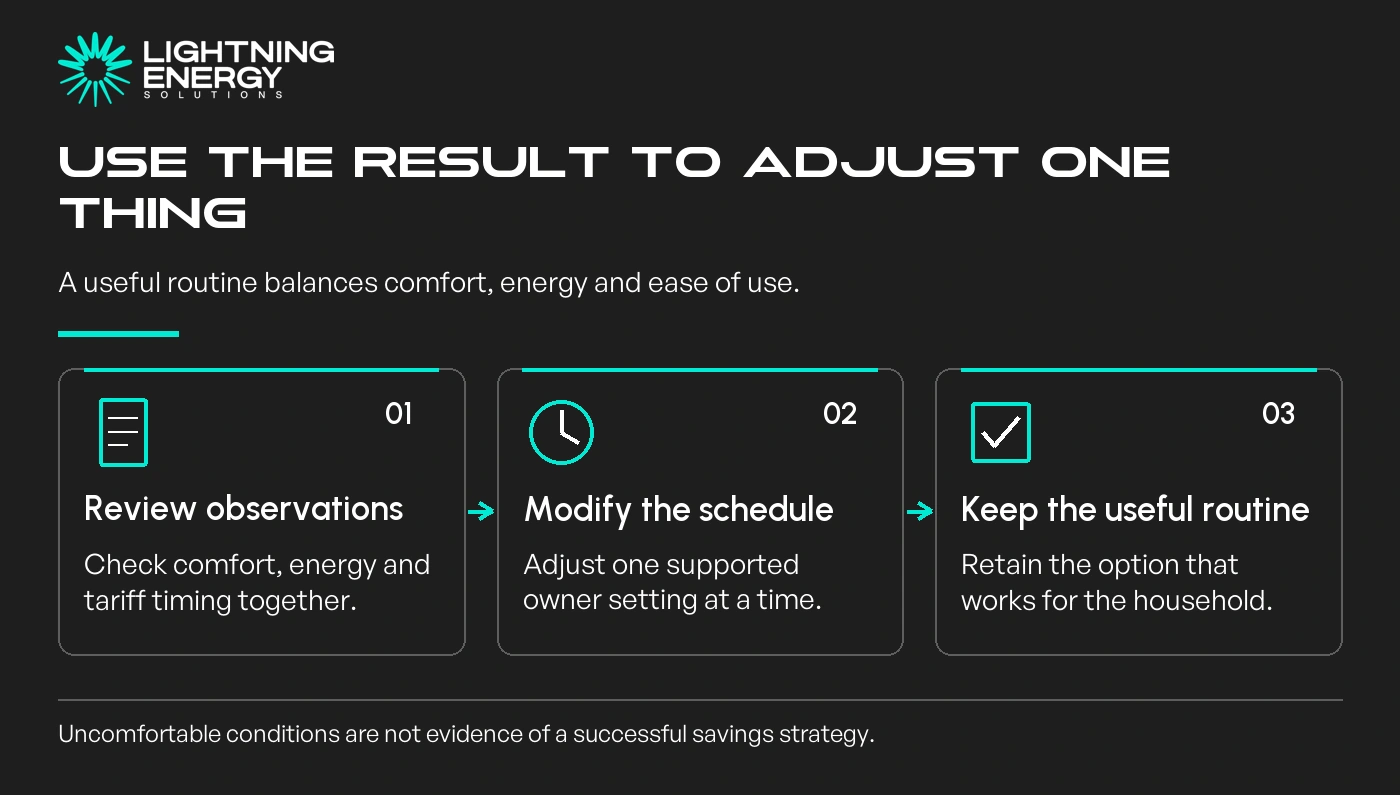
Keep your two schedules and a short temperature-and-energy record. Ask for a review if neither provides reasonable comfort, especially if the issue seems confined to one room or appears suddenly.
Available times
Book a consultation and we'll map solar, storage, hot water, and the rebates around your bills and your goals.
Question 1 of 6