Tesla Turns Cars Into Home Backup: Model 3 and Model Y Join US Powershare
Tesla has expanded Powershare Home Backup to qualifying Model 3 and Model Y vehicles in the US. Here is why it matters, what Powerwall adds, and what Australian owners should check.
LLuke CoveLightning Energy7 October 2026 · 5 min read
The electric car in the driveway has just gained a bigger role. Tesla has expanded Powershare Home Backup to qualifying Model 3 and Model Y vehicles in the United States, pairing them with Powerwall 3.
For Australian households thinking about solar, batteries and their next car, this is a development worth watching. The announcement concerns the US rollout.
It is not confirmation that Australian Model 3 or Model Y owners can switch on home backup today.
Tesla’s Colby Hastings announced the expansion on LinkedIn.
We checked Tesla’s product and support pages on 7 October 2026.
What Tesla has actually announced
Tesla’s US eligibility note covers new Model 3 and Model Y orders in the US and Puerto Rico after 1 October 2026. Some earlier vehicles qualify, but not all. A familiar model badge alone does not establish compatibility.
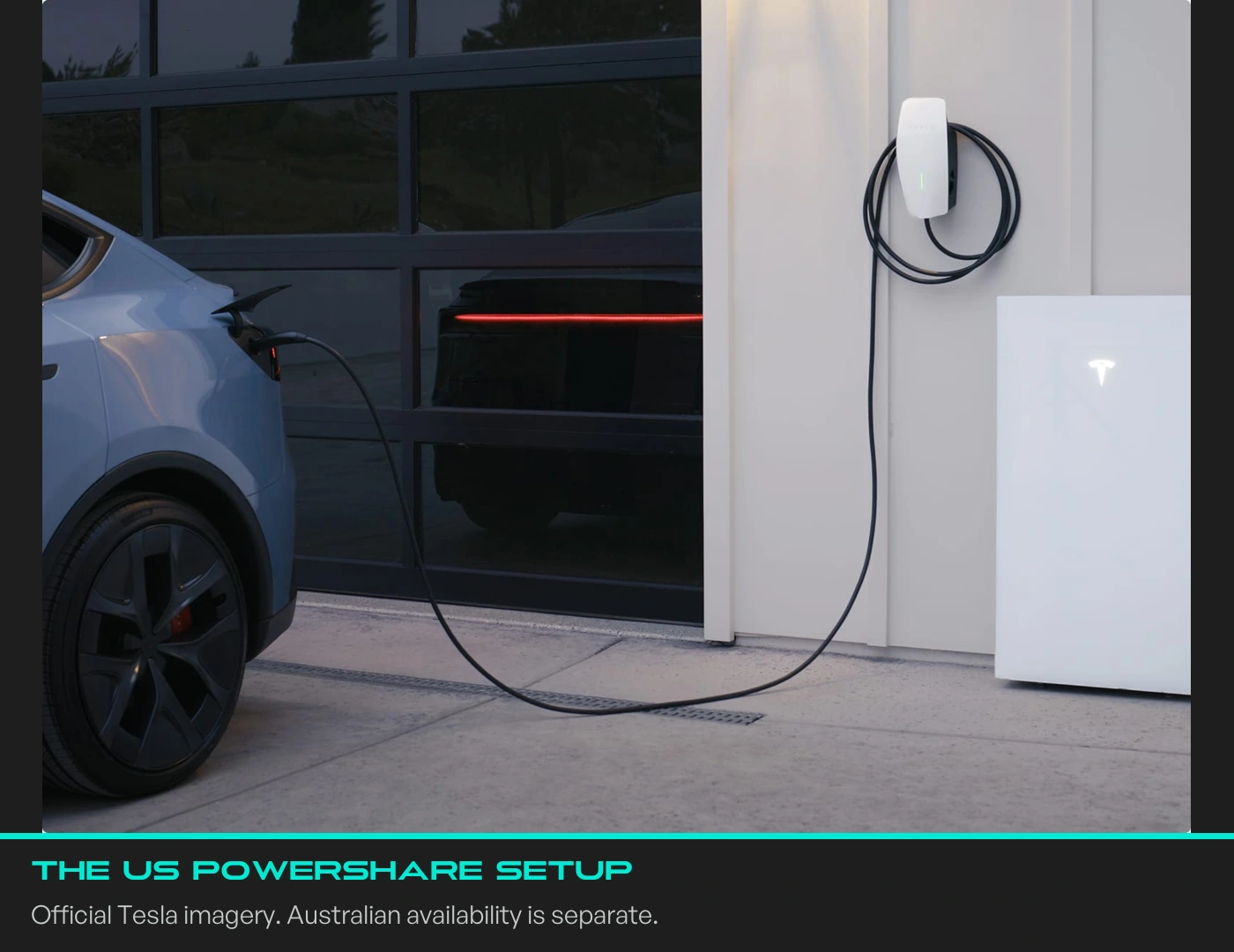
The listed home configuration combines an eligible vehicle, Powerwall 3 and a Wall Connector 3 or Universal Wall Connector. Powerwall 2 and Powerwall+ support is described as coming soon, rather than available now.
Image: Tesla, US Powershare page. Manufacturer imagery; not an Australian installation or a compatibility promise.
Why the driveway battery matters
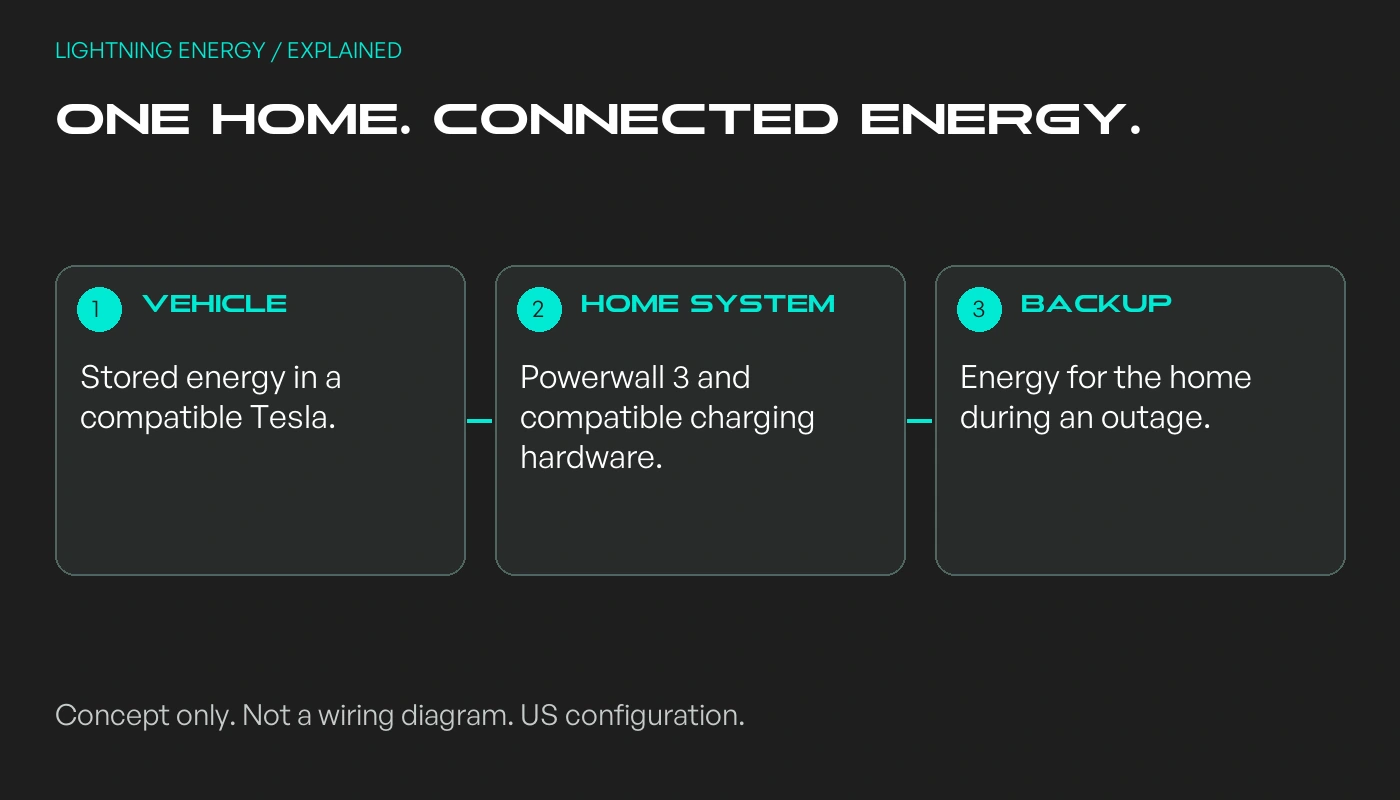
Our view: the interesting shift is how people might plan a home and a car together. A vehicle bought for transport could also contribute energy when the house needs it. That makes the driveway part of the household energy discussion.
But a car leaves the house. Think about a household that needs to drive during an outage: taking the car also takes its stored energy away. A stationary battery and a vehicle have different jobs, even when they can work together.
That is why we would start with a household’s priorities: which appliances matter, when the car is usually parked, and how much driving reserve the household wants to keep.
Original Lightning Energy concept graphic based on Tesla’s US product information. Not electrical installation instructions.
How long could it keep a home running?
Tesla’s support table estimates up to two extra days for Model 3 and Model Y Standard, and over two for Premium and Performance. Its assumptions are 30 kWh household use per day and a vehicle starting at 90% charge.
These are estimates, not a household guarantee. Vehicle variant, starting charge, solar and actual consumption affect the result.
Tesla’s headline product page uses a full-battery assumption; we have used the more specific support-table basis here.
A useful planning exercise is to separate essential use from discretionary use. Lighting, communications and refrigeration create a different load profile from running every large appliance at once.
Your own usage history is more useful than a headline duration.
For the wider design decision, explore home battery options alongside the actual loads you want backed up.
Home backup is different from selling power to the grid
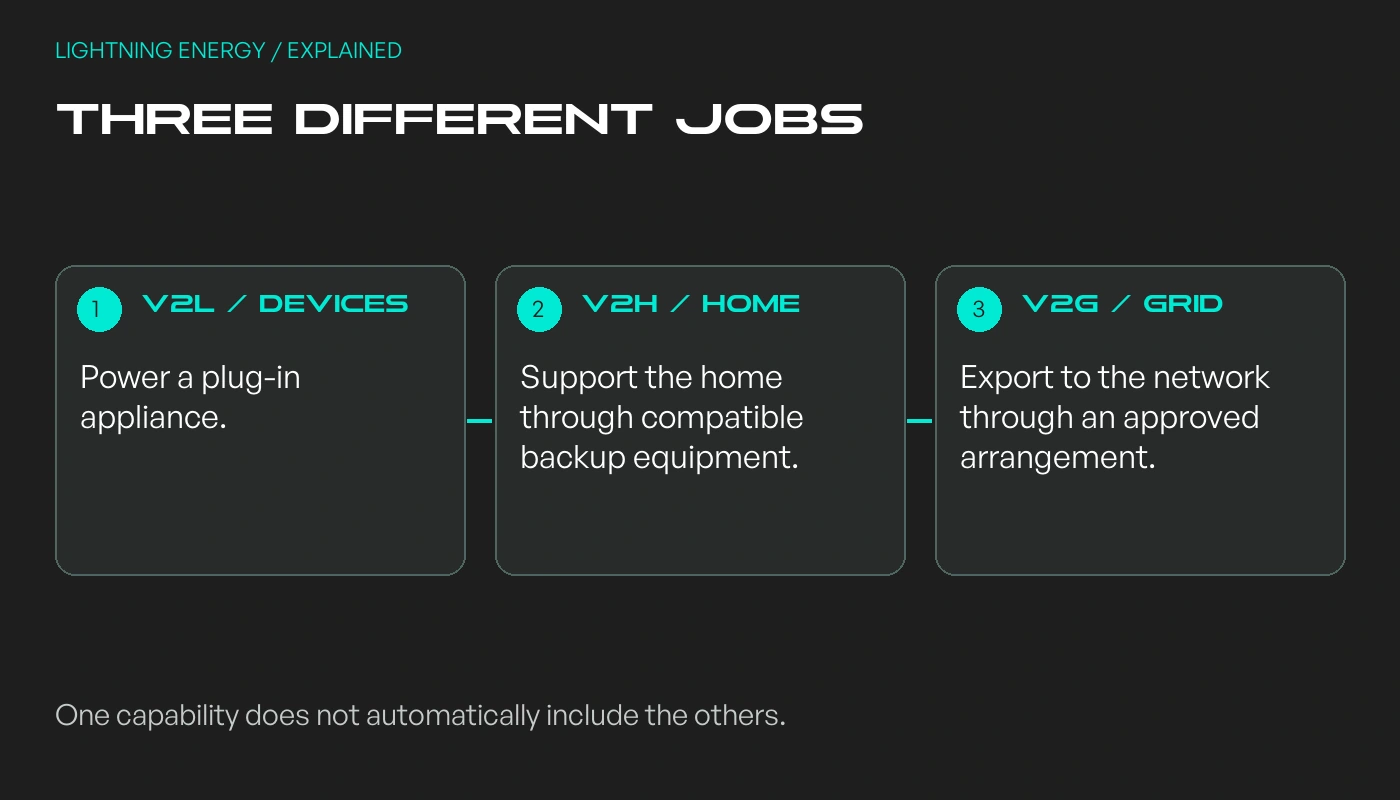
Vehicle-to-load, or V2L, means powering devices. Vehicle-to-home, or V2H, serves a house through suitable equipment. Vehicle-to-grid, or V2G, involves electricity flowing back to the network.
Tesla’s US Powershare page explicitly says Grid Support is available for Cybertruck in limited markets, and is not available for Model 3 or Model Y. The home-backup announcement is not a promise of grid-export income from those cars.
Original Lightning Energy explanation. These are distinct capabilities, not interchangeable product claims.
What does it mean for Australia?
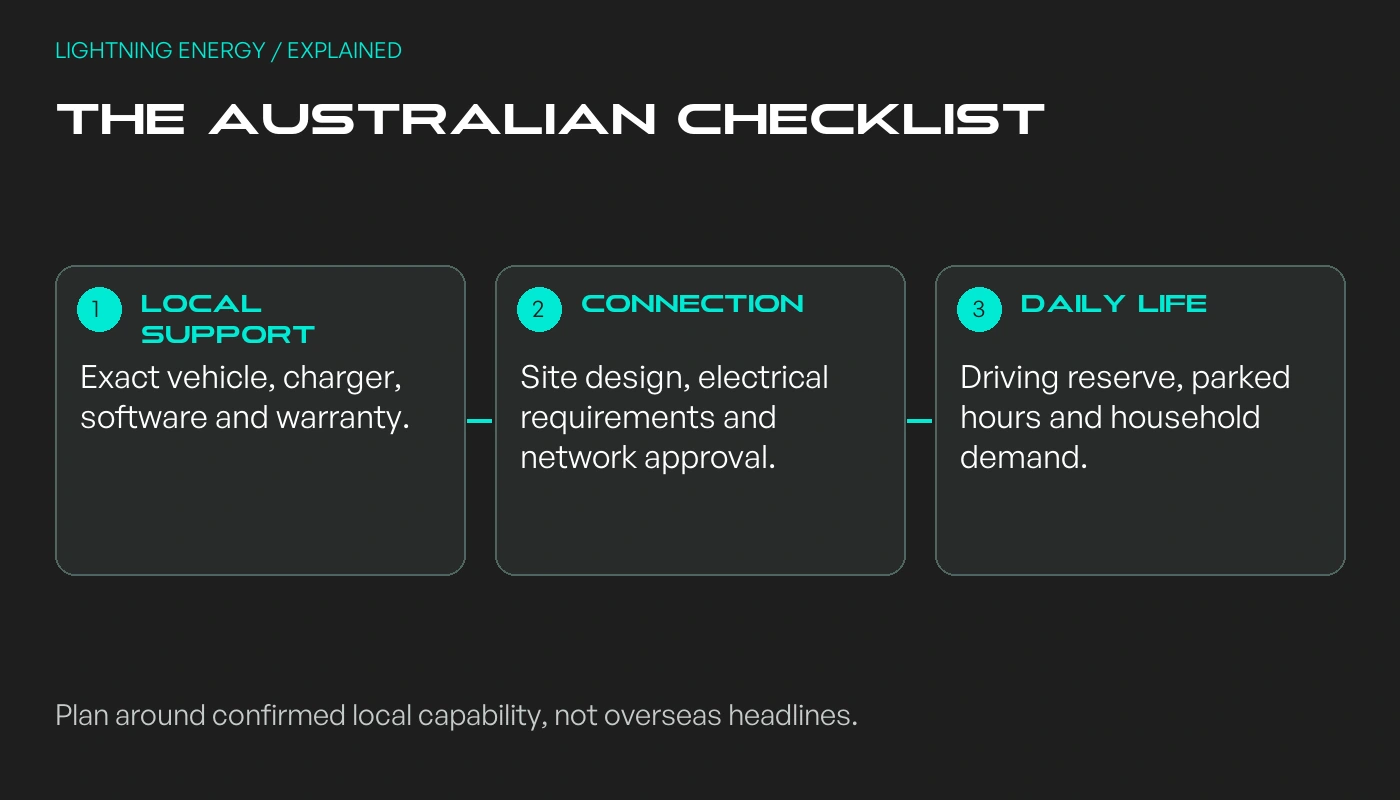
The sensible Australian response is interest, followed by checking the local details. We did not find confirmation in the Tesla sources reviewed of an Australian Model 3 or Model Y Powershare Home Backup launch date.
Do not confuse an outlet accessory or device-power feature with approval to supply a home. Australian vehicle specifications, supported hardware and installation requirements need their own confirmation.
ARENA’s Vehicle-Grid Network describes an emerging Australian market with compatibility, certification, connection approvals, warranties and retail-program questions still to navigate.
Those details matter as much as the vehicle announcement.
Source: ARENA Vehicle-Grid Network. This is Australian industry context, not an endorsement or certification of Tesla’s US system.
Original Lightning Energy checklist. Confirm the exact local combination before relying on future functionality.
How to plan without betting on a launch date
For a new build or an electrical upgrade, document the priorities now: parking location, charging needs, essential circuits and possible battery space.
Ask the designer to explain what the proposed system can do today and what would require later changes.
Keep the car decision and the electricity decision connected, but avoid paying for an assumed future software feature. A clear scope and a supported equipment combination are more useful than an undefined “future-ready” label.
Review EV charging options and your solar setup together. Tell us how you use the house and car, and we can discuss a practical system based on confirmed Australian products and requirements.
This is original reporting and analysis, checked 7 October 2026. Availability can change. Tesla photographs are credited manufacturer promotional material; explanatory graphics are by Lightning Energy.
Book a consultation and we'll map solar, storage, hot water, and the rebates around your bills and your goals.
Loading consultations…
Lightning EnergyPlan your next energy upgrade.
⚡
Hi, I’m Lightning Energy’s project guide. I’ll ask a few practical questions, explain what usually matters for your project, and help you decide on a useful next step — no guesswork or sales pressure.
First, what kind of property are we planning for?