Tesla’s New Roadster: Suction, Thrusters and the Questions Behind the Spectacle
Tesla’s latest Roadster announcement combines suction downforce and cold-gas thrusters. Here is what the claims mean, what remains unverified and what Australians should check.
LLuke CoveLightning Energy16 October 2026 · 6 min read
Tesla has given the new Roadster a much bigger talking point than acceleration: a system designed to change how the car interacts with the air around it. Its latest announcement combines active aerodynamics, suction and cold-gas thrusters.
The interesting question is how those systems differ. Pushing a car towards the road and pushing it away from the ground are very different engineering jobs, even when both make dramatic launch imagery.
It also describes adjustable wings and thrusters for rapid stabilising corrections.
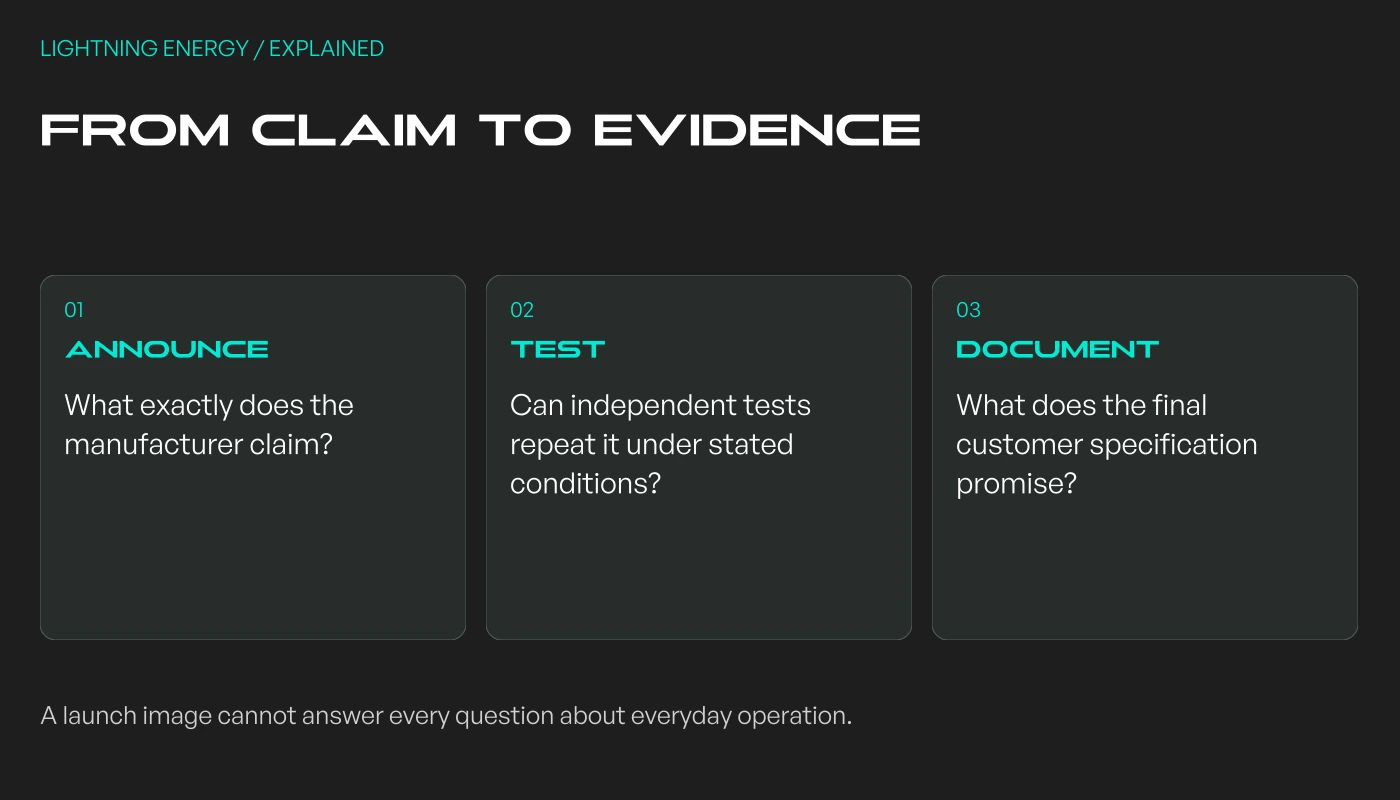
Tesla says the suction system can hold the vehicle upside down while stationary. That is a manufacturer claim, not a performance result independently verified by Lightning Energy. The promotional image is not a substitute for test data.
The post also describes weight-saving materials and a fixed seating position. We have not confirmed an Australian delivery date, final local price or local charging specification from this announcement.
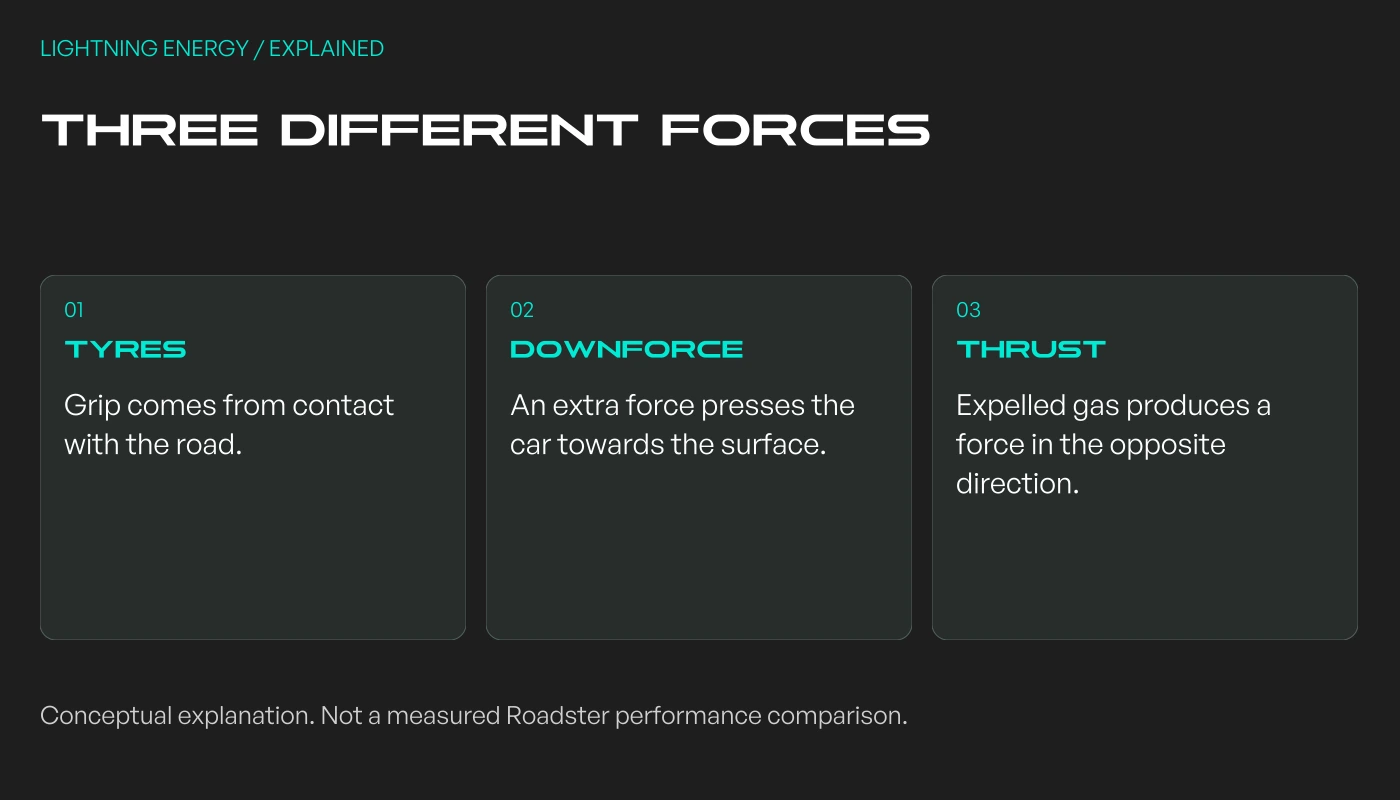
Original conceptual comparison. It does not depict the Roadster’s engineering layout or measured performance.
Downforce and thrust are different forces
Downforce acts towards the road. In a conventional aerodynamic arrangement, airflow around the body and wings can create a force that presses the tyres against the surface. The result depends on speed, geometry and surrounding air.
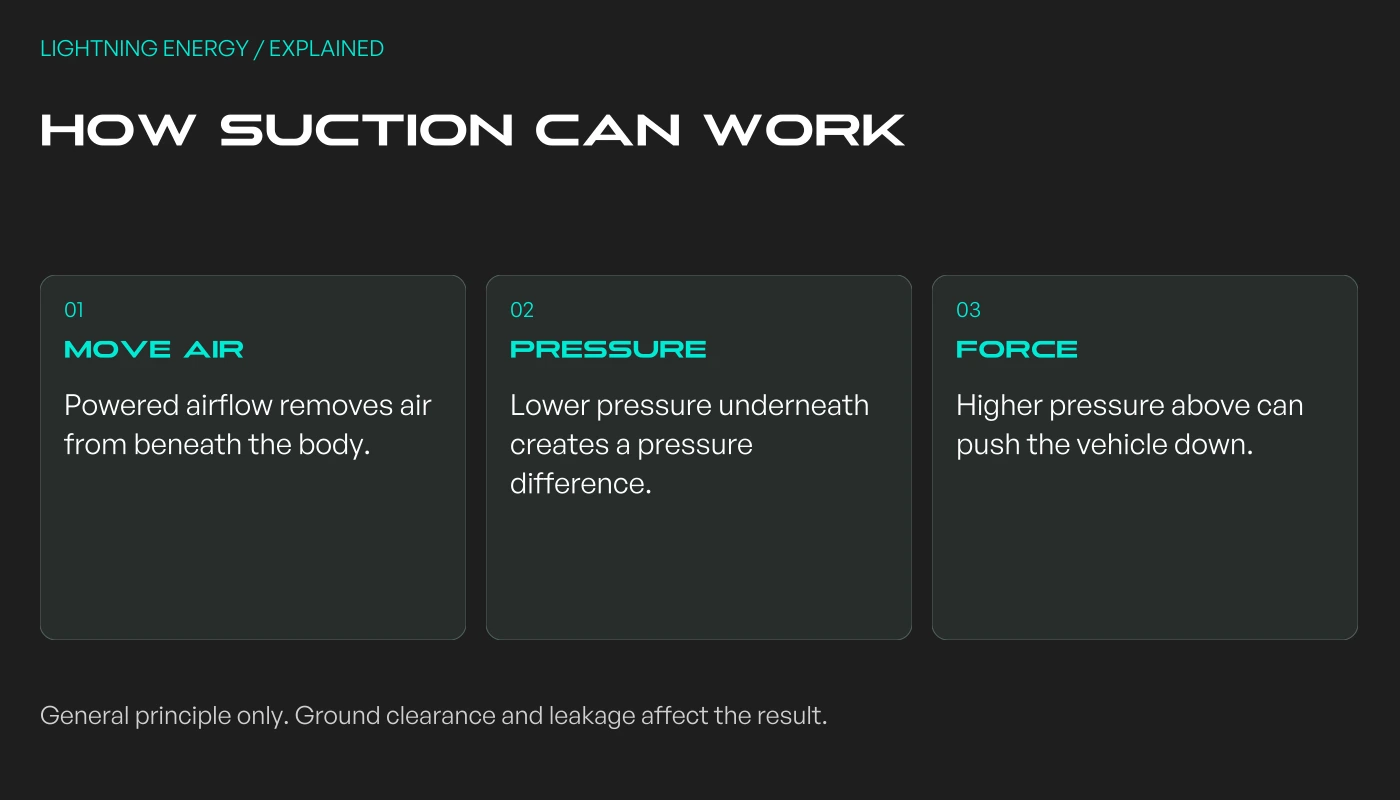
A powered suction arrangement instead moves air from beneath the car.
If pressure below the body is lower than pressure above it, the pressure difference can push the car towards the road.
Maintaining that difference matters as much as creating it.
This makes surface clearance, leakage, debris, noise and power demand useful questions for future testing. These are engineering questions raised by the concept, not faults we have identified in a production Roadster.
A tyre still has limits. More force pressing it down does not mean unlimited grip, and a controlled demonstration does not establish performance on every road surface or in every weather condition.
General physics illustration, not a Tesla system schematic. No performance scale is implied.
What does cold-gas propulsion mean?
NASA describes cold-gas propulsion as generating thrust by releasing stored pressurised gas without combustion.
Expelling gas in one direction produces a reaction force in the other.
That explanation establishes a physical principle. It does not establish the Roadster’s thrust output, operating time, recharge process, safety envelope or energy consumption. Those require vehicle-specific documentation and testing.
Electric actuators control a mechanism; their presence does not mean the gas supply is unlimited.
Battery energy, stored gas and the forces at the tyres are separate quantities.
Treating them as interchangeable makes the headline harder to understand.
Our reading is that the reveal deserves attention as an ambitious control-system concept. The next useful evidence would show how often the features can operate, under what conditions, and what maintenance they require.
An editorial checklist for assessing new vehicle technology, not a claim about completed testing.
What should Australian buyers wait for?
A global announcement is only one part of a local buying decision. Australian specification, availability, warranty coverage, servicing arrangements and the applicable approval pathway all need their own confirmation.
An Instagram post is not evidence that a particular vehicle has met the requirements for Australian supply.
We have not determined the approval status of this Roadster.
Nor should readers infer permission to operate an airborne feature on public roads from promotional material.
Those are separate questions for the relevant authorities and final product documentation.
Our earlier Roadster announcement guide separates reveal dates from production and handover. This article focuses on the new technical claims rather than repeating an event timetable.
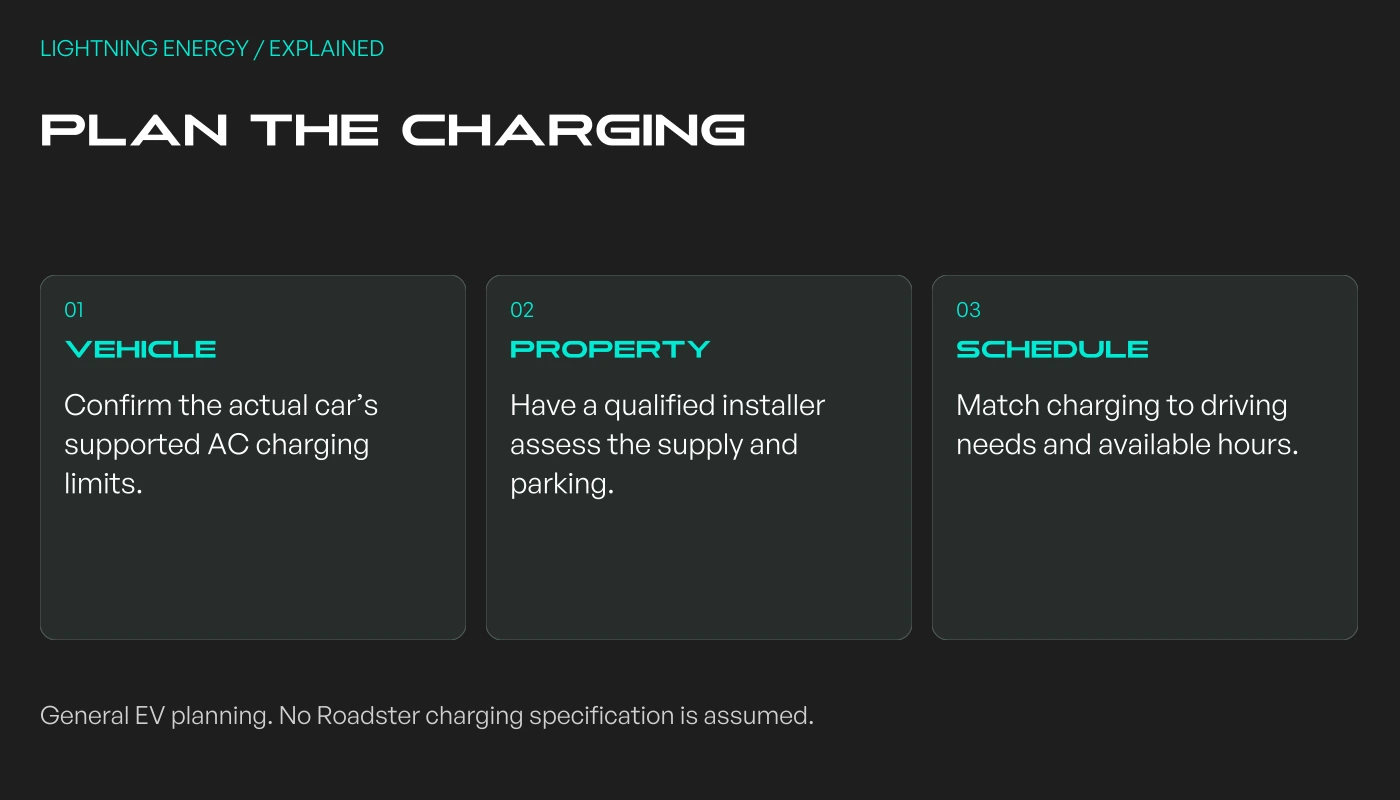
General planning guidance for an Australian EV. This is not a Roadster charging specification or DIY wiring guide.
The practical home-energy connection
A sports car’s performance headline does not tell an electrician what charger to install. Start with the actual vehicle’s charging limits, the property’s available supply and the time the car normally spends parked.
Do not transfer a specification for another Tesla model to the Roadster.
For households exploring EV charging, the useful goal is enough energy for normal driving within the available charging window. A larger electrical upgrade should follow a site assessment, not the excitement of a launch.
If you have rooftop solar and storage, consider when charging happens and which loads have priority. Our solar, EV and home-battery guide explains how to approach that decision.
The Roadster announcement is a striking glimpse of Tesla’s ambitions.
For a home installation, the sensible next step remains a clear vehicle specification and a property assessment. Talk to Lightning Energy about the charging setup you actually need.
Checked 16 October 2026.
This is an announcement explainer, not a road test.
Cover image: Tesla’s official promotional artwork, reproduced with attribution for commentary on the announcement.
Interior graphics are original conceptual explanations.
Book a consultation and we'll map solar, storage, hot water, and the rebates around your bills and your goals.
Loading consultations…
Lightning EnergyPlan your next energy upgrade.
⚡
Hi, I’m Lightning Energy’s project guide. I’ll ask a few practical questions, explain what usually matters for your project, and help you decide on a useful next step — no guesswork or sales pressure.
First, what kind of property are we planning for?