
Who Controls Your Battery in a Virtual Power Plant?
Understand who can charge and discharge your battery in a VPP, and check the contract’s reserve, override, notification and exit rules before joining.
Understand who can charge and discharge your battery in a VPP, and check the contract’s reserve, override, notification and exit rules before joining.

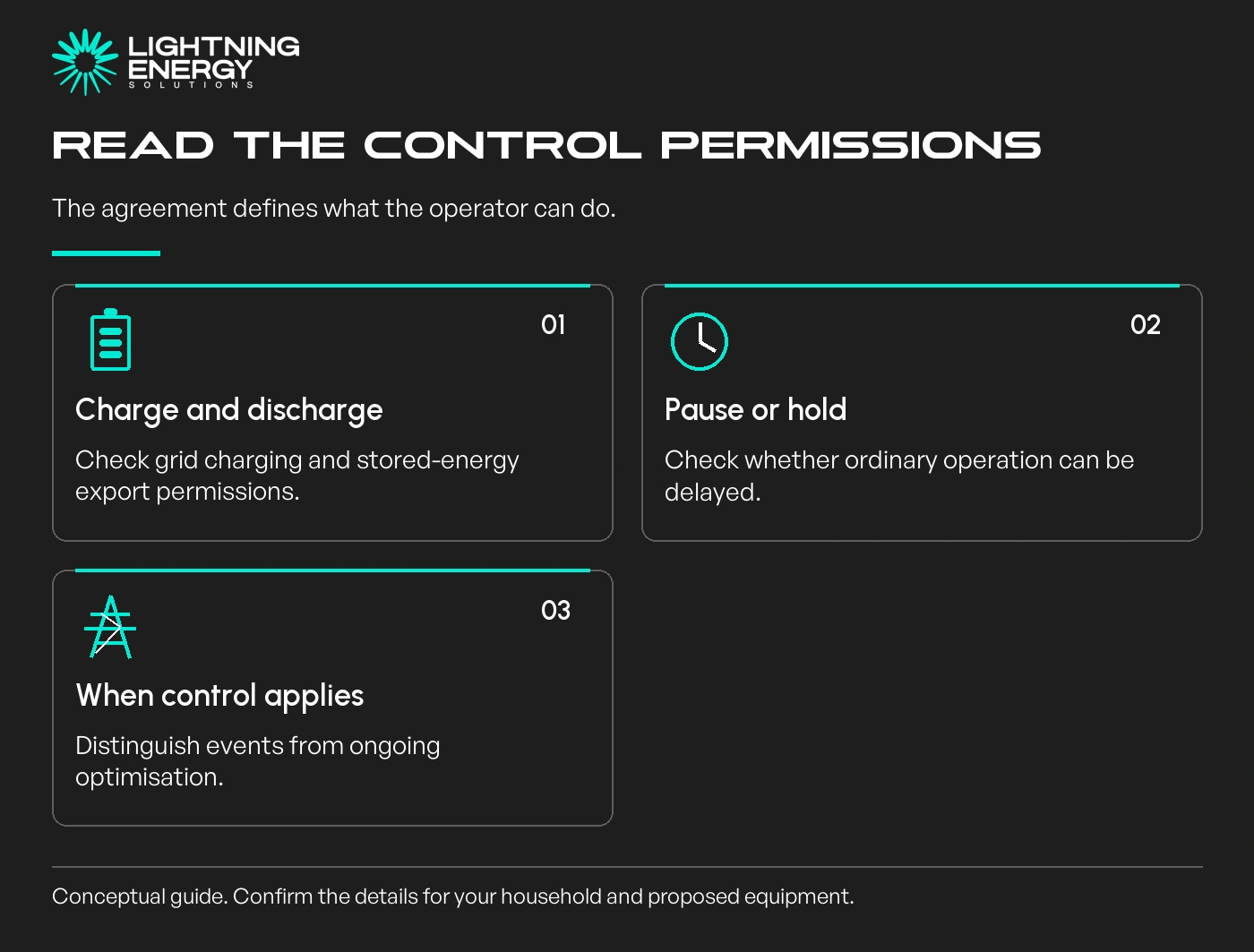
Joining a virtual power plant gives the provider defined permissions to operate your battery. The contract explains those permissions, including when the battery can charge, discharge or hold energy.
Read that section before focusing on rewards. The practical question is how provider control interacts with household energy needs and the backup protection you expect.
Look for clauses covering remote access, charging from the grid, exporting stored energy and pausing normal operation. Check whether control is limited to announced events or extends to ongoing optimisation.
The Clean Energy Regulator describes VPP participation as an arrangement that can let an operator manage stored energy. Read the actual offer to understand the permissions involved.
Clean Energy Regulator: virtual power plants.
Offers differ. Ask the provider to identify the controlling clauses in your actual agreement and explain anything unclear before enrolment.
Our VPP guide introduces the coordinated operation behind these arrangements.
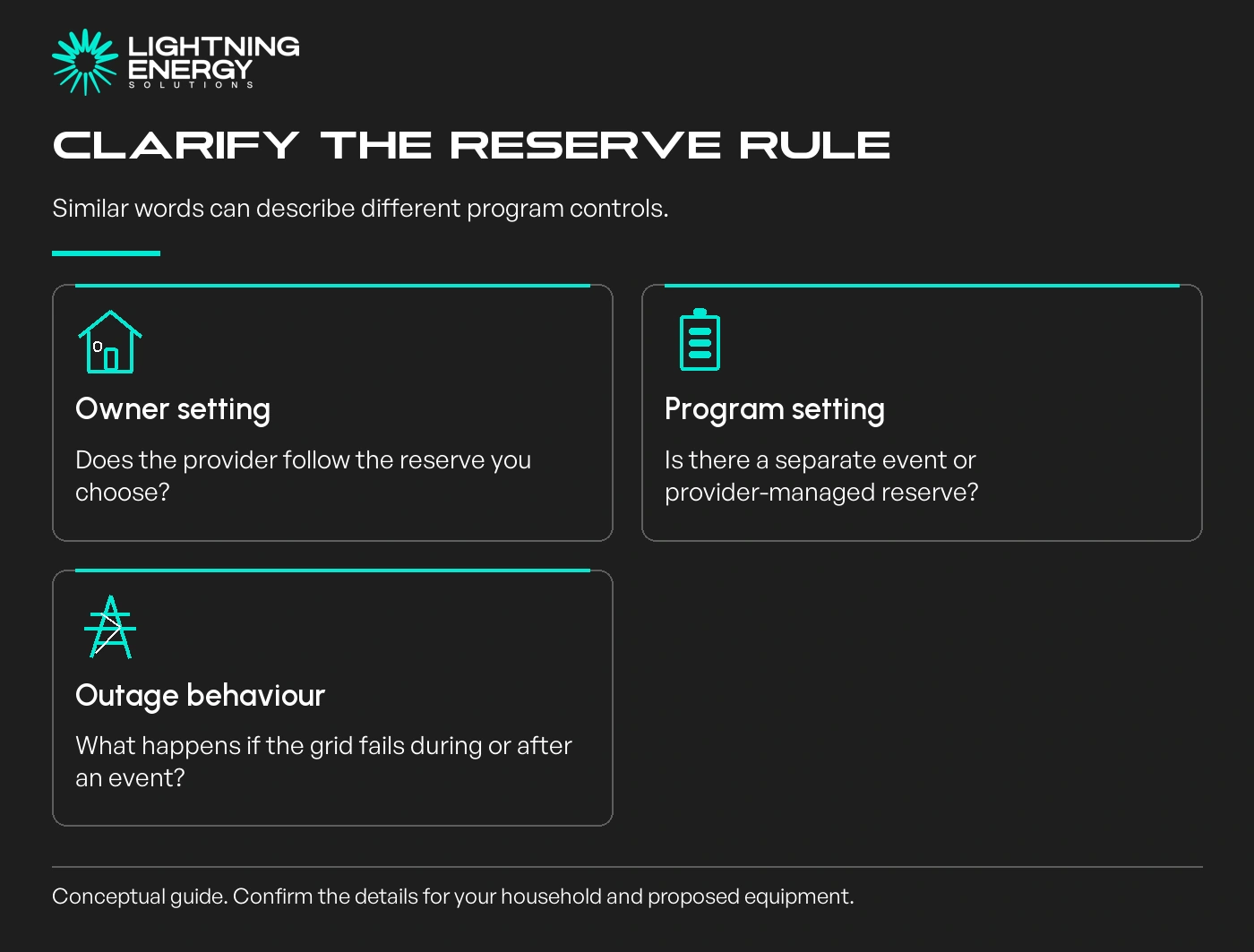
Ask whether the program respects your selected reserve, applies a separate event reserve or sets the reserve itself. Identify any exceptions and what happens when the grid fails during or after an event.
A percentage target is not a guarantee of runtime. Available charge, backed-up circuits and appliance demand still matter. It also does not create energy if the battery has not reached the target.
Our blackout guide helps turn a reserve promise into the household questions that actually matter.
Do not substitute a provider's marketing phrase for the detailed rule. Ask for the applicable clause or operational document and keep it with the enrolment records.
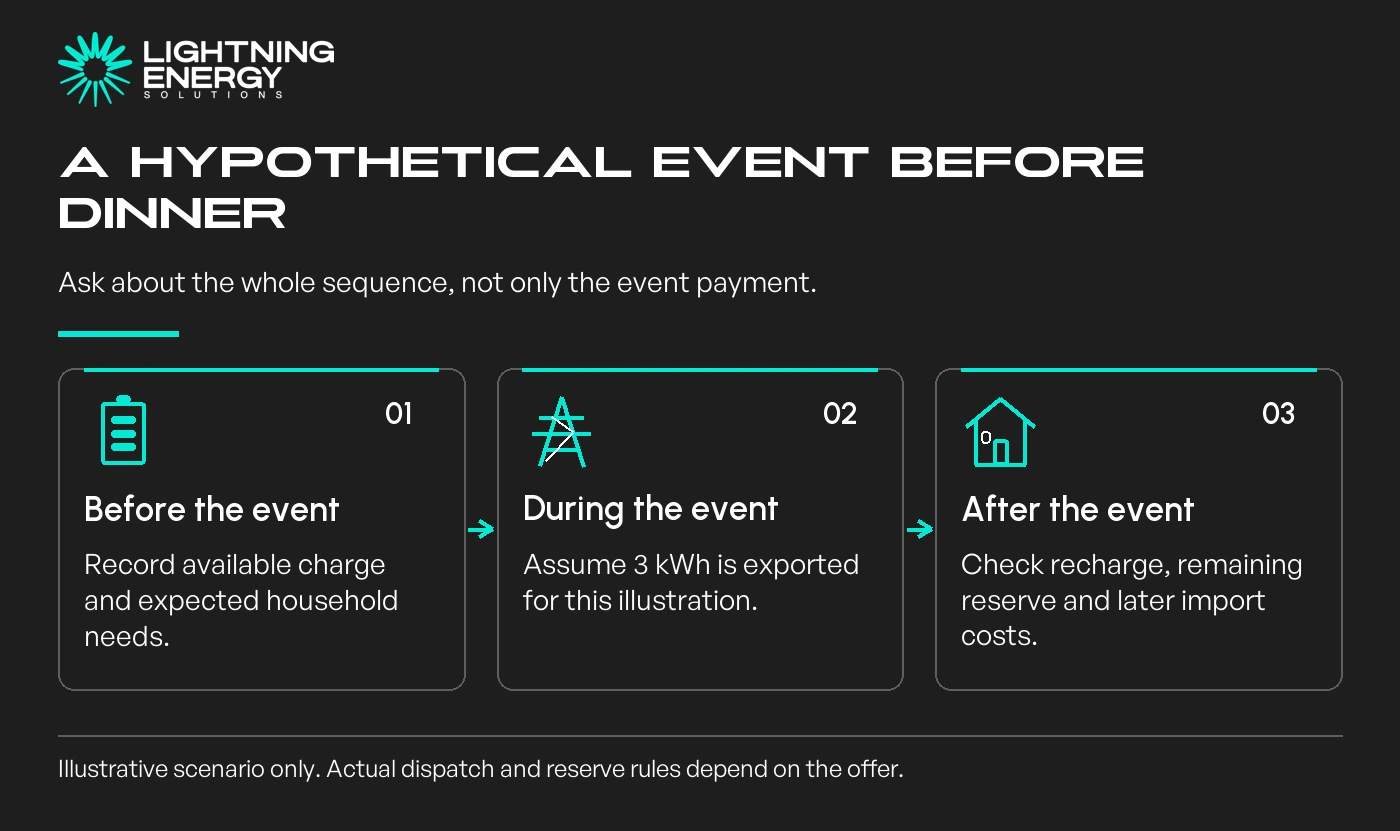
Imagine a hypothetical VPP event exporting 3 kWh from your battery before dinner. Ask what happens afterwards if solar production has ended and the household still needs electricity.
Will the system recharge, preserve what remains or allow more grid imports? Which prices apply, and is the event payment separate from ordinary export credits?
The purpose is not to assume an event is harmful. It is to understand the full energy movement and the household trade-off rather than looking only at the exported amount.
Write a second scenario involving an outage after the event. Ask the provider to explain the actual reserve rule, then keep any runtime expectation grounded in your assessed load list.
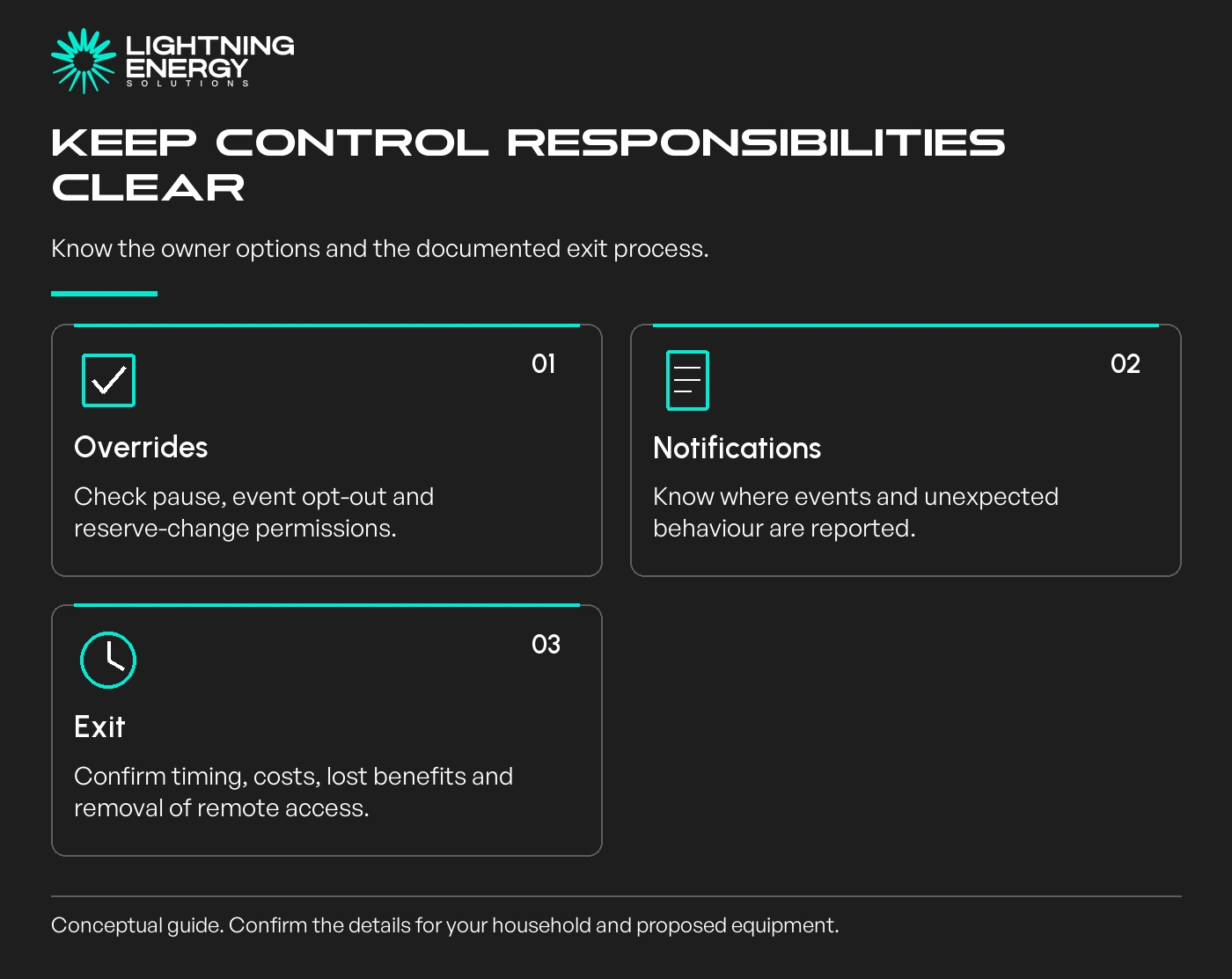
Find out whether you can pause participation, opt out of an individual event or change the reserve. Ask whether those actions affect eligibility, rewards or other benefits.
Check how much notice is given, where event information appears and which contact handles unexpected behaviour. An email or app notification is useful only if the household knows where to find it.
Keep a record of important settings and permissions before enrolment. After joining, compare event records with the battery's energy history and the bill, allowing for timing differences between systems.
Ask how to leave, how long the process takes and how remote control is removed. Confirm any retailer change, fee, repayment or lost benefit that could accompany the exit.
Do not assume uninstalling an app ends the contract or revokes the provider's access. Obtain confirmation through the program's documented exit process.
Our battery quote checklist can be used to keep provider responsibilities alongside the installation records.
If the controls conflict with your household priorities, choose a different offer or retain an appropriate owner-managed arrangement. A VPP should be assessed as an operating agreement, not simply a reward attached to the battery.
Plan your battery upgradeBring the VPP terms and your backup priorities. We can help identify the technical questions to put to the provider before you grant control of the system.Available times
Book a consultation and we'll map solar, storage, hot water, and the rebates around your bills and your goals.
Question 1 of 6
