
Battery kW and kWh: Why Storage Size Does Not Set Appliance Limits
Understand battery kW and kWh, then compare continuous output, starting loads and runtime so storage capacity is matched to the appliances you want to run.
Understand battery kW and kWh, then compare continuous output, starting loads and runtime so storage capacity is matched to the appliances you want to run.

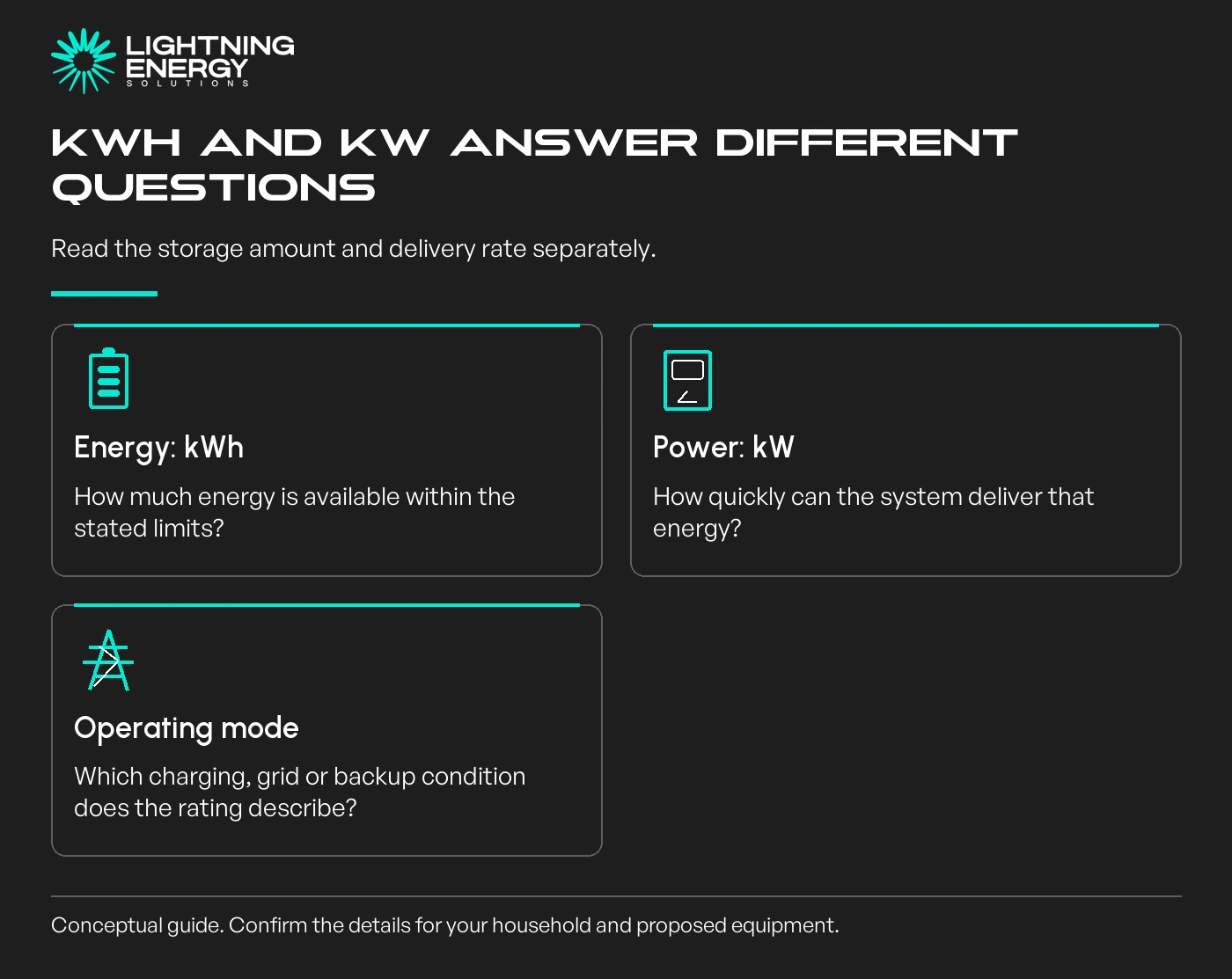
A battery's kilowatt-hours tell you about stored energy. Its kilowatts tell you how quickly it can supply energy. You need both figures to decide whether a system suits the household.
A larger energy store may run modest loads for longer without supporting a larger simultaneous load. That is why two battery systems with similar capacity can behave differently when several appliances switch on.
Think of kWh as the available amount and kW as the delivery rate. The Australian Government's battery guide uses that distinction and advises checking usable storage rather than relying only on an overall capacity label.
Government battery definitions.
Also ask which operating condition a rating describes. Grid-connected operation, charging and backup may have different limits. A product brochure's largest number should not automatically be used for all three.
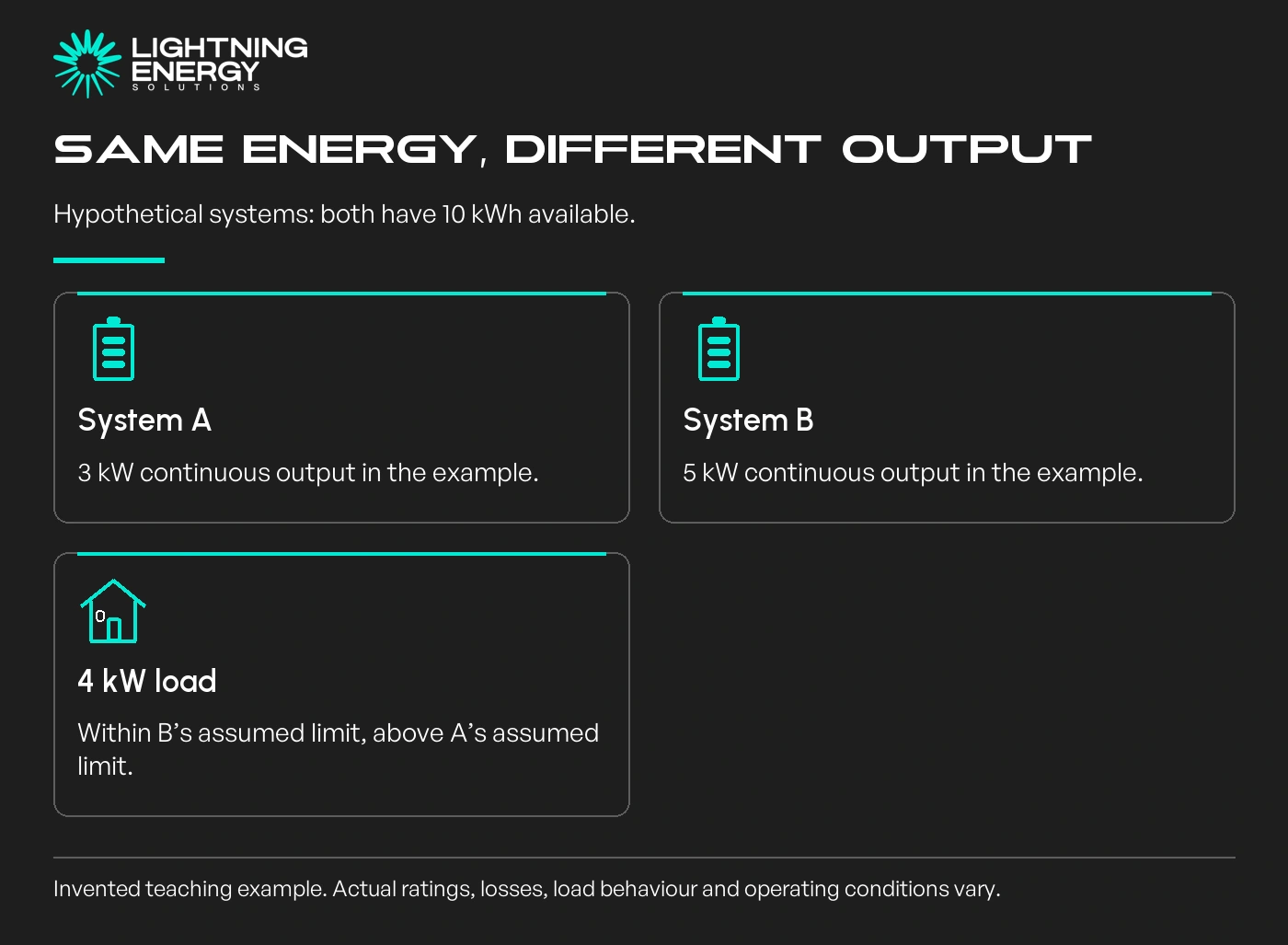
Imagine System A and System B each have 10 kWh available for the example. A can supply 3 kW continuously; B can supply 5 kW continuously. These are invented figures to explain the distinction, not product specifications.
A steady 2 kW load uses 2 kWh in an hour. Ignoring losses and other limits, either example could supply it for five hours. A 4 kW simultaneous load fits B's assumed power limit but exceeds A's.
Adding energy capacity to A would not, by itself, establish a higher output limit. The power-conversion equipment and supported configuration must also be checked. Extra runtime and extra simultaneous capability are different benefits.
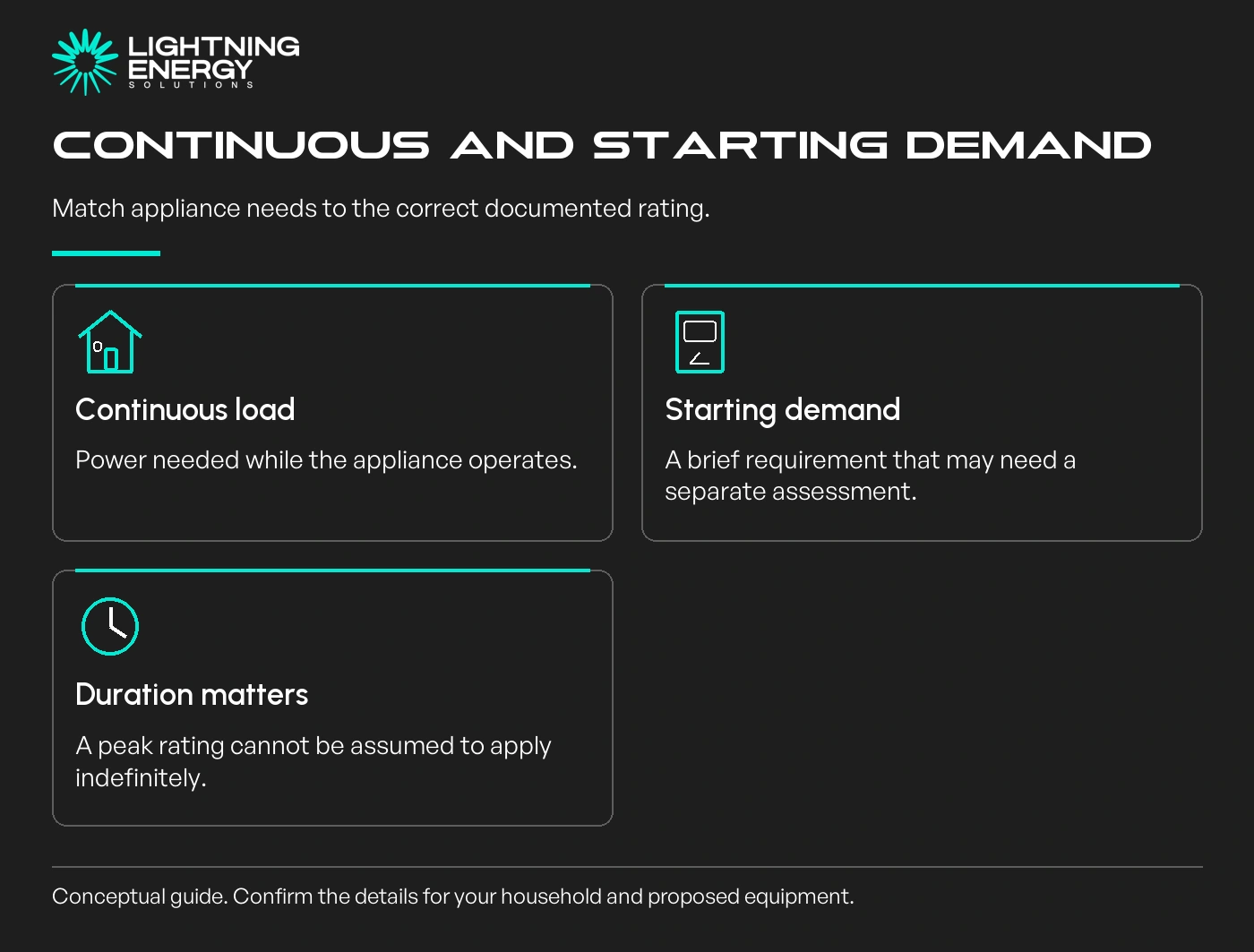
Some appliances need a brief increase in power when starting. Check the appliance requirements against the battery's documented starting or peak capability, including the duration and conditions attached to that rating.
Do not compare a short peak figure with a continuous appliance load as if they describe the same job. Also avoid adding every appliance's maximum input and assuming that total is a realistic all-evening average.
For an outage plan, the blackout guide helps separate essential tasks from optional heavy loads. The installer can then assess the actual combinations you want to use.
Tesla's Australian Powerwall 3 Expansion table provides a concrete example. It lists larger stored-energy configurations while keeping configured output as a separate figure. That is a reason to request both numbers after an expansion.
Tesla Australian expansion specifications.
The Powerwall expansion guide explores this further.
Other systems have different configurations, so use the selected manufacturer's documentation rather than applying one product's rules to another.
A home importing electricity late at night may need more available energy, a different schedule or a lower reserve. A home exceeding backup output when appliances overlap faces another problem. More modules are not a diagnosis.
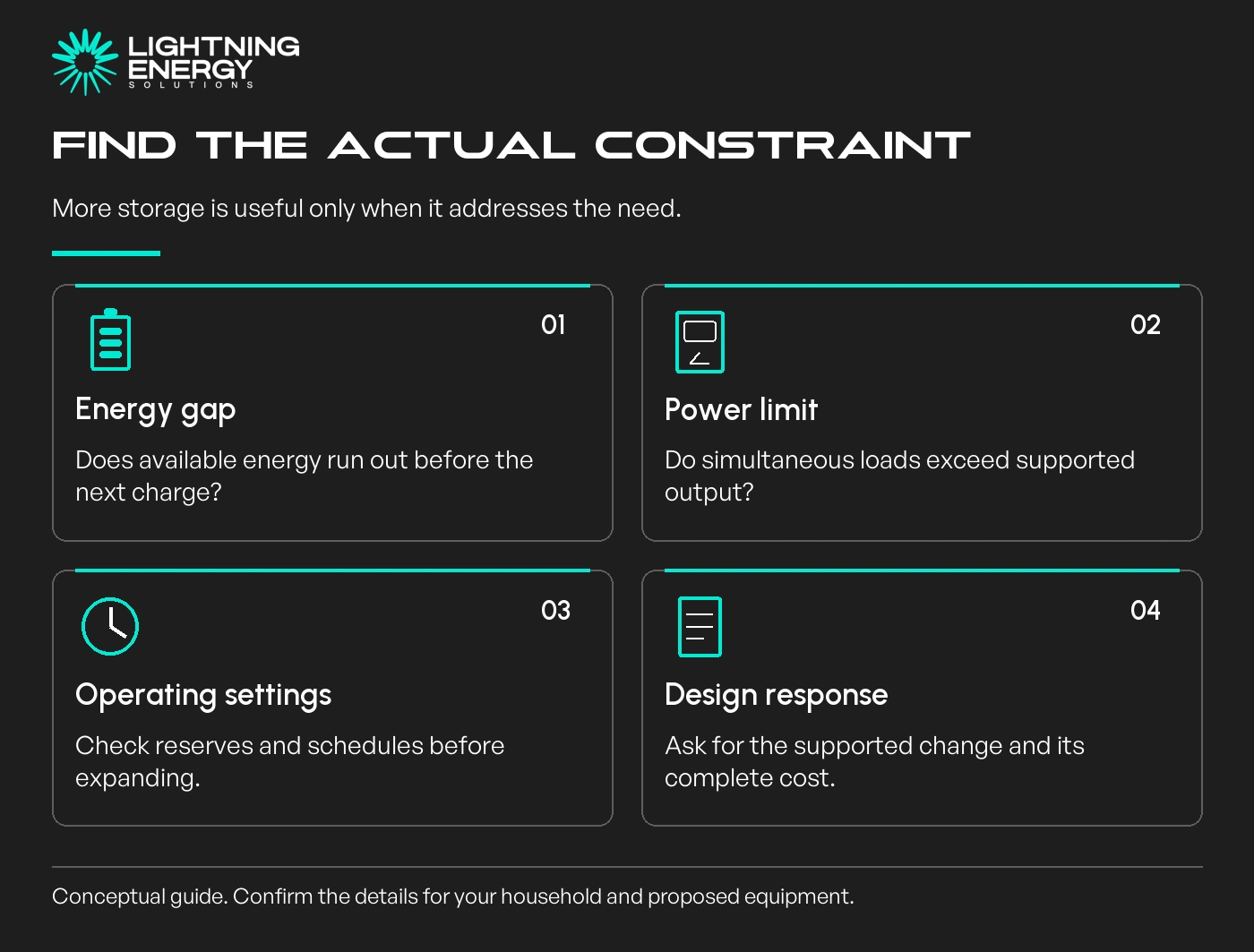
Give the designer the model details of important loads and describe when they run together.
Ask for continuous output, starting capability and expected runtime to be explained separately, using stated initial charge and operating assumptions.
If a proposal adds capacity but cannot explain the extra useful work it performs, compare a smaller configuration. If output is the constraint, ask which supported design change would address it and what that change costs.
A clear assessment should leave you able to answer two questions: what can operate together, and how long might the stored energy cover the agreed loads? Keep those answers with the installation scope.
Plan your battery upgradeAsk Lightning Energy to match both battery energy and power capability to the appliances and operating patterns that matter in your home.Available times
Book a consultation and we'll map solar, storage, hot water, and the rebates around your bills and your goals.
Question 1 of 6