
Three-Phase Battery Quotes: Fox ESS, GoodWe, Tesla and Sigenergy Compared
Compare Australian three-phase battery quotes from Fox ESS, GoodWe, Tesla and Sigenergy: backup limits, gateways, phase loading and current availability.
Compare Australian three-phase battery quotes from Fox ESS, GoodWe, Tesla and Sigenergy: backup limits, gateways, phase loading and current availability.

A three-phase battery quote needs to answer a practical question: what will your home still run when the grid goes down? A large storage figure and a familiar brand name do not answer it on their own.
This Australian desk-research comparison checks named Fox ESS, GoodWe, Tesla and Sigenergy options on 9 November 2026. It compares documented capabilities and quote requirements, not hands-on performance or installed prices.
There is an important availability difference.
GoodWe and Sigenergy have identifiable approved products in the registers checked.
Tesla says Powerwall 3P is not yet available in Australia.
The new Fox PQ3-M needs approval and supply verification.
Three-phase homes distribute their electrical loads across three phases. Some appliances also need a three-phase supply. The battery system must be designed for the particular loads you want to keep operating.
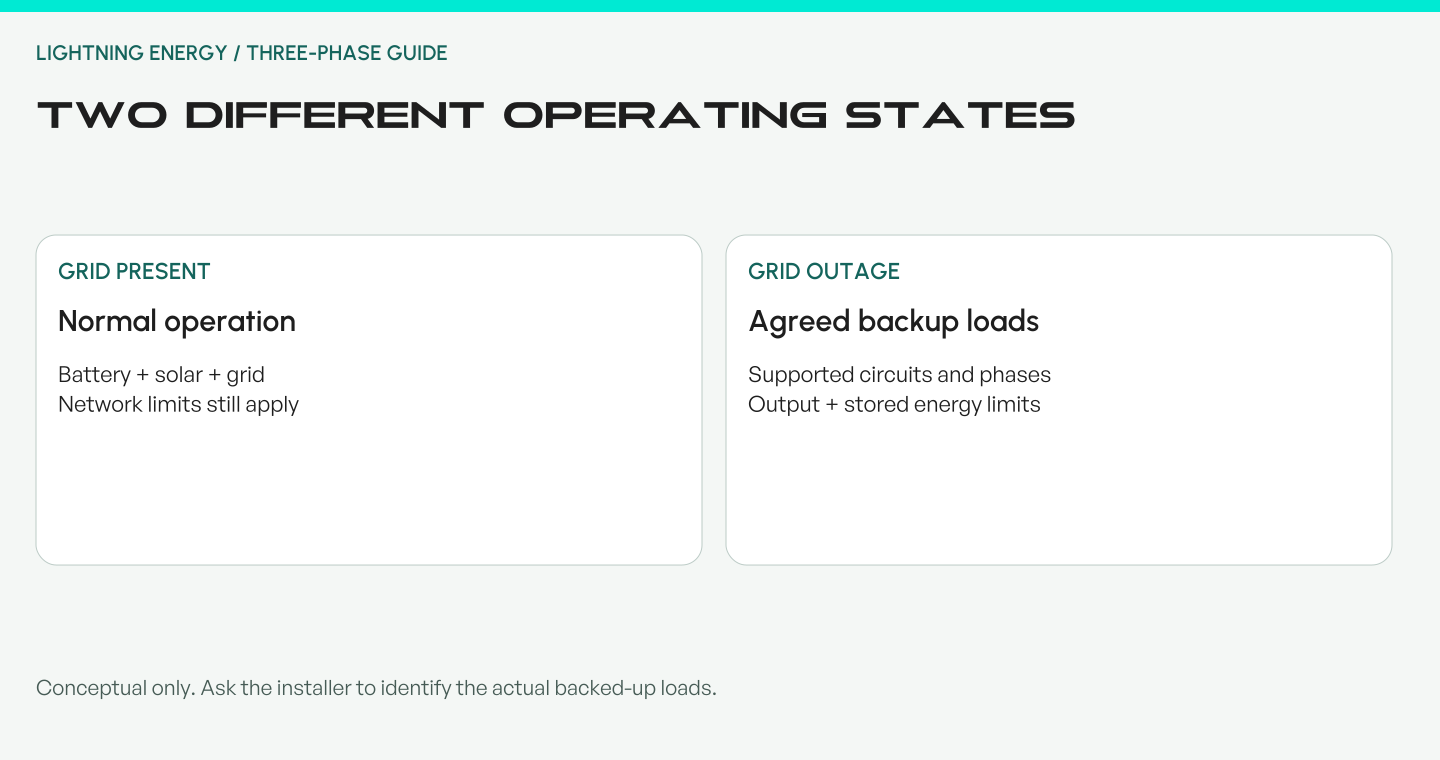
A system can help manage electricity use while the grid is present without backing up every circuit during an outage. Ask for two written descriptions: normal grid-connected operation and operation after the grid fails.
Usable storage, measured in kWh, affects how much energy is available. Output limits determine how much equipment can run at once. Adding storage does not automatically increase inverter output or the permitted load on one phase.
For the broader design questions, see our guide to battery backup for three-phase homes.
Here the focus is what should appear on a four-brand quote comparison.
The 6 November 2026 Australian PQ3-M datasheet lists PQ3-10.0-L-M_EQ5500-S_3S: the near-10 kW three-phase inverter with three EQ5500-S modules. The specified storage is 16.38 kWh usable.
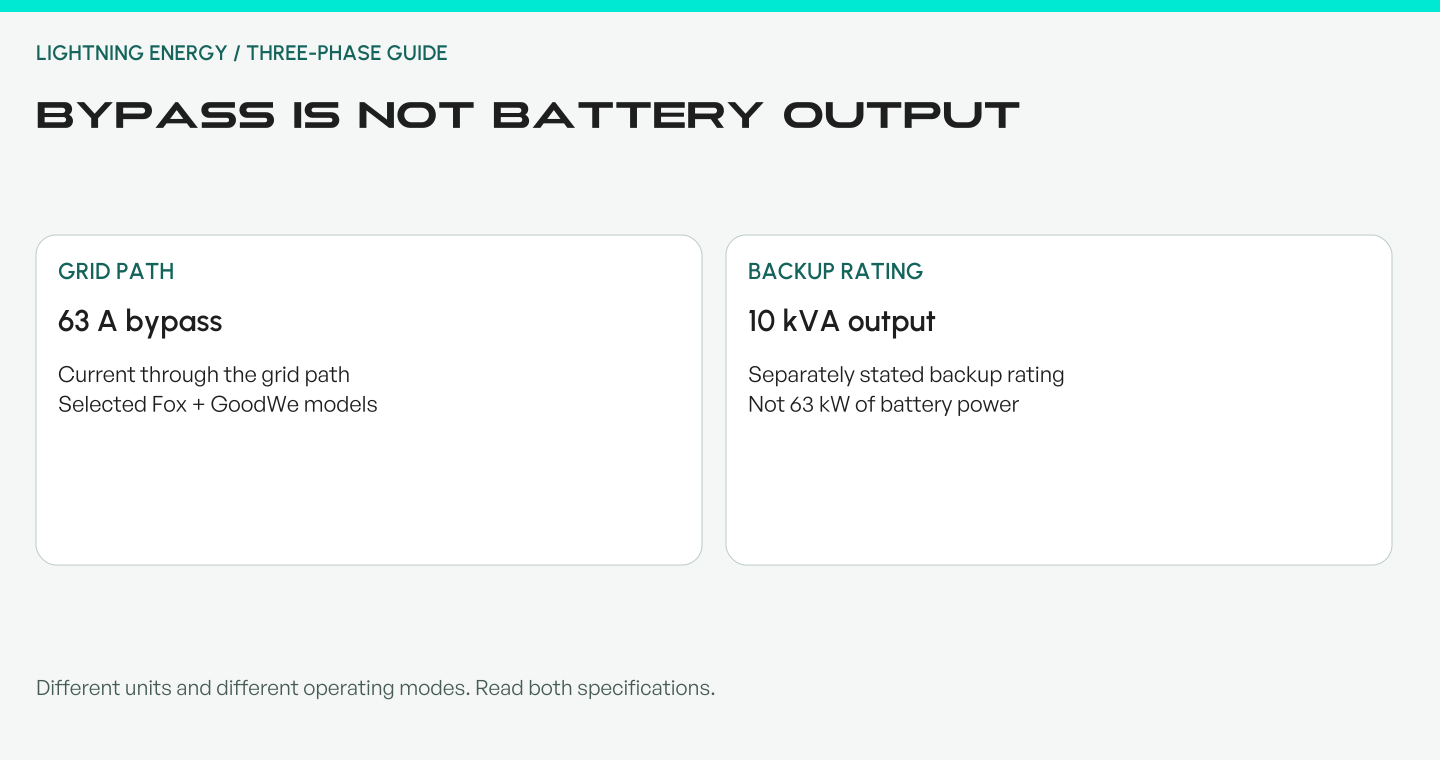
Its grid output is rated at 9.999 kW. Its off-grid rated apparent output is 10 kVA. The datasheet also describes a built-in gateway and a 63 A bypass path. Those are different specifications.
The 43,470 W backup-load figure appears in the grid-connected section. It must not be presented as 43 kW of battery-only blackout output. Ask the supplier to mark the relevant operating mode beside every power figure.
Our exact PQ3-10.0-L-M searches returned no result in the CEC inverter and battery lists on the review date.
That is a verification gap, not a finding about every Fox product.
Do not assume approval, rebate eligibility or local stock from a new datasheet.
Before accepting this configuration, request the exact current listing, Australian installation instructions, phase-loading limits and a confirmed supply date. Do not substitute an older PQ3, H3 or single-phase PQ1 specification.
Source: Fox ESS PQ3-M Australian datasheet, version 2.0.
For the three-phase ESA, our power-module example is GW9.999K-ETA-G20. The current Australian datasheet rates grid output at 9.999 kW and the backup port at 10 kVA. This model has a 63 A grid bypass specification.
GW8.3-BAT-D-G20 is one of the listed battery-module choices, with 8.32 kWh nominal and 8 kWh usable energy per module. Ask for the number and exact model of modules, plus the supported system configuration, on the quote.
The current CEC inverter register identifies GW9.999K-ETA-G20 as a three-phase, 9,999 VA model. We also matched GW8.3-BAT-D-G20 in the battery register. An approved component is still not approval of every proposed site design.
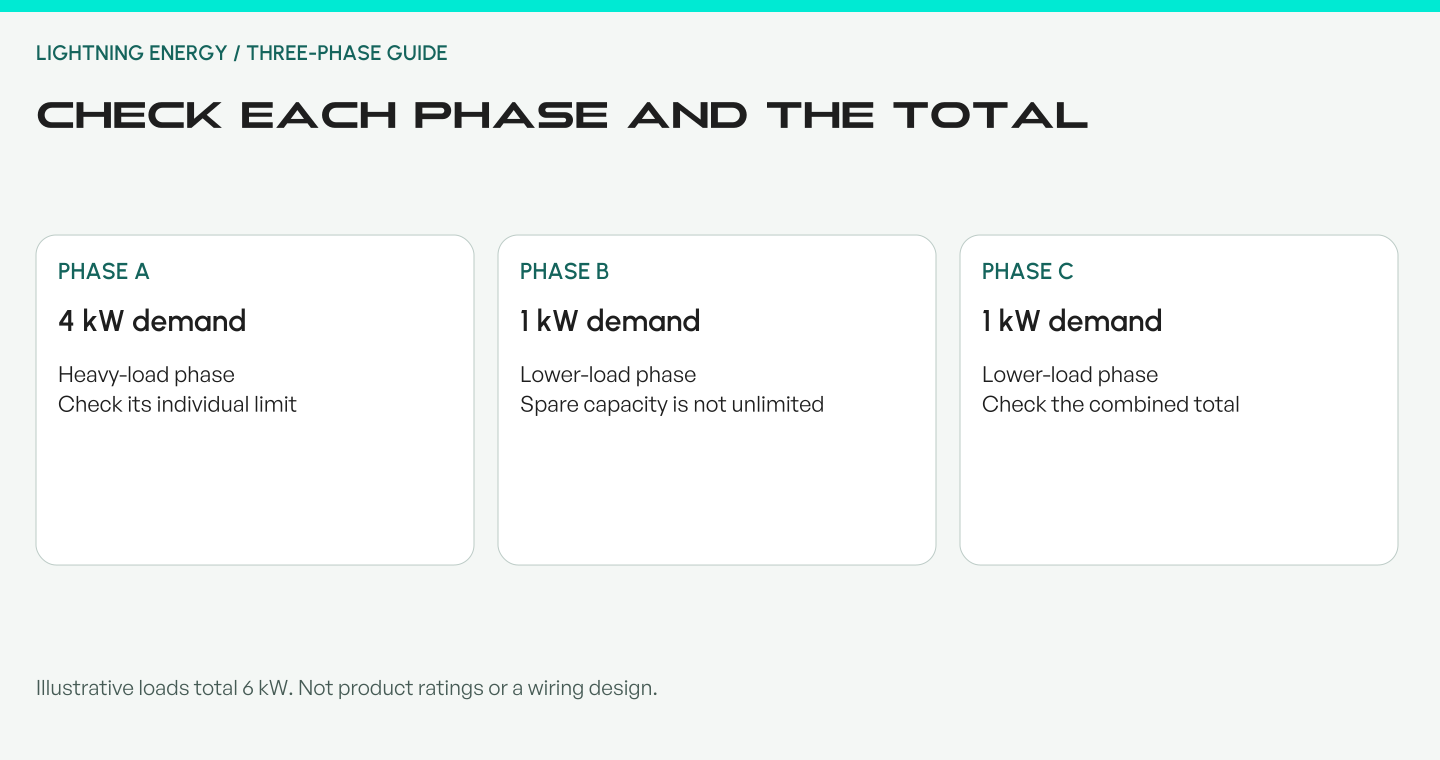
The ESA user manual distinguishes total output from the maximum on a single phase. For the GW9.999K-ETA-G20 it lists a 5 kW single-phase maximum. Unbalanced operation therefore does not mean all the system output can go onto one phase.
Ask whether the proposed backup circuit arrangement, module count and large appliances stay within both limits. Confirm starting loads separately, particularly for pumps and motors.
Sources: GoodWe Australian ESA product page and downloads,
Our controller example is SigenStor EC 10.0 TP.
The Australian controller datasheet specifies 9,999 W nominal grid output and 10,000 W nominal backup output.
The Australian system documents require an external Sigen Energy Gateway for backup.
Sigen Gateway Home TP AU has a nominal 30 kW AC input/output rating. That is a gateway rating, not a promise that a 10 kW controller can deliver 30 kW during a blackout. Size the controller, batteries and backup loads together.
For storage identification, the CEC battery register lists SigenStor-10T-16 (AS4777-2 2020) at 16.12 kWh nominal and 15.6 kWh usable. That is a particular listed system, not a generic label for every SigenStor stack.
Newer Australian documents also contain configurations using different battery-module generations.
A quote must match its complete system identifier, module schedule and current manufacturer configuration documents.
Do not mix capacities from different generations.
Get the permitted load per phase in writing for the quoted setup. A total system rating and an unbalanced-output claim do not establish that one heavily loaded phase can use the entire total.
Sources: Australian controller datasheet,
Gateway Home and HomePro Australian datasheet and
Australian three-phase system documentation.
Tesla’s Australian support page still says Powerwall 3P is not yet available in Australia, with pricing to be announced when it becomes available. An expected date from an informal source is not a confirmed installation date.
Tesla says a Gateway is required for monitoring, grid connection and backup. It also says Powerwall 3P cannot be combined with Powerwall 3 or Powerwall 2. Do not treat it as a drop-in expansion for an existing Powerwall installation.
For a household planning ahead, ask what is available now and what would change if it waits for 3P. Require the final Australian configuration, approval status, gateway and warranty documents before accepting a launch-dependent quote.
Source: Tesla Australia: what to expect from Powerwall 3P.
Our Powerwall 3P Australian guide covers the announced product in more detail.
Start with the equipment that matters: refrigeration, lighting, internet, necessary medical equipment, water pumps or selected air conditioning. Record which loads must run together and which can be deferred.
Then ask the designer to explain the weakest limit: controller output, battery discharge capability, one phase, startup demand or the available stored energy. A larger battery may solve only one of those constraints.
An EV charger and a ducted system can materially change the design. Ask whether they will be disconnected, limited or supported during an outage. Do not assume a three-phase label settles that decision.
Also confirm what happens to existing solar during an outage and how the system restarts after the battery reaches its reserve. These answers depend on the installed configuration, not simply the brand.
For sensitive equipment, read our guide to why battery backup is not automatically a UPS.
A short advertised transfer time is not a universal continuity guarantee.
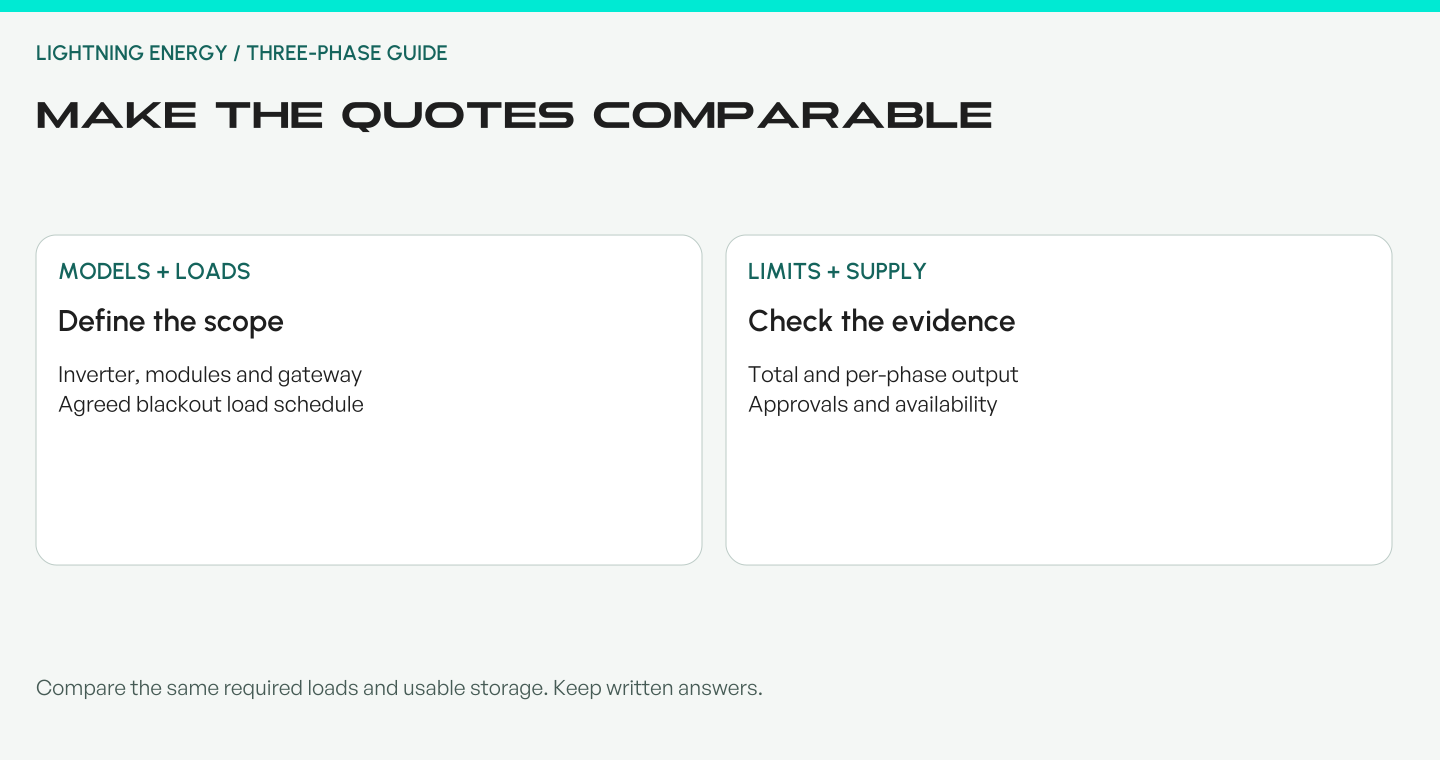
Use the same required backup loads and usable-storage target for each quote. Separate equipment, gateway or backup hardware, switchboard work, commissioning and any load-control equipment in the price breakdown.
Ask for exact inverter, battery and gateway model numbers. Record grid-connected output, sustained backup output, per-phase limits and the conditions attached to any short-duration overload figure.
Check the live CEC inverter list and battery list against those identifiers.
Listings can change; local network permission and programme eligibility remain separate checks.
Finally compare the applicable Australian warranties and service arrangements.
Our four-brand battery warranty comparison explains why years alone are not enough; use the policy for the exact three-phase equipment quoted.
Bring your existing solar details, electricity usage and required blackout loads to a Lightning Energy battery consultation.
A useful recommendation starts with that household brief and the equipment that can actually be supplied.
Cover photograph: an existing Lightning Energy website image of rooftop solar and an electric car.
It illustrates home energy use, not a particular three-phase installation or any of the four battery configurations.
No installation anecdote or hands-on test is claimed.
Available times
Book a consultation and we'll map solar, storage, hot water, and the rebates around your bills and your goals.
Question 1 of 6
