
Fox ESS, GoodWe, Tesla and Sigenergy: Australian Battery Warranties Compared
Compare Australian battery warranties from Fox ESS, GoodWe, Tesla and Sigenergy: exact models, capacity retention, throughput, internet conditions and service costs.
Compare Australian battery warranties from Fox ESS, GoodWe, Tesla and Sigenergy: exact models, capacity retention, throughput, internet conditions and service costs.

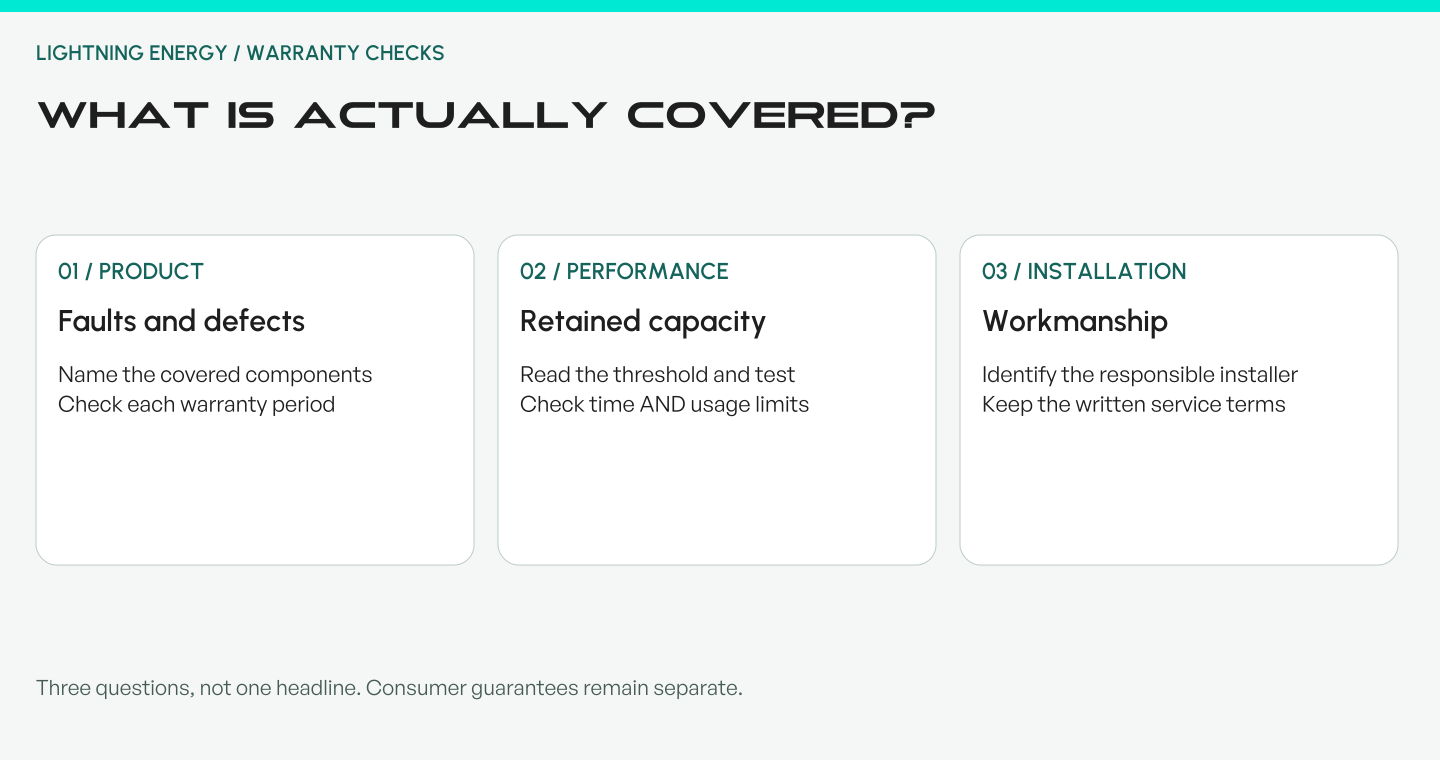
A ten-year battery warranty can mean different things across four quotes. The useful comparison is the exact equipment, the capacity promise, the operating limits and who pays to resolve a fault.
This Australian desk-research comparison checks Fox ESS Power Cube, GoodWe LX D G2, Tesla Powerwall 3 and Sigenergy SigenStor documents on 8 November 2026.
It is not a reliability test, legal advice on an individual claim or a prediction of how long each company will trade.
We examine Fox PQ1-5.0 with three EQ5500-S modules and GoodWe GW8.3-BAT-D-G20 with the ESA GW6K-EHA-G20 inverter.
The other examples are Tesla Powerwall 3 part 1707000 and Sigenergy EC 6.0 SP with BAT 8.0 modules.
Different generations and accessories can have different terms.
Ask for the dated Australian policy alongside the equipment schedule. Keep that copy with the invoice and commissioning record. A brand-wide web headline is not enough to establish the cover for every item on a quote.
Our guide to reading battery warranties explains the terminology. Here we apply those questions to named products.
The Australian Power Cube policy, version 1.1 dated 16 September 2026, expressly gives PQ1/PQ3 inverters 120 months from installation, capped at 132 months from manufacture, whichever comes first.
It states a separate NSW PDRS exception to that manufacturing-date cap.
For three EQ5500-S modules, the performance table lists 16.38 kWh and 69.11 MWh throughput. The retention promise is 70%, ending at ten years or the specified throughput, whichever occurs first, subject to the policy conditions.
Do not turn those clauses into a claim that every component has identical cover. Ancillary parts can have separate policies. Ask the supplier to identify the battery defect cover as well as its performance promise.
Claims under this policy go through an installer or Fox-authorised personnel.
Service rebates have conditions and exclusions; travel and accommodation are excluded.
If the original installer is insolvent, a substitute installer can be appointed at the owner’s cost.
Source: Fox ESS Australian Power Cube warranty.
The LX D G2 Australian/New Zealand policy, revision 1.1 dated 17 September 2026, includes GW8.3-BAT-D-G20.
It provides ten-year product cover and a 70% retained-usable-energy promise ending at ten years or the throughput limit, whichever comes first.
The limit is 3.0 MWh of DC throughput per usable kWh. The policy also specifies capacity equivalent to one full cycle per day. Do not assume unrestricted daily trading simply because the headline says ten years.
The battery warranty normally starts at purchase.
Without adequate purchase evidence, it uses the earlier of installation or six months after manufacture.
Its default cost cover is hardware; transport and on-site labour arrangements are conditional and may be capped.
Report faults promptly. The policy’s preconditions say within two weeks, while its claims section says one month. Seek written clarification rather than relying on the longer period.
Sources: LX D G2 battery warranty and the separate Australian inverter warranty.
The latter lists ten years for the ESA 3–10 kW single-phase series; accessories have separate terms.
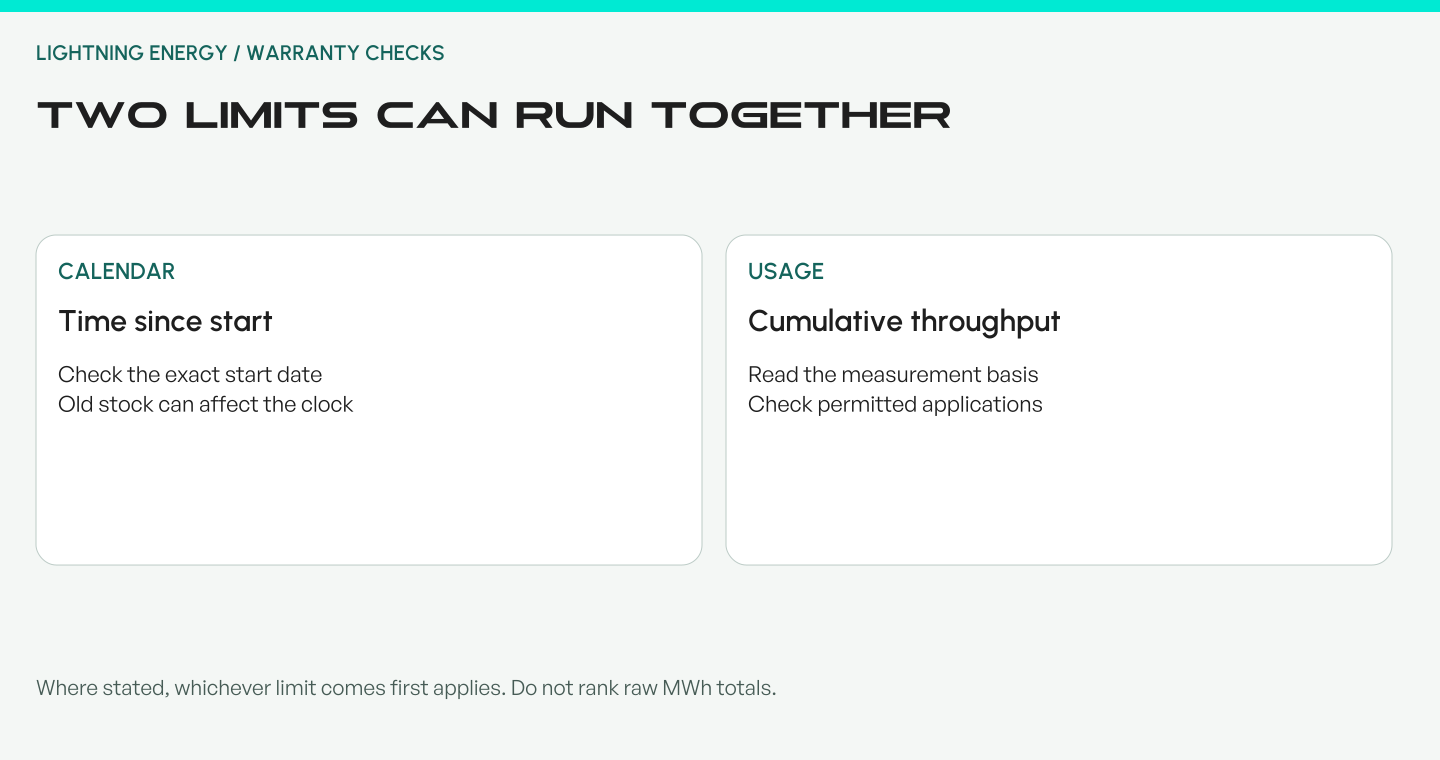
Tesla’s Australian/New Zealand warranty revision 1.17, effective 3 September 2026, covers the selected Powerwall 3 part number. It gives ten-year defect cover from initial installation and 70% retention of the initial 13.5 kWh at ten years.
Unlimited cycles applies to the listed solar self-consumption, time-based control and backup uses. Other applications, or combinations including one of them, have a 37.8 MWh aggregate-throughput limit measured at the AC output.
Ask Tesla or the supplier to confirm in writing how a proposed VPP or trading arrangement fits those definitions. A marketing description of a VPP is not that confirmation.
Internet connectivity and registration matter.
Extended disconnection or missing registration can affect the full ten-year cover; the policy says at least four years remains, subject to its exclusions.
Start a claim with the selling installer, then Tesla if that installer cannot be contacted.
Source: Tesla Powerwall Australian/New Zealand warranty.
The Australian/New Zealand SigenStor warranty dated 26 May 2026 gives the battery and energy controller ten-year product cover. The EV DC charging module has three years and specified decorative consumables have two.
BAT 8.0 is listed at 7.8 kWh usable and 29.64 MWh warranted throughput.
Its 70% retention promise runs until ten years or that throughput, whichever comes first.
The start date is commissioning and registration, or 180 days after factory shipment if that happens earlier.
More than 90 days offline triggers Safe Operation Mode. More than one year offline adjusts cover to five years from original activation under the policy.
For a validated covered defect, the stated cover includes repair-related on-site labour, removal and reinstallation, basic travel and normal ground shipment.
Conditions and exclusions still apply.
Claims should be made within 30 days through mySigen, with installer or national-office alternatives if needed.
Source: Sigenergy Australian/New Zealand SigenStor warranty.
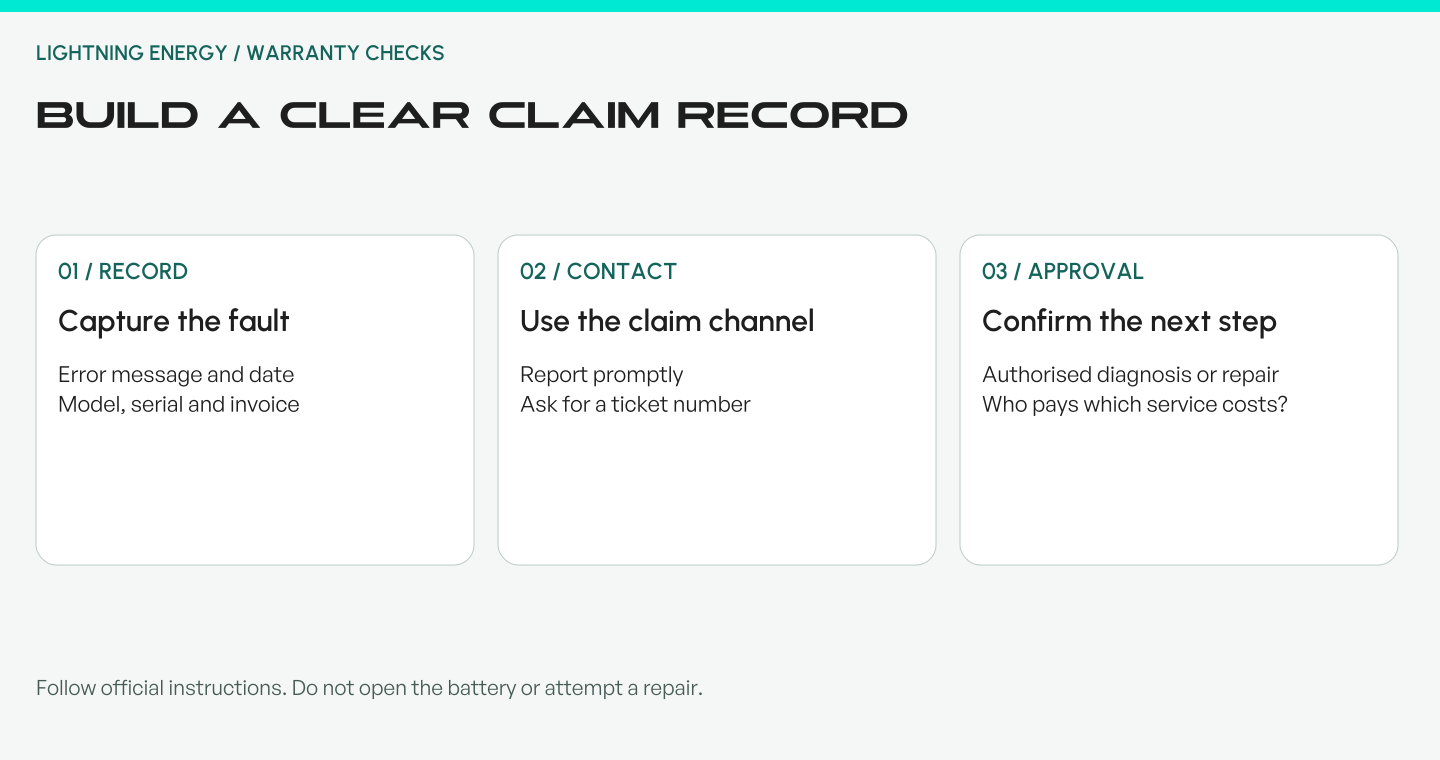
These examples have different storage sizes, measurement points and operating conditions. Tesla specifies AC-output throughput; GoodWe specifies DC throughput; the other documents use their own definitions and test conditions.
Putting the raw MWh totals in a league table would hide those differences. Ask for a comparison using the same usable capacity and intended operating pattern, with the measurement basis clearly stated.
A retained-capacity threshold is also not a forecast. It does not say the battery will reach that exact capacity in year ten, nor guarantee how many blackout hours your household will get.
For backup design and expansion, see our Fox ESS versus Sigenergy comparison.
Also see our guide to adding modules later.
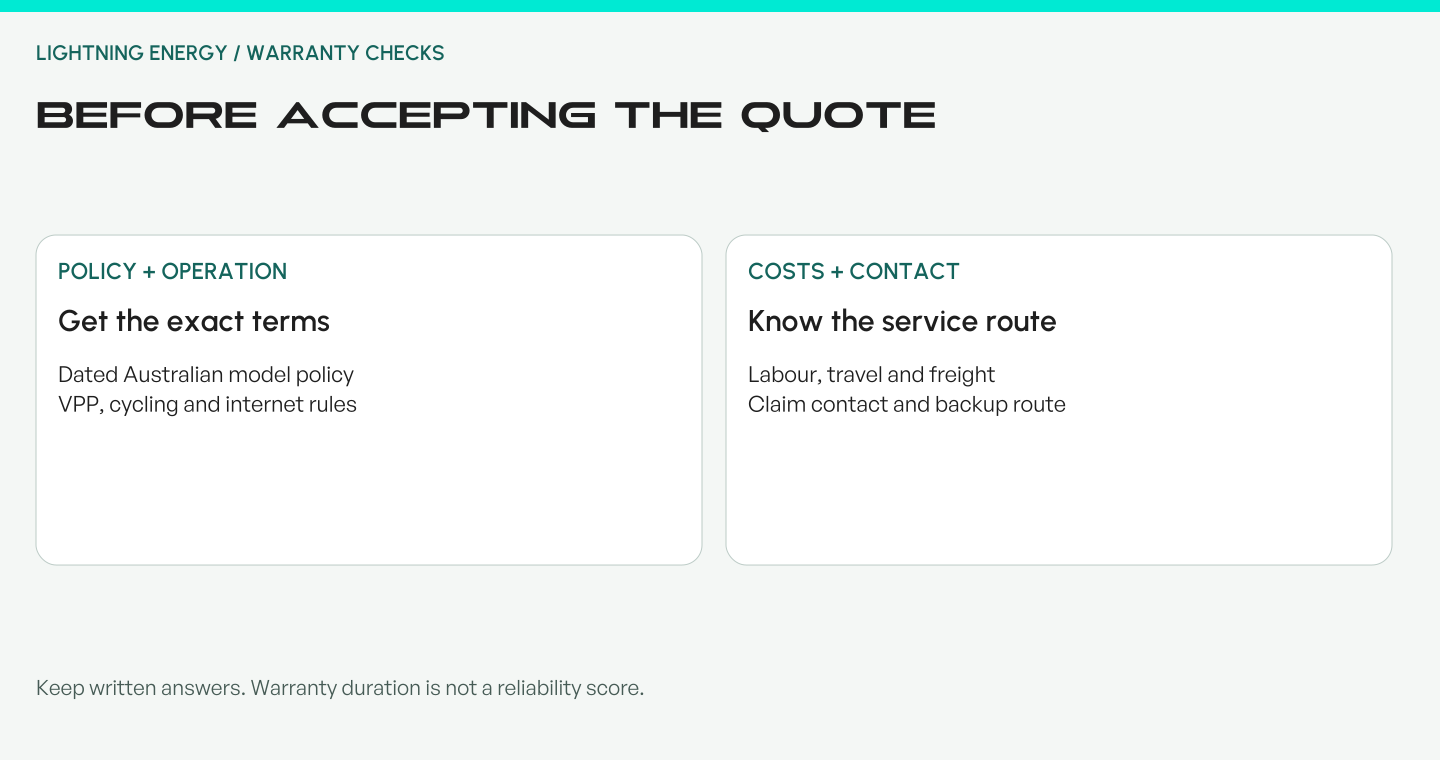
Ask who pays for diagnosis, travel, removal, freight, replacement installation and commissioning. Record any caps or approval requirements, and separate the manufacturer’s promise from the installer’s workmanship warranty.
For every brand, ask who handles a claim if the selling business closes. A current contact route is useful; it is not a guarantee of future company solvency or immediate replacement stock.
The ACCC explains that warranties are additional promises.
They cannot replace or remove automatic consumer guarantees, which can last longer than the written warranty.
A manufacturer’s exclusion is therefore not necessarily the end of a customer’s rights.
The appropriate remedy depends on the fault and circumstances.
The ACCC provides guidance but does not resolve individual warranty disputes.
See its warranties guide.
Bring your equipment schedule and dated policies to a Lightning Energy battery consultation.
We can help identify the questions your quote should answer without treating a warranty headline as proof of performance.
Cover photograph: a Powerwall 3 image already used on Lightning Energy’s website. It illustrates one of the products discussed, not all four brands. No hands-on testing or particular customer experience is claimed.
Available times
Book a consultation and we'll map solar, storage, hot water, and the rebates around your bills and your goals.
Question 1 of 6
