
Setting a Home Battery Reserve for Everyday Use and Outages
Choose a battery backup reserve by weighing essential outage energy against everyday use, with clear assumptions about starting charge and controls.
Choose a battery backup reserve by weighing essential outage energy against everyday use, with clear assumptions about starting charge and controls.

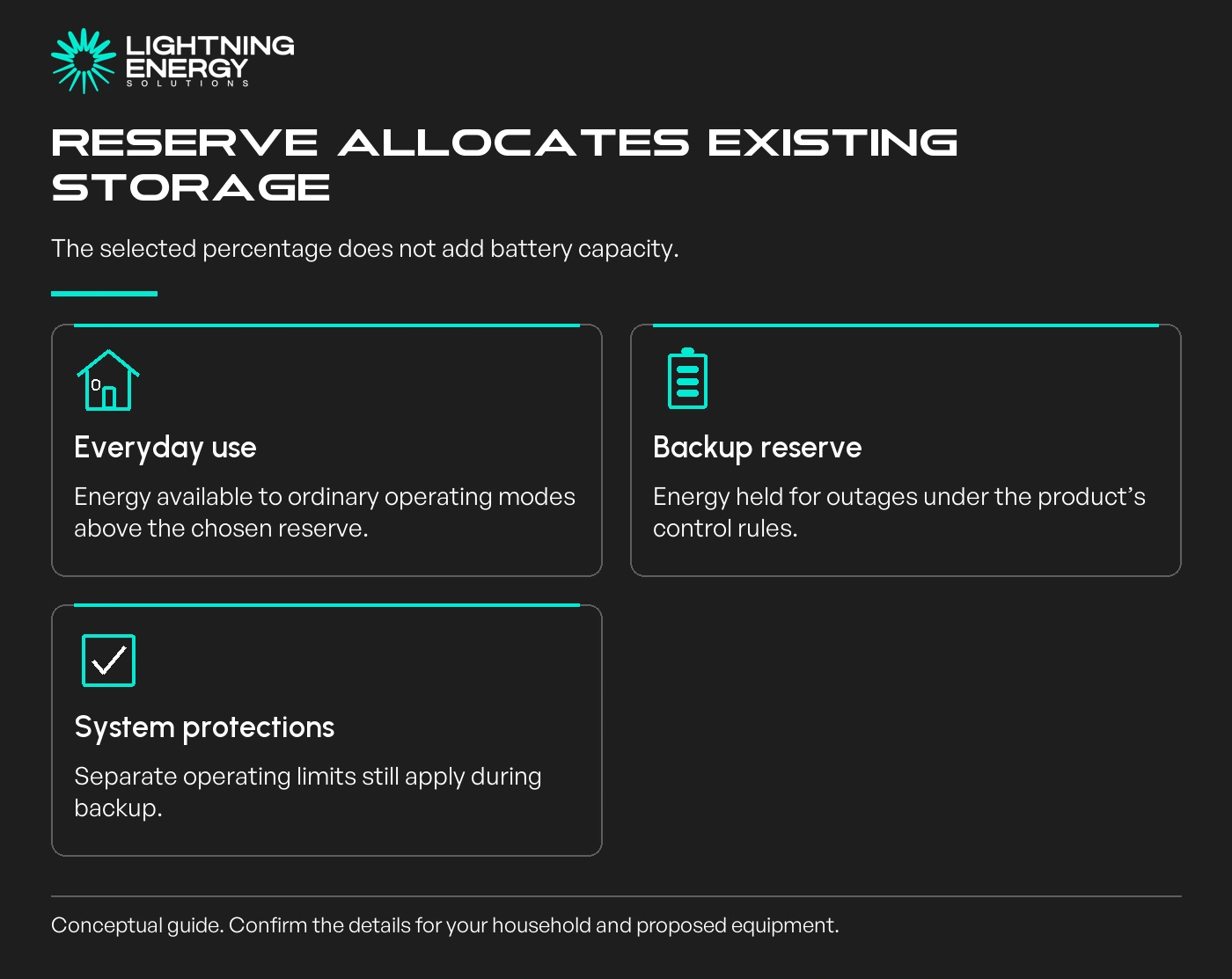
A backup reserve sets aside some battery energy for outages instead of ordinary daily use. It does not add storage, guarantee that the battery is already charged or increase the power available to appliances.
There is no single percentage that suits every household. Start with the loads you want to support, the likely charging opportunity and how much everyday battery use you are willing to give up.
Tesla's Australian guidance explains that its selected reserve is kept for backup, while the remaining portion supports its everyday operating modes. During an outage, the battery can discharge below that selected reserve.
Tesla Australia: Backup Reserve.
That distinction matters. A 30% reserve is not necessarily a shutdown point during a blackout. The manufacturer's operational limits and protections remain separate from your chosen daily-use setting.
Read the instructions for your own system before transferring that explanation to another brand. Different apps may use similar labels for controls with different details.
List the appliances on the agreed backup circuits and the period you would like them to operate. Use a realistic average demand, including equipment that cycles, and discuss appropriate allowances with the installer.
Our blackout guide provides a practical starting point for that household list.
For an illustration, consider a battery described as having 10 kWh usable energy. A 30% allocation represents 3 kWh arithmetically. That does not mean exactly 3 kWh will reach appliances in every outage.
If an assumed essential load averaged 0.5 kW, 3 kWh would correspond to six hours before relevant losses and operating allowances. A heavier average load shortens that calculation immediately.
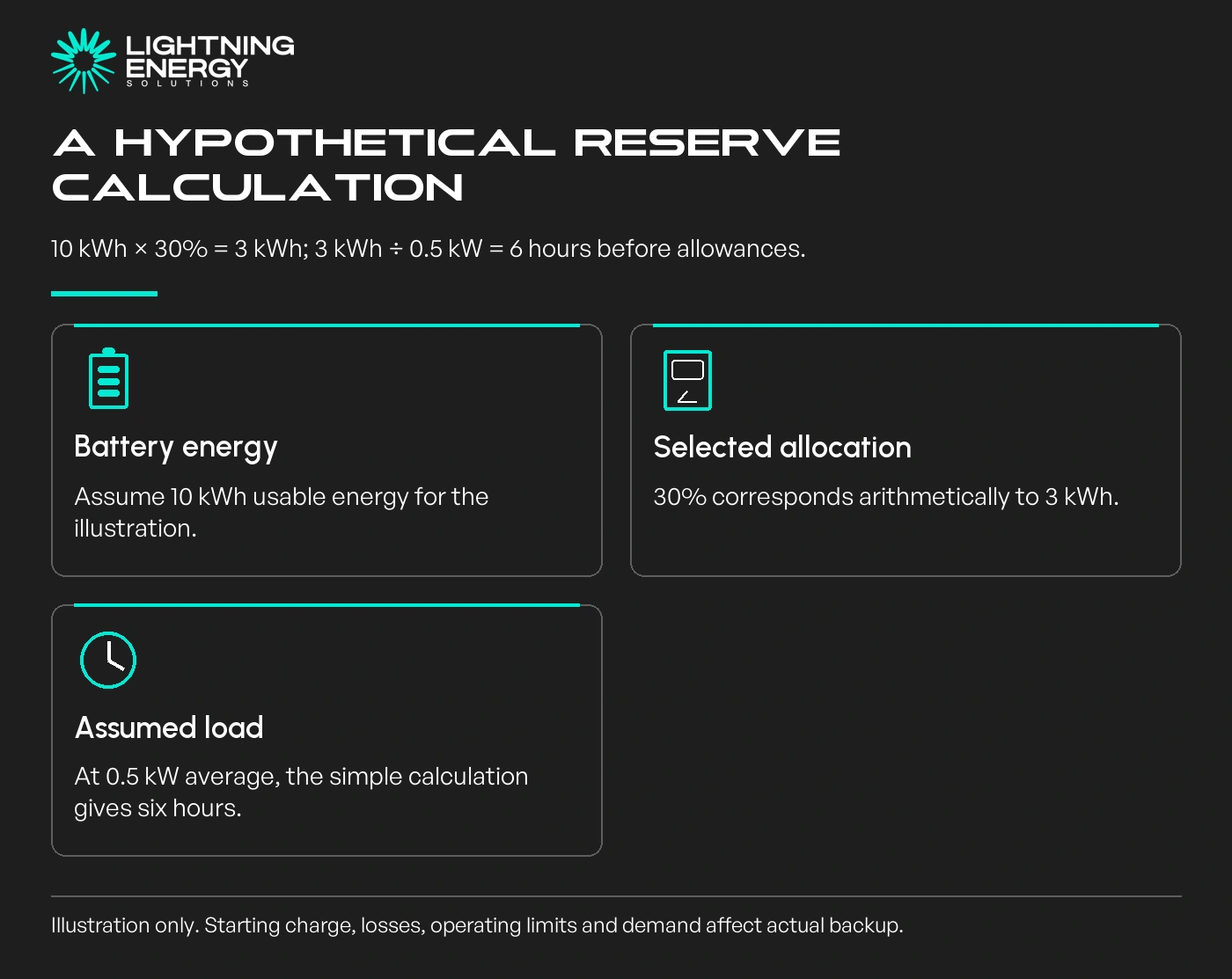
Do the calculation with several starting-charge and load assumptions. An outage can begin while the battery is still charging or after an earlier period of backup use.
Holding a larger reserve can leave less energy available to replace ordinary evening grid imports. That is a deliberate choice about resilience, rather than evidence that the battery is underperforming.
Imagine two otherwise identical days with the same available charge. A household holding more energy back may buy more electricity during the evening, while beginning a later outage with more stored energy.
The financial effect depends on the tariffs, available solar and actual controls. Our battery value guide explains why savings need household assumptions.
Tesla specifically notes that a 100% reserve prevents use of its Self-Powered or Savings modes. A maximum setting therefore has an everyday consequence, even when no outage occurs.
A period of greater outage concern, a change in household needs or a different seasonal charging pattern may justify reviewing the reserve. Revisit it deliberately instead of continually changing settings after individual cloudy days.
Check whether automatic weather preparation, tariff automation or a virtual power plant interacts with the setting. Ask the provider how owner preferences and external control are prioritised under your actual arrangement.
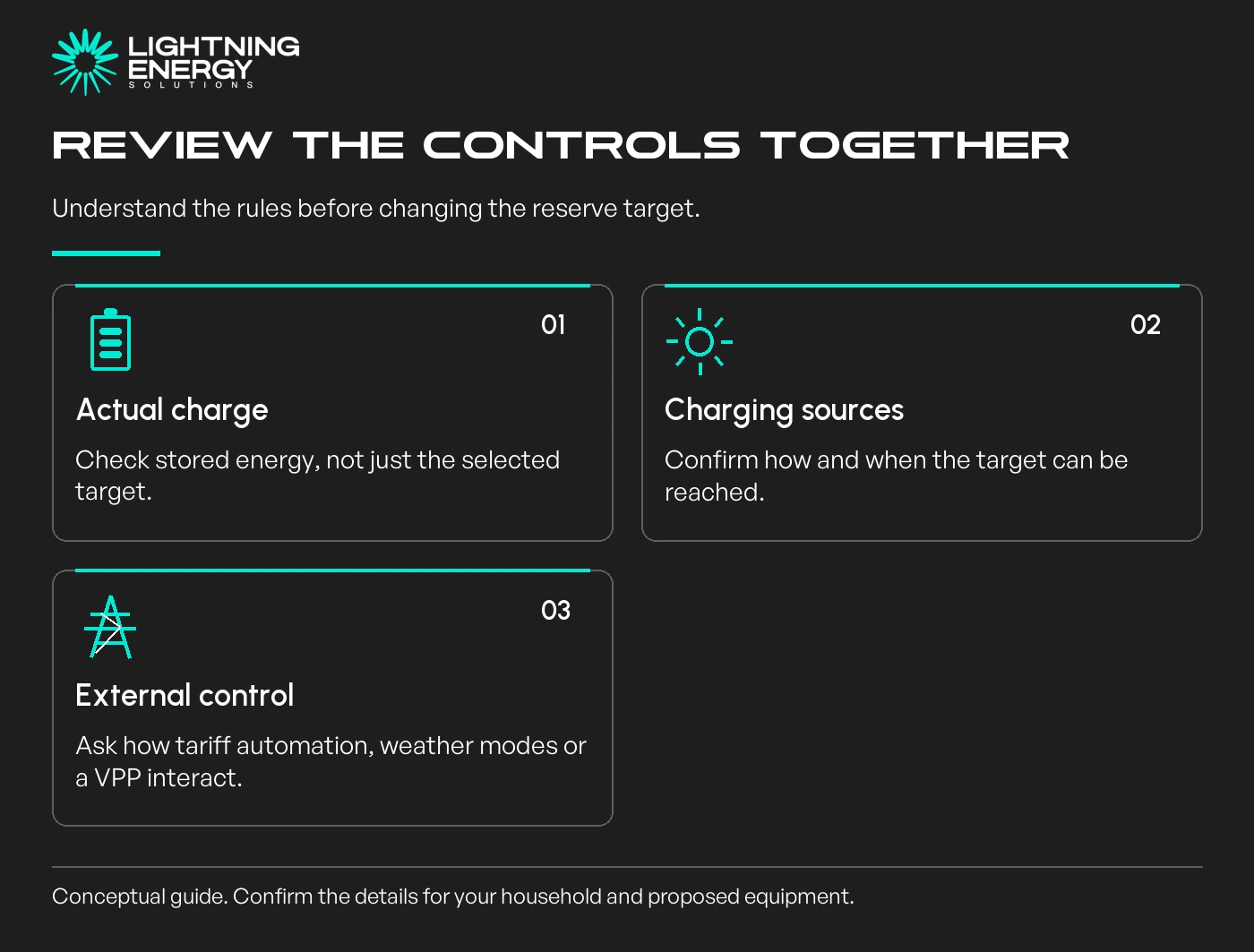
Do not assume moving a slider will instantly fill the battery. Confirm the permitted charging sources and available time, and look at the actual charge level rather than the reserve target alone.
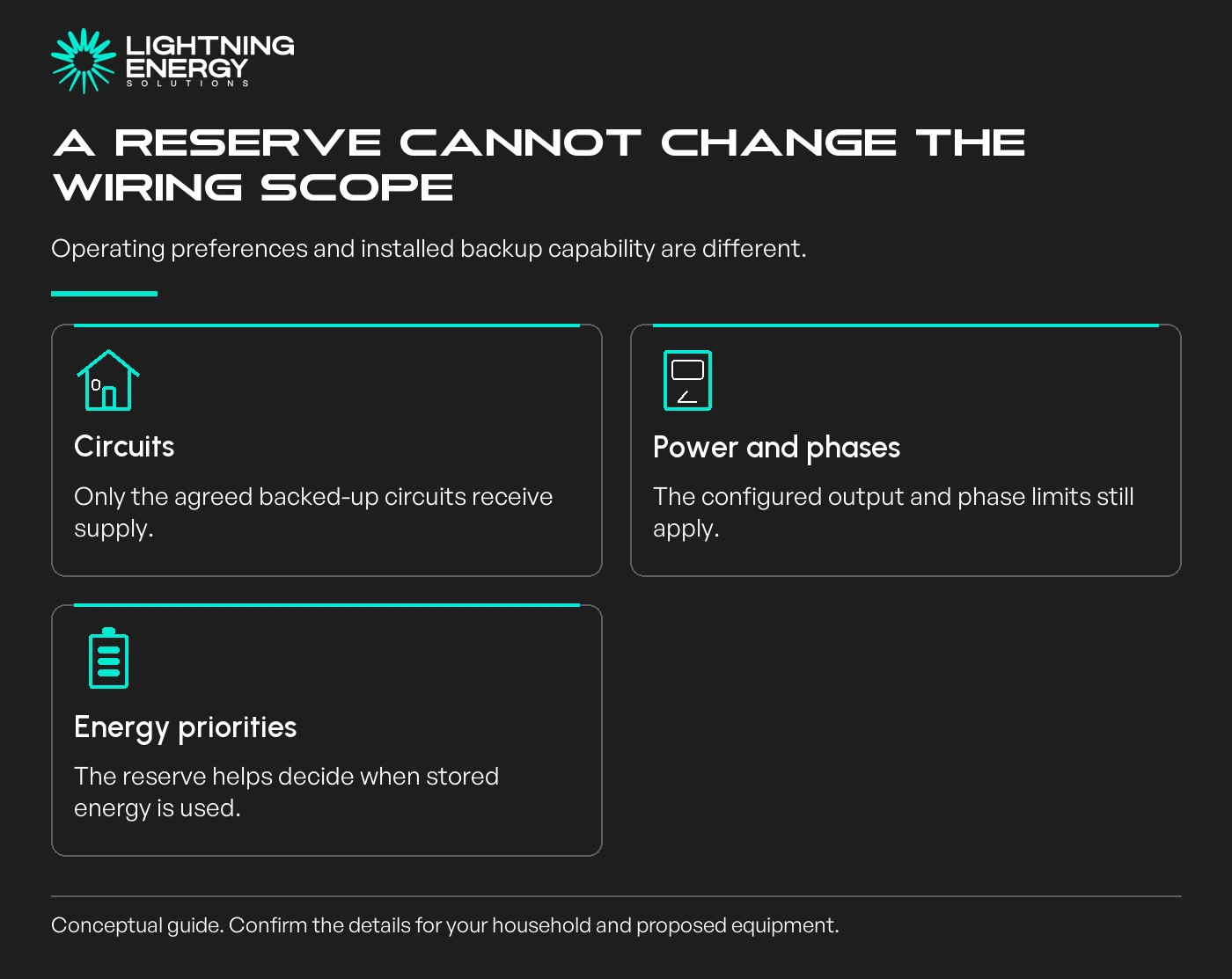
A reserve cannot make an excluded circuit operate, supply an unsupported phase or overcome the battery inverter's output limit. Those are design questions to settle before changing app settings.
A battery assessment should document both the physical backup scope and the operating preferences you can manage afterwards.
If outages are a low priority and the available reserve adds little practical value, a lower setting may suit your goals. If the household needs stronger resilience, assess the complete backup plan rather than relying on a percentage alone.
Plan your battery upgradeBring your essential-load list and current operating settings. We can help explain the reserve trade-off and identify which questions belong with the installer or control provider.Available times
Book a consultation and we'll map solar, storage, hot water, and the rebates around your bills and your goals.
Question 1 of 6